
As we move into 2026, the demand for fast, reliable, and real-time financial data continues to grow. Developers, analysts, and financial institutions increasingly rely on accurate market insights to build smarter tools and make informed decisions. Financial APIs are now transforming how market data is accessed, analyzed, and applied across global markets.
Whether you are building a next-generation personal finance application or powering a high-frequency trading system,
In this guide, we explore the top financial data APIs for 2026, covering both free and premium options to suit different needs and budgets. From leading market data API providers to global financial data platforms, we compare key features, performance, and real-world use cases. This will help you select the right API to support your financial analysis, product development, and innovation goals in an ever-evolving market landscape.
What Are Financial Data APIs?
Financial Data APIs, short for Application Programming Interfaces, are digital connectors that allow software applications to access, retrieve, and process financial information from third-party data providers. They act as the foundation of modern financial products, powering everything from stock trading platforms and forex analytics tools to AI-powered advisors and personal budgeting apps.
At their core, Financial Data APIs enable a smooth and secure flow of data between a financial data provider and an end-user application. They deliver structured information, usually in formats like JSON or XML, making it easy for developers to integrate real-time and historical financial data into websites, mobile apps, spreadsheets, and backend systems.
Think of Financial Data APIs as intelligent middlemen between fast-moving global markets and your software. They transform complex market data into clean, actionable insights that applications can process and respond to in real time, helping users make smarter and faster financial decisions.
Key Use Cases of Financial Data APIs
- Stock Market Data APIs: Deliver real-time stock prices, historical performance data, dividends, stock splits, and advanced technical indicators for equities and ETFs.
- Forex Data APIs: Provide live exchange rates, currency conversion values, historical trends, and insights across major, minor, and exotic currency pairs.
- Investment Data APIs: Aggregate data from multiple asset classes to support portfolio tracking, backtesting strategies, performance monitoring, and risk analysis.
- Open Banking APIs: Enable secure access to bank account balances, transaction histories, and financial details through trusted third-party applications.
- Financial Services APIs: Allow seamless integration of banking, insurance, credit scoring, payments, and other financial services into modern digital products.
Why Are APIs Critical to Financial Data Integration?
APIs simplify what was once a complex and time-consuming process of financial data acquisition. By eliminating manual data entry and unreliable scraping methods, APIs allow developers to access high-quality financial data with just a few lines of code.
Through Financial Data APIs, developers can easily retrieve:
- Up-to-the-second price feeds
- Historical charts and financial statements
- Economic calendars and macroeconomic indicators
- Sentiment data, news, and earnings reports
As a result, Financial Data APIs power far more than just trading platforms and analytics dashboards. They play a vital role in machine learning models, automated trading strategies, risk management systems, and regulatory compliance solutions across the financial services ecosystem.
By reducing data maintenance overhead, these APIs free engineering teams to focus on building innovative products, improving user experiences, and delivering new features faster.
Why Financial Data APIs Matter in 2026
In 2026, developers are building smarter, faster, and more adaptive financial systems than ever before and Financial Data APIs sit at the core of this evolution. These APIs aren’t just about pulling stock prices; they’re key to powering automated workflows, model-driven decision engines, and real-time analytics that scale.
Enabling Model Context Protocols (MCPs) for Scalable AI Integration
Modern AI systems like Claude and other LLMs increasingly rely on Model Context Protocols (MCPs) to interact with tools, APIs, and databases in real time. In this setup, Financial Data APIs act as standardized data inputs, supplying models with the context required for market analysis, financial summarization, and large-scale decision making. This approach separates AI logic from data pipelines, resulting in systems that are more adaptable, secure, and scalable.
Powering Algorithmic Trading and Real-Time Decision Engines
Algorithmic trading platforms depend on speed and accuracy. Financial Data APIs deliver low-latency, high-frequency market data that enables buy and sell decisions within milliseconds. From feeding live price data into quantitative strategies to running real-time arbitrage systems, these APIs provide the performance and reliability modern trading systems require.
Automating Manual Processes and Data Entry
Manual tasks like copying stock prices into spreadsheets or tracking currency conversions are no longer needed. Financial Data APIs automate these processes completely. With just a few lines of code, developers can:
- Pull real-time financial data into accounting systems
- Auto-populate dashboards with live stock or commodity prices
- Sync macroeconomic indicators directly into investment models
In short, Financial Data APIs act as the connective layer between raw market data, intelligent models, and high-performance applications, helping teams build faster, automate more, and scale smarter in 2026.
Here is a 𝗧𝗼𝗽 𝗥𝗮𝘁𝗲𝗱 updated and lightly refined version for 2026, keeping the wording clear and practical:
How to Choose the Best Financial Data API
With a wide range of financial market data solutions available in 2026, choosing the right API starts with understanding your technical needs and business goals. Whether you are building a simple dashboard, an algorithmic trading engine, or a full-scale investment research platform, your API choice will directly impact speed, accuracy, and data depth.
Key Evaluation Criteria
Data Coverage
- Does the API support your required asset classes such as equities, forex, commodities, crypto, or bonds?
- Does it provide real-time financial data, historical market data, or both?
- Is the data coverage global or region-specific?
Latency and Refresh Frequency
- Low latency is critical for live dashboards and high-frequency trading.
- Look for fast response times and frequent data updates, such as per second or per minute.
Integration and Developer Experience
- RESTful APIs with clear and complete documentation are ideal.
- Check for support across major programming languages and platforms.
- SDKs, sample code, and quick-start guides add strong value.
Scalability
- Can the API handle increasing request volumes as your application grows?
- Review rate limits, concurrency support, and enterprise-grade options.
Security and Compliance
- Especially important for financial services APIs and open banking APIs.
- Ensure encrypted connections using HTTPS, OAuth2 support, and compliance with standards like GDPR, PSD2, or SOC 2.
Cost and Licensing
- Free stock APIs work well for MVPs and early testing.
- For production use, compare pricing based on usage, features, and geographic coverage.
- Choose providers with transparent pricing and flexible plans.
Matching APIs to Use Cases
For developers needing real-time market data with broad asset coverage:
Marketstack and CurrencyLayer remain two of the strongest all-around options in 2026. Marketstack offers extensive stock, index, and commodity data from global exchanges, while CurrencyLayer delivers reliable and accurate forex data with real-time exchange rates. Both are scalable, well-documented, and well suited for production-grade financial applications.
For startups, hobbyists, and smaller-scale projects:
Exchangerate.host is an excellent choice. Its “Starter” plan is tailored for startups and early-stage projects, making it ideal for lightweight financial apps, currency converters, and proof-of-concept builds.
For quantitative analysts and financial modeling teams:
APIs such as Tiingo, Quandl, and Alpha Vantage provide deep historical datasets, technical indicators, and fundamental data. These are well suited for backtesting strategies, financial research, and quantitative model development.
For AI-driven systems and MCP-based integrations:
Choose APIs that offer low-latency responses, structured JSON formats, and bulk data endpoints. These capabilities are essential for feeding financial context into AI models through Model Context Protocols (MCPs), enabling real-time and intelligent decision making in systems like Claude and other LLMs.
Marketstack stands out here due to its fast response times, clean JSON structure, and broad market coverage, making it highly compatible with MCP pipelines.
By aligning your technical requirements and product goals with the right API capabilities, you can confidently select a financial data API that supports your strategy, performance needs, and long-term growth in 2026.
Marketstack API: A Top All-Around Pick
When it comes to versatility, performance, and ease of integration, Marketstack continues to be one of the top financial data APIs in 2026. Its developer-friendly design and broad data coverage make it suitable for everything from fintech startups to enterprise-grade trading platforms.
Why Developers Choose Marketstack
Marketstack provides real-time and historical market data for stocks, indices, ETFs, and commodities across 70+ global exchanges. It is built for scale, offering a powerful yet intuitive RESTful API with clear documentation. Whether you are building a live stock tracker, powering a robo-advisor, or integrating financial data into an MCP-based AI workflow, Marketstack adapts easily to different use cases.
Key Features
- Real-time market data from major global exchanges
- Historical data spanning decades for backtesting and long-term analysis
- Fast, lightweight JSON responses ideal for low-latency applications
- Flexible endpoints for tickers, intraday pricing, historical data, and exchange metadata
- Simple API key-based authentication with transparent usage tiers
- Reliable infrastructure suitable for production systems and live trading dashboards
Ideal Use Cases
- Financial dashboards tracking global equity markets
- Trading bots and algorithmic strategies requiring real-time stock prices
- Investment research tools focused on historical price trends and volume analysis
Pricing Tiers
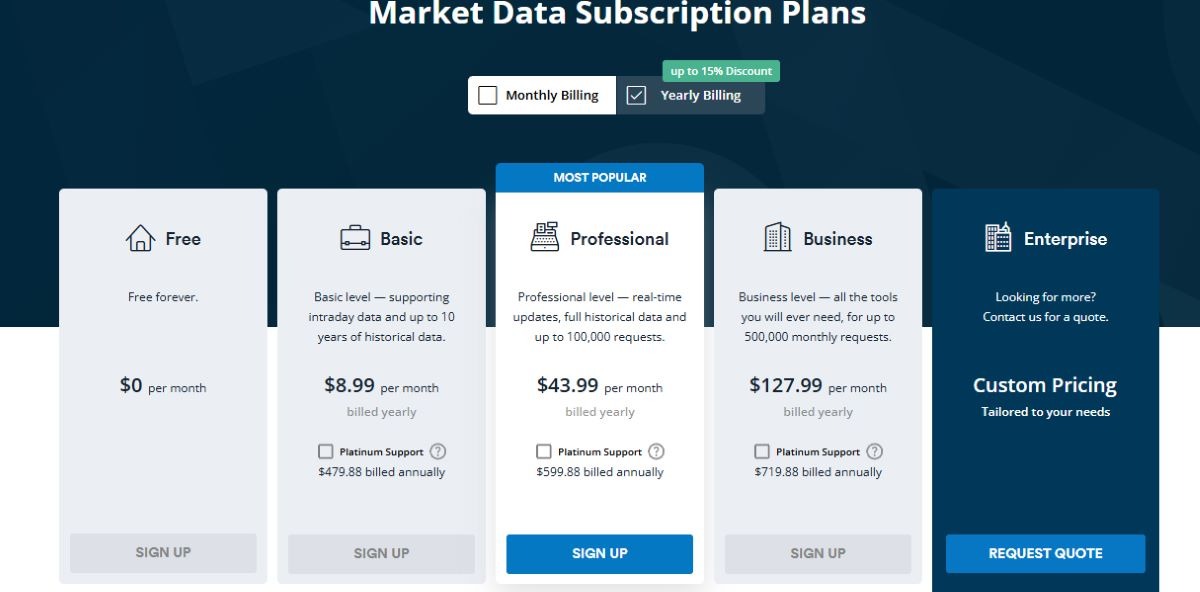
Marketstack offers multiple pricing plans designed to support everything from small projects to high-volume production environments, allowing teams to scale as their data needs grow.
Marketstack’s strong balance of speed, structure, and scalability makes it one of the most recommended financial data APIs for developers building real-time and data-driven financial applications in 2026.
Exchangerate.host API: Best for Startups and Indie Developers
If you are just getting started with financial market APIs or building a lightweight currency application, Exchangerate.host remains one of the most developer-friendly and cost-effective options in 2026. It delivers reliable exchange rate data with transparent pricing and generous free and starter tiers.
Why It’s Ideal for Beginners and Indie Developers
Exchangerate.host is built with simplicity and accessibility in mind. It supports real-time and historical exchange rates across hundreds of currency pairs, along with crypto conversions and regular updates. With fully usable free and starter plans, it is a strong choice for prototyping, side projects, and early-stage fintech products.
The real value comes from the Starter Plan, which allows developers to scale beyond hobby use without committing to a large budget.
Starter Plan Highlights
- 5,000 requests per month
- Hourly data updates
- Access to historical exchange rates
- Standard support
- HTTPS encryption
- Currency conversion
- Source currency switching
- Affordable pricing at $7.99 per month
- Additional requests priced at $0.003196 per request
Ideal Use Cases
- Currency converters and travel budgeting apps
- MVPs for global payment and remittance tools
- Early-stage forex dashboard prototypes
- Educational or no-code financial automation projects
- AI or chatbot tools experimenting with MCP-based currency queries
Exchangerate.host is well suited for developers who need clean, consistent, and flexible access to foreign exchange data without overpaying or facing strict rate limits. It provides a smooth entry point into financial data APIs, with the flexibility to grow as your application scales in 2026.
Pricing Tiers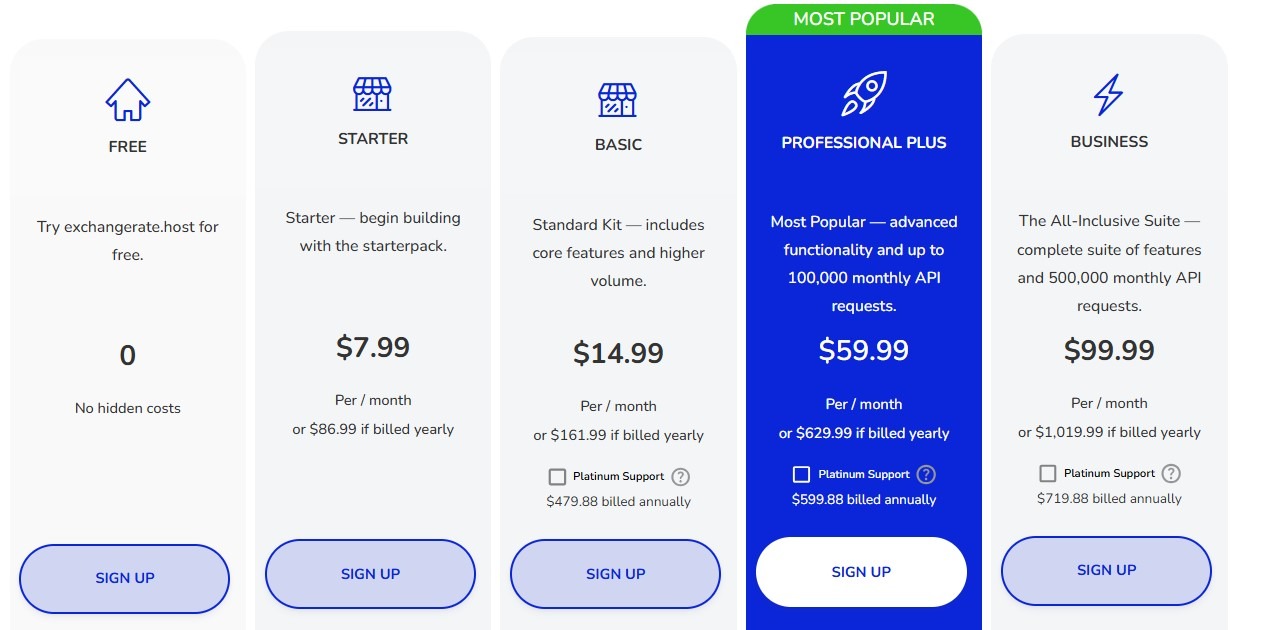
CurrencyLayer API: Best for Multi-Currency Platforms
CurrencyLayer is widely recognized as one of the most reliable APIs for real-time and historical foreign exchange data. In 2026, it continues to be trusted by thousands of businesses and developers worldwide, offering institutional-grade accuracy powered by data from banks and financial institutions.
Why Developers Trust CurrencyLayer
Built specifically for forex-focused use cases, CurrencyLayer delivers high-frequency updates, precise exchange rates, and robust endpoints through a clean, RESTful API. It is an excellent choice for teams building currency conversion tools, international pricing systems, or forex trading dashboards where real-time accuracy is critical.
Key Features
- Real-time exchange rates for 168+ global currencies
- High-accuracy data sourced from commercial banks and financial data aggregators
- Historical forex data with 19+ years of coverage
- Currency conversion and multi-currency support in a single API call
- HTTPS encryption for secure data transmission
- Scalable pricing plans with tiered request volumes
- Easy integration with popular development stacks
Ideal Use Cases
- Forex trading platforms and signal tools
- International e-commerce pricing and checkout systems
- Budgeting and expense tracking apps for frequent travelers
- AI-powered financial advisors with real-time currency conversion
- MCP-integrated bots requiring accurate currency context
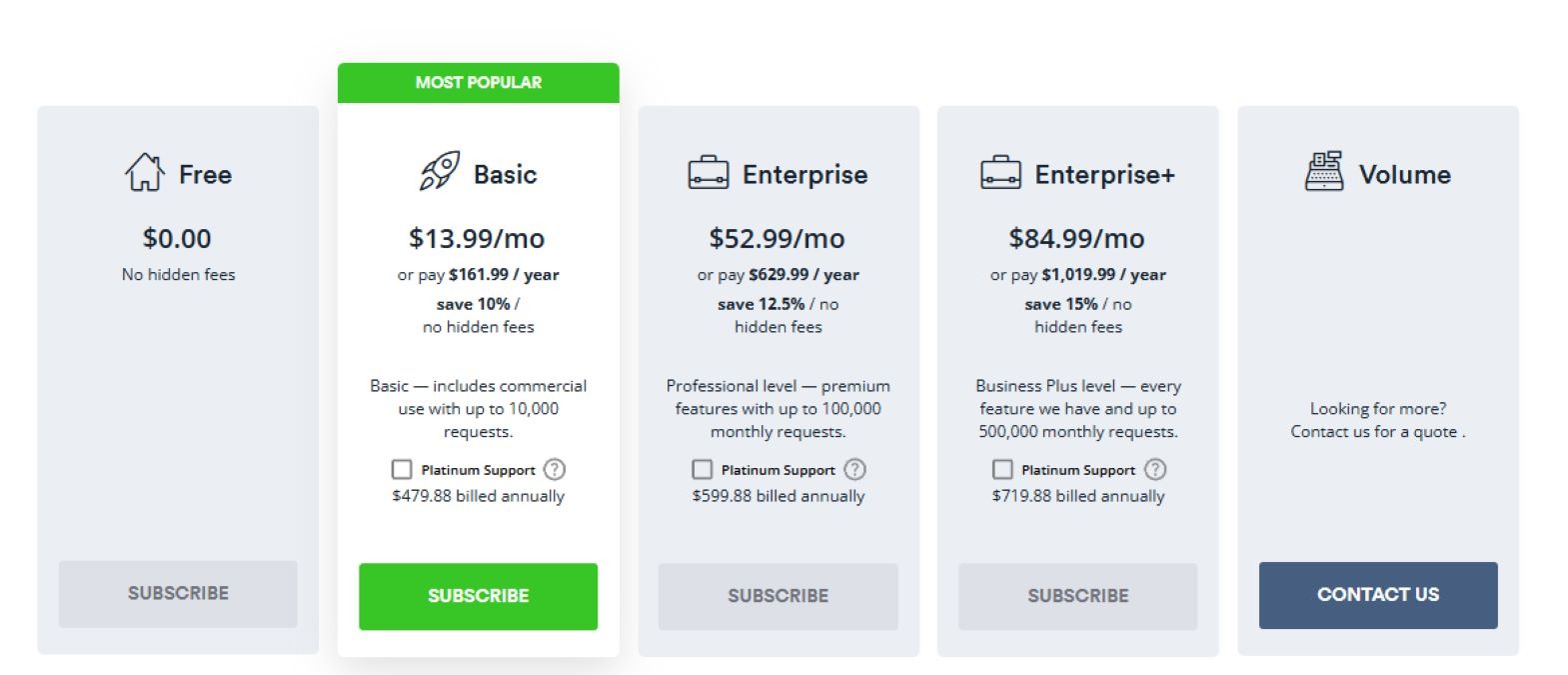
Whether you are building a global application that converts prices in real time or training models on historical forex trends, CurrencyLayer delivers the speed, accuracy, and reliability needed to support modern multi-currency financial platforms in 2026.
Fixer.io API: Most Trusted for Currency Conversion Accuracy
When accuracy and trust are critical, Fixer.io remains one of the most reliable exchange rate APIs in 2026. Backed by official sources such as the European Central Bank, it delivers highly dependable forex data with both real-time and historical coverage.
Why Fixer.io Appeals to Precision-Focused Projects
Fixer.io is designed for teams that need trustworthy currency conversion in applications where data accuracy matters most, including accounting software, payment gateways, and financial dashboards. Its intuitive setup, stable infrastructure, and consistent data quality make it a dependable choice across industries.
Key Features
- Real-time foreign exchange rates for 170+ global currencies
- Data sourced from central banks and leading financial institutions
- Historical exchange rate data dating back to 1999
- Secure HTTPS connections with reliable daily updates
- Simple RESTful API with clear documentation
- Scalable pricing plans for projects of all sizes
Ideal Use Cases
- Financial reporting platforms requiring precise currency conversion
- Accounting and invoicing tools supporting multiple currencies
- Payment systems needing accurate exchange rates at checkout
- International SaaS products calculating cross-border pricing
- AI workflows where clean and reliable currency inputs are essential
Pricing Tiers
Fixer.io offers flexible pricing tiers designed to support everything from small applications to enterprise-level financial platforms. 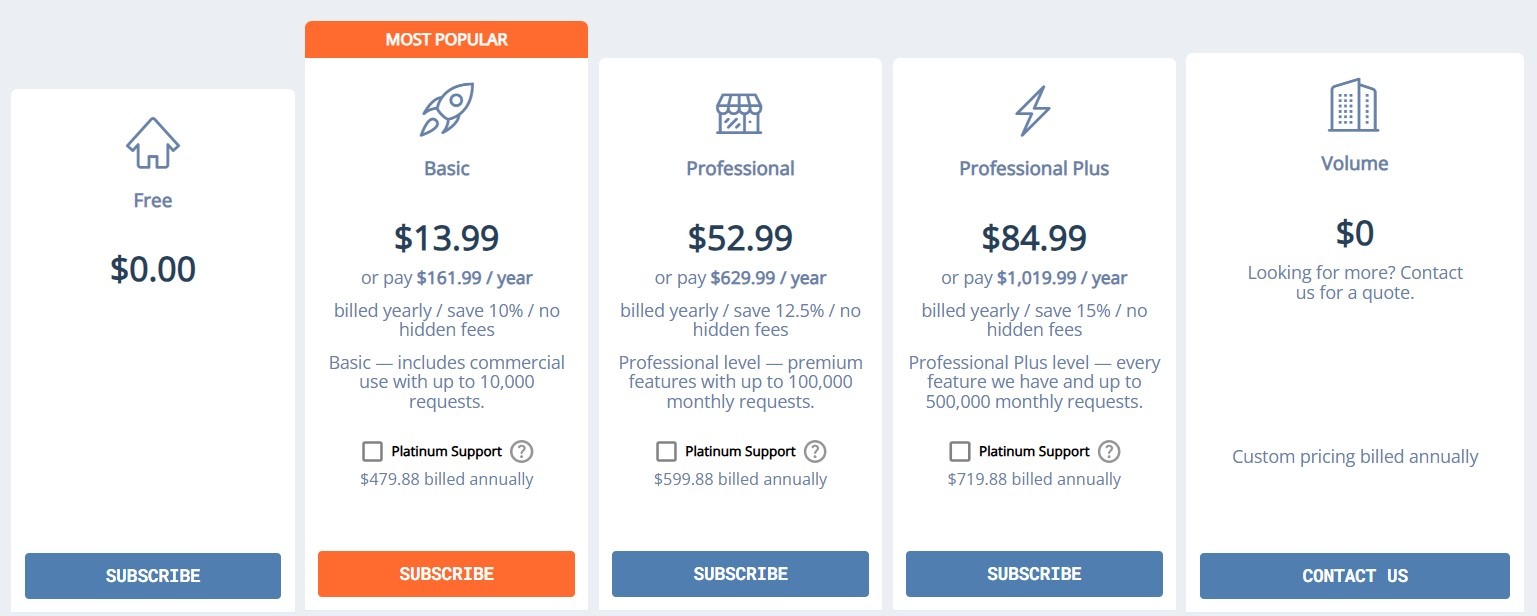 Fixer.io is a strong choice when your application’s credibility depends on delivering exchange rate data that is accurate, auditable, and built for production use in 2026.
Financial Modeling Prep API: Best for Deep Financial Data
For developers and analysts who need in-depth access to company fundamentals, earnings reports, and structured financial statements, Financial Modeling Prep (FMP) remains a powerful all-in-one API platform in 2026. With over 30 years of financial history combined with real-time market data, FMP delivers the depth, accuracy, and flexibility required for advanced financial modeling, research, and analysis.
Why It’s a Go-To for Financial Analysts and Builders
Financial Modeling Prep (FMP) delivers a rich and structured data stream for U.S. and global equities. It combines live stock prices with balance sheets, cash flow statements, income statements, valuation metrics, and more. With RESTful endpoints and data available in both JSON and CSV formats, FMP supports everyone from solo quant developers to enterprise-grade financial platforms.
Key Features
- Real-time stock prices and intraday market data
- 30+ years of historical financial statements and ratios
- Company fundamentals including margins, debt ratios, ROE, ROA, and more
- Access to macroeconomic indicators and forex rates
- Market news, press releases, and analyst sentiment
- Structured quarterly and annual financial statement endpoints
- Developer-friendly documentation with code samples
- CSV download support for spreadsheet-based workflows
Ideal Use Cases
- Stock screeners and equity research platforms
- Automated valuation models and DCF analysis
- Financial report automation for SaaS companies and investment firms
- MCP-integrated workflows requiring structured financial context, such as balance sheet comparisons
- Custom dashboards combining fundamentals, ratios, and technical indicators
Pricing Tiers (Billed Annually)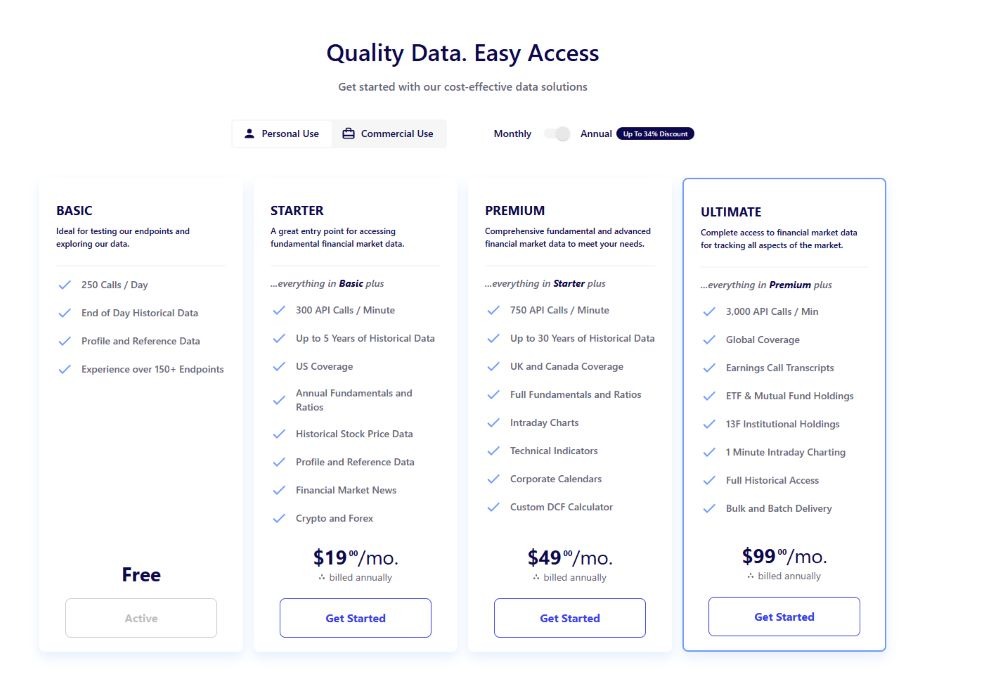 FMP is designed for teams that need clarity and control over corporate financial data. If your product depends on fundamentals rather than short-term price movements, this API provides the historical depth and data structure needed to support confident, data-driven decisions in 2026.
Alpha Vantage API: Best for Quantitative and Technical Analysis
Alpha Vantage continues to be a popular choice in 2026 among quants, algorithmic traders, and developers building tools that depend heavily on technical indicators and time-series data. With support for equities, forex, cryptocurrencies, and technical overlays, it is built for flexibility and analytical precision.
Why It’s Popular Among Quantitative Developers
Alpha Vantage offers one of the largest libraries of ready-to-use technical indicators, from moving averages and RSI to MACD and Bollinger Bands. This allows developers to quickly prototype, test, and deploy signal-based trading systems or build analytics dashboards that surface actionable insights.
Key Features
- Real-time and historical market data for stocks, forex, and crypto
- 50+ built-in technical indicators including RSI, MACD, Bollinger Bands, and SMA
- Intraday, daily, weekly, and monthly time-series data
- Fundamental data for U.S. equities
- JSON and CSV response formats
- Free API key with generous limits on the free plan
- Well-supported Python, JavaScript, and Excel integrations
Ideal Use Cases
- Backtesting strategies using historical technical patterns
- Generating buy and sell signals with minimal custom logic
- Building low-code or no-code trading tools with embedded analytics
- Educational platforms and tutorials for learning technical analysis
- MCP-enhanced modeling systems needing fast access to indicators
Whether you are experimenting with a new trading strategy or enhancing a research platform, Alpha Vantage offers a fast, reliable, and accessible entry point into quantitative financial data in 2026.
Twelve Data API: Best for Comprehensive Market Coverage
Twelve Data continues to stand out in 2026 as a full-spectrum financial data API, offering real-time and historical data across a wide range of asset classes. Whether you are working with global stocks, ETFs, indices, forex, or cryptocurrencies, Twelve Data delivers broad coverage, advanced analytics, and high-frequency updates through a single, unified API.
Why Developers Love Twelve Data
With support for 100,000+ financial instruments across 120+ countries, Twelve Data is well suited for developers building scalable platforms that span multiple asset classes. Its flexible endpoints, fast update intervals of up to 1 second, and developer-first approach make it a strong choice for both retail and institutional-grade applications.
Key Features
- Real-time and historical price data for stocks, ETFs, forex, crypto, and commodities
- 100+ built-in technical indicators including RSI, EMA, MACD, and Bollinger Bands
- WebSocket support for live market data streaming
- Batch requests, candlestick pattern recognition, and global time-series data
- SDKs for Python, JavaScript, PHP, and more
- Excel and Google Sheets add-ons for spreadsheet workflows
- JSON-formatted responses for easy integration
Pricing Overview
Basic (Free):
- 800 API requests per day
- U.S. stocks, forex, and crypto data
- Access to technical indicators
Grow – $79 per month:
- 377 API credits per month
- No daily request limit
- Access to 24+ markets and selected fundamentals
Pro – $229 per month:
- 1,597 API credits per month
- 47 additional markets
- Batch requests, market movers, extended fundamentals
Ultra – $999 per month:
- Full market and fundamentals access
- Mutual fund and ETF breakdowns
- Advanced analysis data and priority support
Enterprise – $1,999 per month:
- Enterprise-grade security
- Dedicated support
- 99.99% SLA
- 17,000+ API credits per month
Ideal Use Cases
- Multi-asset trading dashboards
- Global portfolio monitoring platforms
- Market data infrastructure for financial applications
- Algorithmic trading systems using multiple data feeds
- AI or MCP-based tools analyzing diverse instruments in real time
If you are building a financial product that requires broad market coverage without compromising on speed or accuracy, Twelve Data offers a scalable and powerful solution ready for 2026 growth.
Finnhub API: Best for Fast Prototyping and Broad Market Coverage
Finnhub continues to be a strong choice in 2026 for developers who need quick access to real-time financial data across multiple asset classes. Its generous free tier, global coverage, and well-structured documentation make it ideal for fast prototyping and scalable product development.
Why Developers Choose Finnhub
Unlike unofficial wrappers or scraped data sources, Finnhub is an officially maintained API platform. It provides real-time stock quotes, forex rates, crypto data, economic indicators, and company fundamentals through secure and scalable REST endpoints. Developers also gain access to market news, earnings calendars, sentiment analysis, analyst ratings, and ESG scores from a single API.
Key Features
- Real-time and historical stock price data
- Forex, crypto, and international market coverage
- Company fundamentals, earnings data, and key financial ratios
- Economic indicators and macroeconomic data
- Market news, analyst ratings, and sentiment scores
- 60 API calls per minute on the free plan
- SDKs for Python, JavaScript, and other major languages
- WebSocket support for real-time streaming on paid plans
Ideal Use Cases
- Financial dashboards and mobile investment apps
- No-code and low-code finance tools with rapid refresh needs
- Early-stage robo-advisors and portfolio tracking platforms
- Educational applications focused on trading and market analysis
Finnhub API Pricing Overview
Finnhub offers multiple pricing tiers based on data type and usage requirements:
- All-in-One: Free to $2,500
- Fundamental Data: $50 per month per market to $200 per month per market
- ETFs, Funds, and Indices: $500 per month to $1,000 per month
- U.S. and Global Market Data: $49.99 per month to $200 per month
- Crypto Data: $49.99 per month to $129.99 per month
Finnhub is a strong option for teams that want fast setup, broad market access, and the flexibility to scale from prototype to production in 2026.
Tiingo API: Best for Historical Accuracy and Backtesting
When your application relies on clean, accurate, and highly granular historical data, Tiingo remains one of the most respected providers in 2026. Built with quantitative developers and institutional users in mind, Tiingo places strong emphasis on data integrity and long-term consistency across time-series datasets.
Why Quant Developers Choose Tiingo
Tiingo is known for its high-quality historical price feeds and carefully adjusted datasets. It provides access to equities, ETFs, mutual funds, and alternative data such as news and sentiment. This makes it especially popular with backtesting teams and quantitative researchers who require confidence in data accuracy over long time horizons.
Key Features
- End-of-day and intraday historical price data with 30+ years of coverage
- Real-time pricing for stocks, ETFs, mutual funds, and crypto
- High-resolution time-series data optimized for backtesting workflows
- News sentiment API with up to 3 months of queryable history
- Optional access to fundamental data with commercial licensing
- Developer-first approach with flat-rate pricing and strong documentation
Pricing Overview
Starter (Free):
- 1,000 API requests per day
- Up to 500 symbols per month
- 1 GB monthly bandwidth
Power Plan – $30 per month or $300 per year:
- 100,000 API requests per day
- 96,000+ symbols per month
- 40 GB monthly bandwidth
Business Plan – $50 per month or $499 per year:
- Same access as Power Plan
- Licensed for internal commercial use
Ideal Use Cases
- Backtesting long and short equity strategies
- Portfolio and factor model research using historical data
- Academic and financial research projects
- Risk modeling systems requiring precise time alignment
Tiingo is a strong choice when your work depends on premium-quality historical data and long-term accuracy. For institutional analytics, quantitative research, or rigorous backtesting, it delivers the structured and reliable datasets advanced strategies need in 2026.
Polygon.io API: Best for High-Frequency Trading and Real-Time U.S. Markets
Polygon.io remains a top choice in 2026 for developers who need speed, scale, and ultra-low-latency access to U.S. market data. It is purpose-built for trading systems, real-time dashboards, and execution platforms where tick-level precision and WebSocket streaming are essential.
Why Traders and Engineers Choose Polygon.io
Designed for algorithmic trading, brokerage platforms, and institutional-grade systems, Polygon delivers real-time market data with deep access to trades, quotes, aggregates, and market depth. It supports U.S. equities, options, forex, and crypto through a consistent API structure backed by high-performance infrastructure.
Key Features
- Real-time data for U.S. stocks, options, forex, and crypto
- Tick-level access to trades, quotes, and market depth
- WebSocket support for streaming live market updates
- Aggregated OHLC data at 1-minute, hourly, daily, or custom intervals
- Historical trades and quotes with 20+ years of coverage
- Market snapshots, reference data, corporate actions, and fundamentals
- RESTful API with detailed and well-maintained documentation
Pricing Overview
Individual Plans (Monthly)
Basic – Free:
- 5 API calls per minute
- Up to 2 years of historical data
- End-of-day prices, reference, and fundamental data
Starter – $29 per month:
- Unlimited API calls
- 5-year historical data
- 15-minute delayed market data
- Minute-level aggregates
Developer – $79 per month:
- 10-year historical data
- Second-level aggregates
- WebSocket and trade-level access
Advanced – $199 per month:
- Real-time market data
- 20+ years of historical data
- Tick-level trades and quotes
- Unlimited API access
Business Plans
Business – $1,999 per month:
- Unlimited API access
- Real-time fair market value data
- 20+ years of history
- No exchange fees
- WebSocket streaming
- Full trade and quote access
- Commercial usage license
Enterprise – Custom Pricing:
- Dedicated SLAs
- Custom data feeds
- Slack support
- Implementation services and team onboarding
Ideal Use Cases
- High-frequency trading bots and execution platforms
- Real-time stock and options dashboards
- Market surveillance and dark pool monitoring tools
- Advanced volatility modeling and tick-level backtesting
If your application demands ultra-fast execution, granular U.S. market data, and institutional-grade reliability, Polygon.io is one of the strongest API choices for 2026.
Intrinio API: Best for Financial Statements and Valuation Metrics
Intrinio is built for fintech developers and enterprises that need reliable access to structured financial statements, valuation metrics, and SEC filings. In 2026, it remains a strong choice for teams building investment platforms, analytical dashboards, and custom financial models.
Why Fintech Platforms Prefer Intrinio
Intrinio stands out for its clean, normalized financial data. It provides full income statements, balance sheets, and cash flow reports, along with pre-calculated valuation ratios such as EV/EBITDA and P/E. This significantly reduces the effort required to build investor-grade analytics and valuation tools.
Beyond core financials, Intrinio also offers advanced modules like peer comparison data, real-time IEX stock prices, and institutional-grade ESG scores, making it suitable for both enterprise applications and investment-focused platforms.
Key Features
- Standardized financial statements including 10-Q and 10-K filings for thousands of U.S. companies
- Valuation metrics covering price ratios, profitability, liquidity, efficiency, and leverage
- Direct access to SEC filings via EDGAR
- Real-time and end-of-day stock prices from IEX
- Peer group analysis and comparison tools
- Developer-friendly API with detailed documentation and SDKs
- Enterprise licensing and custom data packages available
Ideal Use Cases
- Equity research platforms and valuation modeling tools
- Robo-advisors calculating fair value and market comparables
- Credit scoring and financial health analysis systems
- Compliance monitoring tools and audit dashboards
Pricing Tiers
Intrinio offers flexible pricing tiers and custom enterprise plans based on data modules and usage requirements.
Intrinio delivers the structure, depth, and flexibility required for advanced financial analysis. For teams focused on equity research, valuation modeling, or embedded financial insights, it provides a dependable data foundation for 2026 and beyond.
Here is a 𝗧𝗼𝗽 𝗥𝗮𝘁𝗲𝗱 refined, 2026-updated, and lightly polished version with clear structure and minimal word inflation, keeping everything practical and readable.
Quandl API: Best for Economic and Alternative Financial Data
Quandl, a subsidiary of Nasdaq, remains a trusted source in 2026 for alternative financial data, macroeconomic indicators, and premium institutional datasets. Its API is widely used by analysts, economists, data scientists, and financial researchers who need insights beyond standard market prices.
Why Researchers and Analysts Choose Quandl
Quandl stands out for its access to unique and hard-to-find datasets, including government macroeconomic releases, ESG scores, central bank forecasts, and industry-specific indexes. With coverage spanning commodities, real estate, energy, employment, and global economic indicators, it enables deeper, multi-dimensional analysis that market price data alone cannot provide.
Key Features
- Extensive macroeconomic and alternative financial datasets
- Premium databases from providers like Nasdaq, Zacks, CoreLogic, and others
- Coverage across equities, commodities, futures, options, and global economics
- Data available in JSON, CSV, and XML formats
- Native integrations for Python, R, and Excel
- Freemium access to open datasets with subscription-based premium data
- Documentation designed for analysts, researchers, and academic use
Ideal Use Cases
- Economic forecasting dashboards using long-term time-series data
- Quantitative research combining financial and non-financial signals
- Macro-driven or fundamental portfolio models
- ESG scoring and corporate responsibility analysis
- MCP-powered AI systems synthesizing multi-source financial context
Quandl is well-suited for teams that want to look beyond charts and price movements and focus on the macroeconomic and structural forces shaping financial markets.
Conclusion: Making the Right Financial Data API Choice in 2026
Choosing the right financial data API in 2026 is a strategic decision, not just a technical one. The APIs you integrate directly affect the accuracy, speed, and intelligence of your product, whether you are building a trading system, investment platform, AI assistant, or enterprise analytics solution.
From ultra-low-latency tick-level feeds to deep fundamental and macroeconomic datasets, modern APIs now deliver capabilities that were once limited to hedge funds and large institutions. Today, startups, solo developers, and researchers can access the same infrastructure, often with free tiers and scalable enterprise plans.
Final Takeaways
- For a reliable, all-around stock market data solution, Marketstack remains a strong choice, especially for global equity applications.
- For currency data and exchange rates, ExchangeRate.host, Fixer.io, and CurrencyLayer offer dependable, scalable solutions with generous entry-level plans.
- For AI-driven systems, financial modeling, and deep analytics, platforms like Financial Modeling Prep, Intrinio, Twelve Data, Polygon.io, and Quandl provide the structure and depth advanced products require.
- As your application grows, compare enterprise-grade APIs based on latency, coverage, support, and licensing to ensure long-term scalability.
No matter where you are in your development journey, choosing the right financial data API enables smarter decisions, faster execution, and more trustworthy user experiences. Build carefully, scale confidently, and innovate boldly.
FAQs
What is the best financial data API for global stock market coverage?
Marketstack is one of the best all-around options for global equity data. It supports 70+ exchanges, offers real-time and historical data, and provides a clean RESTful API suitable for both startups and enterprise platforms.
How do I choose between free and paid financial data APIs?
Start by matching your technical needs, such as real-time access, asset coverage, and update frequency, with what free tiers offer. As usage grows, look for APIs with transparent pricing, scalable limits, and strong developer support.
What’s the best API for financial statements and valuation metrics?
Intrinio and Financial Modeling Prep both provide structured access to income statements, balance sheets, cash flow data, and valuation ratios, making them ideal for equity research and automated valuation models.
What’s the difference between tick-level, intraday, and end-of-day data?
- Tick-level data captures every trade or quote
- Intraday data aggregates prices at intervals like 1-minute or 15-minute
- End-of-day data provides daily open, high, low, and close prices
Tick-level data suits HFT and backtesting, while EOD data is better for long-term analysis.
Which APIs are best for currency conversion tools?
Fixer.io and ExchangeRate.host are popular choices due to their simple integration, broad currency coverage, and affordable pricing. Both support real-time and historical forex data for global applications.
[story continues]
tags