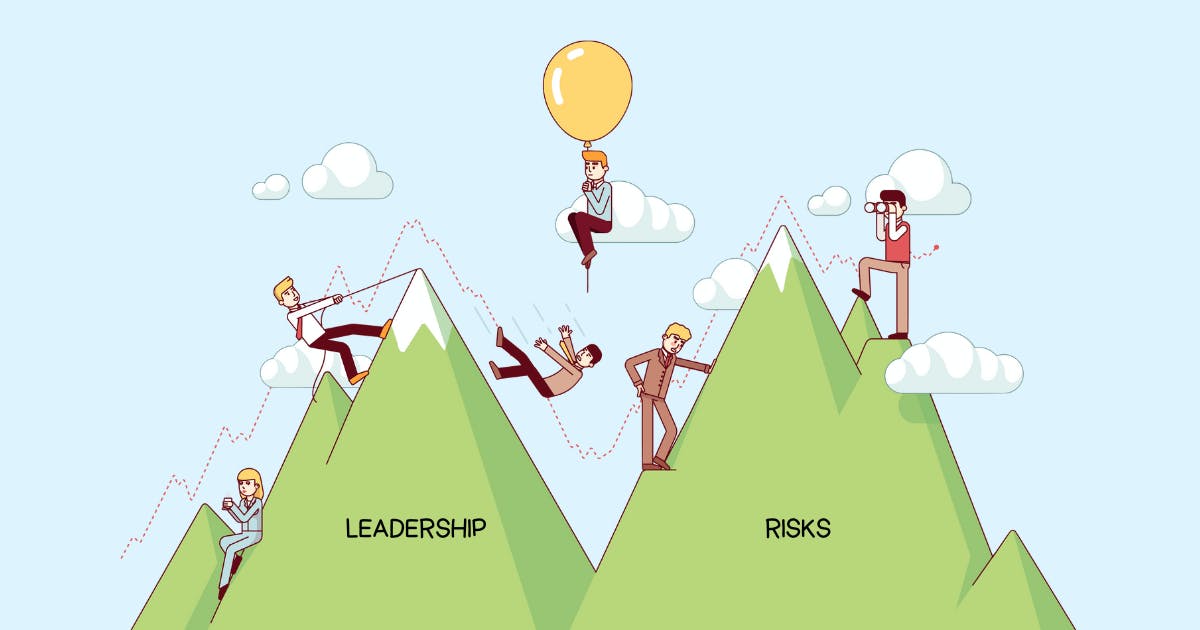
The biggest risk as a leader is playing safe and not taking any risks—going with popular decisions instead of pushing for unusual prospects, faking confidence and projecting an image of perfection instead of showing up authentically by admitting limitations and acknowledging what they don’t know, saying yes all the time to people please and build likability instead of saying no to focus on high-impact work even if it displeases someone in the short-term, staying silent to maintain peace and harmony instead of speaking up and voicing their concerns, maintaining the status quo with fear of failure instead of pushing for continuous reinvention and maintaining a tight control over their team instead of empowering and letting go.
Leaders need to have a high appetite for taking risks, not just in choosing unconventional paths, taking bold risks or setting aggressive business targets, but also in the way they lead their teams—what they choose to hide and what they choose to share, how do they balance freedom and control, what image they project and the message that passes to their teams and how they handle difficult situations that are messy and hard. It’s often a tricky balance, one that requires taking risks without going overboard and stepping into the unproductive zone.
For example:
Giving boundaryless freedom can lead to very bad decisions.
Sharing information that doesn’t concern people in the team can confuse and distract them.
Displaying extreme emotions in the name of authenticity can dilute the impact of the message being conveyed.
Speaking truth without a sign of compassion can seem cruel and inhuman.
Every situation at work has some risk involved—risk of failure, risk of reputation, risk of judgment, risk of criticism, risk of disappointment, risk of misunderstanding. These risks can often prevent leaders from engaging in behaviors that are uncomfortable at first. When risk hijacks the amygdala in the brain, it exaggerates negative outcomes and sidelines logical reasoning, making leaders hyper-focused on avoiding threats rather than exploring opportunities.
But leaders who don’t take these risks limit their team’s growth and potential. People in the organization take their cues from their leaders and model their behaviors—leaders who don’t embrace risks indirectly tell their teams to play it safe too.
Leadership is scarce because few people are willing to go through the discomfort required to lead. This scarcity makes leadership valuable.…It’s uncomfortable to stand up in front of strangers. It’s uncomfortable to propose an idea that might fail. It’s uncomfortable to challenge the status quo. It’s uncomfortable to resist the urge to settle. When you identify the discomfort, you’ve found the place where a leader is needed. If you’re not uncomfortable in your work as a leader, it’s almost certain you’re not reaching your potential as a leader.
— Seth Godin
Here are the 5 risks every leader must take daily because it’s impossible to get better at anything without consistent practice:
Making Unpopular Decisions
It’s safe to go with the majority and nod in agreement to a popular decision. You don’t have to voice your concern, share your opinion, or express a disagreement because doing these things often comes with a risk.
What if it goes wrong?
What if others don’t like it?
What if they turn against you?
But prioritizing consensus, popularity, approval, and likability keeps the possibility of a better decision out of reach. You may not share your opinion when it doesn’t align with the majority because it requires standing up with courage and conviction. You may not speak up when you disagree because you worry about how it will be perceived. You may agree to a decision that you know won’t work because telling others they’re wrong is often scary.
Challenging the status quo, voicing your concerns, and sharing disruptive ideas is risky—but it’s the risk you’ve got to take as a leader. It may subject you to frowns from people who think your ideas are crazy. You may face resistance at first. Some might even disapprove of it. Others might resent you for your ability to think creatively and provide a fresh perspective.
The true mark of a leader is the willingness to stick with a bold course of action — an unconventional business strategy, a unique product-development roadmap, a controversial marketing campaign — even as the rest of the world wonders why you're not marching in step with the status quo. In other words, real leaders are happy to zig while others zag. They understand that in an era of hyper-competition and non-stop disruption, the only way to stand out from the crowd is to stand for something special.
— Bill Taylor
To build risk-taking capacity for speaking up without falling for groupthink, ask these questions:
- Am I saying yes to this decision because I really believe in it or because it aligns with the majority?
- Are all ideas simply small variations of one another, tried-and-tested approaches, or things that have less risk involved? What would be a completely unique approach that we haven’t explored yet?
- Why are other options less exciting compared to the current choice?
- What’s the worst that could happen if this decision does not work out as expected? What’s my plan B?
- How can I get a buy-in without intimidating and pushing others away?
Avoiding new opportunities with fear of failure, dismissing ideas because they seem too risky, or defaulting to tried-and-tested methods over bold initiatives caps your team’s potential. Have the courage and conviction to stand alone. Take the risk by navigating the uncharted territory.
Showing Vulnerability
You may put on a facade of strength by hiding your vulnerabilities to protect yourself from being exposed. Bringing your authentic self to work by admitting gaps in your knowledge, sharing your mistakes, or expressing your true emotions and feelings often comes with a risk.
What if people doubt your competence?
What if they don’t respect you?
What if it makes you look weak?
But projecting an image of confidence, faking knowledge when you don’t know something, and hiding your true emotions and feelings prevent you from building a bond with people at work. Leaders aren’t expected to be perfect—they’re required to be human. What builds respect isn’t your successes but how gracefully you handled failures. What develops a sense of connection isn’t your imperfections, but the flaws you were willing to share. What enables safety isn’t the fancy messages or the words of encouragement, but how you model safety through your own behaviors and actions.
Vulnerability is not weakness—admitting mistakes, not having all the answers, or saying “I don’t know” does not hurt your credibility as a leader. In fact, it increases approachability, builds likability, and increases respect. Pretending to know something or coming across as a “know-it-all” frustrates others—they can see when you genuinely have the knowledge and experience and when you’re just faking it. But remember this: authenticity can’t be an excuse for burdening others by oversharing or justifying your reckless behavior. You have to seek a balance by defining clear boundaries for yourself and others.
Fear of being shamed causes people to put on masks and live in fear and pretense, creating a stronghold of pride. Authentic, transparent leaders encourage people to develop trust through their own honesty and vulnerability. They do not view transparency as weakness, but recognize it as a source of their virtue, power and anointing because power flows through humility.
― Laura Gagnon
To build risk-taking capacity while showing up authentically without going overboard, ask these questions:
- What information do I need to share with others? Is it important for them to know? How will it be helpful without overwhelming them?
- How can I combine my struggles with the solutions I implemented so that it encourages others to stay resilient and not develop a complaining attitude?
- How can I express my lack of confidence in something without coming across as unsure or indecisive?
- How can I share what I’m feeling without unsettling others or making them feel responsible for fixing it?
Leaders aren’t deeply admired for their intelligence, knowledge, experience, or skills, but for the way they make others feel—human. Don’t hide your mistakes. Don’t cover your flaws. Show up authentically.
Speaking Hard Truths
Difficult conversations, by nature, are tricky. They are touchy topics that no one likes to talk about. They involve addressing differences of opinion, emotional issues, sensitive subjects, or other potential reasons for conflict—anything you find hard to talk about. They are challenging because they require you to navigate through discomfort, uncertainty, and a wide range of complex emotions.
You may ignore difficult situations at work or put them off for too long—an employee not performing, a high performer displaying toxic behavior, or stakeholders making unreasonable demands. These situations are sensitive and often need to be handled with care. Staying silent and doing nothing seems like a safer option when speaking up and not getting the alignment you need can be even more risky. It’s much easier to avoid emotionally draining and mentally exhausting situations than step right into them consciously.
What if they don’t agree with you?
What if they quit?
What if they go behind your back to seek approvals?
But putting off
No matter how hard a conversation is, you can’t put it off or delay it forever. Addressing issues directly, providing clarity, and seeking closure can help you gain trust and respect, and also alleviate stress.
Beginning a conversation is an act of bravery. When you initiate a conversation, you fearlessly step into the unknown. Will the other person respond to favorably or unfavorably? Will it be a friendly or hostile exchange? There is a feeling of being on the edge. That nanosecond of space and unknowing can be intimidating. It shows your vulnerability.
— Sakyong Mipham
To build risk-taking capacity for speaking hard truths, ask these questions:
- How am I dealing with this difficult situation—am I facing the situation head-on or seeing the problem, closing my eyes, and getting busy with something else?
- What’s the impact of not addressing this issue at the right time?
- What’s the worst that can happen if I speak the truth?
- How can I communicate in a manner that does not cause the other person to react badly or turn defensive?
Difficult conversations, though necessary, are hard to crack. Fear of a bad outcome or not knowing what to say can prevent you from speaking hard truths. Stop playing silly games. Engage in healthy dialogue right when you need it the most.
Letting go of control.
You may be involved in every small decision, every minute detail, and every communication that happens in your team. Staying on top of everything makes it less likely for things to go wrong—risk factor is minimized when you’re in control. Letting go requires you to relinquish control, which can leave you with feelings of anxiety, insecurity, and helplessness.
What if they make a big mistake?
What if they misuse it?
What if they overshadow you?
But not empowering your team to make their own decisions or demanding that they consult you on every problem prevents them from developing the skills required to grow in their role—if you keep doing all the thinking for your team, they’ll never develop creative thinking skills. If you keep solving their problems, they’ll never learn to navigate complexity. If you keep preventing mistakes, they’ll become more reckless and inattentive.
Empowerment is risky, but it’s the only way to develop future leaders. Unless people in the team get the freedom and opportunity to own their decisions, make mistakes, and try different strategies to achieve their goals, they’ll always be dependent on someone else, which will not only slow them down but also prevent them from developing the skills required to grow in their role. Both freedom and control are necessary—but you have to seek the right balance. Without taking that risk, you’ll be left with a team that can’t keep up as business scales and expectations expand.
Micromanagement happens when you keep power to yourself. Empowerment is when you give power to your team.
― Nick Chellsen
To build risk-taking capacity for letting go by enabling your team to do great things independently, ask these questions:
- Is my team clear on the goals and the outcomes they are expected to achieve? What information might be missing that can prevent them from succeeding?
- Do people in the team have the skills and knowledge required to make their own decisions? What gaps exist? How can these gaps be filled without my continuous intervention?
- Have I set clear decision boundaries with my team on the kind of decisions they can make independently and the ones where I need to be involved?
- Do I hold my team accountable to meet their deadlines while not compromising on quality?
- Do I encourage my team to learn from their mistakes, put a new plan into place, and keep moving forward instead of berating them and filling them with feelings of incompetence and self-doubt?
Keeping tight control over your team for the risk of failure prevents you from scaling and building a high-performing team. It’s a recipe for short-term wins, not long-term success. Coach, don’t spoon-feed your team. Let them spread their wings.
Saying no.
You may say “yes” to every request, every opportunity, and every change you’re asked to consider. Being agreeable puts less burden on you to prioritize and also reduces chances of conflict—saying no can be risky because you don’t know how others will respond or how your decisions will turn out.
What if they take it personally?
What if it upsets them?
What if you let go of a great opportunity?
But committing more than you could handle or saying “yes” to inconsequential activities will ultimately hurt your reputation as you fail to meet commitments or create the desired impact. Saying “yes” brings short-term comfort—you don’t have to worry about how others will respond or the fear of making the wrong decision. But not considering the consequences of your decision turns into regret when you finally have to face them in the future.
Your responsibility as a leader isn’t to please everyone or make them happy; it’s to multiply your impact and the value you add by risking saying no. Saying no that lands right does not need lengthy explanations—they come across as justifications and often distract and confuse the other person. Instead, be precise. State your reason by being straightforward, clear, and concise—three elements of good communication.
The great art is to learn to integrate the two, to marry yes and no. That is the secret to standing up for yourself and what you need, without destroying valuable agreements and precious relationships. That is what a ‘Positive No’ seeks to achieve.
― William Ury
Instead of a knee-jerk yes or no, build risk-taking capacity for saying no by asking these questions:
- What’s this request about—what exactly is it asking me to do?
- What excites me about this opportunity?
- What’s the cost of taking it on—in terms of effort, time required, and the impact on the team’s existing priorities? What’s the scale and scope of the request? What kind of time commitment does it demand?
- What’s the cost of not doing it? How important is it to the person and the organization?
- How does it align with my team’s current plans and commitments?
- What could be my reason for saying no?
No is risky, but so is yes. Every “yes” you say has an opportunity cost—doing something will always come at the cost of not doing something else. Give yourself permission to say no. Protect your team’s time and energy.
Leadership is all about making the jump, taking risks, and learning from your mistakes. It's about falling, dusting ourselves off, and getting back up again and again and again.
― Sebastien Richard
Summary
- Leaders need to build a very strong appetite for taking risks, not just in business decisions—defining strategies, setting targets, and taking bets, but also in how they lead their teams.
- Standing up and suggesting an unpopular choice is often risky—it may not work, others may not like it, or you may face a lot of resistance. But not challenging the status quo and staying with safe options limits your impact. Don’t take the easy road—fight for choices that are hard at first, but rewarding in the end.
- Expressing gaps in your knowledge or sharing your fears can be risky—what if others doubt your competence or your authenticity is mistaken for weakness? But faking knowledge or pretending to be someone you’re not prevents you from bonding and building trust. Showing up authentically as a leader builds connection—seeing the real you makes you more trustworthy and appealing as a human. Vulnerability is not weakness—balance it by defining boundaries without overwhelming others with too much information or excessive emotions.
- Facing difficult situations head-on and resolving the conflict evokes strong feelings of fear as pointing out performance gaps, addressing toxic behavior, or confronting unreasonable stakeholders is often risky—others may turn defensive or resent you for speaking the truth. But not addressing them at the right time makes the problem worse. Care personally and challenge directly—be candid and compassionate to make yourself heard.
- Being too involved with your team gives you a sense of control and makes it feel less risky, as it gives you the opportunity to make decisions, solve problems, and avoid mistakes. But doing all the thinking for your team keeps them dependent and prevents them from learning and growing. Let go of control. Empower your team—optimize for long-term growth, not short-term wins.
- Saying yes to every request and every change appears less risky, as you don’t have to worry about upsetting someone or letting go of a great opportunity. But not prioritizing work makes you overcommit—you overpromise and underdeliver, which hurts your credibility. Learn to say no without feelings of shame or guilt. Don’t just make commitments, keep them, too.
This story was previously published here. Follow me on LinkedIn or here for more stories.
[story continues]
tags