


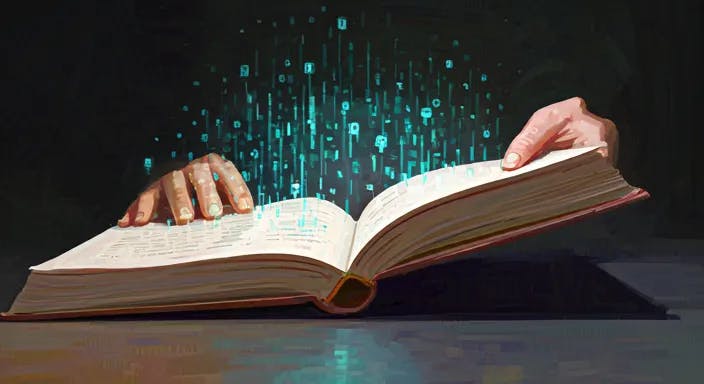
Before platforms, feeds, and algorithms, hypertext quietly rewired culture.
Several years ago, I picked up La Praga magica by the Italian Slavist Angelo Ripellino. When I returned to it recently, I realized that what I was holding was not just a scholarly monograph, but something much stranger and more familiar at the same time: a hypertext in disguise.
Ripellino’s book is dense with allusions, references, cross-references, and footnotes - so dense that some readers fall in love with it, while others bounce off it almost immediately. It stretches far beyond the conventions of a traditional academic work. Yet embedded within it is a powerful idea: that culture, and especially cultural history, may demand a new way of being described - one that resembles how we actually experience the world today.
This article is a tentative attempt to ask whether a hypertextual way of describing culture makes sense - and if so, what it reveals about how we read, think, and live.
Hypertext Is No Longer a Metaphor
Hypertext used to function as a metaphor: a theoretical model that helped us talk about complexity, interconnection, and non - linearity. That phase is over.
Today, hypertext is a fully fledged scholarly concept, on par with terms like text, intertextuality, or deconstruction. It’s used not only by programmers and multimedia designers, but also by philosophers, literary scholars, and cultural theorists. Hypertext has become part of late twentieth - and early twenty-first-century culture - so much so that culture itself increasingly behaves like a hypertext.
Despite linguistic, social, and historical differences, we inhabit a shared reality that feels fundamentally non - linear. We no longer experience the world as a tidy sequence of causes and effects. Instead, we move through a labyrinth of choices - choices that feel voluntary, but are often imposed by the structure of reality itself.
Living in a Non-Linear World
Hypertext has not merely complicated communication; it has shattered the idea that information exchange can ever be fully unambiguous. Traditional, linear modes of expression struggle to capture a reality that is fragmented, shifting, and constantly branching.
As a result, hypertext has emerged as a surprisingly effective way of describing the world and our relationship to it. For some, this world feels like a cursed maze - seductive, infinite, and overwhelming. For others, hypertext offers a tool for reconciling technological change with an older human longing: the memory of a time when the world was young, unnamed, and still pointed at with a finger rather than indexed by a link.
What Is Hypertext, Exactly?
One of the clearest definitions comes from Christopher Keep and Tim McLaughlin, who describe hypertext as information presented as a network of linked nodes that readers can navigate non - linearly. Hypertext allows multiple reading paths, blurs the boundary between author and reader, and resists clear beginnings and endings.
Many discussions of hypertext reduce it to a purely electronic phenomenon: something that exists only on screens, inside computers, or on the internet. But this view misses the point. Encyclopaedias, dictionaries, and reference works have long operated hypertextually - even in print.
Hypertext is not a technology; it is a way of organising discourse.
Before the Web, There Was Ted Nelson
Although hypertext feels inseparable from the internet, its conceptual foundations were laid long before HTML, browsers, or global networks. In the 1960s, Theodor Nelson described texts that lacked continuity and encouraged readers to move through them by jumps rather than by linear progression.
In Literary Machines, Nelson defined hypertext as non-sequential writing. Such writing fragments narrative continuity and replaces hierarchy with a constellation of interconnected text chunks. The result is something paradoxical: one text that is also many texts at once.
Authors may design these structures, but during reading, hierarchy collapses. The reader chooses paths, directions, and sequences. Reading becomes an act of construction rather than consumption.
When Readers Become Co-Authors
Around the same time, Roland Barthes introduced the concept of lexia: small semantic units that emerge during reading. Meaning, for Barthes, is not extracted but produced. Reading becomes a form of rewriting (lecture-réécriture) in which the unity of the text dissolves into a network of relations.
What grounds a text, Barthes argues, is not its internal structure but its openness to other texts, codes, and signs. In other words, intertextuality is not a feature - it is the foundation.
Hypertext as Fate
The Russian cultural theorist Vadim Rudnev offered a striking metaphor: hypertext is like fate. A person walks down the street, lost in pleasant thoughts, when suddenly a button is pressed and their life veers in a new direction. Another button sends them back. Old problems return, but now complicated by the knowledge gained elsewhere.
Even when someone attempts to escape their past - to abandon a profession, an ideology, or a worldview - the elements of their previous life remain packed in their luggage. Language, habits, and concepts function like links to an earlier hypertext from which there is no final exit.
The Three Core Features of Hypertext
Despite the diversity of definitions, three elements consistently define hypertext:
1. Dispersiveness - information appears in fragments, with no fixed starting point.
2. Alinearity - readers must choose paths, effectively becoming authors of their own texts.
3. Multiplicity of media - text, image, sound, and video coexist within a single structure.
Hypertext also reshapes how we experience space and time. Its space is pragmatic, defined by use rather than geography. Its time is serial and non-chronological, allowing past, present, and future to intermingle. Like myth, hypertextual time neither begins nor ends.
Links Are Meaning Made Visible
The hyperlink is hypertext’s most important structural element. It materializes what, in traditional texts, appears only as allusion or connotation. By activating a link, the reader concretises meaning - but the choice to click always remains optional.
In this sense, hypertext does not eliminate interpretive freedom. It merely makes its mechanics explicit.
The simplest and most familiar example of hypertext is the encyclopaedia. It can be read in multiple ways:
- Linearly, ignoring references altogether.
- Combinatorially, following references while attempting to preserve continuity.
- Alinearly, beginning and ending anywhere, guided entirely by links.
Only the last mode fully activates hypertext’s potential. It invites the reader to experience reading as authorship.
Why This Still Matters
Hypertext is not just a digital format. It is a model of reality.
Understanding hypertext helps us understand how we navigate information, construct meaning, and experience time in a world that no longer moves in straight lines. We are not just readers anymore. We are navigators - clicking, branching, returning, and rewriting as we go.
And perhaps that is the quiet truth Ripellino’s book revealed long before the web made it obvious: the world was always hypertextual. We just didn’t have the language - or the links - to see it.
Hypertextual Sketches is a micro-series of essays on hypertext, the post-modern condition of culture, semiotics, and non-linear ways of describing how meaning circulates when continuity breaks down. Original research essays were written between 1997 and 2000, in Prague, Krakow, and Leipzig, when the internet was still experimental, but its logic was already reshaping how we read, write, and think. Larger portions of this work were actually published on paper (!) between 1999 and 2003. Read today, these essays function less as historical artifacts and more as early signals of a reality we now take for granted.