One evening, an old Cherokee told his grandson about a battle that goes on inside people. He said, “My son, the battle is between two wolves inside us all. One is Evil. It is anger, envy, jealousy, sorrow, regret, greed, arrogance, self-pity, guilt, resentment, inferiority, lies, false pride, superiority, and ego. The other is Good. It is joy, peace, love, hope, serenity, humility, kindness, benevolence, empathy, generosity, truth, compassion, and faith.”
The grandson thought about it for a minute and then asked his grandfather, “Which wolf wins?” The old Cherokee simply replied, “The one you feed.”
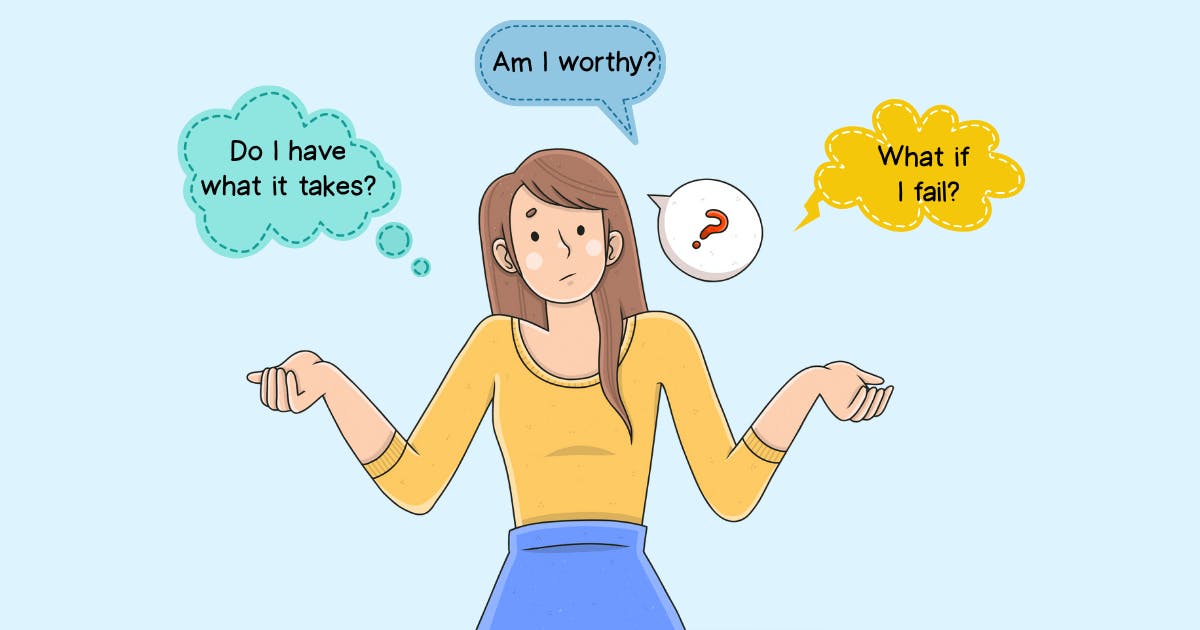
The evil wolf in your case is your self-doubt. The more you feed it, the more it overpowers you and dictates your actions.
Neuropsychologist Donald Hebb said, “Neurons that fire together wire together” to describe how pathways in our brain are formed and reinforced through repetition. Every experience, thought, feeling, and physical sensation triggers thousands of neurons, which form a neural network. When you repeat an experience over and over, the brain learns to trigger the same neurons each time. This is also how habits are formed. The more you practice a certain habit, the stronger the neural pathways get over time, making those habits easier to perform. What works well for habits also applies to how you choose to deal with feelings of unworthiness, self-doubt, and not being good enough.
When haunted by feelings of self-doubt, if you focus on negative attributes—things you have done wrong, mistakes you have made, skills and abilities you don’t possess—and respond to those feelings by telling yourself that you’re indeed a
Your brain runs on autopilot for a large part of your decisions. When struck by feelings of self-doubt, feeding your brain with negativity makes it your default go-to strategy. Since the brain learns to make this decision beneath your consciousness, you may not even realize the harmful behaviors you adopt to deal with your feelings of inadequacy. They provide temporary relief but often limit your long-term potential.
For example, when repeated multiple times…
- If you tell yourself that speaking up in a meeting will expose you and choose to keep quiet, your brain learns to associate “keeping quiet” as a safe behavior while “speaking up” as a threat.
- When given an opportunity to lead, if you let it go with fear of failure, your brain learns to reject anything risky.
- If you disregard positive feedback or praise because you don’t consider yourself worthy, your brain learns to diminish your other accomplishments, too.
- When given a challenging task, if you keep delaying it with the fear that nothing you do can ever be good enough, your brain learns to put off difficult tasks automatically.
Since repetition is what builds new neural pathways in your brain, anything done multiple times becomes an unconscious truth for your brain.
What you do now and how you focus your attention influence your brain and how it is wired. Whenever you repeatedly avoid some kind of overtly painful sensation, your brain learns that these actions are a priority and generates thoughts, impulses, urges, and desires to make sure you keep doing them again and again. It does not care that the action ultimately is bad for you…This means that if you repeat the same act over and over—regardless of whether that action has a positive or negative impact on you—you make the brain circuits associated with that act stronger and more powerful.
— Jeffrey Schwartz
But you know what the good news is? Your brain has this amazing ability to change. You can overwrite old brain pathways with new preferred attitudes and behaviors. Instead of repeating self-defeating behaviors, you can reprogram the neural pathways in your brain to take constructive action. You can replace automatic shortcuts to negative thought patterns with positive strategies.
Once you unlearn old default behaviors and relearn new ways of being, when your feelings of self-doubt strike, your brain recognizes those thoughts and the new pathways that allow you to step fully into your expertise. Whether it’s asking for a raise, presenting to a large group, taking up a new job, or a challenge, your feelings of self-doubt don’t get in the way. Your new belief system reminds you of your credentials and tells you that you have the ability to do it. The new neural pathways in your brain help you recalibrate your perception of yourself and build the resilience needed to deal with your feelings of unworthiness. It enables you to recognize your inherent worth and acknowledge your accomplishments.
Michael Gervais is a sports psychologist who works with athletes in high-stakes and consequential environments. He has worked with the Seattle Seahawks for eight years and with Felix Baumgartner, the Austrian who free dived from 130,000 feet as part of Red Bull’s 2012 Stratos project. He says that what we say to ourselves matters. He suggests an increase in awareness of the narrative that is either constraining you or creating freedom. “It's one of those two: constriction or freedom. And the more space we have, the more freedom we have to play, usually the better things go in all facets of life.”
To choose freedom over constriction, you need to reframe your thinking. You have to do the work to create new pathways in your brain. Simply saying positive affirmations like “I am amazing” or “I am capable” won’t make your fears disappear. They are in direct conflict with your deeply held core beliefs that you’re not enough and unworthy of success. Also, positive thinking works at the conscious part of the brain, while negative self-talk and limiting beliefs operate out of the subconscious mind. That’s where you need to tap. You don’t need positive thinking; you need to reframe your negative thoughts.
It Worked for Others
Leigh McBean, a former professional athlete turned lawyer, held a series of high-pressure management roles throughout his career. Once, he was pulled out of an existing role and assigned to a major distribution center that ordered goods and sent them across the state in bulk. He was asked to map the warehouse layout, the path of the forklifts, how the pickers received their instructions, the stock placement on the shelves, the loading of the orders into containers, and then manage the logistics with the drivers, yet he had no relevant experience at the time. On his first day, he remembers going into the bathroom feeling quite ill and very much like an imposter who would be found out as someone who knew not much at all. “It was outside my comfort zone, I felt like I was in the wrong place and that someone had made a mistake.”
Instead of letting his feelings of self-doubt screw up this great opportunity in front of him, he decided to deal with the overwhelming discomfort he was experiencing. “I acknowledged the feelings, firstly, and took a big breath…I thought about why I was there—it was partly because I had no experience in those areas that I was asked to do the role because they specifically wanted a fresh perspective from someone who could ask good questions and build rapport with people.”
Yunita Ong was one of the youngest students among her cohort at Columbia University, Graduate School of Journalism. She was also one of the few who entered the program straight from undergrad without full-time working experience. She doubted herself heavily at the beginning. With journalists who were decades-long industry experts as her classmates, she questioned if she belonged and whether she could deliver on the program’s requirements. She felt nervous to offer her opinions in class, and whenever she did, she felt her classmates were more eloquent.
But then Yunita learned a very powerful lesson: to not see self-doubt as something to suppress or ignore, but as a helpful ally. Over the academic year and during her career, whenever her self-doubt feelings surfaced, she used them as a signal to reframe those feelings of self-doubt. “I started seeing it as my brain’s way of telling myself I have an opportunity to transform beyond anything I can imagine at this current point. Now, I find it easier to replace my fear with excitement when embarking on a new journey. I also see it as my brain trying to help me. I pause to identify: What areas are there for me to learn and grow? What parts of my worry may not be valid? And I remember to identify the ways I can bring my strengths to the table as well.”
Leigh McBean and Yunita Ong rewired their brain by reframing their thoughts. Instead of considering their feelings of self-doubt as a lack of their abilities, they used them as a signal to use their knowledge and skills to do well. By consciously tapping into their thoughts, they were able to reframe and change their subconscious-level thoughts as well, which often run on autopilot.
You need to do the same. You need to train your brain to think differently. You need to build new neural pathways by adopting new ways of connecting with your thoughts and purposefully taking action. Once your brain learns these new ways of being, it won’t let your feelings of self-doubt take you away from your true goals.
Here’s the three-step process to rewire your brain:
Name It to Tame It
You can’t change what you don’t notice. So, the first step in rewiring your brain is to start with self-awareness and catch your feelings of self-doubt as they arise in real-time. Instead of letting these feelings slip through your consciousness, become fully aware of them as they show up.
Mindfulness guides us to become more emotionally agile by allowing us to observe the thinker having the thoughts. Simply paying attention brings the self out of the shadows. It creates the space between thought and action that we need to ensure we’re acting with volition, rather than simply out of habit. But mindfulness is more than knowing ‘I’m hearing something’, or being aware ‘I’m seeing something’, or even noticing ‘I’m having a feeling’. It’s about doing all this with balance and equanimity, openness and curiosity, and without judgement. It also allows us to create new, fluid categories. As a result, the mental state of mindfulness lets us see the world through multiple perspectives, and go forward with higher levels of self-acceptance, tolerance and self-kindness.
— Susan David
It will require you to be mindful of different moments in your life, observing and seeing things as they are happening. When feelings of self-doubt strike, recognize the emotions you’re feeling and invite them in. Do not judge them. Remind yourself that you have no control over their presence. All you need to do is be aware and step outside of your emotions
Next, name the emotion to tame the emotion. In other words, say to yourself, out loud, what negative emotion you’re experiencing, as you’re experiencing it. For example, when you feel a negative emotion like fear, say “I’m experiencing fear.” Simply naming it is going to calm you down. This technique, introduced by psychologist Dan Siegel, creates a bit of space between you and that emotion. Naming your emotions tends to diffuse their charge and lessen the burden they create.
There’s another advantage of naming emotions this way. Matthew Lieberman is a Professor of Psychology at the University of California, Los Angeles (UCLA). His research has shown that labeling of negative emotions, also called “affect labeling,” can help people recover control. His fMRI brain scan research shows that labeling of emotions decreases activity in the brain’s emotional centers, including the amygdala.
And once your amygdala is calm—that part of your brain involved in “fight-flight-freeze” mode—it gives you the chance to take a step back and come up with a more thoughtful response. Instead of letting your unconscious brain give in to your feelings of self-doubt and whatever emotion you experience as a result of it, recognizing and naming the emotion gives you a sense of control, enabling you to choose a more appropriate response.
Reframe Your Thoughts
Naming the emotion and acknowledging it gives you just the space needed to address your self-doubt. Next, pay focused attention to the specific words you use to describe your feelings:
What are you saying to yourself?
What are the limiting beliefs you’ve been telling yourself?
What’s the negative self-talk you’re engaging in?
Then reframe these thoughts in a way that empowers you and shifts your negative self-talk from destructive to constructive. Reframing involves putting a different spin on your thoughts by looking at them from another perspective, one that involves a more helpful lens. Here are some of the ways to reframe your thoughts:
- Look for alternative ways to think about your situation.
- Involve problem-solving areas of your brain by asking questions that challenge your thinking.
Use compassion to acknowledge that you’re learning and evolving each day.- Consider mistakes and failures as learning opportunities. Focus on progress as opposed to achieving specific outcomes.
- Use past evidence in the form of your accomplishments, positive feedback, or comments to refute negative thoughts.
Use these reframing examples to shift your feelings of self-doubt from limiting you to empowering you.
Scenario: When taking on a new challenge.
Instead of: I’m going to fail terribly. It’s better to opt out now.
Reframe: What’s the worst that can happen? What’s the likelihood of it happening? If it does happen, how can I handle it?
Scenario: When you make a mistake.
Instead of: I suck at my job.
Reframe: There are multiple times I have excelled at my job and received positive feedback. It’s ok if I made a mistake this time. I can learn from this mistake and put measures in place that will help prevent it from happening again.
Scenario: When considering a new opportunity.
Instead of: Everyone else is smart, intelligent, and competent. I don’t have what it takes.
Reframe: I am not alone in this experience. Others also feel this way. What can I learn from this opportunity? What new skills can I build?
Scenario: When required to speak up.
Instead of: Others will find out how stupid and dumb my thoughts are.
Reframe: I have made some really valuable suggestions in the past. There’s no harm in sharing what I have to say.
Scenario: When solving a complex problem.
Instead of: Procrastinate with the belief that nothing you do will be good enough.
Reframe: How can I use my strengths to make it work? What other skills do I need?
Once you start reframing your thoughts, these new thoughts will become natural to you, and the old thoughts that told you “you’re not good enough” will wither away. Remember this, though: your feelings of self-doubt may never completely go away. They may show up again within a different context or at a different time. Knowing these reframing strategies can help you deal with them as they arise.
Reinforce Through Action
You have named the emotion. You have reframed your thoughts. The final step to rewire your brain is to take action. It’s the action that registers and makes the neural connections in your brain stronger. It changes the old thought patterns and replaces them with new, powerful behaviors—behaviors that no longer block you from reaching your goals; behaviors that encourage you to take on a challenge; behaviors that consider mistakes and failures as learning lessons.
It’s important that you start small. Small steps not only change your thinking over time, but they also turn off your brain’s alarm system that resists and fears change. As Mark Twain, writer, humorist, and entrepreneur, puts it, “The secret of getting ahead is getting started. The secret of getting started is breaking your complex, overwhelming tasks into smaller, manageable tasks, and then starting on the first one.”
Consider these examples of small steps:
- Email your manager that you’re excited about the new opportunity.
- Visualize asking for help in your mind.
- Write the first 5 lines of a draft proposal pending submission.
- Kick-start the new skill by doing it only for 10 minutes.
- Practice sharing your opinions in a safe environment with your friends first.
John Wooden, the legendary basketball coach, also highlighted the importance of small improvements when he said —
When you improve a little each day, eventually big things occur. When you improve conditioning a little each day, eventually you have a big improvement in conditioning. Not tomorrow, not the next day, but eventually a big gain is made. Don’t look for the big, quick improvement. Seek small improvement one day at a time. That’s the only way it happens—and when it happens, it lasts.
These small steps may seem trivial at first, but they create new neural pathways through a series of small changes. Over a period of time, small consistent effort combines and turn into massive gains. You stop resisting these actions as the new connections in your brain make them your default behaviors. They become a part of your being, something you desire on your own.
You can’t control your initial thoughts. But you can definitely control how you view them and the actions you take afterward. By naming your emotions, reframing negative self-talk, and taking small actions, you can turn down your inner critic, which prevents you from going after the things you desire.
Your brain’s natural fixation towards “bad” makes it give more weight to things that can go wrong than things that can go right. Combine that with your feelings of self-doubt, and it may seem impossible to achieve your long-term goals.
However, knowing how your brain works and using a reframing strategy can help you overcome its instinctual reactions, which often have devastating effects, and instead go after the progress you’ve made. Rewiring your brain to not become distraught by a single mishap, embracing new opportunities, and realizing that you have the power to choose your response even in the most difficult situations can have a massive impact on your success and growth.
Between stimulus and response there is a space. In that space is our power to choose our response. In our response lies our growth and our freedom.
— Victor E. Frankl
Summary
- Your brain is a series of circuits and pathways that are constantly learning and forming connections every moment. Every time you experience something and decide to act on it, it fires a pathway. When you do something consistently, the same pathway fires multiple times and strengthens the circuit.
- When you feel self-doubt and give in to those feelings by adopting self-sabotage behaviors, your brain learns to associate them together. Done multiple times, your brain switches to autopilot and makes these decisions for you. Without your conscious awareness, self-doubt makes you give up new opportunities, avoid challenges, and only do work that feels safe.
- Your brain is not fixed. You can change its programming. You can teach your brain to think in new ways because it can be rewired. Instead of giving in to your feelings of unworthiness, adopting behaviors that are aligned with your goals and desires can shift your brain from destructive to constructive.
- Instead of trying to replace negative self-talk with positive affirmations, reframe your thoughts. Use self-compassion, alternative explanations, and the power of questions to engage in a conscious choice.
- The first step to rewire your brain is to name the emotion as you feel it. Naming it creates a distance between you and the emotion and gives you the space needed to choose a more thoughtful response. The next step is to reframe the thoughts by shifting the language you use to describe those emotions. Finally, taking an action aligned with the new thoughts creates the connection needed to repeat those behaviors.
This story was previously published here. Follow me on LinkedIn or here for more stories.
[story continues]
tags