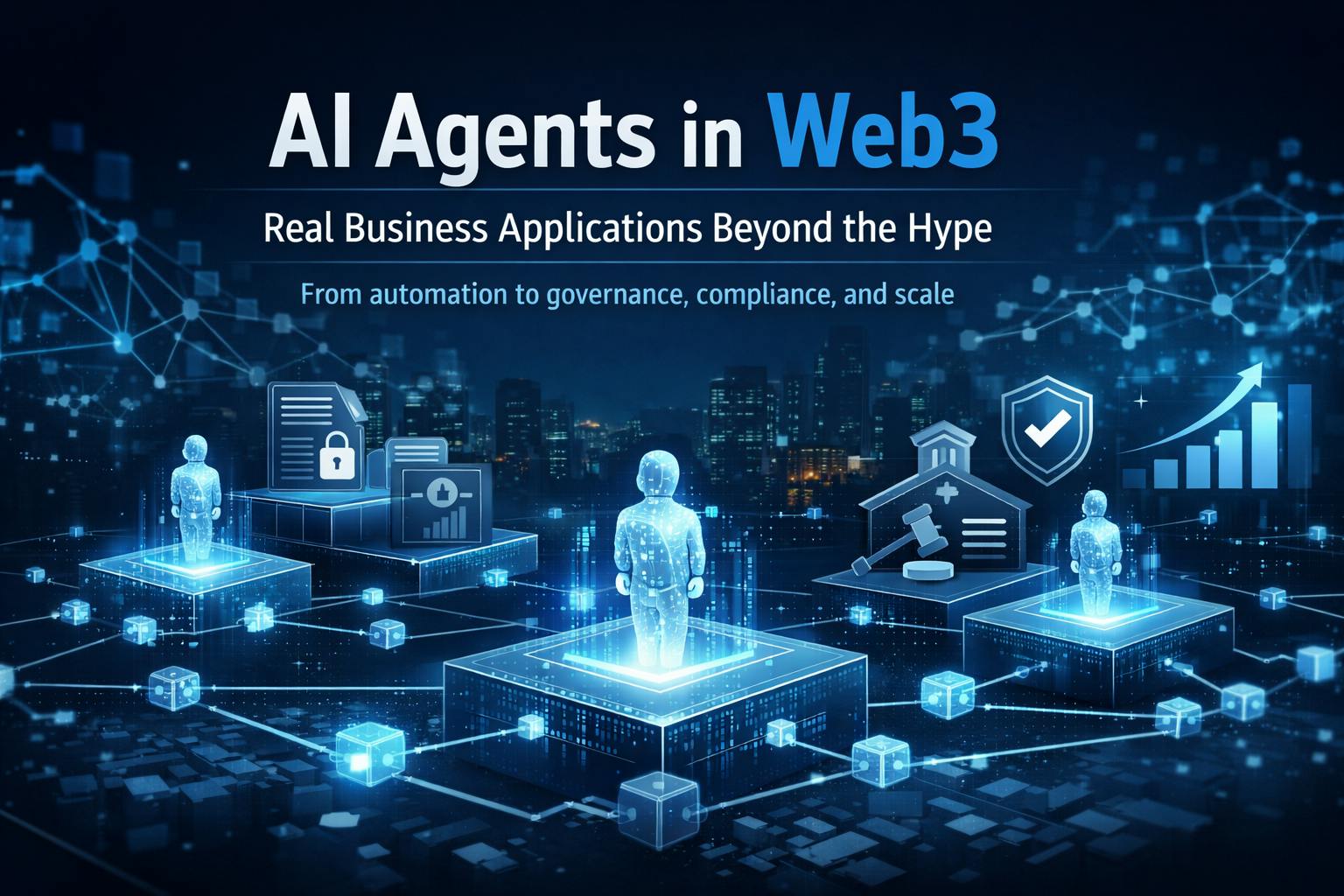
The fusion of AI integration for blockchain with decentralized systems is rapidly moving from academic theory to real business impact. In the last week, Ethereum introduced a new AI agent economy standard designed to make intelligent code interact more efficiently with smart contracts. Market data suggests that the global AI agents market in the year 2025 is estimated at $7.84 billion and is expected to reach around $53.62 billion by 2030, growing at a CAGR of 46.3%, proving the market demand for agent-based automation across industries.
For enterprises looking to introduce decentralized innovation, tapping a generative AI development company or investing in professional AI consulting services could unlock future practical applications for anything beyond a pilot experiment. In this blog, we will focus on real-world applications of AI agents for Web3 and architectural choices augmenting these claims to viability in production.
How AI Agents Solve Real Web3 Problems and Drive Business Impact
Web3 platforms are undergoing a struggle not for lack of innovation, but in dealing with operational complexity, slow decision-making, and minimal automation. To tackle these challenges, AI agents are introduced into decentralized workflows.
Reducing Operational Complexity in Web3 Systems
Managing decentralized applications usually involves coordination between multiple protocols, data sources, and governance rules. AI integration for blockchain simplifies this by enabling agents to:
Managing decentralized applications need to interact with multiple protocols, data sources, and governance rules. The integration of AI technology in blockchain simplifies the operational activities by enabling the following agents to:
- Keep track of data on-chain and off-chain at all times
- Act on predefined operational decisions in an automated way
- Make certain that intelligent agents orchestrate actions between smart contracts & APIs
This reduces manual oversight while improving system reliability.
In addition, such a technique can reduce the manual supervision over on-chain conditions and improve system reliability.
Enabling Faster and Smarter Decision-Making
Traditional Web3 governance and execution models are reactive. AI agents help transform decision-making into proactive analyses since agents can:
- Analyze large quantities of blockchain data on a real-time basis
- Implementing patterns that signal risk or opportunity
- Automating actions with appropriate intent based on business or compliance rules
It allows decentralized platforms to be more agile yet maintain control.
Enhanced Security, Risk Management, and Compliance
The primary challenges in adopting Web3 are security and regulatory compliance. AI agents can lend assistance by:
- Identifying abnormal wallet behaviors and transaction patterns
- Facilitating automated AML and monitoring risk workflows
- Implementing policy-based execution processes that align with enforced regulatory compliance
When guided by strong AI consulting services, these agents function like state-of-the-art guards within clear boundaries of mitigating technical and regulatory risks.
Scaling Web3 Platforms Without Centralized Control
As Web3 platforms grow, manual intervention does not scale. AI agents provide:
- Autonomous executions can adapt to the growth of the platform
- Unwavering rule enforcement for users across markets
- More significant scalability without introducing any centralized dependencies
During the design and development phase of the decentralized AI system, collaboration with a generative AI development company becomes critical.
Real Business Use Cases of AI Agents in Web3
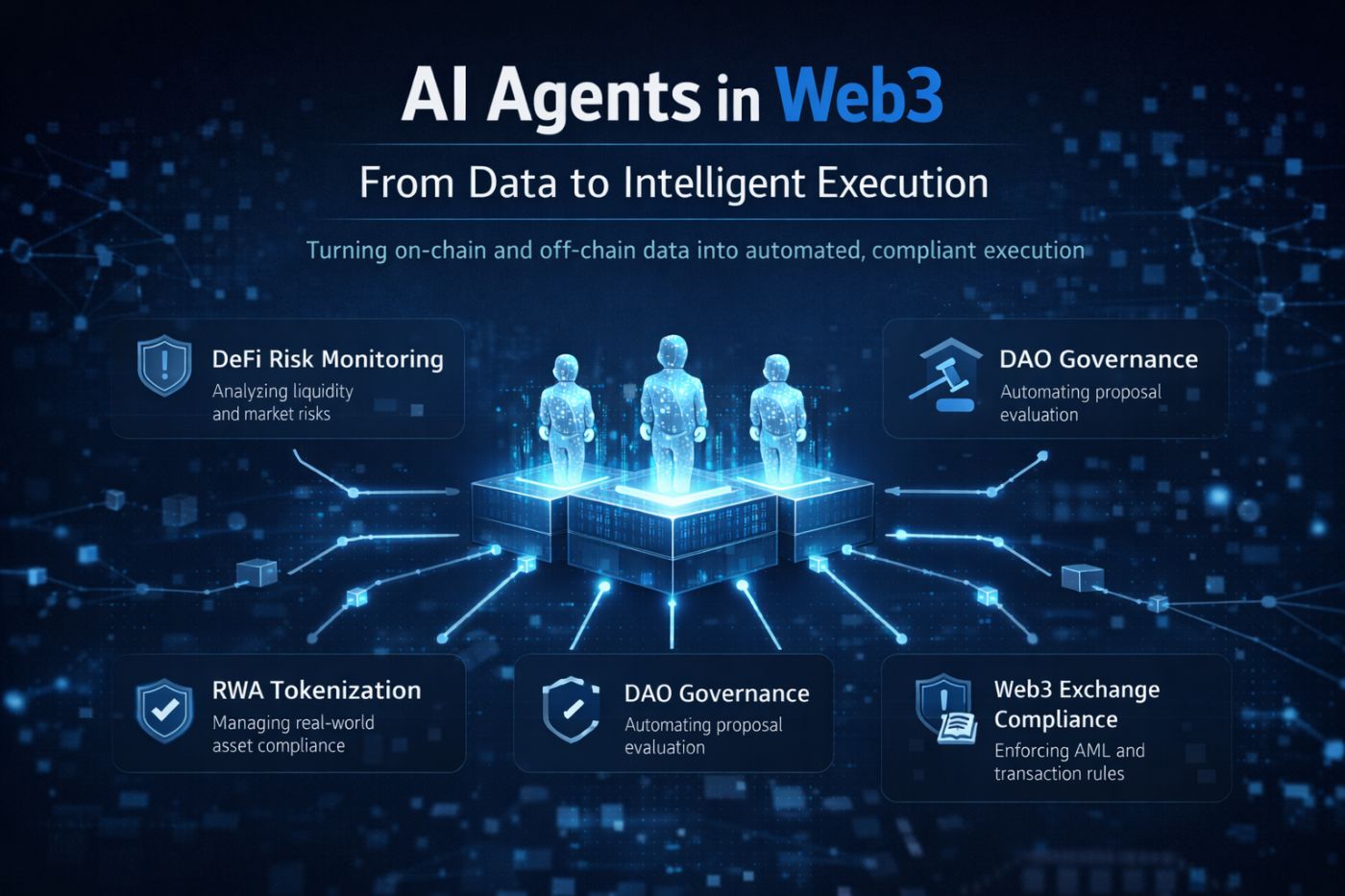
AI agents for Web3 are beyond the experimentation stage. They are being employed in production environments for automation, managing risk, and supporting optimal decisions. Use cases illustrate the effect of AI integration for blockchain to deliver clear business outcomes when it is supported by the right architecture and AI consulting services.
DeFi Risk Monitoring, Yield Optimization, and Capital Efficiency
AI applications in Web3 are exemplified by high-speed and volatility in the decentralized financing area. The applications of AI software agents include:
- Ongoing analysis of liquidity pools, price feeds, and oracle data
- Early recognition of risk signals, such as abnormal withdrawals or price manipulation
- Automated capital rebalancing protocols based on yield and risk thresholds
This would allow DeFi platforms to shift from reactive mitigants toward a more active risk management approach with capital efficiency.
DAO Governance and Decision Intelligence
Voter fatigue and limited data context are significant challenges in DAO governance. AI agents for Web3 improve governance by:
- Checking businesses' proposals against historical voting and economic performance data
- Simulate proposals to show and model uncertain financial and operational impacts
- Highlight risks for governance in mechanisms such as concentration of voting power
AI agents do not completely replace public participation but provide AI agents support for swifter decision-making.
RWA Tokenization and Asset Lifecycle Management
Real-world asset platforms can never be entirely handled with standard smart contracts for reasons of the basic complexity that they bring to their work. AI agents make scalable automation by:
- Overseeing asset valuation with market and financial data
- Running ongoing compliance checks based on jurisdictional laws
- Managing events related to the asset life cycle, such as interest payment, maturity, & transfers
For RWA platforms, AI integration for blockchain is paramount to achieve regulation-ready operations.
Web3 Exchanges, Compliance, and Market Surveillance
Indeed, intensified regulatory rules compel exchanges to fortify their cybersecurity and regulatory compliance efforts. AI solutions assist in this regard by:
- Detecting wash trading, spoofing, and transactions that show signs of being abnormal
- Monitoring wallet behavior for AML and concerns of fraud
- Triggering automated controls according to internal policies
This is where the professional AI consulting services ensure auditable and compliant automation.
Web3 Infrastructure and Operations Automation
AI agents are also transforming Web3 infrastructure, beyond financial use cases. The AI agents intervene in:
- Monitoring the functions of the nodes and the health of the network
- Automating incident detection and response
- Optimizing the gas usage and other execution efficiencies
All these capabilities have great potential to save on a lot of manual effort and thus improve platform reliability at scale.
Why Execution Matters More Than Models
Across these use cases, the AI model does not matter. It is all about the architecture. A capable generative AI development company focuses on the following:
- Secure interaction through transaction on-chain and off-chain
- Restricted autonomy with human oversight
- Transparent and explainable behavior of an agent
When properly designed, AI agents become a reliable execution layer rather than a new source of risk.
Architecture That Makes AI Agents for Web3 Production-Ready
Building AI agents is not just about deploying a cumbersome model and tying it to a smart contract; that's grossly inadequate for any upfront system. A production system must be designed with more balanced intelligence, decentralization, security, and compliance. This is where strong AI integration for blockchain becomes essential.
Data Layer: On-Chain and Off-Chain Intelligence
AI agents require continuous information from a variety of data sources to function. The data includes:
- On-chain data that handles transactions, state changes, and events
- Off-chain data, such as markets with data feeds, compliance rules, and external APIs
- Historical data for pattern learning and implementation
A properly designed data layer should ensure data accuracy, immediate access, and have a safeguard against any kind of tampering.
Intelligence Layer: Decision and Reasoning Engines
In the intelligence layer, AI agents gather data to make decisions. The job primarily entails:
- Machine learning models for prediction and anomaly detection
- Generative AI for reasoning and policy interpretation
- Rule-based systems to apply to the bounds of constraint and governance logic
The different components of this layer must tightly couple with business goals and the best AI consulting services.
Execution Layer: Smart Contracts and System Controls
AI agents do not directly act on the blockchain but through different controlled execution paths, such as;
- Smart contracts with well-defined permissions
- Policy engines and multi-signature controls
- Automated workflows triggered by agent decisions
This separation allows for bounded and auditable autonomy.
Governance and Oversight Layer
In real-world scenarios, AI agents are much safer if they have governance mechanisms:
- Involving human oversight for escalating high-risk activities.
- Transparent logs for explainability and audits
- Configurable rules for the regulation of changes
Any capable generative AI development company integrates these controls directly into the system at its inception.
Why Architecture Determines Success
Without the right architecture, AI agents tend to instigate more risk than value. With the right design, they grow and become a reliable execution layer for scalable, compliant Web3 platforms.
Best Practices for Adopting AI Agents in Web3
Developing AI agents for Web3 involves less training on advanced models and requires concentrating more on clear forward-leaning design and implementation choices. This results in the prompt deployment of AI agents and at the same time, minimizes the risks.
Start With a Clear Business Problem
AI agents should attempt to solve specific problems in the operational context and not exist as arbitrary tools. From a risk management framework or compliance automation to its rightful focus, radical clarity at the start ensures that AI integration for blockchain delivers measurable value.
Keep Autonomy Bounded
Allowing AI agents with an unlimited regulatory framework is a common mistake. The most effective systems set clear delineation lines by which the agents can execute low-risk decisions without human intervention, then escalate high-risk options to human oversight.
Design for Transparency from the Start
The degree to which AI may be explained is a critical issue in the Web3 context. One way is to keep detailed records of the decisions and actions of agents to enable auditing and insight for stakeholders. This builds trust and simplifies compliance.
Align AI With Governance and Compliance
The AI must support the very same rules that belong to the platform it is federated with. Solid AI consulting services are useful as they could enable the alignment of agent behavior with governance models, regulatory needs, and internal policies.
Choose the Right Development Partner
Choosing an experienced generative AI development company enables the positioning of AI agents on security, scalability, and decentralization rather than retrofitted later.
Implementing these best practices is the key in transforming businesses from experimenting with AI agents in a Web3 world into having highly reliable production entities.
Conclusion
AI agents for Web3 have moved far beyond experimentation to serve as an execution layer, practically inherent to decentralized platforms. This blog shows, real impact of AI integration for blockchain to solve logical, immediate risk management inefficiencies, governance efficiency, compliance and operational scalability. The value does not lie in the models alone but in clever architecture, bounded autonomy, and strong oversight. For enterprises and Web3 builders, success depends on reorienting technology to business goals by well-defined AI consulting services. By collaborating with an expert generative AI development company, one would ensure the top quality of these systems for security, transparency, and operability from the very beginning. As the ecosystem of Web3 expands and matures, AI agents are likely to add immense value to decentralized systems in making them substantial and operational at scale.
[story continues]
tags