The IT economy still relies heavily on COBOL (Common Business-Oriented Language), which powers 70% of global data processing—from banking and ATM transactions to tax processing and healthcare. With over 800 billion lines of code in active production, these systems form a critical foundation, yet they are increasingly at risk.
However, as the original engineers retire, organizations face a dangerous knowledge gap; modern developers find COBOL's procedural logic nearly impenetrable. To prevent these systems from becoming "black boxes," industry leaders are deploying AI Agents for legacy COBOL modernization. These agents function as translators, decoding legacy COBOL and converting it into modern, maintainable code, bridging the 60-year gap between mainframes and today’s software stack.
In this blog, we’ll explore AI coding agents, such as GitHub Copilot, to address the skills gap crisis, reverse-engineer opaque business logic, and de-risk the transition from legacy mainframes to modern cloud architectures.
How AI Coding Agents like GitHub Copilot Help With COBOL and Mainframe Modernization
According to Julia Kordick, a Microsoft Global Black Belt, COBOL or mainframe modernization can be done without learning COBOL. Sounds remarkable, yet confusing?
She emphasized a structured legacy system modernization approach that leverages AI coding agents to support all mainframe modernization projects, including COBOL.
Phase 1: Reverse Engineering
COBOL modernization begins with understanding what the legacy code does—a problem that every organization faces. Even though they are still using legacy code and building workflows around it, they’ve lost sight of its purpose. AI agents reverse-engineering legacy systems
This is where AI Agents reverse-engineer legacy systems. They:
- Extract business logic from legacy
- Document the analysis in the desired markdown for review
- Identify dependencies
- Eliminate unnecessary comments and change logs
- Provide supplemental information/explanations as comments wherever needed
Here is a sample of business logic and preliminary analysis generated by GitHub Copilot: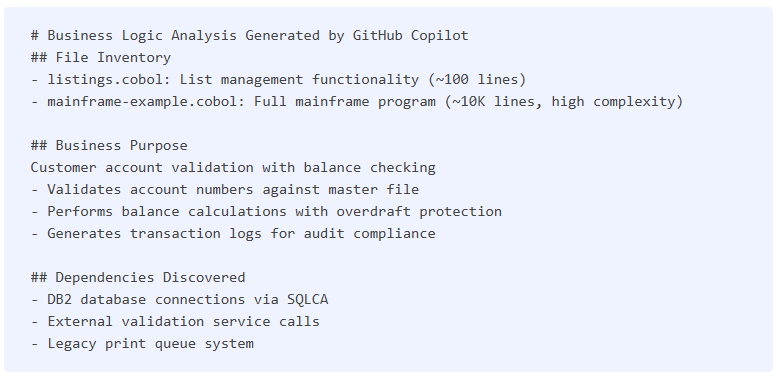
Phase 2: Enrichment
For further processing, this analysis/understanding is supplemented with additional content to help other AI coding agents better understand your requirement. This could require:
Translation: AI coding agents are better with English context. If your COBOL code contains other languages, use GitHub Copilot to translate it. Structural Changes: COBOL systems follow specific patterns that can be deduced even without knowing this language. You can instruct GitHub Copilot to follow the same
- Identification - Metadata
- Environment - Files & Systems
- Data - Variable & Data
- Procedure - Actual Business Logic
Ask AI coding agents, such as GitHub Copilot, to map these divisions. This is achievable by using prompts like: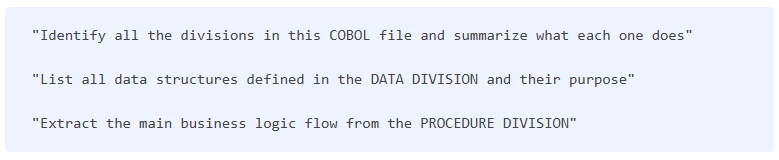
Save the enriched context as markdown files for future reference.
The Plus Point: GitHub Copilot is highly verbose. Straightforward prompts like “enrich with total sales data or add annual revenue details” are almost self-documenting.
Phase 3: Repeat and Scale with Legacy System Tools for Automation
Once you have understood the business logic and enriched it with context, shift from using GitHub Copilot as a conversational assistant to relying on it as an AI coding agent that builds mainframe modernization workflows.
Use multiple AI coding agents and manage them using Microsoft Semantic Kernel. Assign specific tasks to each AI Agent:
- Map Call Chains: Have one AI coding agent read your COBOL, another to evaluate CALL statements, and another to generate diagrams for file interactions. With simultaneous processing, you will produce a map of the entire system.
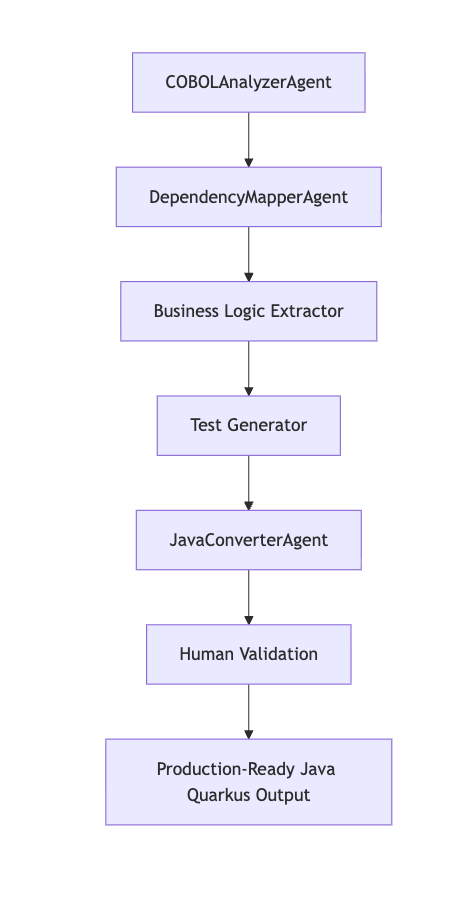
- Mainframe Modernization: An agent extracts actual logic, 2nd agent generates test cases, and 3rd generates rewritten code to pass those test cases.
- Dependency Optimization: An AI coding agent can identify all libraries and classes that require replacement with modern equivalents. The other will replace them.
While the above process is pretty much automated, always have a human expert validate and approve the modernized code generated by GitHub Copilot or any other AI coding agent.
GitHub Copilot AI Agents Workflow
 Benefits of Deploying AI Agents for Legacy COBOL Modernization**
Deploying AI coding agents like GitHub Copilot brings several benefits:
Reduced in Discovery Timelines
Traditional discovery timelines, in which developers manually analyzed legacy code to understand system behavior, averaged 8-12 months. This comes down to a few days and weeks when you use AI coding agents for COBOL modernization.
Better Functional Equivalence
The biggest fear in a mainframe modernization project is that the new system won't "act" like the old one. But AI coding agents like GitHub Copilot excel at generating comprehensive unit tests based on inferred legacy logic. Modernized COBOL code that passes these tests serves as a safety net and ultimately the modern counterpart.
Improved Cost Efficiency
Most companies partner with a legacy application modernization company or hire consultants for legacy work because in-house teams often lack COBOL skills. However, when you leverage AI agents for COBOL modernization, you get digital co-workers who act as force multipliers.
Architectural Transformation
Basic AI legacy system tools work as simple translators. However, AI coding agents re-architect legacy logic from scratch and often refactor it into reversible units or microservices. This architectural upgrade enhances your IT system and does not merely translate the code.
The Flip Side: AI Coding Agents are Still Not 100% There
Although AI coding agents like GitHub Copilot automate the mainframe modernization process, some steps still require manual, strategic navigation. This is because:
Lack of “Tribal Knowledge”
While AI coding agents read legacy COBOL, they cannot read the purpose. Several legacy COBOL systems have functions and logic that’s undocument and based on ‘workarounds’ that are probably 30 years old.
The “JOBOL” Problem
Literal translation of COBOL code often results in JOBOL—Java code that follows COBOL patterns line-by-line. Without proper validation and specific structural changes, this code becomes as challenging to maintain as the original mainframe code. [Source: IBM Research]
Inherent Gaps
Currently, AI Agents are designed to handle multi-step transactions as “continuous workflows” without a transaction coordinator (TC) to manage estate transactions for each task in the chain. If the AI coding agent crashes mid-task, the entire chain breaks, and the consequences can be adverse and irreversible.
According to Google Research, this is only resolved when atomicity/granularity are emphasized as Agentic AI infrastructure requirements. Until then, there must be guardrails to undo Agentic actions and convert the entire multi-step process into reversible tasks.
Key Takeaways:
- Human experts (not necessarily in COBOL) must remain part of this process to ensure thorough QA and validation.
- Each COBOL modernization project is unique—the above is not a one-size-fits-all workflow.
- The IT economy is still in the early (largely experimental) stages of Agentic AI—don’t trust AI coding agents blindly (not even GitHub Copilot).
- 100% automation and autonomy are at least half a decade away.
Wrapping Up
The COBOL problem has persisted for years and is often viewed as a ticking time bomb, especially when you lack COBOL fluency. But with AI coding agents, you don’t need this level of fluency for COBOL modernization. These AI Agents can analyze outdated code, extract legacy logic, and rewrite it in any modern programming language of your choice.
Using AI agents for COBOL modernization will not only help you survive in the modern tech space but also help you reclaim decades of business intelligence, making it accessible to the newer generation of engineers who will manage your systems in the future. You can either integrate agents like GitHub Copilot or hire AI Agent developers to build custom agents for your modernization project.
[story continues]
tags