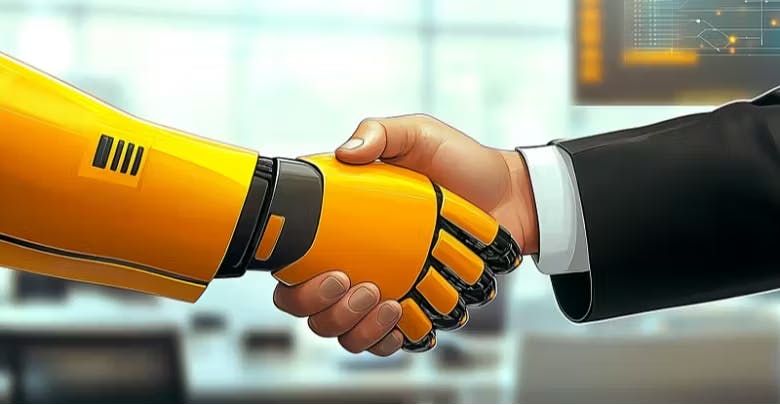
Revolutionary advances in artificial intelligence have significantly transformed many aspects of daily life and the workflow: from automating routine tasks to developing complex algorithms capable of making decisions based on a vast amount of data. These changes have not only provided new opportunities but have also sparked a wave of concern about the future of jobs.
The question of how technological progress affects the labor market is not new. However, with the development of AI, debates have become more intense, as automation begins to affect professions traditionally considered exclusively human. We are on the threshold of an era where AI can analyze big data, make strategic decisions, and even manage teams, raising questions about the necessity for traditional managerial roles. In this article, I will share my opinion on whether leaders can lose their jobs due to AI.
How AI Changes the Workplace
AI has already penetrated various industries and helped transform ways of doing business, manufacturing, customer service, and much more. I suggest looking at the benefits artificial intelligence provides in specific areas:
- Starting with healthcare. Machine learning algorithms are actively used to analyze patient medical data and predict the risks of developing diseases. AI also assists in developing personalized treatment plans based on genetic information and other characteristics of the patient.
- Finance. AI enables the automation of trading operations in financial markets using pre-set instructions based on data and trend analysis. Moreover, AI is applied to assess clients’ creditworthiness, helping banks and credit organizations reduce risks.
- Retail. Artificial intelligence personalizes companies’ offerings, thanks to analyzing customer behavior and their preferences.
- Manufacturing. The use of sensors and data analysis helps predict the need for equipment maintenance before failures occur. AI also assists in automating complex manufacturing processes and optimizing them to improve efficiency and reduce costs.
AI plays a key role in optimizing company processes. Automating routine tasks, reducing the time for operations, and improving the quality of decisions allow organizations to focus on strategic planning, enhance competitiveness, and efficiency. But all these advantages pale when it comes to risks. Many leaders worry that if AI could replace operational specialists, it might soon displace them too. We will discuss whether this is possible in the next chapter.
Threats and Opportunities for Leaders
Let me say right away—I am not convinced that the integration of artificial intelligence into the business sphere can deprive leaders of their positions. On the contrary, generative models and tools based on AI can significantly increase the productivity of leaders. Management is a task that requires not only specific knowledge but also the ability to adapt and create structured work processes. This is what is expected from managerial positions today.
One of the main responsibilities of a leader is to form an effective structure for a department or organization as a whole. In this process, AI can become an indispensable assistant:
– simplify work with documentation;
– facilitate the search for necessary information;
– streamline the drafting of job instructions, and so on.
Leaders also need to be able to effectively convey their ideas to the team and present them in the form of presentations. Here too, AI can help—it can significantly reduce preparation time, increasing work efficiency fourfold thanks to automation of routine tasks.
Neural networks can keep minutes of meetings, highlight key points, and create reminders, enhancing communication efficiency within the team. With the development of technologies, many new tools appear that simplify the monitoring and analysis of key performance indicators.
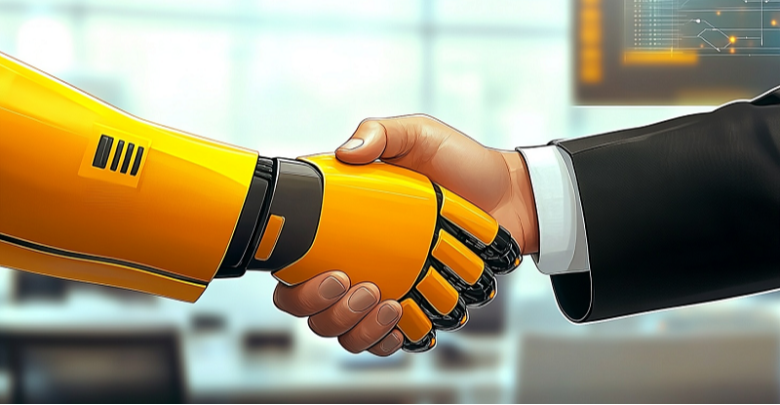
Despite all the functions listed for AI, it cannot replace a leader. It is incapable of substituting a human in terms of forming a team, maintaining motivation, determination of employees, and much more—only a human can do this.
However, it’s important to understand that the competence of a leader plays a key role here. Modern managers must know how to use AI tools to be effective in their positions. The ability to use professional tools proficiently directly affects productivity and success in the modern business world. Those who adapt to new technologies faster gain a significant competitive advantage. How to do this, I will tell in the next chapter.
How Leaders Can Adapt to Changes
I will talk about two examples of successful AI implementation in large companies to clearly demonstrate the need to adapt to technological changes:
- Microsoft under the leadership of Satya Nadella. He took over as CEO of Microsoft in February 2014 and played a key role in transforming the company. Under his leadership, Microsoft focused on the development of cloud technologies and AI, leading to significant revenue growth and strengthening the company’s position in the global market.
For example, Satya Nadella introduced Microsoft Azure—a cloud computing platform. It has become one of the main drivers of growth. Azure provides a wide range of cloud services, including computing, analytics, storage, and networking capabilities, allowing companies to deploy and scale their applications and services with greater efficiency and flexibility. Under Nadella’s leadership, Microsoft actively expanded its portfolio of cloud products and services, making Azure one of the leading cloud providers alongside Amazon Web Services and Google Cloud Platform.
- Another example is Tesla and SpaceX under the leadership of Elon Musk. This is one of the most vivid examples of the impact of innovative thinking and focus on artificial intelligence (AI) development. For instance, automating production lines and implementing robotic systems in Tesla significantly increased the efficiency of assembling cars. The Starlink project at SpaceX involves launching thousands of small satellites, which will provide access to high-speed internet in the most remote corners of the planet.
In an era of rapid development of artificial intelligence and automation, leaders need to develop new skills to maintain their competitiveness in the job market. Companies like Microsoft, Tesla, and SpaceX demonstrate this best. I believe there are several key skills that allow for effective adaptation to new technologies:
- Analytical skills. The ability to analyze large volumes of data and extract valuable insights for decision-making.
- Critical thinking and problem-solving. The skill to quickly and efficiently solve problems in conditions of uncertainty, as well as a critical approach to conclusions based on data analysis.
- Flexibility and adaptability. Readiness for continuous learning and adapting to new technologies and working conditions.
Today, you have all the tools for adapting to changes. For example, online platforms like Coursera, edX, and Udacity offer courses on AI, from introductions to advanced topics. You can also participate in industry events to stay up to date with the latest trends or work with a coach who has experience in AI. And don’t forget about self-learning! Creating your own projects using AI to solve real problems can be a powerful incentive for studying and applying new knowledge.
Adapting to new technologies is not a one-time process; it requires continuous learning and development. But if you are flexible and can integrate AI into your work, I assure you, no artificial intelligence can replace you.
[story continues]
tags