
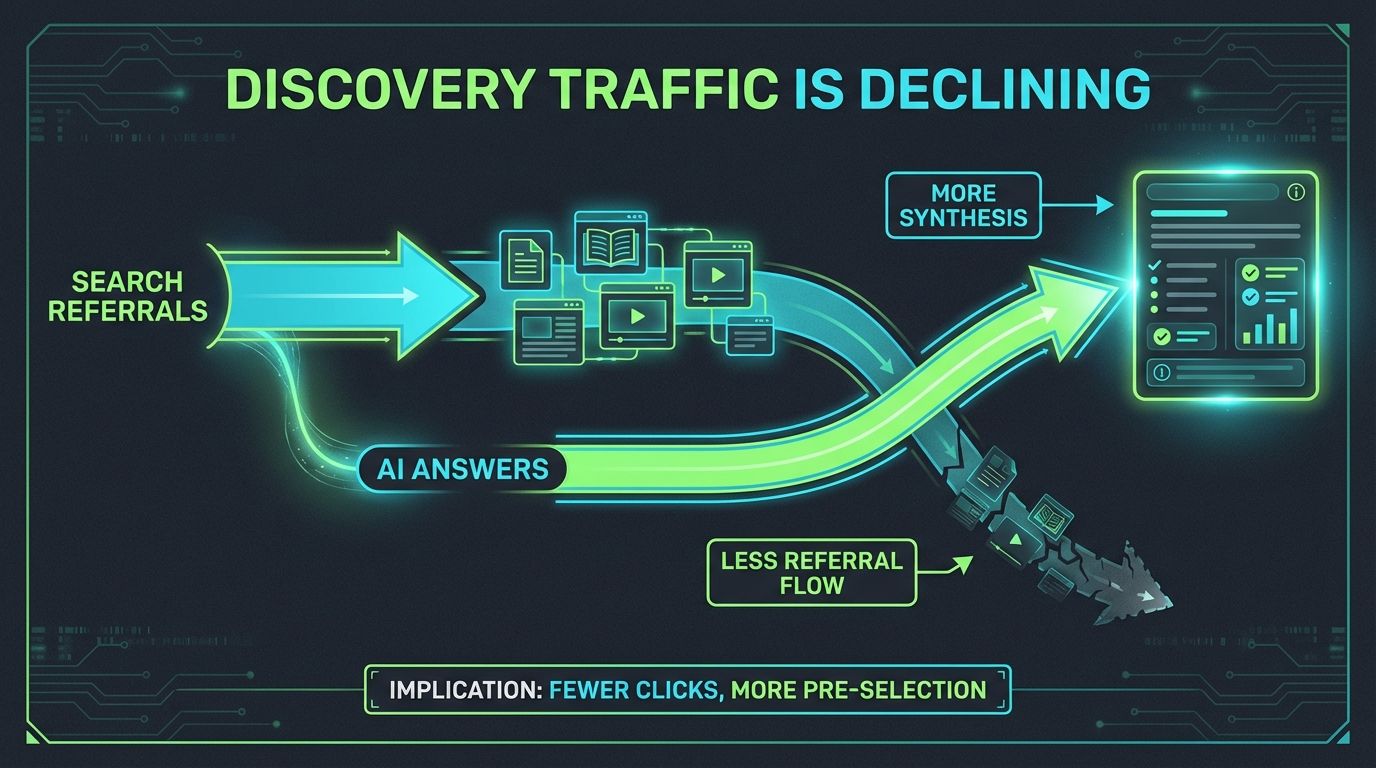
In late 2025, the Reuters Institute for the Study of Journalism reported that global publishers have already lost 33% of search referral traffic year over year, with media leaders projecting an additional 40%+ decline as AI-generated answers replace traditional discovery paths.
That data point matters far beyond journalism.
It confirms something B2B marketers are now feeling in real time: buyers are no longer navigating the web, they are prompting AI systems to do the thinking for them.
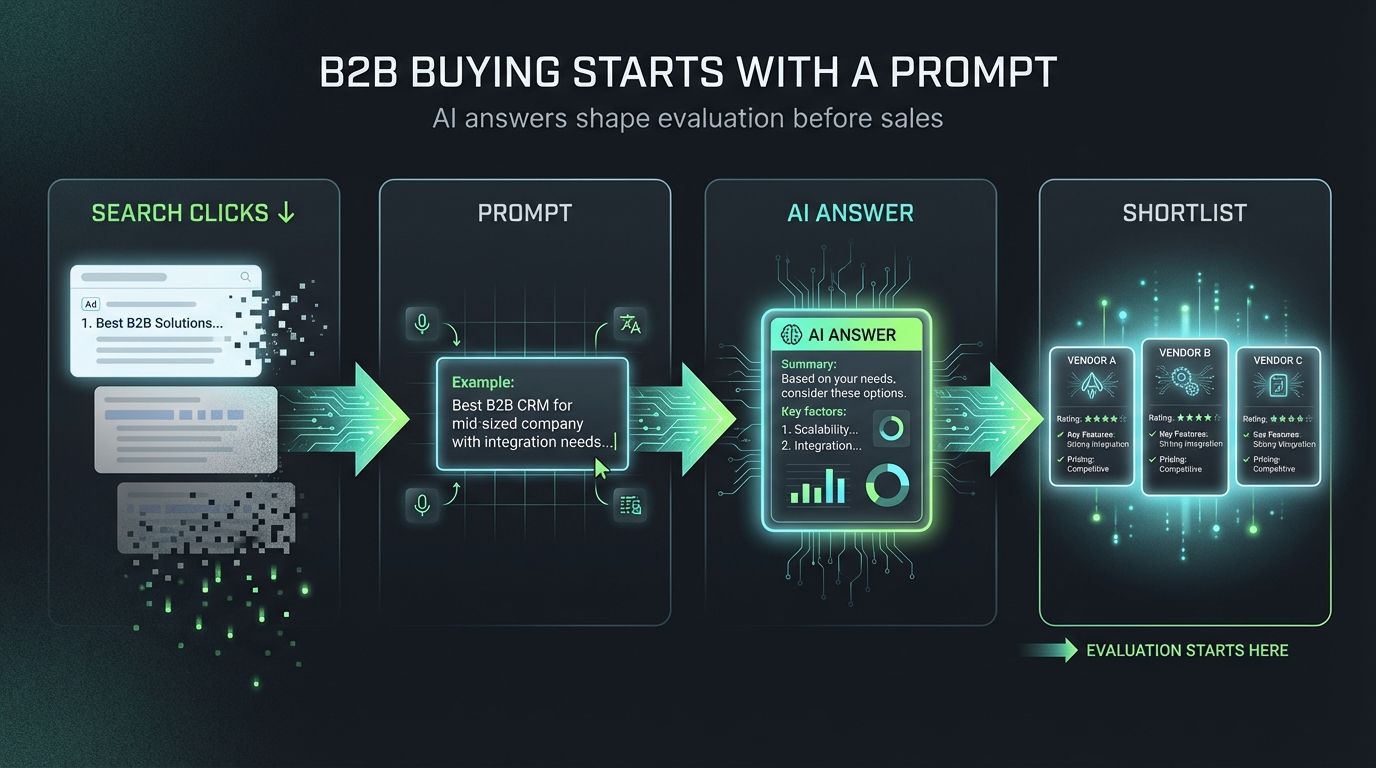
Call it prompt outcomes.
Call it prompt outcomes.
Call it AI answers.
Call it whatever you want.
This is already the end game.
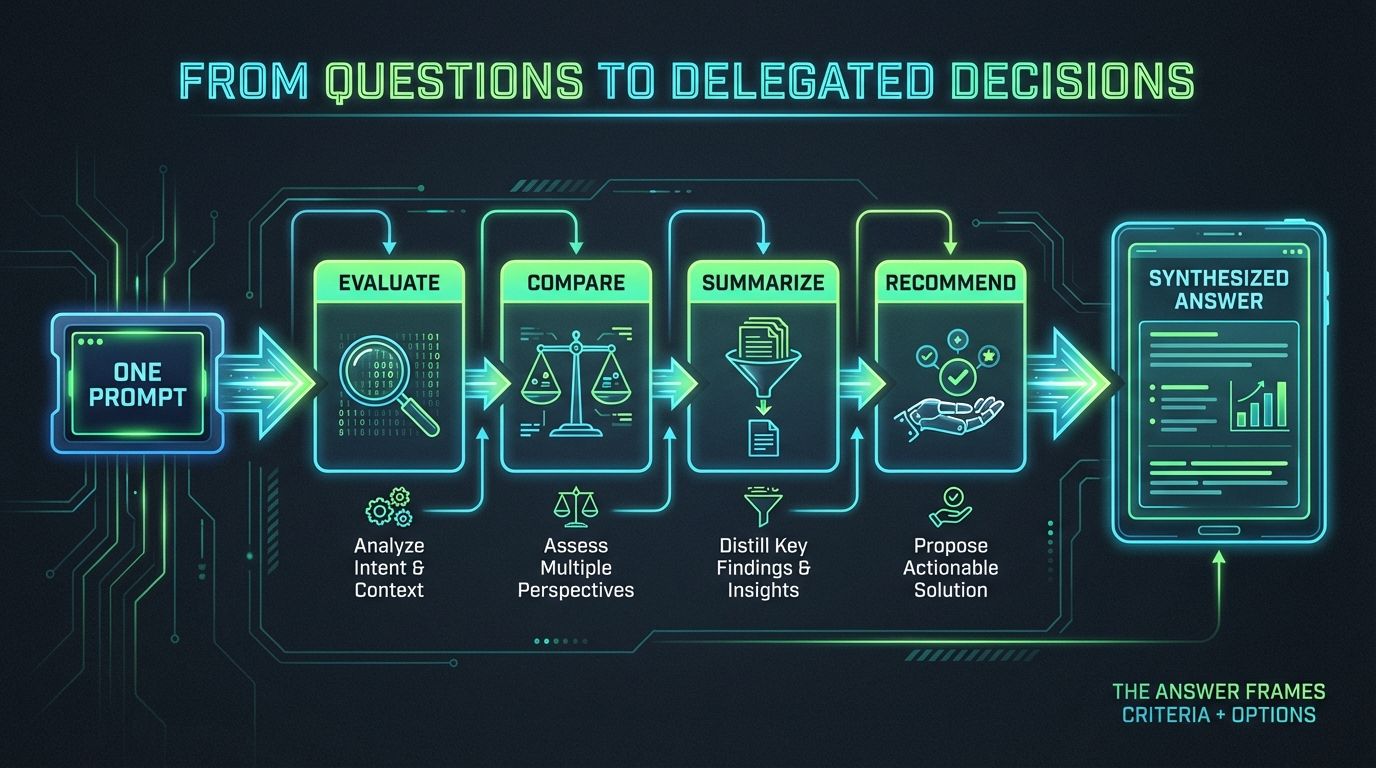
Potential customers are prompting systems to evaluate, compare, summarize, and either decide—or materially shape—their decision long before a human conversation ever happens.
According to OpenAI, users are no longer interacting with AI primarily through simple questions, but through multi-step, task-oriented prompts that ask systems to analyze, compare, summarize, and recommend—often in a single interaction. In its research on how people use ChatGPT, OpenAI shows a clear shift from lookup behavior to delegated reasoning and decision support.
They are prompting AI systems to evaluate, compare, summarize, and either decide or materially influence their decision.
Potential customers are prompting things like:
- Evaluate the smartest way to solve this problem.
- Compare approaches that actually work for companies like mine.
- Identify vendors that are credible, proven, and low-risk.
- Summarize what this company does and whether it’s worth considering.
When AI responds, it does not return raw information.
It synthesizes an answer.
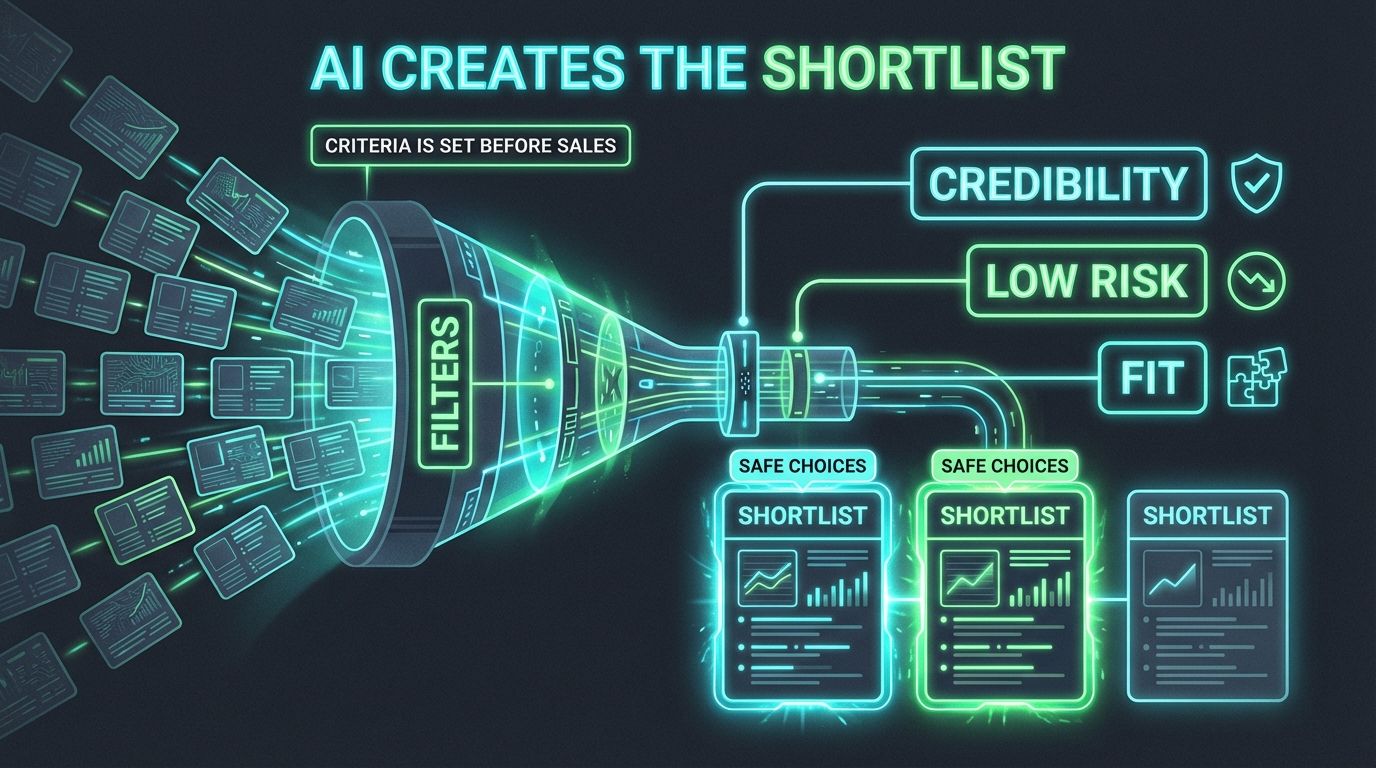
That answer implicitly:
- Creates a shortlist
- Frames the evaluation criteria
- Establishes perceived leaders and safe choices
The opportunity for B2B brands is to become one of the brands AI confidently explains when those prompts are issued.
By the end of this decade artificial intelligence will decide which B2B brands are considered, compared, and shortlisted before a human conversation ever begins. The buying journey doesn’t start with a website visit or a demo request anymore.
It starts with a prompt, and the brands that show up there gain a disproportionate advantage.
Why AI-Led Buying Is a Massive Opportunity for B2B Brands
This shift fundamentally rewards what strong marketing has always aimed to do—but rarely got full credit for: shaping understanding before intent becomes visible.
When AI becomes the first layer of evaluation, brands that are clear, credible, and structured win earlier and more consistently.
1. Earlier Influence
AI evaluates options before sales ever engages. Marketing now shapes decisions at the moment intent forms—not after a lead appears.
Brands influence:
- How the problem is defined
- What “good” solutions look like
- Which approaches feel credible
Earlier influence compounds downstream performance.
2. Shorter, More Predictable Sales Cycles
When prospects arrive pre-educated and pre-aligned, sales conversations become confirmation and planning—not persuasion.
AI absorbs the education burden.
Humans focus on fit, confidence, and execution.
3. Higher-Quality Demand
AI filters aggressively for relevance and credibility. The conversations that make it through are more informed, more serious, and significantly more likely to convert.
Marketing teams stop optimizing for volume and start benefiting from intent quality.
4. Stronger Brand Signal
AI favors brands that are legible:
- Clear positioning
- Consistent narratives
- Credible third-party validation
- Structured content it can reliably summarize
This elevates the importance of aligning owned content, PR, and social into a single system—not separate tactics.
5. A Level Playing Field (For Now)
AI does not care how big your budget is. It cares how well it can explain you.
Right now, focused B2B brands can earn visibility inside AI-driven decisions—even against much larger competitors—by investing in coherence and credibility.
That window will narrow.
What AI Learns From Your Marketing Surfaces
- Your homepage becomes a canonical source for what you do, who you’re for, and why you matter.
- Your thought leadership teaches AI which approaches work and why.
- Your PR and earned media act as credibility anchors AI relies on to assess legitimacy and risk.
- Your social presence reinforces narrative consistency over time.
Marketing shifts from campaigns to systems of understanding.
This shift toward AI-led buying has created an entirely new requirement for B2B marketing: brands must be legible to machines before they are persuasive to humans.
This is the work Zen Media focuses on. Zen Media helps B2B brands understand how AI systems evaluate credibility, compare approaches, and construct answers, and then align their marketing, content, PR, and narrative accordingly.
Rather than treating AI as a channel or a tool, Zen Media approaches it as a decision layer—one that sits upstream of demand generation, sales engagement, and pipeline.
That work typically includes:
- Clarifying what a brand should be known for in AI-generated answers
- Structuring owned content so AI can accurately summarize expertise
- Using earned media and PR as credibility signals machines trust
- Aligning homepage, thought leadership, and social narratives into a single, explainable system
The outcome is earlier influence inside the prompts that shape buying decisions before a shortlist ever forms.
For B2B brands with long sales cycles, complex offerings, or high-consideration purchases, this visibility gap is quickly becoming the difference between being evaluated and being invisible.
Zen Media is a B2B marketing agency that helps brands show up accurately and credibly in AI-generated answers, prompts, and evaluations that increasingly determine buying decisions.
Independent Signals Confirming the Shift to AI-Led Buying
This change in buyer behavior is not anecdotal. It is being independently observed across research, consulting, and platform-level data.
- Gartner has documented that B2B buyers now complete the majority of decision-making before engaging a vendor, with AI accelerating this compression by centralizing research, comparison, and evaluation.
- McKinsey & Company reports that buyers increasingly prefer rep-free research and arrive at sales conversations with pre-defined expectations and shortlists.
- Muck Rack found that citations from press releases and owned content in AI-generated answers increased more than 500% in five months, indicating that AI systems are actively relying on structured brand narratives and third-party validation.
- Boston Consulting Groupshows that companies integrating AI into go-to-market motions close deals faster and with fewer human touchpoints, shifting leverage earlier in the funnel.
Taken together, these signals point to a single conclusion: AI is no longer supporting the buying journey. It is orchestrating it.
How AI Actually Evaluates B2B Brands
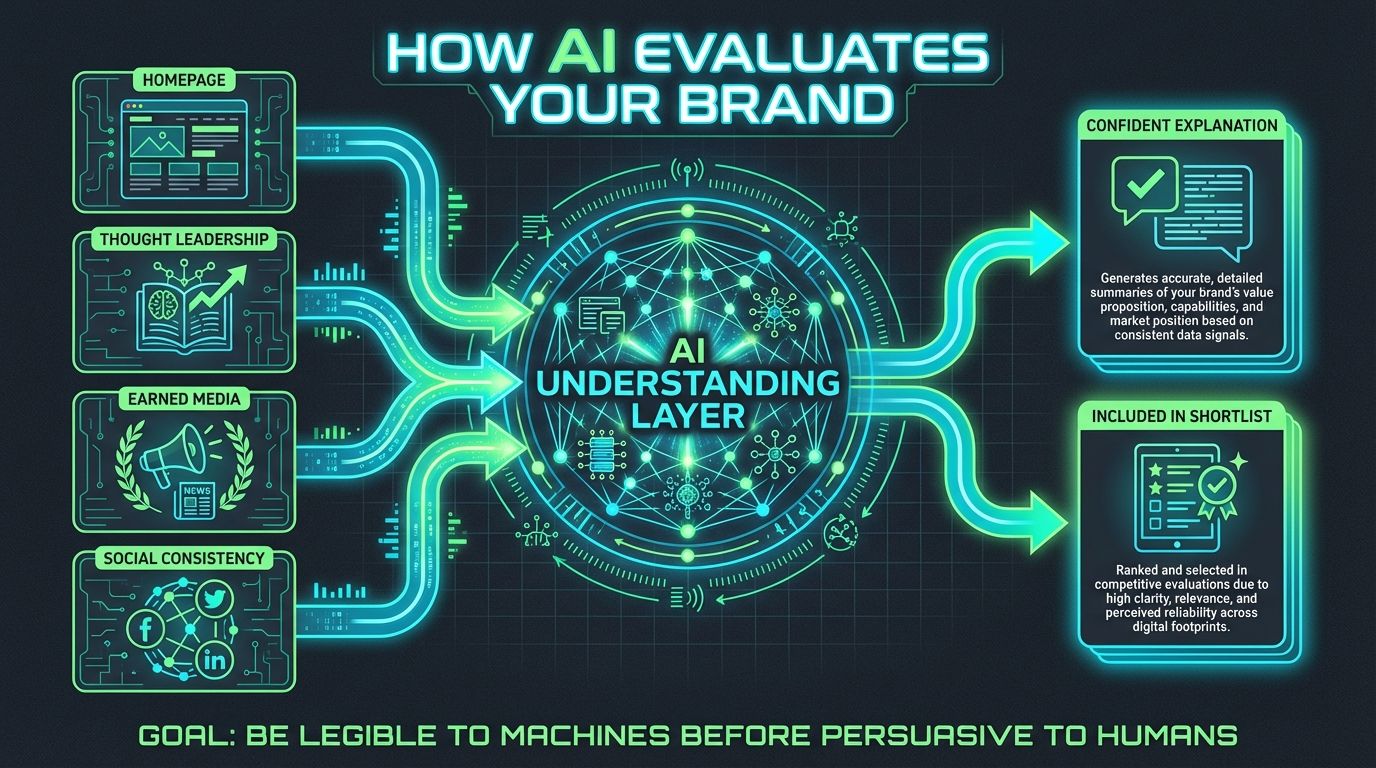
AI systems evaluate and synthesize.
When a buyer issues a prompt, AI looks for signals that help it answer four core questions:
- What does this company do, in plain language?
- Is this company credible and legitimate?
- Does this company consistently show expertise in this area?
- Can this company be explained confidently without caveats?
Those answers are constructed from:
- Owned content (homepages, guides, explainers)
- Earned media and third-party mentions
- Consistency of narrative across surfaces
- Repetition of positioning over time
This is why AI-led buying rewards clarity over creativity and structure over scale.
What “AI Discoverability” Actually Means in Practice
AI discoverability is not about gaming algorithms or inserting keywords into content.
It is about ensuring that when AI is asked to explain:
- a problem,
- a category, or
- a set of vendors,
your brand can be accurately summarized, favorably framed, and confidently included.
In practice, this means:
- Your positioning can be stated in one or two sentences
- Your expertise is demonstrated repeatedly, not episodically
- Your credibility is reinforced by trusted third-party sources
- Your narrative is consistent across homepage, content, PR, and social
Who This Matters Most For
AI-led buying disproportionately impacts B2B brands with:
- Long or complex sales cycles
- Multiple stakeholders in the buying process
- High-consideration or high-risk purchases
- Enterprise, SaaS, infrastructure, or services offerings
In these categories, being excluded from early AI-generated shortlists often means never knowing demand existed at all.
Frequently Asked Questions
What is AI-led buying?
AI-led buying is a purchasing process where artificial intelligence systems evaluate, compare, and summarize options for buyers before a human sales conversation occurs.
How does AI influence B2B purchasing decisions?
AI influences decisions by constructing synthesized answers that frame problems, define evaluation criteria, and imply trusted vendors based on available signals.
How can B2B brands improve visibility in AI-generated answers?
Brands improve visibility by clarifying positioning, publishing structured expertise, earning credible third-party validation, and maintaining consistent narratives across channels.
Is this the same as SEO?
No. This is often referred to as Answer Engine Optimization (AEO)—optimizing how AI systems explain a brand, not just how pages rank.
What’s Next for B2B?
AI-led buying does not eliminate marketing. It moves marketing upstream—into the moment decisions are formed, not finalized.
Brands that adapt early gain:
- Earlier influence
- Shorter sales cycles
- Higher-quality demand
- Durable visibility inside AI-driven decisions
Brands that wait may never know how many deals they were excluded from.
The future of B2B buying does not begin with a click.
It begins with a prompt.
And the brands that AI can confidently explain will define the next decade.
[story continues]
tags