I'll be honest. The first time I heard “vibe coding,” I rolled my eyes a little.
It sounded like something a 22-year-old developer coined after too much coffee and a Cursor subscription. But then I sat with it. And then I actually tried it.
And let me tell you, my early experience was underwhelming in a different way. Unlike Java, where “Hello, World!” required setting up the JDK, configuring the classpath, wrestling with the IDE for hours just to print two words. AI has almost no setup friction. You’re in a chat window in seconds. That’s not the problem.
The problem is that the early outputs feel like a glorified search engine. Generic. Fluffy. Confidently wrong about your domain. I’d prompt it about a cybersecurity feature and get something that sounded like a product brochure written by someone who’d read exactly one Wikipedia article about zero trust. I was underwhelmed. Not because it was hard to start. Because nothing I got back was actually useful yet.
But I kept going. And somewhere on the other side of that initial friction, things shifted. Dramatically. My outcomes changed. I was solving customer pain points with more precision than I had before, and I started seeing it in the adoption metrics. Almost everything I shipped from that point was landing. Customers were actually using it, getting value from it, coming back for more. And once I understood what was actually driving that quality gap, I couldn’t unsee it. This is a product management inflection point. The PMs who dismiss it as a dev buzzword are going to feel it in about 18 months.
Let me explain what I mean, especially from where I sit, in the trenches of Enterprise Cybersecurity product management, where the stakes are high, the domain is dense, and “move fast and break things” has never been an acceptable philosophy.
First: What Does Vibe Coding Actually Mean for a PM?
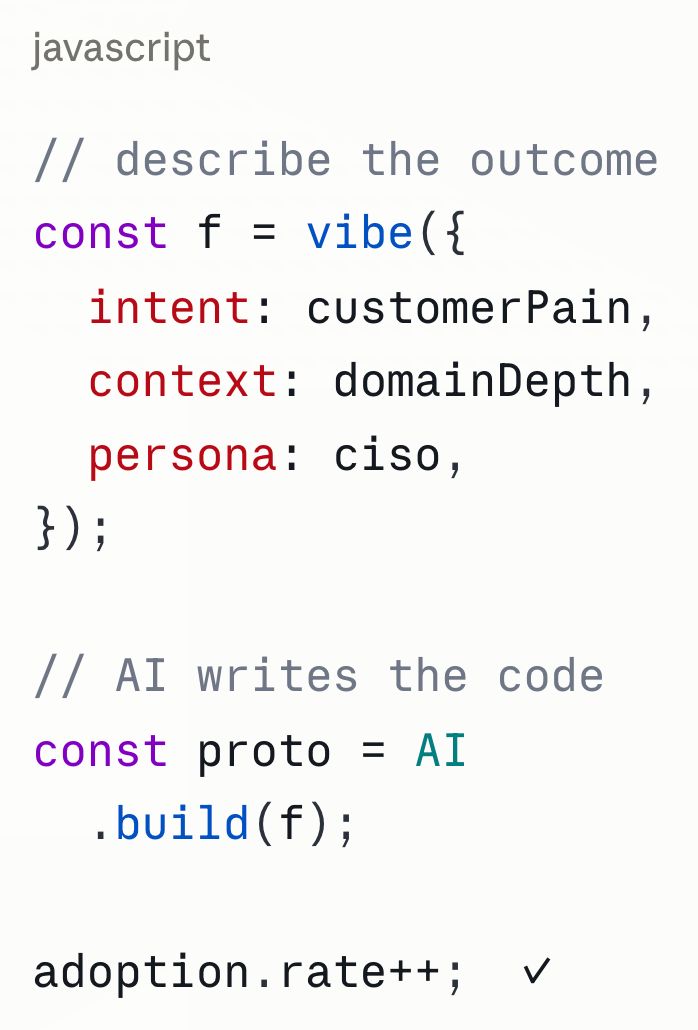
For developers, vibe coding is roughly this: describe what you want in natural language, let the AI generate the code, iterate with prompts until it works. Less syntax obsession, more intent-driven creation. The “vibe” is your mental model of the outcome, and the AI does the translation.
For product managers, we don’t traditionally write code. But vibe coding changes what’s possible for us, and it goes beyond just setting context.
On one level, yes. We’ve always been in the business of translating intent. We set the product vision and translate it into strategy and roadmap. We translate a CEO’s business goals and revenue targets into product bets. We translate customer pain into prioritized decisions. We’ve always been the language layer between humans and systems.
But vibe coding adds a new dimension: I can now describe what I want a customer experience to feel like, what outcome I want a specific persona to reach. The system will write the code to show it. Not a wireframe. Not a spec document. An actual working prototype that I built by expressing intent in plain language. That’s genuinely new. For the first time, a PM can go from customer insight to something tangible, something a real user can click through, without waiting for an engineer to have bandwidth.
So when vibe coding enters the picture, the question for AI PMs isn’t just “should I learn to code?” It’s: how do I become precise enough in expressing customer outcomes that the AI can build toward them?
And to be clear: none of this replaces engineers or architects. Not even close. What I prototype is a thinking tool, a validation surface. The moment it needs to go to production, you need the deep technical expertise that architects and senior engineers bring. The kind that ensures the code is robust, scalable, secure, and not a liability waiting to happen. In cybersecurity especially, there is zero room for vibe-coded production code. The prototype gets us to the right answer faster. The engineering team builds it the right way.
"The quality of your AI output is directly proportional to the quality of your context."
The Three Things That Will Separate AI PMs in the Next 24 Months
1. Context: The New Product Currency
Speed is table stakes now. Every PM has access to the same Claude, the same Copilot, the same suite of AI-assisted tools. What you don’t all have is the same depth of context.
In cybersecurity product management, I see this constantly. You can prompt an AI to write a threat detection feature brief all day long. But if you don’t understand the difference between behavioral analytics and signature-based detection, if you don’t know why a CISO cares about mean time to detect vs. mean time to respond, if you don’t know the compliance pressure your customer is under right now. The output is beautiful-sounding garbage.
Vibe coding for PMs means your context IS your prompt engineering. The PMs who invest deeply in understanding their domain, their customers, their ecosystem. They’re going to generate better work with AI than someone who half-knows the space and half-knows the tools.
And here’s where it gets really interesting on the tooling side: the smartest thing I’ve done recently is stop treating AI as a standalone prompt box and start thinking about how to systematically feed it the right context. MCP servers (Model Context Protocol) are a game changer for this. When you connect your AI to the right data sources through MCP, it stops answering in generalities and starts reasoning with your product context, your customer data, your competitive landscape baked in. The output quality jumps. It’s the difference between asking a brilliant consultant who just walked in the door versus one who’s been embedded in your accounts for six months.
And here’s the nuance worth sitting with: the PM is one vector of context, an important one, carrying domain knowledge, customer empathy, and strategic judgment. But not the only one. Your CRM, your customer support tickets, your usage analytics, your competitive intelligence feeds... all of that can flow into your AI workflows too. The PMs who figure out how to orchestrate all of those context streams, not just their own mental model, are going to operate at a level that feels almost unfair to those still typing prompts cold.
Context is not Google-able on demand. It’s built slowly, through customer calls, through domain immersion, through reading boring whitepapers that everyone else skips. And increasingly, it’s about building the infrastructure to pipe that context into your AI workflows, not just typing it into a chat box every morning. That’s your moat. Don’t outsource it. Do systematize it.
2. Speed: But the Right Kind
I want to push back on something. There’s a version of “AI makes you faster” that’s actually making some product managers worse.
Faster at generating documents nobody reads. Faster at producing roadmaps that aren’t grounded in real customer signal. Faster at filling backlogs with features that feel strategic but aren’t. That’s not speed. That’s noise, at scale.
The right kind of speed is compressing the gap between insight and decision. It’s using AI to do the analytical heavy lifting: competitive scans, pattern recognition across customer interviews, draft PRDs that you then pressure-test. Your judgment gets more reps, not fewer.
I think about it this way: a senior PM used to spend 60% of their time on synthesis and documentation, and 40% on thinking and judgment. AI flips that. If you’re using it well, you’re now spending 70% of your time thinking, deciding, connecting dots. Only 30% executing and documenting. That ratio shift is the velocity advantage. And it compounds over time in a way that pure output speed doesn’t.
3. Deep Domain Expertise: Non-Negotiable, Now More Than Ever
Here’s the counterintuitive part of the vibe coding era: AI makes domain expertise more valuable, not less.
I know that sounds backwards. If AI can generate a security product requirements doc in 3 minutes, why does deep cybersecurity knowledge matter? Because the AI needs someone to know when it’s wrong. Because your customer doesn’t want a product built by someone who just-in-time Googled their problem. Because in high-stakes domains like healthcare, finance, defense, and security, the cost of a bad product decision isn’t a missed sprint. It’s a breach, a compliance failure, a patient outcome.
The PMs who are going to win aren’t the ones who learn AI tools the fastest. They’re the ones who combine genuine domain depth with AI fluency. That combination is still incredibly rare.
In my world, cybersecurity is changing faster than any other enterprise domain right now. Agentic AI is creating entirely new attack surfaces. Zero trust is no longer just a framework. It’s an expectation baked into enterprise procurement. The threat landscape is evolving in real time. No AI tool can give me the judgment I’ve built by living in this space. It can accelerate how I use that judgment. But it can’t substitute for it. Build your domain depth like it’s your most defensible asset. Because it is.
The Evolving Role: AI PM Is Not a Job Title, It's a Capability Layer
When people talk about “AI Product Managers” right now, there are broadly two interpretations: PMs who manage AI products (model behavior, data pipelines, AI feature roadmaps), and PMs who use AI as a core capability in how they work. I think the future belongs to both, but the second one is going to be table stakes for every PM, not just a specialization.
In the next 5 years, I expect we’ll stop saying “AI PM” the same way we stopped saying “mobile PM.” It won’t be a category. It’ll be assumed. Just like we assume a PM can write a user story, we’ll assume a PM can effectively leverage AI for research synthesis, customer analysis, scenario modeling, and rapid prototyping of ideas.
The PMs who are building this capability now, intentionally and not just by accident, are the ones who are future-proofing their careers.
What I'm Actually Doing Differently
I’ll be specific, because I find that thought leadership that stays abstract isn’t actually useful. Here’s what the vibe coding mindset has changed in how I work:
Prototyping before engineering: This is the one that’s changed my product practice the most. I now prototype real, clickable, testable experiences and put them in front of customers before a single engineer has touched the problem. AI makes this possible in a way it wasn’t even two years ago. I can translate my product thinking into something tangible fast enough to run it through a customer conversation the same week. The feedback I collect at that stage is sharper, more specific, and more honest than feedback on a written spec. And I’m not spending engineering cycles on a direction that the customer might have told me was wrong in the first five minutes of a demo.
Shipping is not the finish line. As a product manager, I’m measured by how the ship lands: whether customers actually adopt it, whether it changes their behavior, whether it solves the problem we promised it would. That’s the job. My adoption numbers are going up significantly. Not because I’m shipping more. Because I’m shipping things that customers were already reaching for before we even built them.
Customer research: I used to synthesize interview notes manually. Painful, slow, subject to my own biases. Now I feed transcripts into AI with a very specific context brief: the persona, the product area, the hypothesis I’m testing. I get pattern recognition at scale and then I interrogate the output. My job is now the interrogation, not the first-pass synthesis.
Competitive intelligence: In cybersecurity, the vendor landscape is a moving target. I use AI to do first-pass scans on competitor positioning, pricing signals, new capability launches. I bring domain expertise to validate what actually matters to my customers vs. what sounds impressive in a press release.
PRD drafts: I don’t start from scratch anymore. But I also don’t ship AI-generated first drafts. I use them as thinking surfaces, places to react against, punch holes in, and sharpen my own thinking. The draft that goes to engineering always has my fingerprints all over it.
Stakeholder communication: This one surprised me the most. AI has made me a better communicator with executives because I can pressure-test my narratives before I present them. I’ll prompt for counterarguments to my own proposals. Nothing sharpens your thinking like a well-constructed devil’s advocate.
The Warning I'll Leave You With
The biggest risk I see for product managers in this vibe coding era isn’t irrelevance. It’s shallow confidence.
AI makes it very easy to sound informed. It makes it easy to produce fluent, well-structured content that mimics expertise. And in a world where everyone has access to the same tools, the PMs who lean on AI as a replacement for deep thinking are going to hit a wall: in customer conversations, in executive reviews, in the moments that require genuine judgment.
The north star I hold for myself: AI should amplify your thinking, not replace it. If you find yourself unable to defend your AI-assisted output without the AI, something has gone wrong.
Context. Speed. Deep domain expertise. These aren’t just strategies for the vibe coding era. They’re the foundation for any product manager who wants to stay ahead of the curve and build something that genuinely matters for customers.
That’s the work. Let’s get to it.
About the Author
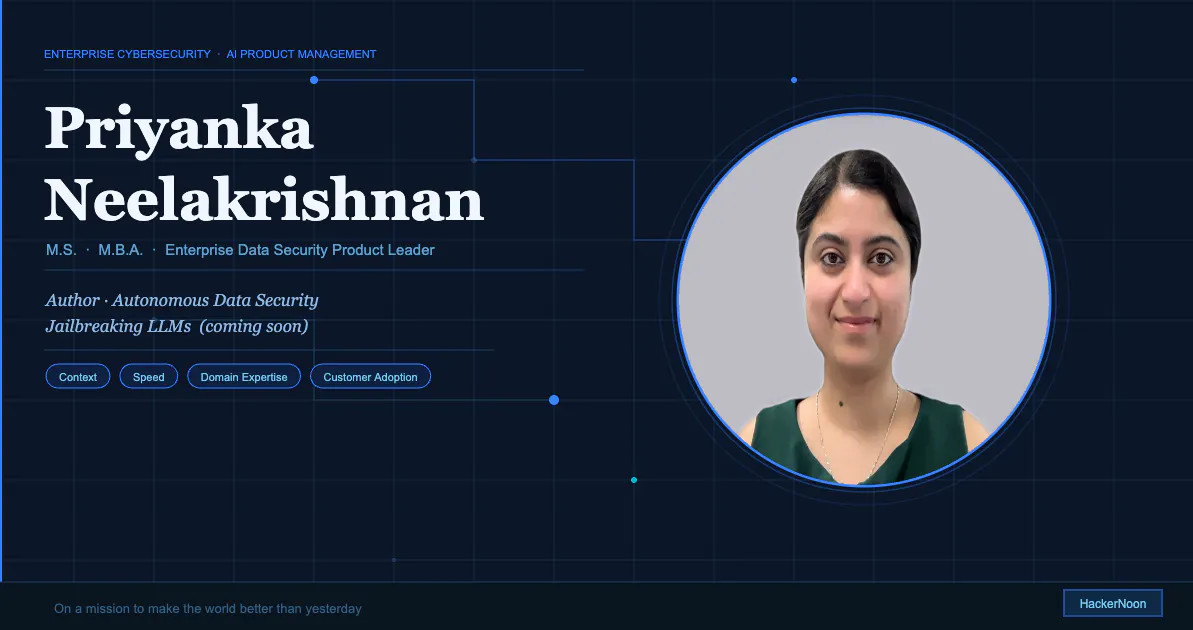
Priyanka Neelakrishnan (B.E., M.S., M.B.A.) is an Enterprise Data Security Product Management Leader with over a decade of experience building and launching products that solve real security problems for enterprises at scale.
She is the author of Autonomous Data Security and her next book, Jailbreaking LLMs, to be published soon. She writes on HackerNoon on the intersection of AI, cybersecurity, and product leadership. On a mission to make the world better than yesterday.
LinkedIn: https://www.linkedin.com/in/priyankaneel20/
[story continues]
tags