
Memes have been part of the discourse since Richard Dawkins published The Selfish Gene in 1976. Dawkins defined “memes” as units of cultural transmission—ideas and concepts that spread through imitation. Any idea that replicates by passing from one mind to another is a meme. A meme can be a belief system, a set of behaviors, an ideology, a viral catchphrase, a fashion trend, a cultural artifact, or an urban legend.
But if memes are defined by virality, antimemes are defined by antivirality. Antimemes refer to ideas and concepts that are difficult to share, notice, or remember. Antimemes include pieces of information we’re disincentivized to transmit and recall because they are dangerous (taboos), complex (economic theories), mundane (legal documents), or risky to disclose (bank passwords and social security numbers). Antimemes appear in various contexts, but they all share the same quality: resistance to spreading.
Antimemes survive by evading awareness and remaining obscure; they are the opposite of memes, which survive by being remembered and shared. If an idea feels hard to remember, share, or discuss for any reason, it is antimemetic by nature. Memes and antimemes are two coequal forces of the modern-day attention economy. While memes get most of the cultural airtime, our world is shaped just as much by the ideas we overlook, forget, or fail to discuss as the ones we notice, remember, and share.
In Antimemetics: Why Some Ideas Resist Spreading, Nadia Asparouhova (who has previously written on the open-source movement) provides a beginner-friendly introduction to the nascent field of “antimemetics,” and explains why some of the most consequential ideas of our time struggle to take root. The book is the first serious exploration of antimemes and contributes to the understanding of the processes by which ideas spread, fade, or vanish entirely in complex information environments.
Life Imitates Art
The idea of “antimemes” first gained popularity following the release of There Is No Antimemetics Division, a sci-fi thriller by Sam Hughes (a.k.a. qntm). In the TINAD, antimemes are anomalies with self-censoring properties. They exist within the realm of thought and consciousness as ideas and concepts, but are functionally invisible to human perception. Their very nature prevents and discourages people from noticing, recalling, or spreading information about them.
The antimemes in There Is No Antimemetics Division are “infohazards” or pieces of information that harm the mind simply by being known. In the TINAD universe, individuals who become aware of antimemes risk having their cognitive faculties sabotaged with devastating consequences. Two of the best-known antimemes from the TINAD universe are “SCP-055” and “SCP-3125”, each taking a form that illustrates many characteristics of real-life antimemes.
SCP-055 manipulates memories to prevent anyone from observing or recalling it. For instance, researchers affiliated with the Antimemetics Division of the SCP Foundation (the fictional organization containing infohazards) study SCP-055, make notes, and then immediately forget what they know about the antimeme. As a result of this constant state of forgetfulness, no one can form a complete understanding of SCP-055’s nature and devise a plan for containment.
Unlike SCP-055, which simply erases itself from memory, SCP-3125 actively attacks anyone who fully perceives the antimeme. Those who attempt to reconstruct SCP-3125 or grasp its nature are erased from existence—along with any friends, acquaintances, or colleagues who share their awareness of the anti-meme. This makes SCP-3125 nearly impossible to contain, despite the Foundation’s best efforts.
In TINAD, even the Antimemetics Division itself is an antimeme. Most of the SCP Foundation doesn’t remember that the Antimetics Division exists. The secrecy is by design: since the Division handles anomalies that erase themselves from memory and kill anyone who notices their nature, conventional documentation of its activities would be both impossible and dangerous.
“There is no Antimemetics Division” is something of a meta-joke in this context; the division exists, but is structured as a self-concealing, self-erasing construct that itself escapes awareness and memory.
How do ideas spread?
There Is No Antimemetics Division is the primary inspiration for Asparouhova’s Antimemetics, but readers don’t have to read the fictional precursor to care about the cultural impact of ideas that survive by evading awareness. Antimemetics picks up where the fiction leaves off, turning metaphors into models for understanding how ideas spread in the real world. If some ideas spread effortlessly while others seem to stall on contact, what explains the difference?
Inspired by concepts from epidemiology (the study of how diseases spread), Asparouhova identifies three main factors that influence an idea’s chances of spreading: transmission rate, immunity, and symptomatic period. In the context of antinemetics, the transmission rate captures an individual's willingness to share an idea with others in a network. A high transmission rate means people are eager to share the idea; a low transmission rate means that people are reluctant to spread it. Immunity describes how receptive people are to an idea: a high “immunity rate” means they are very resistant to it and are unlikely to “pick it up” upon hearing about it. Finally, the symptomatic period measures an idea’s staying power (i.e., how long it lingers in individuals after they come to believe the idea).
Successful small-scale memes tend to have high transmission rates, low immunity, and low-to-moderate symptomatic periods. Take cat videos, for example. The average person likes watching, sharing, and seeing cat videos online. Cat videos are innately viral (easily transmitted and low-resistance), but we typically pay attention to them for a few seconds before moving on to other, more important things. Cat videos lack staying power. A few “weighter” memes have high transmission rates, low-ish immunity, and longer symptomatic periods. For example, certain religious beliefs are incredibly memetic and have a persistent influence.
In contrast to memes, antimemes have low-to-high transmission rates, provoke strong immune reactions, and exhibit high symptomatic periods. Social security numbers are a low-stakes example of an “antimeme”: we don’t randomly share SSNs even if some people—ahem, criminals—want that information. This type of antimeme has low transmissibility, doesn’t trigger resistance, and has a long symptomatic period (i.e., SSNs linger in memory even when we’re not consciously thinking about them).
Economic theories are an example of another kind of anti-meme: professors may love to talk about macroeconomics, but the average person is likely to ignore the discussion (partly because understanding macroeconomics is cognitively demanding). In this case, the idea has high transmissibility but falls flat with audiences. Due to their usefulness, however, economic theories are consequential enough to persist while remaining obscure.
Despite their under-the-radar nature, not all antimemes are doomed to obscurity; under the right conditions, antimemetic ideas can escape containment and become memetic. This shift usually requires improvements in transmissibility and a reduction in immunity. Suddenly, individuals become comfortable sharing an idea publicly, and audiences become more receptive to it. Whenever friction decreases, ideas can reach escape velocity and break into public awareness.
For example, gay marriage was largely unpopular and antimemetic in the early 2000s—a combination of social stigma, institutional resistance, and low political capital created enormous friction that blocked its spread. But gay marriage suddenly became memetic once public sentiment shifted, elite support consolidated, and the legal landscape changed. Support for gay marriage feels like the norm today, but the idea of “marriage equality” was once a fringe topic relegated to niche corners of the internet. Future highly memetic ideas may similarly be sitting in obscurity today, waiting for the right cultural shift to break out.
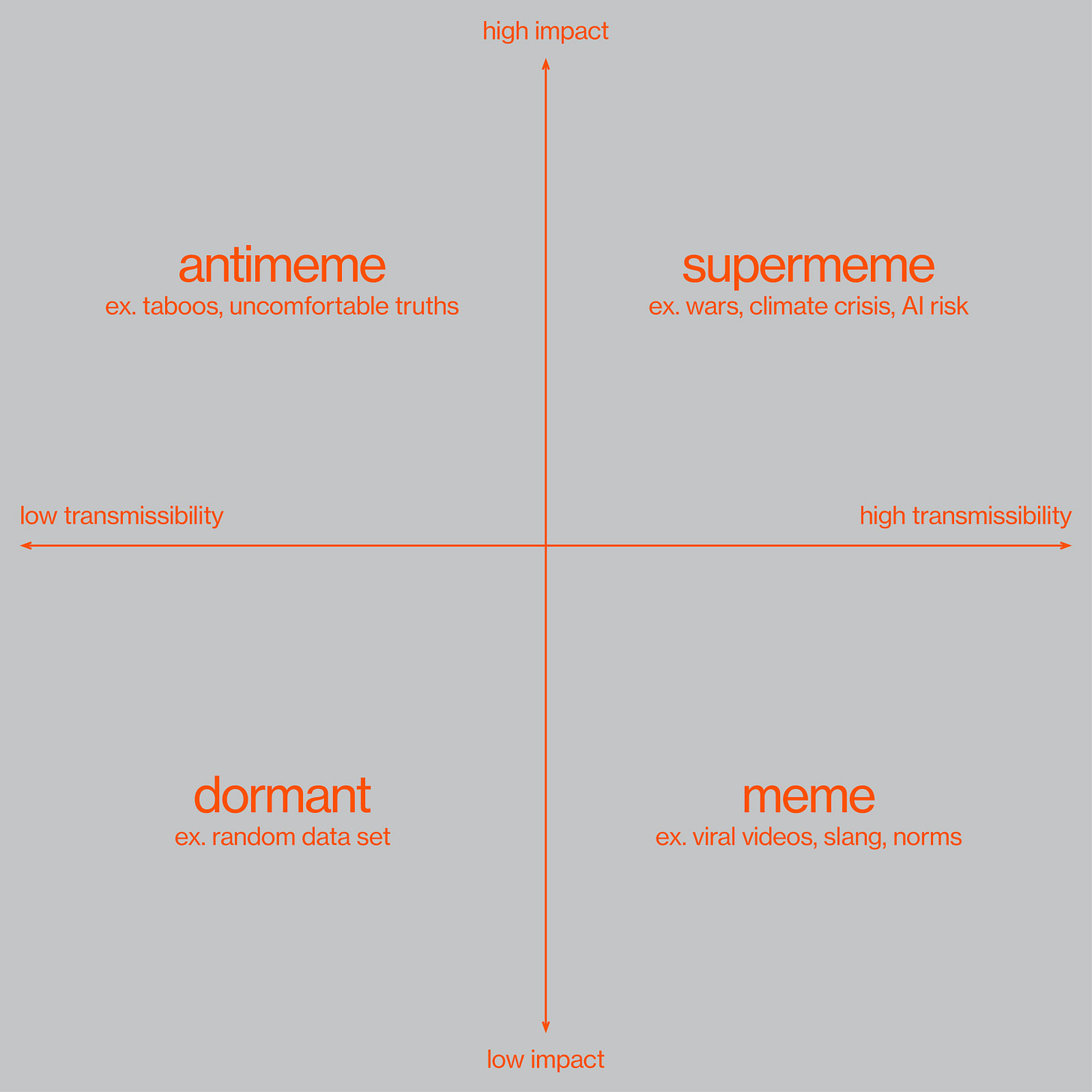
Asparouhova also introduces a third category of ideas to explain the modern information landscape: supermemes. A supermeme behaves like a meme (low immunity and high transmissibility), but is more abstract and has a longer symptomatic period. Supermemes spread quickly because they resonate emotionally, feel important, and appeal to our individual and collective values. War, climate change, gender equality, human rights, and AI risk are among the most recognizable supermemes.
People are more comfortable focusing on super-memes for longer periods because of the supposed importance of merely caring about them. The lack of specificity in supermemes makes them hard to pin down and resolve (i.e., no one really knows what the “climate crisis” means or how to assess progress). This vagueness allows supermemes to persist for decades or more, even when they inspire no useful action.
Take the example of Alice, an impressionable, young professional who works at a Wall Street bank and lives in New York. Alice might feel compelled to debate the Israel-Palestine conflict online. However, she would make a greater positive impact on the world if she advocated for affordable housing policy in New York City. Unlike the war in Gaza, affordable housing is an issue that directly affects Alice and falls within her sphere of influence.
But supermemes override the logic of “doing the most good”: their gravitational pull degrades our ability to think about other, potentially more relevant or actionable ideas. Asparouhova describes supermemes as “cognitive black holes” for this reason. This isn’t to say all supermemes are unimportant or entirely undeserving of attention; war is horrific, and we should care about ending conflicts overseas, for example. But in an information environment where attention is a scarce resource, choosing what we focus on is an ethical and practical responsibility.
Attention is all you need.
Attention is the scarcest resource in the modern world. We live inside an attention economy that thrives when we give our focus to whatever happens to appear in our orbit. Facebook makes money when you stay on the platform; YouTube influencers make money when you click an ad; news outlets gain more traffic when a controversial headline captures public attention, etc.
Antimemetics seeks to help readers understand the dynamics of attention, so we can better police our own. Specifically, Asparouhova proposes a more disciplined approach to allocating attention that accounts for the demands of our hyperconnected digital world. Antimemes may not spread widely, but their nature offers valuable insights into how we can keep dangerously sticky ideas out of our heads.
An important insight from Antimemetics is that even the stickiest and most infectious memes can lose their power with enough resistance. We can apply this insight to develop an antimemetics-inspired strategy for addressing harmful memes. For instance, wilful ignorance (the act of deliberately cultivating limited awareness of a topic or concept) can help stave off memetic ideas, no matter how catchy, emotionally triggering, and cognitively invasive they may be. Importantly, this strategy short-circuits the positive reinforcement loop that activates whenever we encounter new ideas and limits the influence those ideas have on our attention.
Asparouhova also recommends that we take steps to preemptively limit exposure to ideas we know are likely to capture our attention. For example, we can ditch social media platforms that force indiscriminate consumption of information in favor of carefully curated alternatives, such as group chats. A global feed makes exposure to the day’s hot-button topic the default experience; by contrast, group chats filter what gets through using the judgment of trusted peers and keep most memetic ideas out of sight.
Group chats and the case for obscurity.
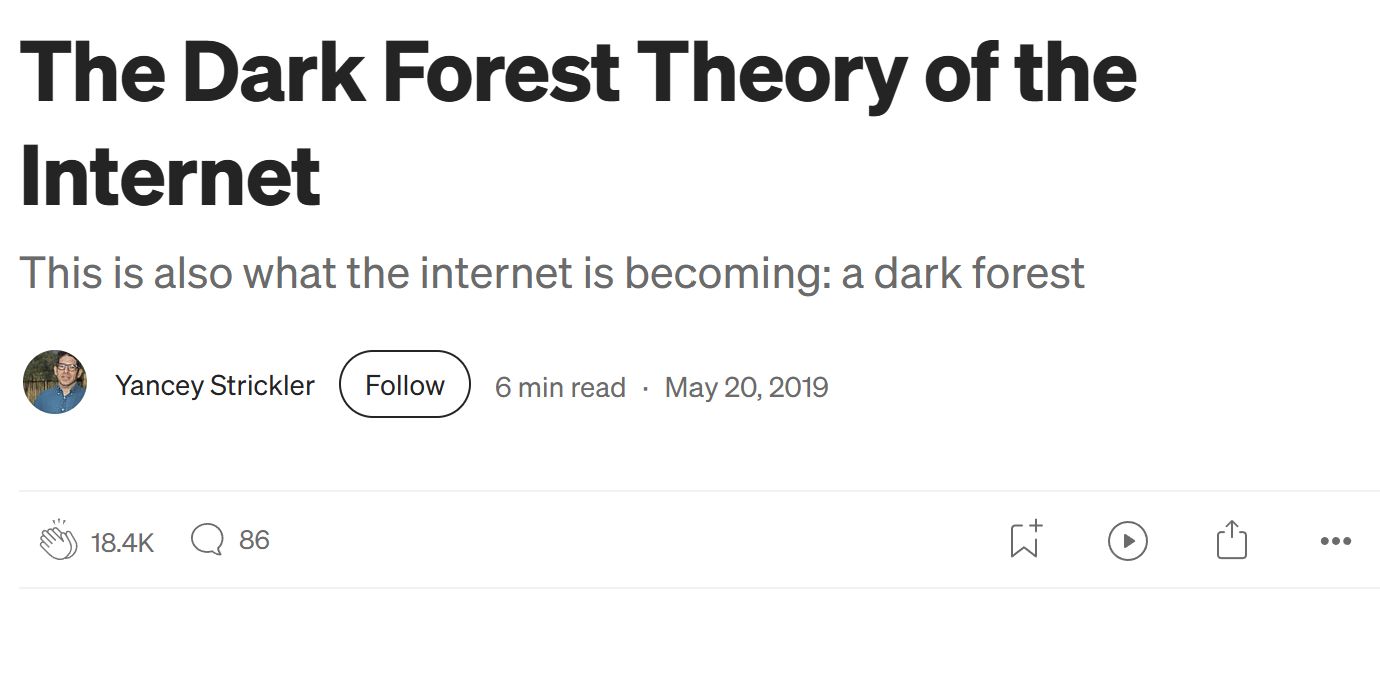
In Antimemetics, Asparouhova explores how group chats became the new centers of intellectual discourse and functioned as incubators for antimemetic ideas. Her thinking is informed by the work of Yacine Strickler, an internet writer and entrepreneur who introduced the dark forest theory of the internet in 2019.
The term “dark forest” comes from Liu Cixin’s sci-fi trilogy, The Three-Body Problem, in which advanced civilizations (including the spacefaring Trisolarans and Earth’s humans) survive by staying hidden to avoid preemptive annihilation from others. In the dark forest, visibility means death, which encourages every actor to go to great lengths to conceal their presence.
Strickler drew on this metaphor to argue that the internet is becoming its own dark forest—an environment where remaining invisible was often the safest and most rational choice. More specifically, Strickler explained that the rise of cancel culture motivated people to stop participating in publication discussions. Instead, internet users gradually began sharing their ideas and thoughts in private, tight-knit communities made up of friends, colleagues, acquaintances, subscribers, and trusted individuals.
 The group chat defined this era of communication (which started in the 2010s and peaked in the early 2020s): individuals turned to private group chats on platforms like iMessage, WhatsApp, Signal, and Telegram to share unfiltered opinions and solicit feedback. These private chats provided a safe, controlled environment for discussing controversial and taboo-breaking ideas without fear of cancellation.
Group chats weren’t the only form of communication to gain popularity during the mid-2010s. Subscriber-only newsletters, podcasts, email lists, private Slack groups, Discord servers and gated channels, Patreon communities, approval-based Mastodon instances, and private Telegram groups also became popular. These spaces offered privacy and insulation from the buffeting forces of public censorship, allowing potentially subversive ideas to develop fully in a safe environment before the existing cultural police could shoot them down. They also enabled conversation with trusted interlocutors—small groups could be selected for people willing to engage with discretion, nuance, and good faith—unlike on major social media sites, where “heretical” ideas could be quickly co-opted by opportunistic commenters for “outrage porn.”
The concept of shielding ideas from premature or unnecessary attention also informs Asparouhova’s discussion of “obscurantism”. Obscurantism is the practice of cloaking unorthodox ideas in dense, complicated prose. Historically, obscurantist writing has helped thinkers and intellectuals avoid censorship and persecution by hiding radical insights in plain sight. The resulting cognitive friction to picking up the idea slows transmission and protects fragile ideas from premature scrutiny (a concept expounded by 20th-century philosopher Leo Strauss).
Obscurantism is not without risks. Some ideas never catch on, or are forgotten entirely, because their initial presentation was too complex and hard to understand. But obscurity can be useful for insights that challenge norms and stray outside the bounds of acceptable discourse. Dense, flowery prose and insider terms filter out the unready, protect the idea from premature scrutiny, and buy time for an idea to develop and become acceptable to a wider audience.
Although it may seem self-evident that all creators want their ideas to spread as far and wide as possible, many of the best ideas begin their lives as antimemes. They are shared only among people we trust, protected by social friction or cognitive difficulty, and refined before release. Dark forest theory and obscurantism both underscore the usefulness of understanding antimemetics. Virality can be a sign of an idea’s viability, but it can just as easily be a death sentence. In an age obsessed with exposure, Antimemetics urges us to nurture our best insights in private—away from the noise and pressure of public platforms. Some ideas need time in the dark before they are ready for the light.
A marketplace of ideas, if we can keep it.
Antimemetics is a reminder that visibility is not the same as importance. Just because an idea is trending doesn’t mean it’s important in the long arc of history; similarly, many ideas that fail to gain traction immediately will become highly influential. So the question becomes: if we know why some ideas vanish, how do we make sure the right ones gain visibility? And how do we leverage our insights to keep the wrong ideas hidden?
The internet, as envisioned by its creators, early adopters, and staunchest defenders, is a marketplace of ideas. Anyone with a connection can post anything they want online on equal footing. In theory, the best ideas should rise to the top. But decades of online life have shown that trivial or toxic ideas can easily dominate public discourse because of their short-term stickiness. At the same time, valuable and consequential ideas often struggle to gain traction for reasons discussed previously. While great ideas can survive for a long time as anti-memes before the public is ready to hear them, we need new mechanisms to surface great ideas when the time is right.

One answer lies in reimagining how we relate to the flow of ideas. Here, Asparouhova introduces the concept of truth-tellers and champions in the public square. Truth-tellers are people who surface ideas before the world is necessarily ready for them, risking their own social capital for the greater good. They are whistleblowers, independent observers, anonymous posters—anyone willing to notice something and bring it up for discussion. Someone has to take the first step of publicly standing behind an idea: without the truth-teller, even the most valuable ideas would stay buried and ignored.
On the other hand, champions are people who persist with an idea after it has surfaced. They pick up on the ideas truth-tellers surface and do the slow, often invisible work of making the idea stick long enough to take root and go mainstream. More importantly, they work to translate ideas into action and ensure abstract discussions lead to meaningful, real-world outcomes.
In this sense, Antimemetics isn’t just a book about why ideas fail to spread. It is a manual with instructions for giving great ideas a fighting chance. The marketplace of ideas won’t fix itself; if we want better discourse, we must stop watching and start acting. With enough truth-tellers and champions, we can crowd out trivial and toxic ideas and cultivate a better, healthier information ecosystem.
The New Antimemetics Division
The field of antimemetics is still nascent and not well-known (one might even call it “antimemetic”). At first glance, it may feel like an extremely online intellectual trend or academic honey trap. But antinemetics has the potential to be a serious intellectual discipline, with great lessons for how we think about the transmission of ideas in an increasingly complex information landscape.
In Antimemetics, Asparouhova offers a strong preliminary framework for understanding the memetic economy, explaining that sociocultural dynamics, online algorithms, and individual psychological quirks shape the rules of attention. But, as Antimemetics emphasizes later in the book, we are not oblivious participants in the matrix. We have agency. We can choose to focus on useful and important ideas that fly under the mental radar, and resist the gravitational pull of ideas that lack any perceivable benefit. The process of reshaping our society begins with curating our attention.
The new Antimemetics Division welcomes anyone who wants to resist the mind’s natural tendency to forget and notice the things that matter. As our attention fractures and memetic overload increases, joining the new Antimemetics Division may well become the only path to clarity and agency in an information-driven world.
[story continues]
tags