


Part 1
Year 2234: fusion‑drive couriers stitch the outer system together at a blistering one‑percent light‑speed. Terraformers on Mars depend on cryo-canisters of N₂, CO, and CO₂ mined from far‑cold moons like Ariel. In the shadows between contracts and patrols, the question of who counts as “crew”, human or machine, decides who gets to breathe tomorrow.
Zayn Jacksen sat at the narrow desk in his quarters on the Ganymede transfer station, the kind of place where the walls pressed in close and the air carried a faint metallic taste that never quite left your tongue. He had spent the better part of the morning sorting cargo manifests, the usual grind of making sure the right pallets reached the right outposts before someone started screaming about shortages. The job paid steady, much better than the one from his youth -serving in the BN space force (what most people now called the BN fleet), and after fifteen years bouncing between stations it was the closest thing he had to a routine. The desk light buzzed when the power cycled, a small annoyance he no longer heard.
A knock at the hatch came sharp and impatient. He opened it and found Marcus standing there, thinner than Zayn remembered, eyes bloodshot from too many days in a cramped transport.
“You look like hell,” Zayn said, stepping aside. “Come in. Coffee’s lab-grown but it’s hot.”
Marcus dropped into the spare chair and accepted the mug. Steam fogged the scratched poly window for a second. He took a long swallow before he spoke. “I came straight from Ariel. Kachina Base is finished if somebody doesn’t step in fast.”
The words landed like a weight in Zayn’s gut. He set his own mug down, fingers leaving a pale ring where condensation met dust.
“Define finished.”
“The habitat’s got breaches in three sections. Pressure doors are holding for now, but the seals are shot. The production plant is offline. The one that scrapes up the N2, CO and CO₂ from the surface ice and packs it for shipment. And the mass driver? Bent to hell. Nothing is launching off that moon.”
Zayn leaned back. He knew the numbers even if he had never set foot on Ariel. That ice was special. Layers of carbon dioxide thick enough to cut into blocks, pockets of carbon monoxide that stayed frozen solid in the cold. Not counting all the frozen nitrogen. Packaged right, the stuff kept greenhouses and fuel cells running in half the wheel habitats between here and the inner belt. The Mars project needed it too, still nursing the atmosphere like a stubborn fire. Without regular shipments the whole supply chain frayed.
“Who’s in charge out there now?” he asked.
“Nobody with any spine,” Marcus answered. “The crew’s holding on, but they’re short on everything. Food, spare parts, even basic repair kits. And there’s talk. Sauli Balcoins has been sending messages from his outfit near Saturn. Says the base is a lost cause and his people could take over the contract, clean it up on their terms. You know how he operates. Low bids, late delivery, then he acts surprised when the quality is garbage.”
Zayn had crossed paths with Balcoins twice before, once on a water‑ice deal that went sour. The man smiled a lot and meant none of it.
“Then there’s Uatobi Amupanda,” Marcus added. “Crew out of the Namibian consortium, parked on a captured rock a couple orbits over. Keeps filing claims that the ice rights overlap. Every time a shipment gets delayed he’s there offering to buy the contract cheap.”
Zayn rubbed the back of his neck. The station lights flickered the way they did when the arrays swung through Jupiter’s shadow. He thought about the people on Ariel, the handful of human supervisors and the hundreds of robots that did the hauling. Management treated the machines like disposable tools; power them down if they glitched, wipe the logs, bring fresh units. The humans were not much better off, most of them locked into long contracts that ate the bonus before it hit their accounts.
“I still have some pull with the consortium back on Luna,” Zayn said. “They listen when I say a route is about to break. I can ask for authorization to go out there and take charge of the rebuild. Habitat, plant, driver, the whole thing.”
Marcus studied him. “You sure? Ariel’s a long haul. If Balcoins and Amupanda decide to make it ugly, you’ll be right in the middle.”
Zayn looked at the manifest still glowing on his screen. Numbers, deadlines, margins. All of it meant less than nothing if Kachina stayed dark. He had spent a career moving supplies so other people could live. Maybe it was time to fix something himself instead of routing around the damage.
“I’ll make the call tonight,” he said. “Tell the crew to hold tight. Help is coming.”
Marcus stood, already lighter by half a step. “I’ll pass the word on the next outbound run. Just… watch your back, Zayn. Those two don’t play fair.”
After the hatch closed, Zayn sat in the quiet. The station hummed, steady and indifferent. He could stay here, keep his head down, let the system sort itself the way it always did. Or he could go.
He reached for the comm panel and keyed the direct line to the lunar office. On the panel’s smooth edge his ring finger brushed the faint groove where a band once lived. He steadied his hand. Some choices you made because walking away felt worse than the trouble ahead.
♦ ♦ ♦
A month later the transport from Ganymede dropped Zayn at the edge of Kachina Base under Ariel’s weak day cycle. The surface stretched out flat and gray, dusted with frost that caught the distant sunlight like scattered salt.
He stepped off the ramp in a fresh pressure suit, the seals hissing as they locked. The descent felt unnervingly light; Ariel’s native gravity was 2.7% of Earth’s. Without help, a careless stride would have sent him drifting into a long, slow arc above the icy crust. However, the suit’s internal induction coils hummed, reacting with the localized magnetic field to provide a steadying downward pull. The pads beneath every landing site were laced with buried ferrite grids; step off them and you will go almost weightless fast. This artificial weight brought the sensation of gravity closer to 10%, giving his boots just enough purchase to grip the landing pad without him floating away into the Uranian sky.
The cold hit even through the layers, a sharp reminder that they were nineteen AU from the Sun and nobody was coming to warm the place up.
A woman waited at the airlock hatch, her faceplate fogged from the short walk. She raised a gloved hand. “Jacksen? I’m Torres. Site operations lead. Marcus said you were on your way.” Torres had held Kachina together for years while the consortium starved it.
“Call me Zayn.”
They moved through the double doors into the habitat ring. The corridor lights flickered every few seconds, a steady reminder that the grid was one surge away from quitting. Torres popped her helmet and shook out short dark hair, a streak of silver catching the light. Lines at the corners of her eyes spoke of too many double shifts and not enough sleep. She looked like someone who had learned to keep going long after the comforts ran out.
“How bad is it really?” he asked.
“Bad enough I almost told the crew to pack it in,” she said. “Living quarters hold pressure, barely. Two sections are sealed off because the outer wall took micro‑meteor hits years ago and nobody patched them right. The plant is worse. Half the scoops are frozen solid. The packaging line is jammed with ice that won’t melt without proper heaters. The mass driver rail is warped like somebody took a torch to it.”
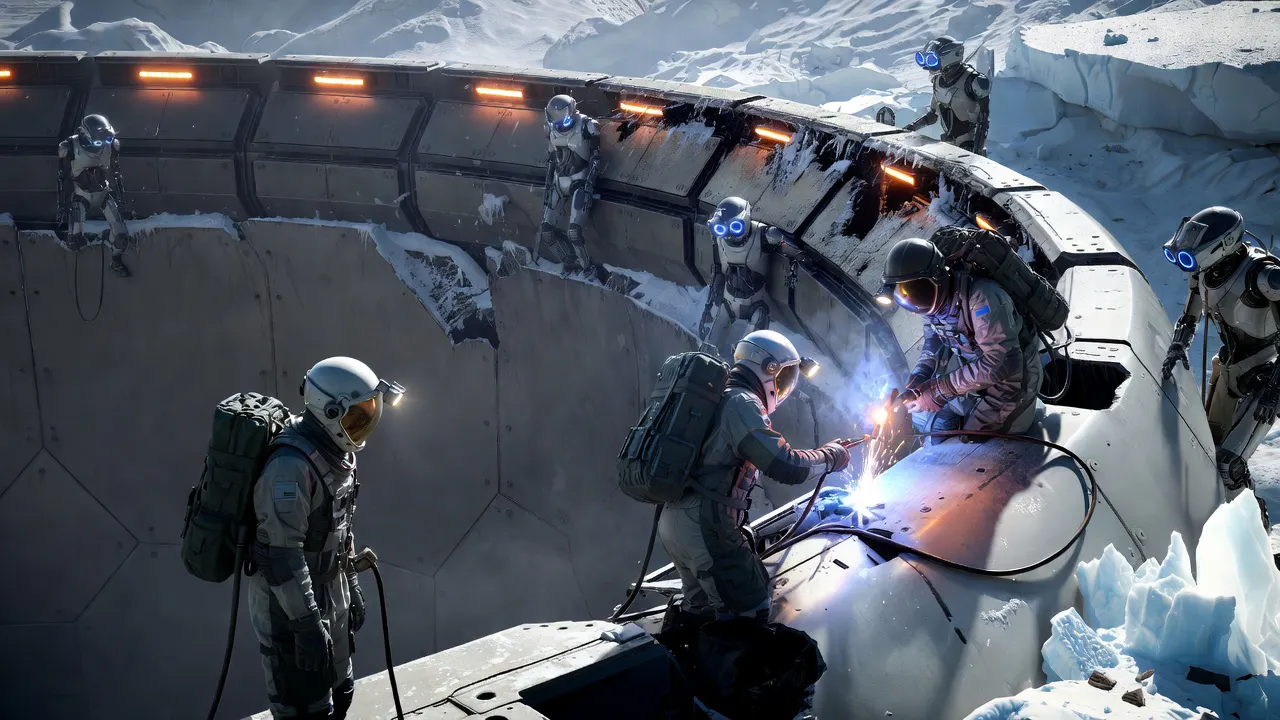
They walked past charging racks where rows of humanoid robots stood motionless, power cables running into their chests. One unit had a cracked faceplate and a missing arm. No one had moved it. A faint smell of warm plastic and ozone hung over the floor, the scent of machines that had been pushed too hard.
“Those the only hands you’ve got?” Zayn asked.
“Mostly. The consortium sends fresh units every six months, then treats them like disposable gloves. Glitch once and the log gets wiped, power cut, new one dropped next cargo run. Humans, there are eighteen of us left. We supervise, sign the manifests, keep the robots from walking into the same crater twice. Pay’s decent if you last the contract, but the bonuses keep getting clawed back for maintenance overruns.”
Zayn stopped at a viewport. Outside, the mass‑driver track curved across the ice plain, its magnetic rail twisted in the middle like a broken spine. “That didn’t happen by accident.”
“No,” Torres said. “Balcoins’s people were out here two months ago on a courtesy inspection. They left the day the rail buckled. Amupanda’s crew filed a competing claim the next week. They smell blood.”
Zayn felt anger flare, the old clean kind that came when a small habitat got shorted and paid the price. “I didn’t come to hand the keys over. The lunar office gave me full authority to rebuild. Habitat, plant, driver. Shipments have to start again or the Mars runs start rationing N2 and CO₂ canisters. Every delay costs lives down the line.”
Torres studied him for a beat. “The crew’s been talking. Some want the robots granted basic decision rights while we rebuild. Let them flag their own repairs instead of waiting for a human to notice. Others say the consortium will yank every contract if we treat machines like partners.”
He looked at the silent racks. He thought of people grinding through twelve‑hour shifts because there was no other place to go.
“We’ll talk after the walls are up,” he said. “Right now the base needs to breathe. I want to walk the perimeter tonight when the light is low. No announcements. Me and someone you trust.”
“Then it’s me,” she said. “I have a rover that still turns left when you ask it to. That counts for something out here.”
Their eyes held for a second too long. Not a promise just a recognition. She looked away first, a quick smile gone as soon as it formed.
“Zayn,” she said, trying his name on her tongue, “Balcoins will not send a polite message. He will send something that breaks more than a rail.”
“I know,” he said. “Let him come.”
They stepped into the lock together.
Inside the lock, the heaters kicked on with a low thrum. Torres pulled off her gloves and flexed her fingers, wincing as warmth returned.
Zayn handed her a thermal packet from the wall rack. “Here. Better than losing a fingertip.”
She smirked. “You always this considerate, or is this a special‑occasion moon?”
He shrugged. “I’ve seen too many good people lose small things before big things go wrong.”
Torres leaned against the bulkhead, watching him for a moment. “You talk like someone who didn’t start behind a desk.”
“I didn’t,” he said. “Military training and then field logistics on the Calisto ring‑hab network, years back. Thought I’d earned a quieter life.”
“How’d that work out?”
Zayn allowed a rare half‑smile. “Ask me after we fix your base.”
Her laugh was soft, real, not the brittle sound of people living on rations and recycled air.
She handed the empty packet back. Their fingers brushed, and neither pulled away immediately.
“Not many people volunteer to walk toward trouble,” she said.
“Not many people keep a place like this standing.”
For a heartbeat, the lock felt warmer than the heaters could account for.
Then Torres cleared her throat. “Get some sleep, Jacksen. Tomorrow you start breaking my work routines.”
He nodded. “Tomorrow.”
The base stirred like a body waking from a long sleep. Zayn stood in the central hub with a battered tablet, running through the repair list Torres had pulled together. The air recyclers hummed louder than they should, but at least they were running. He had slept three hours in a borrowed bunk and woken with the same picture in his head he had carried from Ganymede: fix the habitat so people could breathe, then the plant, then the driver so they could ship the ice.
Torres handed him coffee that smelled faintly nutty, almost enough to mask the recycled tang. “Crew’s assembled. Eighteen humans, four hundred and twelve active robots. I told them you’re calling the shots.”
Zayn stepped onto a raised platform overlooking the floor. Faces turned up, some hopeful, some guarded. The robots stood in rows, lenses glowing soft blue, waiting. He kept his voice even.
“First priority is the outer walls. Patch every breach, reinforce pressure doors, get the ring airtight. Then we move to the plant. N2, CO and CO₂ scoops run before packaging. Last, we straighten the mass driver and fire canisters toward Mars. They need that gas for atmospheric balance. Every week we stay dark slows the work there.”
A stocky man near the front, hands black with grease, raised an arm. “Name’s Carver. What about the robots? They do the heavy lifting, but if one cracks a joint out on the ice we shut it down and order another. No diagnostics. No fixes. Consortium says it’s cheaper.”
Zayn had expected it. He glanced at the machines. “I read the contracts. They’re listed as equipment. Same as a drill. But equipment doesn’t notice when a seal is about to fail and warn the crew. We need every edge if Balcoins or Amupanda make this harder.”
Torres shifted beside him. “You’re talking about decision rights.”
“I’m talking about treating them like the partners they are while this job lasts,” Zayn said. “They log repairs. They flag problems before disasters. We write it into the daily orders. The consortium can argue later. Right now the base stands.”
A low murmur ran through the humans. Some agreed while others looked uneasy. Carver folded his arms. “You do that and the next supply ship might bring orders to pull every unit and replace them with models that don’t talk back.”
“Then we’ll deal with that when it comes,” Zayn said. “If we keep treating them like scrap, we’re no better than the people who let this place fall apart. Collective responsibility. That’s how we finish.”
Zayn stepped down and the crews scattered.