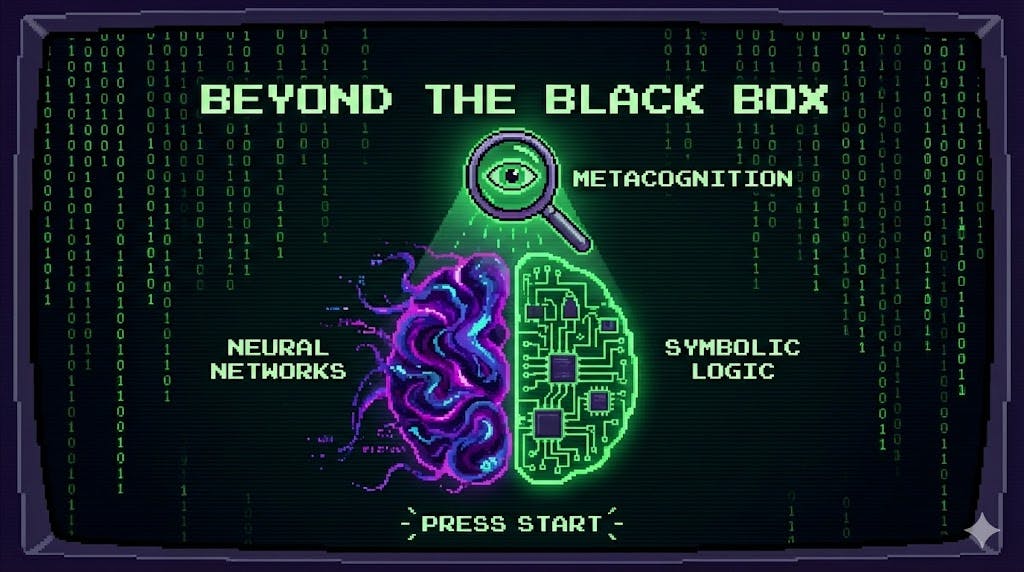
In AI, we like dramatic metaphors: summers and winters, booms and busts, hype cycles and disillusionment. But under all the noise, there’s a quieter story playing out — a slow convergence between two tribes that used to ignore (or mock) each other:
- Symbolic AI: logic, rules, knowledge graphs, theorem provers.
- Sub‑symbolic AI: deep nets, gradients, vectors, everything “end‑to‑end”.
That uneasy marriage now has a name: neuro‑symbolic AI. And if you look closely at the last five years of papers, benchmarks and prototypes, one pattern is hard to ignore:
We’re getting really good at teaching machines what to think — but still terrible at giving them any sense of how they’re thinking.
That second part lives in an awkward, under‑funded corner of the field: metacognition — systems that can monitor, critique and adapt their own reasoning.
This piece is a HackerNoon‑style walk through that landscape: what neuro‑symbolic AI actually looks like today, where the research heat is, why metacognition is the missing “prefrontal cortex”, and what a meta‑cognitive stack might look like in practice.
1. Neuro‑Symbolic AI in one slide: five pillars, not one trick
Most people hear “neuro‑symbolic” and picture a single pattern:
“We bolted a Prolog engine onto a transformer and called it a day.”
The reality (if you read the recent systematic reviews) is more like a five‑way ecosystem than a single recipe:
- Knowledge representation – how the world is encoded.
- Learning & inference – how models update beliefs and draw conclusions.
- Explainability & trustworthiness – how they justify themselves to humans.
- Logic & reasoning – how they chain facts, rules and uncertainty.
- Metacognition – how they notice, debug and adapt their own thinking.
Let’s run through these pillars the way a practitioner would: “what’s the job of this layer, and why should I care?”
1.1 Knowledge representation: giving models a language for the world
Deep nets are excellent at compressing the world into vectors, but terrible at telling you what those vectors mean.
Symbolic methods attack the problem differently:
- Entities, relations and constraints are made explicit — think knowledge graphs, ontologies, logical facts.
- Domain rules and common sense are first‑class objects, not vague patterns in a weight matrix.
- You can query, check and update knowledge without retraining a 70B‑parameter model from scratch.
Modern neuro‑symbolic work tries to have it both ways:
- Use graphs, logical predicates or specialised languages (e.g. NeuroQL‑style designs) to encode structure and constraints.
- Use neural models to estimate missing links, preferences and probabilities over that structure.
The payoff is practical:
- Cheaper training (more structure, less brute‑force data).
- Better transfer (reasoning over new combinations of familiar concepts).
- A cleaner surface for debugging and auditing.
1.2 Learning & inference: not just pattern‑matching, but structured thinking
Vanilla deep learning does one thing insanely well: approximate functions from data. You give it lots of labelled examples and it gets frighteningly good at predicting the next token, frame or click.
What it doesn’t do well, at least on its own:
- Multi‑step reasoning under constraints.
- Generalising from tiny numbers of examples.
- Updating beliefs incrementally without catastrophic forgetting.
That’s where neuro‑symbolic approaches step in. Recent systems:
- Embed logical rules into the loss function, so a network learns patterns that respect known constraints.
- Combine planners or theorem provers with neural modules: the network proposes candidates, a symbolic engine checks and prunes them.
- Use few‑shot or zero‑shot tasks as the target, with symbolic structure doing heavy lifting when data is sparse.
You can think of it as moving from:
“This model was trained on a lot of things like this.” to “This model has explicit rules for what’s allowed, and learned heuristics for how to apply them efficiently.”
1.3 Explainability & trust: from “because the logits said so” to actual reasons
If you’re shipping models into healthcare, finance, public sector, or safety‑critical infra, regulators and users are bored of the “it’s a black box, but the ROC curve is great” story.
Neuro‑symbolic work is quietly rebuilding a different one:
- Use symbolic traces — rules fired, constraints checked, paths taken — as the explanation substrate.
- Attach probabilities and counterfactuals (“if this feature were different, the decision would flip”) to those traces.
- Integrate graph structure or logical programs into summarisation and QA, so models can reference an explicit world model instead of hallucinating one on the fly.
Some projects push this further into “human feel” territory — testing whether models can understand jokes, irony or subtle inconsistencies as a proxy for deep language understanding, not just surface statistics.
The question that hangs over all of this:
Can we build systems that are both accurate and willing to show their working in something like human‑readable form?
Neuro‑symbolic techniques are currently our best bet.
1.4 Logic & reasoning: building an internal causal chain
Classical logic programming has been able to solve puzzles, plan routes and prove theorems for decades. Its Achilles heel: brittleness in the face of noise, missing data and messy language.
Neural nets flip the trade‑off:
- Robust to noise, but vague about why an answer is right.
- Hard to enforce strict constraints (“no, really, this must always be true”).
Neuro‑symbolic reasoning engines try to sit in the middle:
- Use neural models to score, suggest, or complete candidate proof steps or plan fragments.
- Use symbolic machinery to enforce constraints, consistency and global structure.
- Explicitly model uncertainty — not as a hacky confidence score, but as part of the logic.
AlphaGeometry is a good poster child here: a system that uses language models to propose geometric theorems and proof steps, while a symbolic geometry prover checks and completes them. The result looks less like a black box, and more like a collaboration between a very fast undergraduate and a very strict maths professor.
1.5 Metacognition: the awkward, missing layer
Now for the weird one.
Everything above is about what a system knows and how it reasons. Metacognition is about:
“What does the system know about its own reasoning process, and what can it do with that knowledge?”
A genuinely meta‑cognitive AI would be able to:
- Monitor its own inference steps and say “this is going off the rails”.
- Notice when it’s re‑using a brittle heuristic in a totally new domain.
- Slow down and call for help (from a human, another model, or a different algorithm) when confidence is low.
- Learn not just facts about the world, but policies for how to think in different situations.
Right now, that layer is barely there. We have clever pattern‑matchers and respectable logic engines. What we don’t have is a widely deployed “prefrontal cortex” that can orchestrate them.
The rest of this article is about why that layer matters — and what it might look like.
2. What the literature actually says (and why metacognition is a rounding error)
A recent systematic review of neuro‑symbolic AI from 2020–2024 did the unglamorous but necessary work: trawling five major academic databases, deduplicating papers, and throwing out anything that didn’t ship code or a reproducible method. fileciteturn0file0
The pipeline looked roughly like this:
- 5+ databases: IEEE, Google Scholar, arXiv, ACM, Springer.
- Initial hits: 1,428 “neuro‑symbolic”‑related papers.
- After removing duplicates: –641.
- After title/abstract screening: –395.
- After “has a public codebase” filter: 167 left.
- Final core set after closer review: 158 papers.
Those 158 papers were then mapped onto the five pillars above. The rough picture:
- Knowledge representation – 70 papers (~44%)
- Learning & inference – 99 papers (~63%)
- Explainability & trustworthiness – 44 papers (~28%)
- Logic & reasoning – 55 papers (~35%)
- Metacognition – 8 papers (~5%)
A few patterns jump out:
- The hottest intersection is “knowledge + learning” — basically: “how do we inject structure into training so we can do more with less data?”
- The sparsest intersection is “explainability + logic + knowledge” — exactly the place you’d expect truly rigorous, traceable systems to emerge.
- Only one project (again, AlphaGeometry) managed to seriously touch four of the five pillars at once.
Metacognition is, numerically, a footnote. It’s under‑represented, rarely open‑sourced, and mostly lives in small, experimental architectures or cognitive‑science inspired prototypes.
If you believe that next‑generation AI will need some kind of “self‑control” and “self‑understanding”, that 5% slice is the most interesting one on the chart.
3. From clever tools to systems with a point of view
Let’s zoom in on how the more mature pillars are evolving, because they set the stage for metacognition.
3.1 Knowledge representation: moving from static facts to living models
The old picture of knowledge was a big, mostly static graph: nodes, edges, maybe some weights. Update cycles looked like software releases.
The new picture is closer to a living knowledge substrate:
- Events and interactions continuously update the graph.
- Representations are context‑sensitive — the same entity looks different in different tasks.
- Symbolic structures are tightly integrated with learned embeddings, so you can move smoothly between logic and similarity.
The open problem: how do you give an AI system the ability to revise its own knowledge in a principled way? Not just “fine‑tune on the latest data”, but actually re‑organise concepts, detect contradictions and retire stale beliefs.
That’s squarely a metacognitive problem: changing how you think because you’ve realised your previous frame was wrong.
3.2 Learning & inference: training models with a conscience
A lot of current work here boils down to one intuition:
“If we already know some rules about the world, why not bake them into the optimisation process?”
You see this in:
- Loss functions that penalise rule violations (e.g. physical constraints, logical implications, regulatory policies).
- Architectures that route information through logical bottlenecks before making a decision.
- Hybrid systems where a planner or theorem prover is a non‑negotiable step in the pipeline, and the neural parts learn to co‑operate with it.
The good news: you get models that are more sample‑efficient and less likely to break basic common sense.
The bad news: you’ve hard‑coded your notion of “good behaviour”. When the environment shifts, you need some way to notice that your rules are now mis‑aligned with reality or values.
Again: that’s a metacognitive job.
3.3 Explainability & trust: explanations that actually change behaviour
Most real‑world “XAI dashboards” today are decorative. They show feature importances or saliency maps, maybe some counterfactual sliders. But they rarely close the loop:
- The model doesn’t change its behaviour after a bad explanation is flagged.
- The user doesn’t meaningfully calibrate their trust beyond “looks pretty, seems fine”.
Neuro‑symbolic approaches open the door to something else:
- Symbolic traces can be audited, ranked, and even rewritten.
- You can design systems where explanations are first‑class citizens that can be tested, versioned and improved.
- In principle, you can let the model update its own reasoning templates when they lead to user‑labelled “unacceptable” outcomes.
At that point, explainability isn’t just a reporting layer — it’s part of the learning loop. Once more, you’re halfway to metacognition: the model is learning about how it reasons, not just what it predicts.
3.4 Logic & reasoning: robustness in an open world
The logic pillar is seeing interesting blends of:
- Probabilistic logics for reasoning under uncertainty.
- Neuro‑guided search over symbolic spaces (proof trees, plans, programs).
- Techniques to keep reasoning robust when inputs are noisy, incomplete or adversarial.
The hardest cases are exactly those humans struggle with too:
- Conflicting information from multiple sources.
- Shifting ground truths (“the regulation changed last week”).
- Tasks where the rules themselves are evolving.
To cope, you need systems that don’t just apply logic, but also question whether the current rule set is still appropriate.
That’s not just more logic. That’s a control problem over the logic itself.
4. Metacognition: building AI’s prefrontal cortex
Psychologists love Daniel Kahneman’s “System 1 / System 2” shorthand:
- System 1: fast, intuitive, pattern‑based, mostly unconscious.
- System 2: slow, deliberate, logical, effortful.
For a decade, neuro‑symbolic AI has more or less treated this as an architectural blueprint:
- Neural nets = System 1.
- Symbolic reasoners = System 2.
It’s a cute mapping, but also a bit of a trap. As Kahneman himself stressed, “System 1” and “System 2” aren’t real brain regions. They’re metaphors for patterns of behaviour.
Human reasoning isn’t a toggle between two modules. It’s a messy, overlapping, self‑modifying system of systems — with a crucial extra ingredient:
We can notice how we’re thinking, and sometimes decide to think differently.
That noticing and deciding is what we mean by metacognition. Bringing that into AI, in a serious way, means at least four technical capabilities.
4.1 Strategy monitoring
The system should be able to:
- Trace its own reasoning steps: “I retrieved X, applied rule Y, then used heuristic Z.”
- Detect patterns like “this heuristic tends to fail on this kind of input”.
- Flag “I’m looping / stuck / contradicting myself” conditions.
This doesn’t have to be mystical. Concretely, it might look like:
- A controller module that logs all calls between neural and symbolic components.
- Simple metrics over those logs (depth, branching factor, conflict rates, fallback usage).
- Learned policies over those metrics: “if conflict rate > threshold, slow down and switch strategy”.
4.2 Context awareness
Right now, most model behaviour is controlled by prompts, fine‑tunes and a handful of config flags.
A meta‑cognitive system should adapt how it thinks to the situation, not just what it thinks about:
- High‑stakes decision? Switch to conservative, rule‑heavy reasoning; require symbolic approval.
- Low‑stakes creative task? Relax constraints, prioritise speed and diversity.
- Ambiguous or adversarial environment? Increase verification steps, lower trust in external inputs.
This suggests:
- A persistent, symbolic “situation model” that tracks task type, user profile, risk level, and current objectives.
- Policies that map that situation into choices of reasoning style, not just parameter settings.
4.3 Conflict resolution
Real environments are full of contradictions: corrupted data, outdated rules, biased examples.
A meta‑cognitive AI can’t treat every inconsistency as an error; it needs a repertoire of conflict‑handling strategies:
- Temporarily suspend judgement and ask for more information.
- Prefer trusted sources over weaker signals.
- Run what‑if analyses under different assumptions and compare downstream impact.
Technically, this is where games between strategies get interesting:
- One module proposes the most likely answer.
- Another proposes the most conservative safe answer.
- A meta‑controller arbiters between them based on task context, past performance and user preference.
4.4 Instance‑based meta‑learning
Humans don’t just learn “this is a cat”. We also learn things like “last time I rushed that kind of maths problem, I made a silly slip; next time I’ll slow down”.
That’s meta‑learning over our own cognition.
The AI analogue is to store episodes not only of tasks and outcomes, but also of:
- Which reasoning strategy was used.
- How long it took.
- Whether the user was satisfied.
- Whether we had to backtrack or correct ourselves later.
Then, next time a similar situation arises, the system can choose a strategy that historically worked well — and avoid one that consistently led to regret.
5. A sketch of a meta‑cognitive neuro‑symbolic stack
Enough abstractions. If you were to actually design a system that ticks all these boxes, what might it look like? Here’s one opinionated blueprint.
5.1 The layers
- Perception & language layer (neural‑heavy)
- LLMs, vision models, speech, etc.
- Job: turn raw inputs into structured candidates (entities, relations, hypotheses).
- Knowledge & logic layer (symbol‑heavy)
- Knowledge graphs, rule engines, planners, theorem provers.
- Job: enforce constraints, derive consequences, maintain global coherence.
- Task & dialogue manager
- Tracks goals, sub‑tasks, conversation history.
- Job: decompose problems, call the right tools, keep the interaction on‑track.
- Metacognitive controller
- Monitors reasoning traces, performance metrics and user feedback.
- Job: choose reasoning modes, escalate uncertainty, trigger self‑correction.
- Memory and meta‑memory
- Long‑term store for facts, rules, user profiles and past reasoning episodes.
- Job: support both ordinary retrieval (“what is X?”) and meta‑retrieval (“how did we handle similar situations before?”).
5.2 The loop (very simplified)
Input → Perception
      → Knowledge & Logic
      → Task Manager builds a plan
      → Metacognitive Controller monitors plan execution
          ↳ if low risk & high confidence → answer
          ↳ if high risk or low confidence →
                - change strategy (more logic / more search)
                - call external tools or humans
                - log episode for future meta‑learning
In code, you’d see something like:
- A
ReasoningTraceobject, constantly appended to by each module. - A
MetaControllerthat consumes traces plus context and outputs actions over the architecture itself (“retry with stricter constraints”, “sample multiple LLM chains and cross‑check them”, “ask a clarification question”).
That’s the moment your system stops being a smart tool and starts to look like a thinking agent with preferences about its own thinking.
6. Where to go from here (and why this matters now)
Metacognition can sound abstract, even indulgent, when you’re fighting production fires or trying to ship a feature before quarter end.
But zoom out a little:
- We’re already deploying massive, opaque models into domains with real human stakes.
- We already know they can fail in brittle, surprising ways.
- We already know we can’t anticipate every scenario in advance.
That leaves us with two options:
- Keep bolting guardrails and red‑team tests onto fundamentally self‑unaware systems.
- Start designing systems that can notice when they’re out of their depth and change their own behaviour accordingly.
Neuro‑symbolic AI has quietly built most of the substrate we need for option 2:
- Structured knowledge to reason over.
- Hybrid learning and inference machinery.
- The beginnings of honest‑to‑God explanations.
- Stronger logic under uncertainty.
What’s missing is the “cognitive central nervous system” that ties it together — the layer that:
- Knows what it’s doing.
- Knows when it might be wrong.
- Knows how to try something else.
If the last AI decade was about scale, the next one might be about self‑awareness of the limited, engineering‑friendly kind: not consciousness, not feelings, but the ability to reflect on and improve one’s own reasoning.
When that becomes standard, “AI alignment” and “AI safety” discussions will look very different. We won’t just be asking:
“What does this model believe about the world?”
We’ll also be asking:
“What does this system believe about its own beliefs — and what is it prepared to do when they’re wrong?”
That’s the frontier where neuro‑symbolic AI and metacognition meet. And if you care about building AI that’s not just more powerful but more understanding, it’s the frontier worth paying attention to right now.
[story continues]
tags