


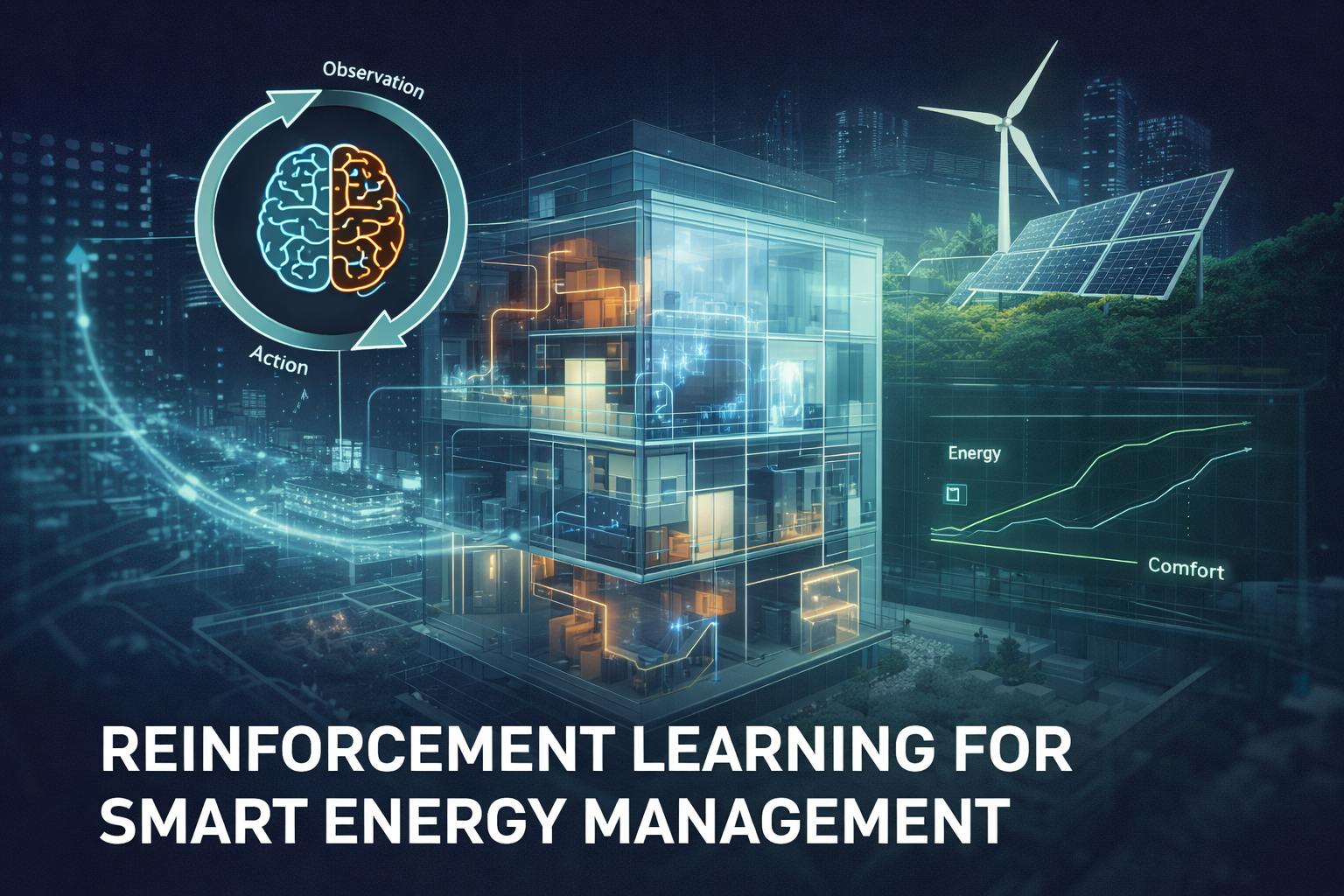
Energy optimization in buildings is often approached using static automation rules: fixed temperature thresholds, scheduled HVAC cycles, or heuristic-based controllers. While these methods are simple to deploy, they struggle to adapt to dynamic environments where weather, occupancy, and energy demand continuously change.
In real-world deployments, energy management becomes a sequential decision-making problem under uncertainty. The challenge is not only minimizing energy consumption but doing so while maintaining occupant comfort and operational stability.
This article presents the design and implementation of a production-oriented Reinforcement Learning (RL) smart energy management system built using PPO-based agents, the CityLearn environment, and a modular evaluation and visualization pipeline. The system emphasizes reliability, explainability, and deployment readiness rather than purely academic reward optimization.
The complete implementation is available on GitHub: https://github.com/harisraja123/Smart-Energy-Management-System-for-Sustainable-Buildings
Problem Context
Commercial buildings account for a significant portion of global energy consumption. Traditional Building Management Systems (BMS) operate using predefined logic, such as:
- Fixed temperature setpoints
- Time-based scheduling
- Manual parameter tuning
These approaches fail when:
- Weather conditions fluctuate rapidly
- Occupancy patterns vary
- Energy prices change dynamically
- Multiple buildings interact within shared energy systems
The objective of this project was to design an intelligent controller capable of:
- Minimizing energy consumption
- Maintaining indoor comfort
- Learning adaptive control policies over time
- Operating within realistic simulation environments
Unlike isolated ML experiments, this system treats energy optimization as a continuous control engineering problem.
System Architecture
The solution follows a modular reinforcement learning pipeline:
Environment → State Processing → RL Agent → Action Execution
        ↓
   Evaluation Engine → Metrics → Dashboard Visualization
Each component is separated to allow independent experimentation and scaling.
| Component | File |
|---|---|
| Training orchestration | main.py |
| RL agents | rl_agents.py |
| Data handling | data_manager.py |
| Dashboard interface | dashboard/app.py |
| Evaluation outputs | results/ |
This separation enables swapping algorithms without redesigning the entire system.
Environment Design with CityLearn
The system uses the CityLearn environment, which simulates energy consumption across multiple buildings under realistic conditions.
The environment provides:
- Building thermal dynamics
- Weather variability
- Electricity demand signals
- Comfort constraints
State observations include:
- Indoor temperature
- Outdoor temperature
- Energy demand
- Time-dependent features
This converts energy management into a Markov Decision Process (MDP).
Environment Interaction
Training follows the standard RL interaction loop:
state = env.reset()

while not done:
    action = agent.predict(state)
    next_state, reward, done, info = env.step(action)
    agent.learn(state, action, reward, next_state)
    state = next_state
Rather than optimizing single-step predictions, the agent learns long-term energy strategies.
Reinforcement Learning Agent Design
Agents are implemented in rl_agents.py, supporting multiple algorithms including PPO and A3C configurations.
The primary agent uses Proximal Policy Optimization (PPO) due to:
- Stable policy updates
- Continuous action compatibility
- Sample efficiency
- Reliable convergence behaviour
Policy Optimization
PPO constrains policy updates to avoid unstable learning:
L = min(
    r(θ)A,
    clip(r(θ), 1-ε, 1+ε)A
)
Where:
r(θ)represents policy probability ratiosAis the advantage estimate- clipping prevents destructive updates
This stability proved essential for long simulation horizons.
Reward Engineering
Energy optimization cannot rely solely on minimizing consumption. Doing so may sacrifice occupant comfort.
The reward function balances competing objectives:
- Energy usage reduction
- Thermal comfort preservation
- System stability
Conceptually:
Reward =
  - Energy Consumption
  - Comfort Violation Penalty
This encourages efficient operation without aggressive temperature swings.
A key engineering insight was that reward shaping dominated learning quality more than model architecture.
Training Pipeline
Training orchestration is handled in main.py.
Key stages include:
- Environment initialization
- Agent configuration loading
- Episodic training execution
- Metrics logging
- Model checkpointing
Example configuration loading:
config = load_config("models/a3c_config.json")
agent = RLAgent(config)
Configurations are versioned to ensure experiment reproducibility.
Data Management and Experiment Tracking
data_manager.py manages training and testing outputs.
Tracked metrics include:
- Energy consumption trends
- Comfort violations
- Episode rewards
- Policy performance comparisons
Outputs are stored as structured datasets enabling post-training analysis.
This separation avoids coupling analytics directly to training logic.
Evaluation and Visualization Dashboard
A Streamlit-style dashboard (dashboard/app.py) provides interactive monitoring.
The dashboard enables:
- Training vs testing comparison
- Energy consumption visualization
- Comfort performance tracking
- Model comparison views
Example outputs include:
- Energy comparison plots
- Comfort deviation graphs
- Performance timelines
Visualization transforms RL behaviour from a black box into an interpretable system.
Performance Evaluation
Experiments were conducted using the CityLearn dataset across multiple buildings.
Evaluation focused on operational metrics rather than raw reward values.
Measured outcomes:
| Metric | Objective |
|---|---|
| Energy consumption | Minimize |
| Comfort violations | Reduce |
| Policy stability | Maintain |
| Learning convergence | Improve |
Key findings:
- PPO achieved stable convergence across training episodes.
- Comfort-aware rewards prevented aggressive control strategies.
- Multi-building dynamics required longer training horizons.
Deployment-Oriented Design
Although trained in simulation, the architecture was designed with deployment in mind.
Key production considerations:
- Modular agent interfaces
- Config-driven experimentation
- Separate visualization layer
- Reproducible environments via
requirements.txt
This allows future integration with:
- Building Management Systems (BMS)
- IoT sensor pipelines
- Real-time control APIs
Limitations
Despite promising results, several challenges remain:
- Simulation-to-reality transfer gap
- Dependency on environment calibration
- Long training times
- Sensitivity to reward weighting
Future work includes domain adaptation and hybrid rule-RL controllers.
Engineering Lessons
Several practical insights emerged during development:
- Reward design matters more than model complexity.
- Stable training algorithms outperform theoretically optimal ones.
- Visualization is essential for RL debugging.
- Modular pipelines accelerate experimentation.
- Energy optimization is fundamentally a systems engineering problem.
Conclusion
This project demonstrates that smart energy management requires more than predictive modeling. By framing building control as a reinforcement learning problem and combining PPO agents with modular evaluation and visualization pipelines, it is possible to develop adaptive systems capable of balancing efficiency and comfort.
Treating reinforcement learning as an engineering system rather than an academic experiment was critical to achieving reliable and interpretable results.
As buildings become increasingly connected, reinforcement learning offers a promising pathway toward autonomous, sustainable energy optimization.