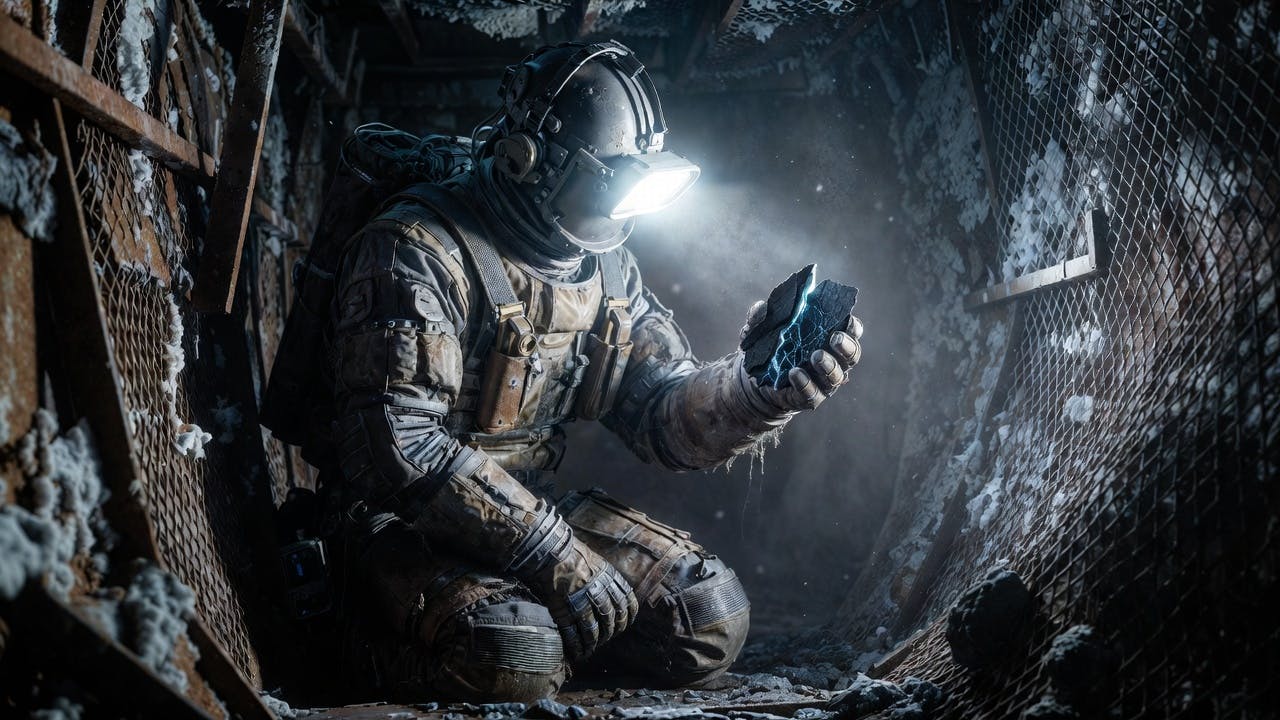
Callisto smells like wet rust and mushroom broth, same as it has for the last hundred and fifty years. The domes are patched so often that the original alloy is just a legend told by old-timers. Most of us down in the lower tiers still chase nickel veins or tend the fungus vats that feed the workforce. I do both. Name’s Caleb Morse. Forty-two, divorced, one lung half-scarred from a dust breach a decade back, and the last registered owner of Shaft 19-B, a nickel hole the survey crews wrote off as dead.
Three cycles ago I was down there by myself, nursing the cutter on its last battery pack, when the blade screamed and died. I figured I’d hit basalt. Instead I found a narrow seam of black shale nobody had ever logged, soft enough to crumble in my glove, threaded with pale fibers that glowed faint blue under the helmet lamp. Wild mycelium, growing in vacuum cracks where nothing is supposed to live. I chipped out a fist-sized chunk, sealed it in a sample bag, and forgot about it until the eviction notice flashed red.
Back in my trailer I dropped the lump on the kitchen table and poked it with a sterile probe. The threads woke up like someone flipped a switch. They started spreading across the scarred plastic surface, slow but sure, weaving a perfect hexagonal lattice. I thought it was pretty until I pulled the handheld spectrometer I use for assaying ore. The cheap little box maxes out at six-nines purity and one defect per ten-to-the-fourteen atoms. The screen locked on those numbers and refused to budge.
h-BN. Hexagonal boron-nitride. Cleaner than anything ever grown in a lab, cleaner than the instrument could even measure.
I sat down so hard the chair creaked.
Every fab from Luna to the Trojans has been chasing h-BN for thirty years. Harder than diamond, carries heat like copper, laughs at radiation, bandgap wide enough to survive cosmic radiation while circuits could run thermodynamic neural chips on the heat of your palm. Only nobody can grow it pure enough or cheap enough to matter. Best clean-room runs still cost a billion a kilo and come out looking like cracked glass full of gravel.
This dirty lump of shale had done it by accident, using a fungus nobody had ever catalogued.
The mycelium kept spreading. By morning it had eaten straight through the flame-retardant layer in the tabletop (boron-rich polymer the company mandates in every hab unit). The plastic blistered and flaked away, and in its place grew a sheet of crystal two millimeters thick, clear as meltwater, edges sharp enough to slice synth-leather. I cut a corner off with the kitchen knife. It rang like a temple bell when I flicked it.
Half a million credits, maybe more, sitting on a handspan from yesterday’s coffee rings.
I killed the trailer mesh, yanked every automatic log, and spent the next six hours watching the fungus work. It pulled nitrogen from the air same as any mushroom, but the boron had to come from somewhere. The table was giving it up molecule by molecule, turning to gray dust as the crystal grew. Feed it the right slurry and it would plate h-BN like frost on a window.
I scraped every visible spore into sterile vials, sealed them in lead foil, and buried the vials behind the frozen vodka. Then I sat in the dark and let the numbers roll over me.
Seven days, maybe ten, before the power draw from a condemned shaft triggered a routine audit. After that, drones would come sniffing, or worse, people.
I had that long to turn a lucky accident into something I could sell, or something that would get me disappeared.
I poured two fingers of the cheap vodka, raised the glass to the quiet trailer, and started planning.
***
Day four, and the table was gone. Nothing left but a pile of gray dust and a perfect hexagonal plate the size of a dinner-plate size, humming faintly when I tapped it. I’d moved the colony into an old nutrient tank I kept for growing oyster mushrooms on the side. Fed it a slurry of ground-up fireproofing foam scraped from the trailer walls, plus a little ammonia cracked from the piss-recycler. The mycelium loved it. Threads raced across the tank like white lightning, plating crystal so fast I could watch the level rise.
I hadn’t slept more than two hours at a stretch since the first night. Couldn’t. Every time I closed my eyes I saw corporate security kicking in the door.
I needed a buyer, but I needed protection first.
There’s only one outfit on Callisto that can stand up to the big consortia: the Independent Miners’ Cooperative. They run the black clinic, the off-grid power taps, and the quiet room where people go when they need to disappear for a while. I’d done favors for them over the years, small stuff, hauling unreported ore, looking the other way. Time to cash the markers.
I wrapped the plate in synth-silk, slid it into a battered sample case, and took the service lift up to Level Nine. Place called Mama Zhu’s Noodle Bar, back booth, red lantern over the door that never quite worked. Mama Zhu herself weighed two hundred kilos and had a smile sharp enough to shave with. She slid a bowl of real pork broth across the table without asking.
“Little bird says you hit the motherlode, Caleb.”
“Little bird talks too much.”
She laughed, low and warm. “Bird also says you’re about to have the kind of attention that gets a man ventilated. What do you need?”
“A vault, a clean lab, and forty-eight hours before anybody knows I’m breathing.”
“Price?”
“Ten percent of whatever I clear, payable when I clear it.”
She didn’t even blink. “Twenty.”
“Fifteen, and I throw in enough seed culture to plate every heat-shield on Callisto for the next decade.”
“Done.”
We shook on it, old style, palms pressed together like we were still on Earth.
By nightfall I was in a sub-basement under the company maps don’t admit exists. Real air scrubbers, real gravity ring, and a biosafety cabinet Mama Zhu’s people had stolen from a university ship twenty years ago. I set the tank under the hood, fed it a proper nutrient mix this time, boron salts I lifted from the refinery waste stream, nitrogen from liquid ammonia, trace metals for flavor. The mycelium went berserk. In twelve hours it plated a sheet thick enough to stop a rail-slug.
Mama Zhu came down herself to watch. She ran one thick finger across the crystal and whistled.
“Boy, you just made silicon obsolete.”
“Only if I live long enough to sell it.”
She nodded, serious now. “Word’s already out. Someone pinged the shaft registry this morning. Company security’s asking questions.”
I felt the cold crawl up my spine. “How long?”
“Twenty-four hours, maybe less.”
I looked at the tank, at the white threads pulsing like veins. Forty-eight hours was a dream. I had half that.
“Then we move tonight,” I said.
Mama Zhu grinned like a wolf. “Thought you’d never ask.”
We spent the next six hours stripping the lab. The tank went into a shock-proof crate lined with lead foam. The crystal plates got vacuum-sealed between two sheets of scrap aluminum so it wouldn’t sing when it moved. Mama Zhu’s crew rolled in with dollies and guns that didn’t have serial numbers.
By 0300 we were in the maintenance tunnels under Dome Seven, riding a stolen ore sled toward the private pads. Destination: a fast courier registered to a shell company that didn’t exist yesterday. Crewed by three ex-BN marines who owed Mama Zhu their lives and didn’t ask questions.
I was buckling into the acceleration couch when the lights went red. Emergency broadcast, all channels.
“Attention. Shaft 19-B has been declared biohazard quarantine. All personnel in sectors 14 through 19 report for immediate decon.”
Mama Zhu met my eyes across the narrow cabin.
“They’re early.”
I nodded, throat dry. “Burn hard. Don’t stop for anything.”
The pilot didn’t wait for traffic control. She lit the main torch and punched us straight through the cargo lane, scattering drones like startled birds. Behind us, Callisto’s sky filled with the blue strobes of company gunships scrambling off the pad.
We had maybe six minutes’ head start.
I looked at the crate bolted to the deck between my boots and felt the old miner’s prayer rise in my chest.
Please let this be worth dying for.
The courier’s engines roared, and Callisto fell away behind us like a bad memory.
***
The courier was an old BN surplus cutter with the military transponder ripped out and replaced by something that lied in twelve languages. We burned at two gees for four straight hours, long enough to put a cold million kilometers between us and Callisto traffic control. My spine felt like it had been run over by a loader, but the crate stayed bolted down and the mycelium stayed alive.
Mama Zhu sat across from me nursing a squeeze-bulb of coffee strong enough to strip paint. “We’re dark now. No beacon, no handshake. Next friendly port is Europa Station, thirty-six hours if we don’t mind cooking the coils.”
I nodded. Europa had a free-market dock and a reputation for looking the other way if the credits were right. More important, it had the annual Materials Consortium expo starting in five days. Every big fab, every patent broker, every venture shark in the outer system would be there with open wallets and closed mouths.
I just had to stay alive until then.
The pilot patched a tight-beam from the rear scope. Grainy image, but clear enough: three company gunships in pursuit, running hot, no running lights. They’d left Callisto space and were still accelerating.
Mama Zhu whistled. “They really want you.”
“They want what’s in the crate.”
She looked at me steady. “How much is really in there, Caleb?”
“Enough to rewrite the whole chip industry. Enough that the people chasing us will burn a billion credits in fuel just to keep it quiet.
”She took a slow sip. “Then we don’t get caught.
”The next twenty hours were a slow-motion chase across the dark. The gunships had better legs, but our pilot knew every trick in the book: ghost burns, cold-coast drifts, hiding in the radar shadow of ice chunks the size of towns. We shaved reaction mass to the bone and prayed.
At hour twenty-six the proximity alarm screamed. One gunship had burned ahead on a least-time intercept. They were close enough now to paint us with targeting lidar.
Mama Zhu unbuckled, pulled a long case from the overhead. Inside was a coil-accelerated slug thrower older than I was. She handed me a sidearm that looked like it had been built from spare parts and bad intentions.
“Ever shoot in zero-gee?”
“Only drunk.”
“Good enough.”
We strapped into the dorsal turret, just a bubble with a railgun and a prayer. The gunship filled the scope, sleek and black, company crest painted over with matte kill-plate. They hailed us once, voice flat and corporate.“
Unidentified vessel, cut thrust and prepare to be boarded. Resistance is futile.”
Mama Zhu keyed the mic. “Come get some, sweetheart.”
The shooting started thirty seconds later.It wasn’t pretty. Rail slugs moving at four kilometers a second don’t care about drama. Our turret chewed the gunship’s forward radiator fins; they answered by putting a round through our number-two tank. Alarms howled. The courier yawed hard, bleeding air and water ice in a glittering spiral.
I watched the crate skid against its straps and felt my heart stop.
Then the second and third gunships flickered onto the scope, still ten minutes back but closing fast. We were done.
Mama Zhu looked at me, calm as Sunday morning. “Time for plan C.”
“There’s a plan C?”
She grinned. “Always.”
She slapped a red switch marked EMERGENCY BROADCAST. The courier’s entire comm stack lit up like a festival, blasting an open channel on every frequency from HF to gamma.
“This is independent vessel Lucky Strike. We are carrying a breakthrough in wide-bandgap semiconductor production. Full technical specs, genome, growth parameters, everything. If we go dark, the packet dumps to every public node from here to Saturn. You want to keep this quiet, you back off now.
”Silence for five long seconds.
Then the lead gunship rolled, fired braking thrusters, and turned away. The others followed. They couldn’t risk the data getting out. Not yet.
Mama Zhu let out a breath that shook. “That bought us twelve hours. Maybe.”
I stared at the retreating ships until they were just sparks. My hands wouldn’t stop trembling.
She clapped me on the shoulder. “Relax, miner. You just went from hunted to untouchable. For a little while, anyway.”
Europa grew from a bright dot to a cracked white ball of ice. We limped into the free-dock with half a hull and no fuel margin, but we made it.
The expo hall was chaos: booths taller than hab blocks, holo-ads for quantum dots and neutron weaves, air thick with money and desperation. I walked the floor in a clean coverall Mama Zhu’s people scared up, sample case handcuffed to my wrist, heart hammering like a jack-drill.
By the end of the first day I had seventeen offers. By the end of the second, thirty-two. The numbers climbed so fast I stopped counting zeros.
I picked the one that didn’t try to kill me in the fine print: New Kyoto Fab Collective, a worker-owned outfit out of Ganymede with a reputation for keeping promises. We met in a rented conference room that smelled of green tea and ozone. Their lead negotiator was a small woman with silver hair and eyes like winter.
“You’re the mushroom man,” she said.
“That’s me.”
“Show me.”
I opened the case. The crystal plate caught the light and threw it back in rainbows. She ran a portable scope over it, breath hissing between her teeth.“
Defect density below instrument threshold. Growth rate?”
“Ten microns an hour at room temp, ambient pressure, feed it boron salts and table scraps.”
She closed the case gently, like it might explode. “Name your price.”I told her.
She didn’t blink. “Half up front, half on verified production. Plus royalties in perpetuity and a seat on the board for you.”
Deal was signed before the tea got cold.
Three days later I walked out of Europa Station with more money than I knew how to spell and a new name on every patent server from Mercury to Triton. Pen-2234 went open-source the same hour, seeded to every university mesh on the net. Let the big boys try to bury it now.
Mama Zhu met me at the dock with a bottle of real Japanese whiskey and a one-way ticket to anywhere.
“You did good, miner.”
“Still breathing,” I said. “That’s a win.”
She poured two fingers into plastic cups. “To accidents.”
“To accidents.”
We drank while Europa’s ice glittered outside the viewport, and somewhere behind us Callisto kept turning, still smelling like rust and mushrooms, but a little poorer for losing the luckiest broke prospector who ever lived.
***
Six months later I was living in a low stone house on the north shore of the Vastitas Sea, where the red dunes drop straight into black water and the wind still carries the bite of thin air. Mars has come a long way, but it isn’t Earth yet. Outside, I wear the little mask that clips over nose and mouth, a clear half-shell no bigger than a pair of sunglasses, fed by a bottles that last hours. Spare rides on the back of my belt like an old habit. Inside the house, inside the boat, inside any dome or car, the air is thick and wet and mine. Outside, I breathe through the bottle and don’t complain, because the view is worth it.
The royalties still land every Thursday, obscene numbers I quit counting after the first month. I bought the house on the cliff, a catamaran with a sealed cabin, and a dock that juts into water the color of gunmetal. The rest goes into the fund that pays for new lungs for old miners. My own pair came courtesy of that fund: pink, perfect, grown from my own cells in a New Kyoto tank. First full breath I took after surgery tasted like money and miracle.
They still call it the Morse Disruption. Chip prices collapsed, fabs on Mars and Luna started sprouting Pen-2234 like mold on bread, and the old silicon giants closed plants and cried in public. I open-sourced everything the day the deal closed, so the courts laughed the lawsuits out the airlock. Now everybody grows the stuff, even school kids in terrariums.
Mama Zhu still flies down once a month on whatever fast packet owes her favors. She brings terrible whiskey and real coffee, sits on my porch while the sun sets blood-red over the sea, and watches me swap bottles without breaking stride. She never takes more than the fifteen percent we shook on. Says the look on the consortia faces was worth the rest.
Some mornings I sail out past the breakwater, seal the cabin, pull the mask off, and let the recycled air hit my new lungs clean and deep. The fish here hit hard: silver torpedoes bred for low oxygen and cold water. I keep a couple for supper, toss the rest back. The sea doesn’t care how rich I got.
Last week a plain gray drone dropped a package on the dock. Inside was a single h-BN wafer the size of my hand, edges sharp enough to shave with, surface etched in UV script:
Thank you for the air, miner.
We grow in the dark so others don’t have to.
I hung it above the hearth where the afternoon light turns the room into green fire. Some evenings I sit with a glass of Mama Zhu’s rotgut in my hand, and listen to the wind hiss against the seals. The crystal hums quiet, like it remembers vacuum and stone and the long wait for one broke fool to set it free.
I never went back to Callisto. Shaft 19-B is buried under concrete and lies now. Good.
Out on the porch the wind shifts, carrying the smell of salt and algae from the shoreline farms. Somewhere down the coast an old rock-rat who used to cough blood every shift is breathing easy on somebody else’s dime, walking his own beach.
That’s legacy enough.
I still fish. I still swap oxygen bottles like other men check their watches. And when the northern lights come down low enough to touch, green fire dancing over black water, I lift my glass to them, to the dark, to the patient threads that changed everything because I was too stubborn to throw a dirty rock away.
They don’t answer out loud.
They don’t need to.
Both lungs full richer than sin and twice as grateful.
Some nights I walk the wet sand that shines like polished metal under the moons listening to the quiet hum of a world learning how to grow its own tomorrow.
[story continues]
tags