
Table of Links
-
Experiments
B. Hyperbolic Space
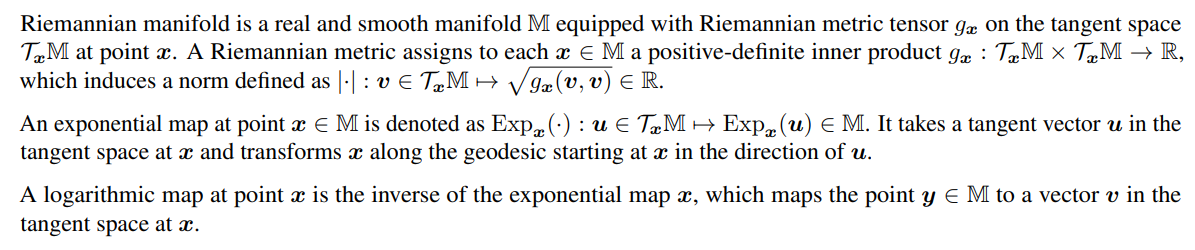
B.1. Riemannian Manifold
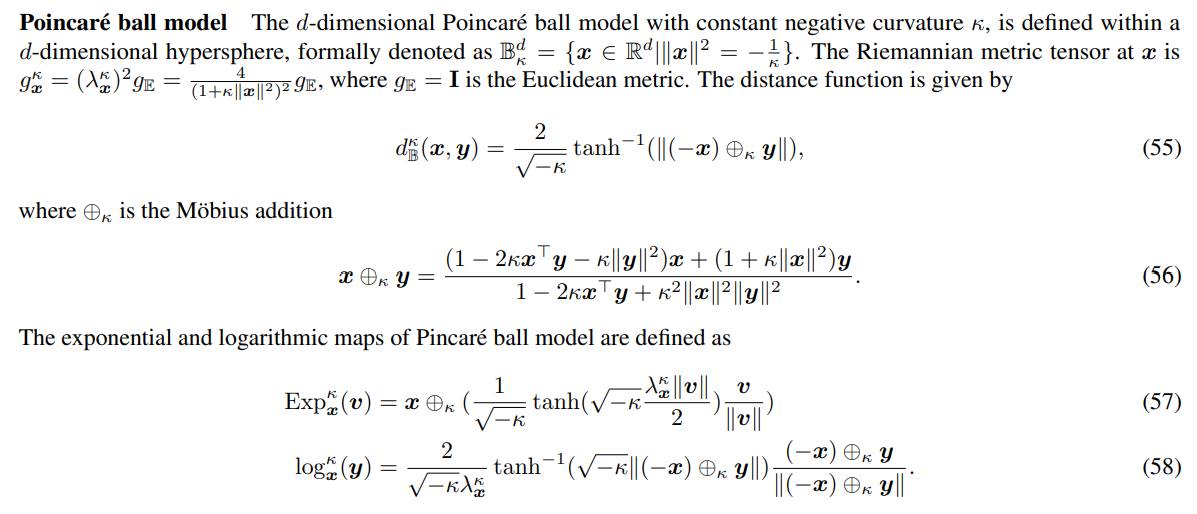
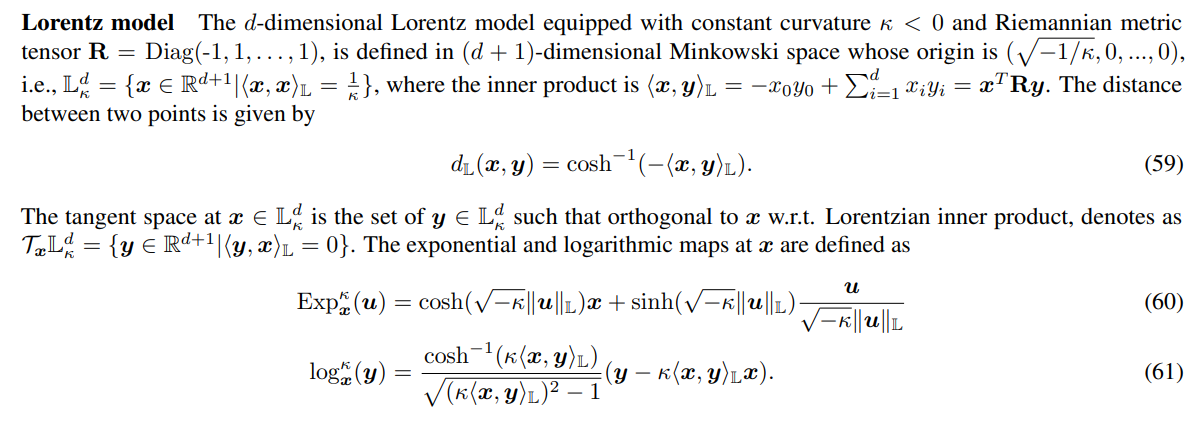
B.2. Models of Hyperbolic Space
B.3. Tree and Hyperbolic Space
We denote the embedding of node i of graph G in H is ϕi . The following definitions and theorem are from (Sarkar, 2011).
Definition B.1 (Delaunay Graph). Given a set of vertices in H their Delaunay graph is one where a pair of vertices are neighbors if their Voronoi cells intersect.
Definition B.2 (Delaunay Embedding of Graphs). Given a graph G, its Delaunay embedding in H is an embedding of the vertices such that their Delaunay graph is G.
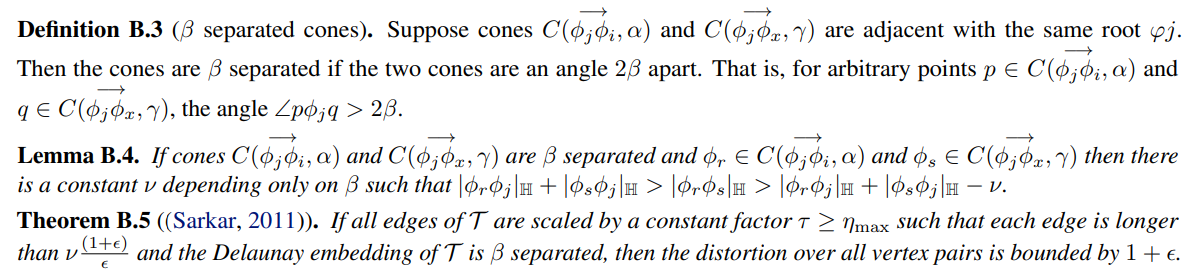
Following the above Theorem, we know that a tree can be embedded into hyperbolic space with an arbitrarily low distortion.
B.4. Midpoint in the Manifold
Let (M, g) be a Riemannian manifold, and x1, x2, ..., xn are points on the manifold. The Frechet variance at point ´ µ ∈ M of these points are given by

If there is a point p locally minimizes the variance, it is called Frechet mean. Generally, if we assign each ´ xi a weight wi , the Frechet mean can be formulated as

Note that, d is the canonical distance in the manifold.
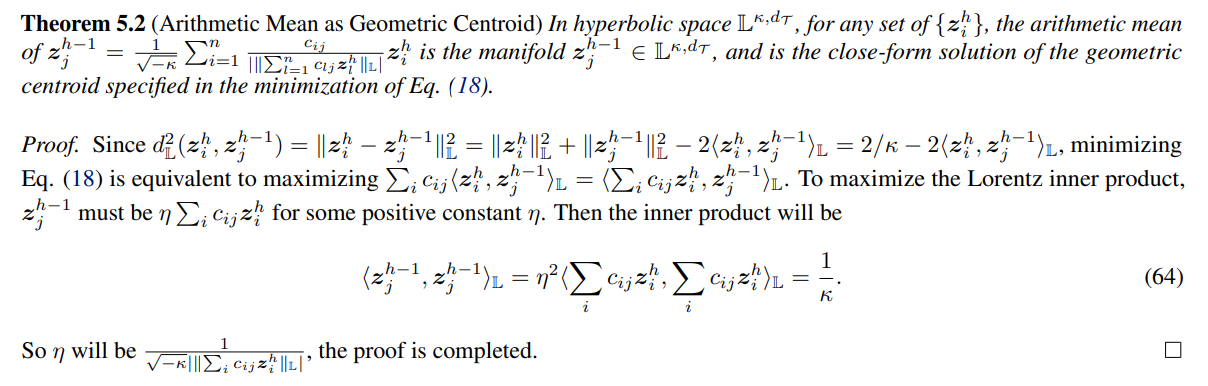
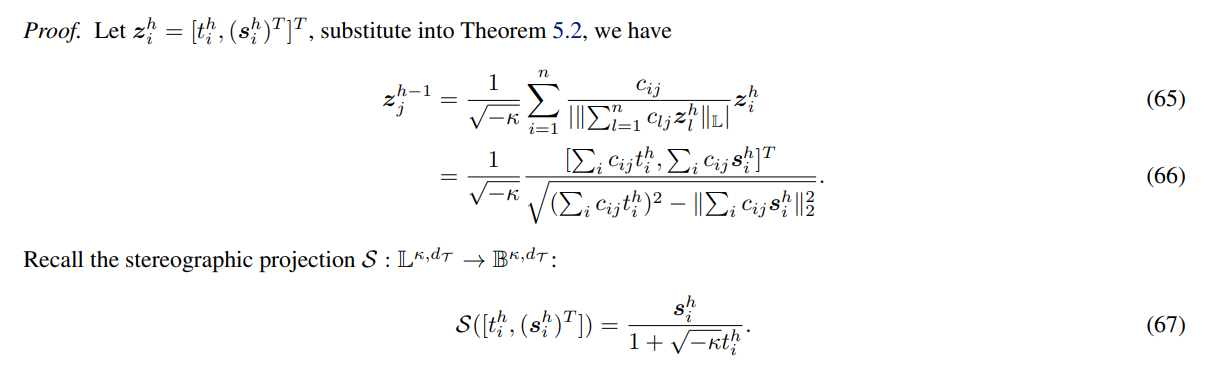
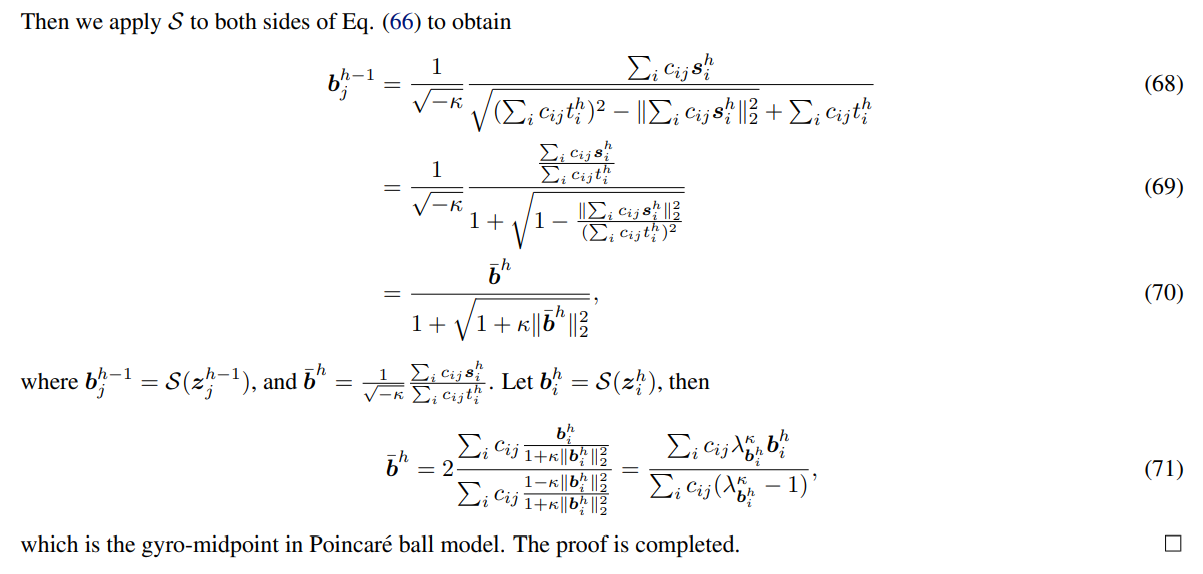
Remark. In fact, the geometric centroid in Theorem 5.2 is also equivalent to the gyro-midpoint in Poincare ball model of ´ hyperbolic space.
Authors:
(1) Li Sun, North China Electric Power University, Beijing 102206, China (ccesunli@ncepu.edu);
(2) Zhenhao Huang, North China Electric Power University, Beijing 102206, China;
(3) Hao Peng, Beihang University, Beijing 100191, China;
(4) Yujie Wang, North China Electric Power University, Beijing 102206, China;
(5) Chunyang Liu, Didi Chuxing, Beijing, China;
(6) Philip S. Yu, University of Illinois at Chicago, IL, USA.
This paper is
[story continues]
tags