In software engineering, code without tests rarely makes it to production.
In data systems, the bar is often much lower: “as long as the table isn’t empty, it’s probably fine.”
But this assumption is expensive.
Data bugs rarely crash services. Instead, they quietly produce broken dashboards, misleading metrics, incorrect business decisions, and long debugging sessions after trust is already lost. The problem isn’t that teams don’t care about quality, it’s that data failures rarely look like failures. They look like slightly wrong numbers.
Over time, this erodes confidence in analytics, ML models, and reports. People stop trusting data not because it is always wrong, but because no one can say with confidence when it is right.
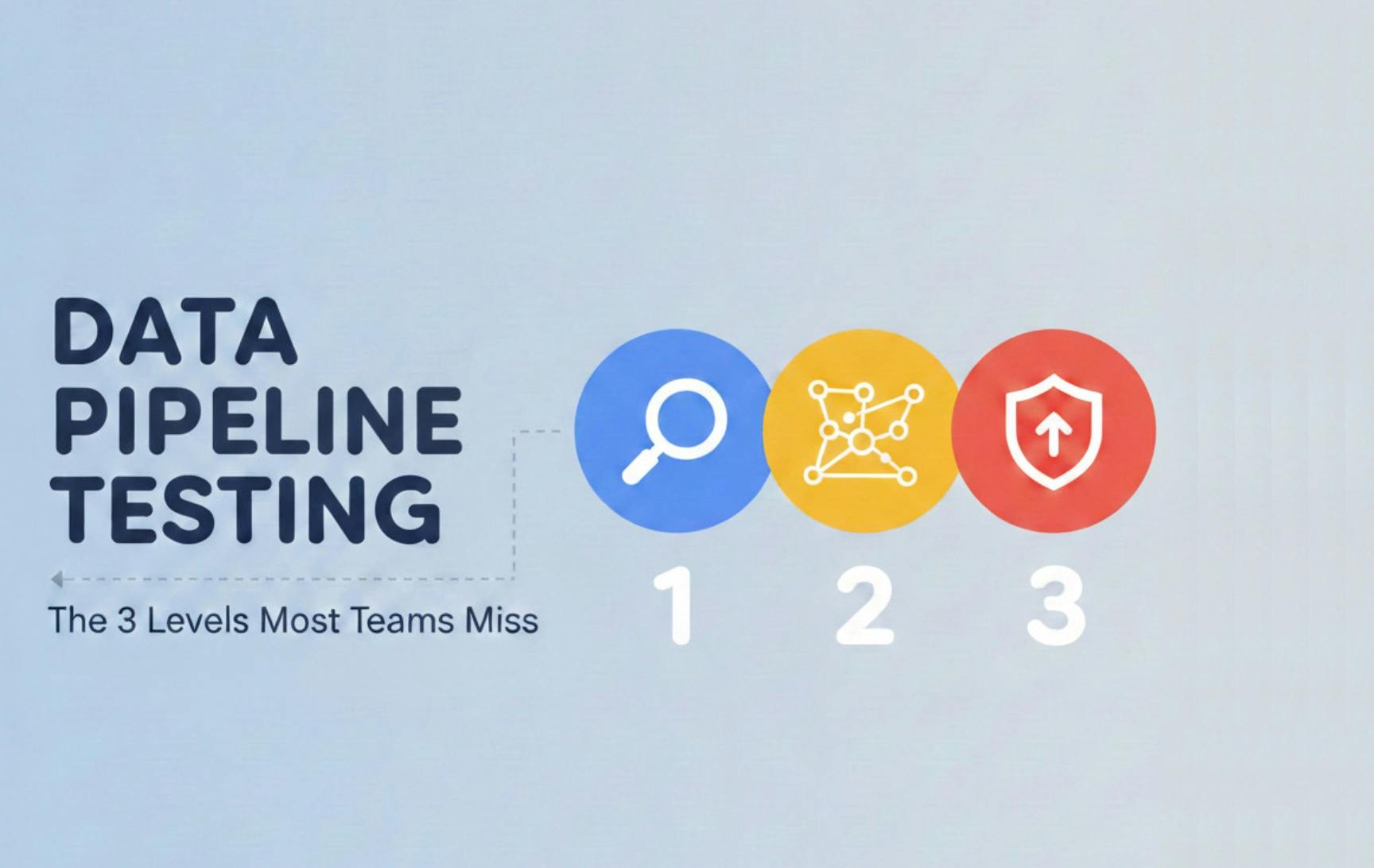
In this article, we’ll look at three levels of data pipeline testing that many teams miss — especially in SQL‑heavy environments — and how to introduce them incrementally without slowing teams down.
Why Data Testing Is Different
A dashboard can look perfectly healthy while being fundamentally wrong.
Revenue might be “up.”
User activity might seem stable.
A week later, someone realizes that key decisions were based on incorrect assumptions and no one can pinpoint when or why the data drifted.
Unlike application bugs, data issues often don’t fail loudly. They propagate silently. By the time someone notices, the damage is already done.
This is why testing data pipelines is not just about correctness, it’s about reducing uncertainty.
Level 1: Schema and Type Checks
The most basic layer of data testing is structural.
Schema and type checks answer a simple question:
“Does this data still look the way downstream systems expect it to?”
Typical checks include ensuring that required fields are not NULL, timestamps are actually timestamps, numeric fields stay within reasonable bounds, and columns don’t disappear or accidentally change type.
These tests catch issues caused by upstream schema changes, partial migrations, malformed ingestion jobs, or unexpected source data.
Many teams skip this layer entirely and rely on analysts to notice problems manually. As a result, schema drift often goes unnoticed until queries start failing or worse, until they stop failing but return incorrect results.
Tools like dbt or Great Expectations make these checks easy to implement, but the real shift is conceptual. Schema stability should be treated as a contract, not as documentation. Once schema changes are allowed to happen silently, every downstream assumption becomes unstable.
Level 2: Business Logic Checks
Schema‑valid data can still be completely wrong.
Business logic checks validate assumptions about how data should behave, not just how it is structured. Examples include rules like order amounts should never be negative, a single user cannot place hundreds of orders in a few minutes, or an order cannot be closed before it is opened.
These rules reflect domain knowledge. They are usually obvious to humans but not to pipelines, unless you write them down.
The most common failure mode here is that such checks exist only informally. Someone notices a strange number in a report, investigates the issue, fixes the data manually, and moves on. The fix rarely becomes automated, so the same class of bug reappears later.
Business logic tests are not about KPIs or analytics logic. They are about invariants - conditions that should never be violated if the system is healthy.
They are often implemented as SQL assertions or lightweight Python checks inside pipelines. The specific tool matters less than the habit: if a rule matters, it should be enforced automatically and logged when it fails.
Level 3: Contract Tests
The third level is the one most teams miss entirely.
Contract tests define explicit expectations between producers and consumers of data. They answer the question:
“What guarantees does upstream data provide to downstream systems?”
Examples include an ML service expecting a prediction field with values between 0 and 1, a reporting team relying on a status column being one of a known set of values, or downstream jobs assuming a specific granularity or partitioning scheme.
Without contracts, any upstream change can silently break downstream logic. Teams often discover the issue only after something important starts behaving strangely.
In software, breaking an API contract usually causes an immediate failure. In data systems, breaking a data contract often produces plausible but wrong results, which is far more dangerous.
Contract tests are especially critical when multiple teams own different parts of the data flow, ML models consume data produced by other systems, or schemas evolve frequently.
They are commonly implemented using schema definitions, CI checks on schema changes, or automated alerts when contracts are violated. The key idea is simple: data dependencies should be explicit, versioned, and enforced, not tribal knowledge passed around in Slack threads.
Data testing becomes much easier when expectations are explicit and versioned. To make the framework in this article more tangible, here’s a small tool‑agnostic repo with example contracts and checks (schema/type expectations, invariants, and producer/consumer contracts).
https://github.com/timonovid/data-pipeline-testing?embedable=true
Think of it as a conceptual starter kit — not a full platform
Integrating Data Tests into CI/CD
Data tests are only effective if they run automatically.
In practice, this usually means running schema and business logic checks on every change to data pipelines, validating contracts when schemas or interfaces change, and running periodic checks on production tables to detect silent regressions.
CI/CD setups don’t need to be complex. Even a minimal configuration that runs tests on pull requests and blocks unsafe changes dramatically reduces production incidents.
What matters most is consistency. Tests should fail loudly, failures should be visible, and ownership should be clear. The goal is not to catch every possible issue, but to prevent known classes of bugs from reaching production repeatedly.
Monitoring Data in Production
Testing does not end at deployment.
Even with CI/CD in place, production data needs monitoring because sources change, user behavior evolves, and pipelines age. Effective data monitoring focuses on signals such as unexpected drops or spikes in row counts, sudden increases in NULL values, distribution shifts in key metrics, and data freshness or latency issues.
Many teams already collect this information but fail to act on it. Alerts fire, but no one knows who is responsible. Dashboards exist, but are rarely checked.
Monitoring only works when paired with ownership. An alert without a clear owner quickly becomes noise.
Final Thoughts: Don’t Wait for a Data Incident
Data testing is not about perfection.
It is about reducing uncertainty.
Teams that invest early in schema checks, business logic validation, and explicit contracts spend far less time debugging mysterious issues later. Problems surface earlier, are easier to diagnose, and stop repeating themselves.
You don’t need to build a full data quality platform on day one. Start small: validate schemas, encode obvious business rules, and make dependencies explicit.
Over time, these practices turn data pipelines from fragile workflows into systems that can survive growth.
[story continues]
tags