This story on HackerNoon has a decentralized backup on Sia.
Transaction ID: RajVeUtDP_0purjj5kJ7PFrZBgaMOT9NNw0J6pCepAs
Cover

Extending Direct Nash Optimization for Regularized Preferences

Written by @languagemodels | Published on 2025/4/17

TL;DR
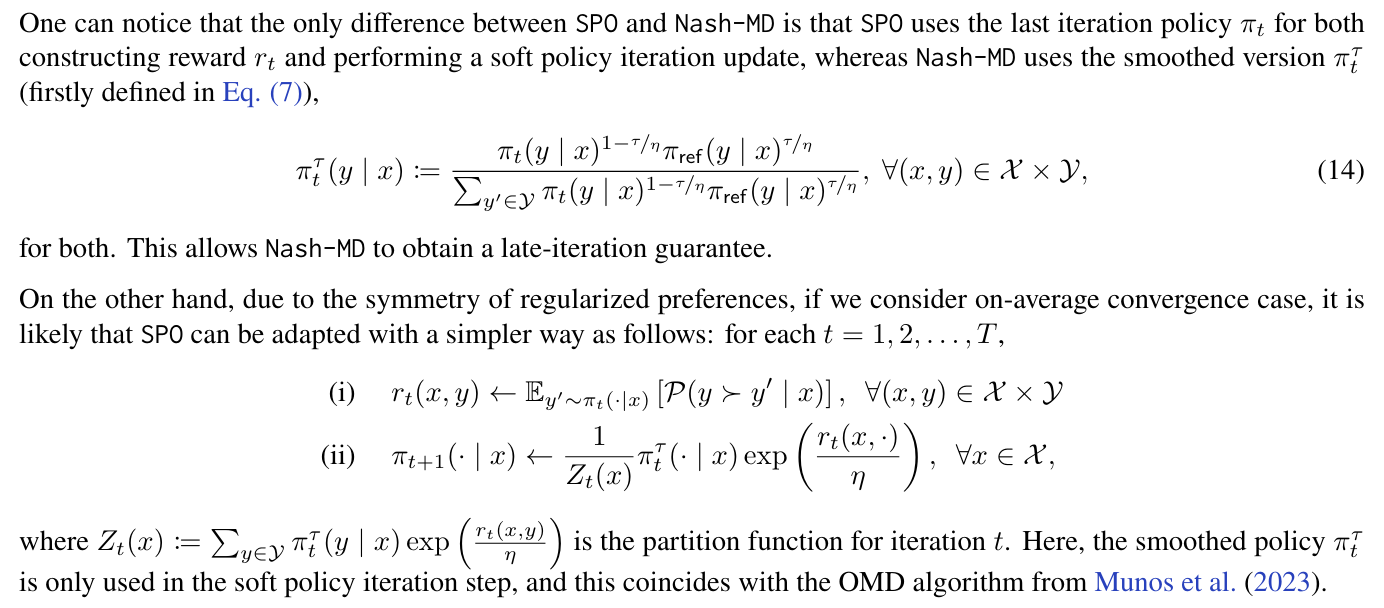
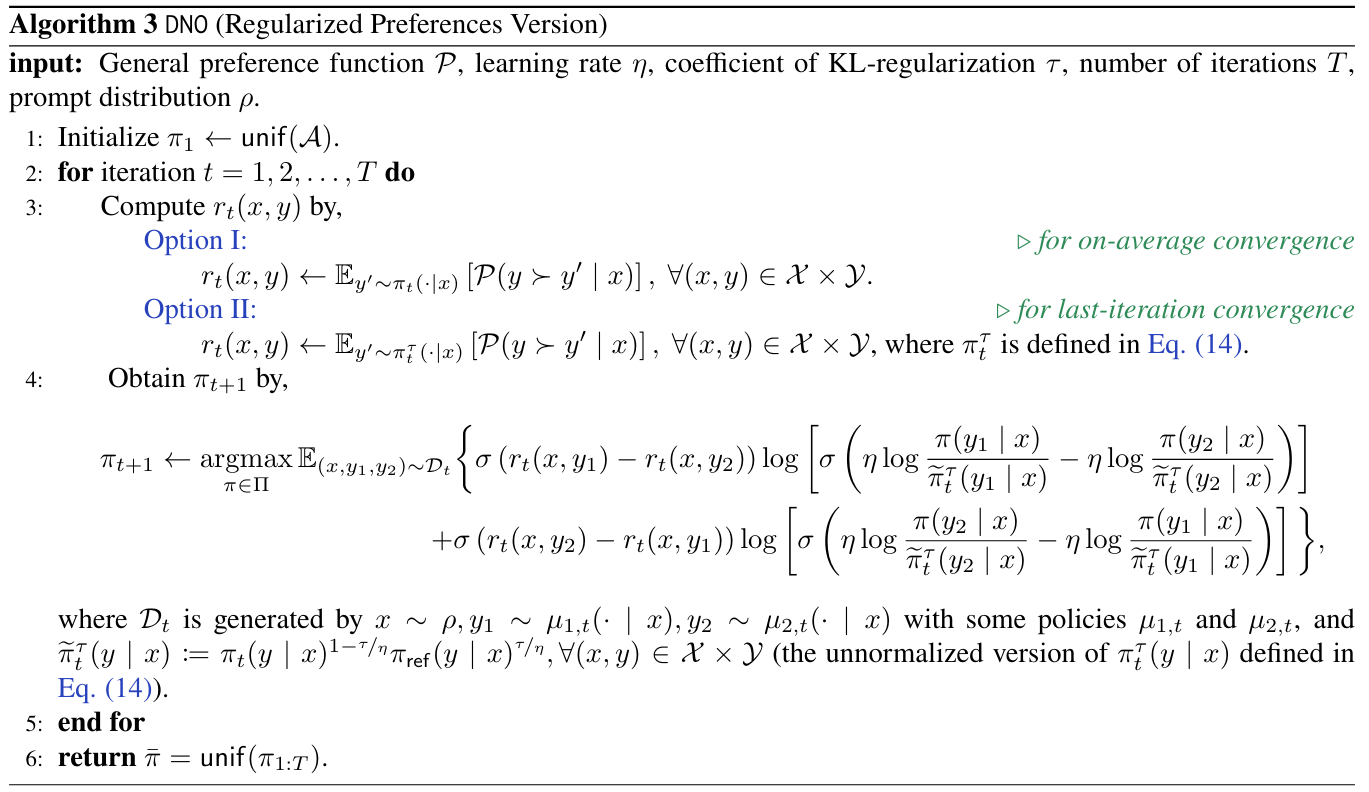
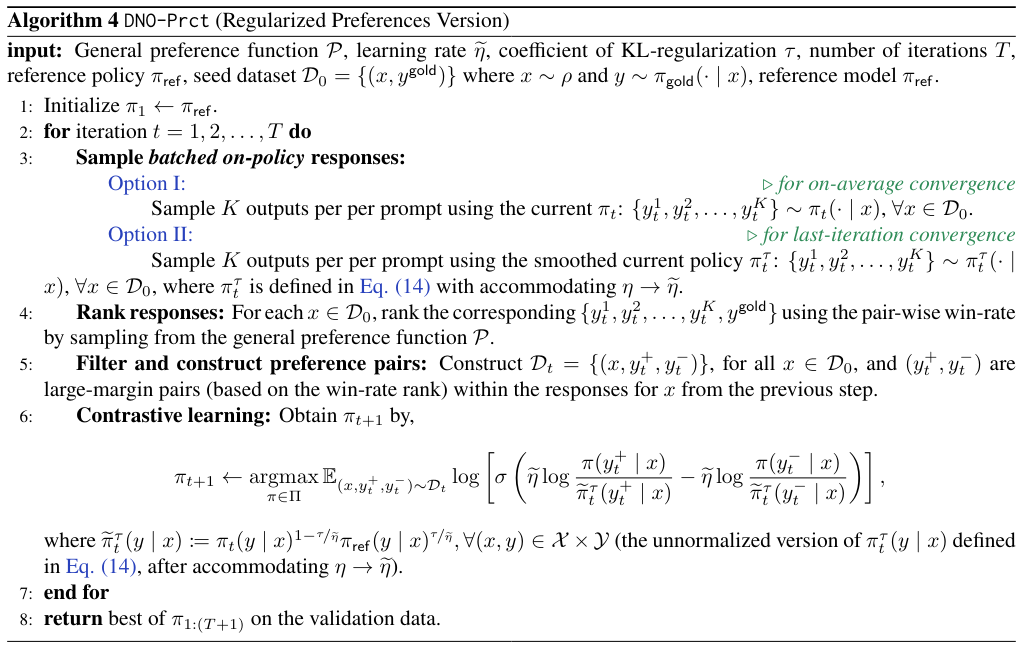
This section presents an extension of the Direct Nash Optimization (DNO) framework for handling regularized preferences. The key difference between SPO and Nash-MD lies in the use of smoothed policies for the latter, which helps obtain a late-iteration guarantee. The section introduces a new version of DNO, designed to converge to a Nash equilibrium using KL-regularization. The algorithm (Algorithm 3) works iteratively, adjusting the policy distribution through a partition function and reward function, ultimately refining the policy with each iteration. The approach helps address the challenges of regularized preferences while ensuring stable convergence.

Authors:

(1) Corby Rosset, Microsoft Research and Correspondence to corbyrosset@microsoft.com;

(2) Ching-An Cheng, Microsoft Research;

(3) Arindam Mitra, Microsoft Research;

(4) Michael Santacroce, Microsoft Research;

(5) Ahmed Awadallah, Microsoft Research and Correspondence to hassanam@microsoft.com;

(6) Tengyang Xie, Microsoft Research and Correspondence to tengyangxie@microsoft.com.

Abstract and 1 Introduction

2 Preliminaries

2.1 RLHF Based on Reward Models

2.2 RLHF with General Preferences

3 Direct Nash Optimization and 3.1 Derivation of Algorithm 1

3.2 Theoretical Analysis

4 Practical Algorithm – Iterative Contrastive Self-Improvement

5 Experiments and 5.1 Experimental Setup

5.2 Results and Analysis

6 Related Work

7 Conclusion and References

Appendix

A Extension to Regularized Preferences

B Detailed Proofs

C Additional Experimental Details

A Extension to Regularized Preferences

In this section, we discuss how to extend the DNO framework to the case of regularized preferences (defined in Eq. (5)),

which was first introduced and solved by Munos et al. (2023) via Nash-MD introduced earlier.

This paper is available on arxiv under CC BY 4.0 DEED license.

[story continues]


Written by
@languagemodels
Large Language Models (LLMs) ushered in a technological revolution. We breakdown how the most important models work.

Topics and
tags
llm-fine-tuning|direct-nash-optimization|contrastive-learning-ai|ai-feedback-loops|ai-preference-optimization|how-to-train-ai|rhlf-optimization|dno-algorithm
This story on HackerNoon has a decentralized backup on Sia.
Transaction ID: RajVeUtDP_0purjj5kJ7PFrZBgaMOT9NNw0J6pCepAs