


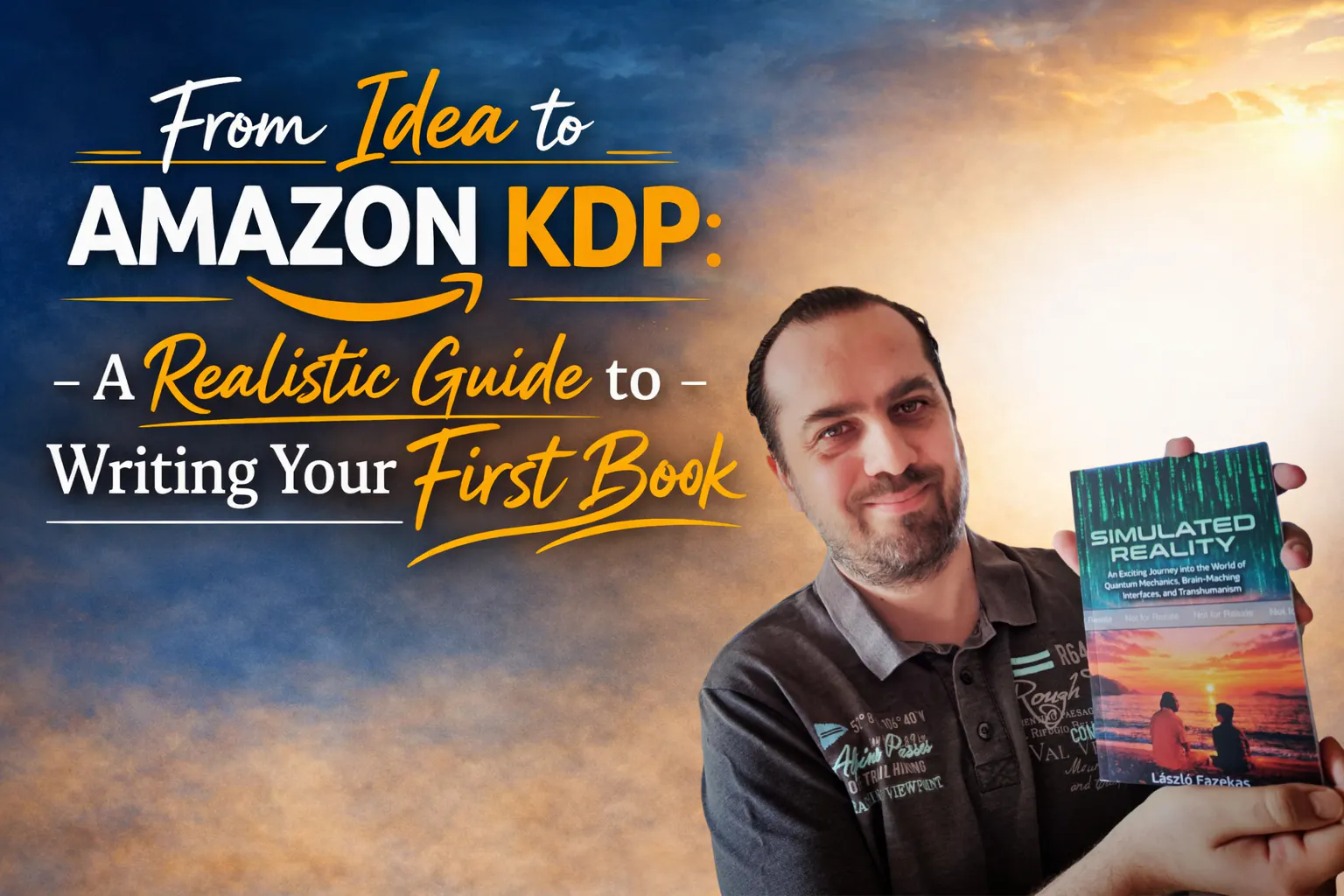
I must have been around thirteen when I decided I was going to write a book about the nature of reality and the simulation hypothesis. That was roughly 30 years ago (yes, I’m old).
At the time, I didn’t feel I had the persistence needed to take on such a “gigantic” project. So instead, I chose to write articles. Over the years, I ended up writing so many that they could have easily filled a book.
At some point, I thought: why not just compile my HackerNoon articles on the topic into a book? I assumed it would take a few weeks.
I was very wrong.
In the end, it took me a full year to write my first book.
In this article, I want to share that journey—and hopefully help those who are thinking about publishing a book themselves.
Do You Really Need to Write a Book?
If you’re thinking about publishing a book, the first and most important question is: Do you actually need to do this?
The answer depends entirely on the topic.
For example, a novel doesn’t really work in any other format. But if you’re writing about science or technology, it’s worth considering alternatives. If your goal is to reach as many people as possible, you’ll usually be better off breaking your book into chapters and publishing them as articles on platforms like HackerNoon.
These platforms already provide access to a large audience. On top of that, articles are much easier to share on social media. People are also far more likely to read an article than to buy a book.
If I add up the total readership of my articles on simulated reality, it reaches into the thousands. I’m almost certain that my book won’t sell in those numbers.
Even if your goal is to make money, writing a book might not be the best choice. As a first-time author, you can realistically expect to earn around $2–$6 per copy. When you do the math, you quickly realize that you need to sell a lot of books to make a meaningful income.
And to reach those numbers, you’ll probably need to invest in marketing, which costs money. So getting rich from writing a book is not exactly the easiest path.
In contrast, if you write a strong article for a HackerNoon contest, you can often win as much money instantly as you would earn from years of book sales.
Now that I’ve successfully talked everyone out of writing a book, let’s look at why it might still be worth doing.
Some topics work better as books. A novel is the obvious example. In my case, the topic of simulated reality doesn’t strictly require a book format, but for me, the book became a kind of premium content.
I’ve already written articles about most of the topics it covers, but in the book, they are explored in much greater depth and arranged into a coherent journey. The reader starts with the known laws of physics and gradually arrives at the idea that, in the not-so-distant future, we may exist digitally in simulated worlds or that we might already be living in one.
You can’t compress that kind of journey into a single article, not with the same depth or clarity.
The other reason is more personal.
As I mentioned earlier, I decided as a teenager that I would write a book someday. It’s been on my bucket list ever since, and I felt like I owed it to myself to do it finally.
The Idea
If you decide to write a book, you’ll need a strong concept.
I built my book around the idea of simulated reality, an interdisciplinary topic that connects physics, technology, neuroscience, and philosophy.
The first part of the book explores how strange reality actually is, based on our current scientific understanding. Relativity and quantum mechanics show that reality is already quite bizarre. When you take that into account, the simulation hypothesis isn’t all that much stranger than the models we already accept.
The book argues for a version of the simulation hypothesis in which the “computer” running the simulation wasn’t created by an advanced civilization, but instead emerged spontaneously, just like our universe. This idea is closely related to a special case of the Boltzmann brain paradox, which still poses serious challenges for theoretical physicists working in cosmology today.
The second part of the book shifts focus. Whether we live in a simulation or not, the argument is that building our own simulated worlds might be one of the most important goals we can pursue. It could even be the only path toward a truly sustainable future, one where everyone can live in abundance.
This section explores the potential technologies that could make this possible.
The final part looks toward the future through the lens of transhumanism. The book suggests that any intelligent species will eventually converge toward an optimal form: a digital existence within simulated realities.
If that’s the case, then when we search for extraterrestrial life, we should be looking for signs of such forms of existence. And if humanity doesn’t go extinct prematurely, this is likely our future as well.
Which brings the idea full circle.
Either we will live in simulated worlds in the future, or we are already living in one.
My concept, therefore, was to create a kind of intellectual journey, one that begins with the simulation hypothesis and ultimately returns to it.
Along the way, I explore topics like quantum mechanics, brain–computer interfaces, nanorobots, and mind uploading, subjects I’ve always been fascinated by and have written about extensively on HackerNoon.
Publisher or Self-Publishing?
Not long ago, if you wanted to publish a book, you had no real choice but to find a publisher.
This was true even for self-funded projects, since producing a book required significant resources. With printed books, you had to deal with printing costs, professional translators, editors, proofreaders, and more. You needed financing, and that’s where publishers came in.
A publisher is to an author what a VC is to a startup.
The book is the project. The publisher invests money and resources in the hope of making a multiple on that investment. And just like venture capital deals, publishing contracts tend to be strict.
The publisher keeps a large percentage of the revenue, while the author typically receives around 10–20%. On top of that, the publisher may have influence over the content and can put pressure on the author to maximize profitability.
Of course, there are advantages. A publisher’s network and resources can help with distribution and visibility, and they can play a major role in building your name, just like VCs help startups grow.
But it’s a demanding path.
And I knew one thing for sure: I didn’t want that.
For me, writing is a hobby and a form of art. I wouldn’t be able to create what I truly want under constant pressure, so I chose the other path.
Thanks to technological advances and the rise of Print on Demand (POD) services, anyone can now publish a book without significant upfront investment other than their own time and effort.
Print on Demand works like this: when a customer orders your book, the service prints a copy and ships it directly to them. There’s no minimum order quantity like with traditional printing; books are produced one at a time.
There are several POD providers, such as Lulu, BookVault, IngramSpark, and, of course, the best-known: Amazon KDP.
You upload your book and cover as PDFs, publish it on the platform, and from that point on, your main job is to drive readers to your book. The POD provider handles printing and shipping.
Amazon typically takes around 40% of the sale price, and printing costs are roughly $4 for paperback and around $8 for hardcover editions. Based on this, you can calculate your profit depending on your pricing. For first-time authors, this usually comes out to about $2–$6 per copy, just as I mentioned earlier.
There’s also the option to order author copies at production cost and sell them yourself through your own webshop. In this case, you avoid Amazon’s 40% cut, but you’ll need your own sales platform and handle shipping.
Some providers, such as Lulu and BookVault, offer integrations that let you connect them directly to your webshop so they can still handle fulfillment. However, you’ll need to build the store and drive traffic to it yourself.
Another option is IngramSpark, which can help you get your book into physical bookstores. But this comes at a cost: you’ll typically need to offer around a 50% wholesale discount, and many retailers also expect you to buy back unsold copies.
If you’re a first-time author without ambitious distribution plans like bookstores or your own webshop, the simplest and most practical choice is Amazon KDP.
You upload your book and let Amazon handle the rest.
AI and Writing a Book
The most important rule: don’t let AI write your book.
AI can help in many ways, but a book written entirely by AI carries very little value. If a model generates your entire book, then anyone else could generate the same thing for themselves, making your work essentially meaningless.
That said, AI can be extremely useful in the writing process.
Translation and Readability
If you want to write your book in English or any language that isn’t your native language, you used to need a professional translator, which can be quite expensive.
Today, AI can handle this task remarkably well. Tools like ChatGPT can produce high-quality translations. Still, it’s important to review the final result to make sure it truly reflects what you intended to say.
A good translation should preserve both the content and your personal style. It shouldn’t strip away your voice as an author.
If you’re not confident enough in the target language to verify the result, a useful trick is to translate the text back into your native language and compare it with the original.
Another helpful tip: if you’re translating into a language like German, Spanish, or French, start from an English version rather than directly from your native language. Large language models are trained heavily on English content, so translations from English tend to be more accurate.
Fact-Checking
AI can also act as a kind of technical reviewer.
Whether you’re writing scientific content, hard sci-fi, or historically grounded fantasy, it can help identify obvious mistakes. Since language models have been trained on vast amounts of information, they can often catch major inaccuracies.
It’s a good idea to run your manuscript through multiple models, as they may spot different issues and suggest improvements.
Images and Cover Design
Modern AI tools can generate surprisingly high-quality illustrations and even book covers.
For eBooks, you can often generate a complete cover with a well-crafted prompt. For printed books, things are a bit more complex due to precise layout requirements. In that case, AI is best used to generate individual visual elements, which you can then assemble using image editing tools like GIMP or Photoshop.
Most platforms provide templates to help with this. For example, Amazon KDP offers a cover calculator that generates a layout template.
As a developer, graphic design is my personal kryptonite, but even I managed to put together a decent cover using Canva. There are also excellent tutorials on YouTube specifically for designing KDP covers.
Editing the Book
Once you have your raw material, you need to turn it into a proper book format.
This usually means EPUB for eBooks and PDF for print versions.
In theory, you can generate these formats using standard text editors like LibreOffice or Google Docs with the right templates. However, there are more professional tools available for this purpose.
I personally used the Reedsy editor for my book. It’s completely free, easy to use, and can generate both EPUB files and print-ready PDFs.
There are, of course, many other options; some people prefer working with LaTeX, for example. But since I was fully satisfied with Reedsy, I didn’t feel the need to explore further.
Selling the Book and Marketing
If you think writing the book or designing the cover was the hardest part, I have to disappoint you.
Many people assume that once the book is published, they can sit back and watch the money roll in. Writing a book sounds like the perfect form of passive income.
It’s not.
Publishing your book is just the first step. The real challenge comes after that.
I’m convinced that out of the 8 billion people on Earth, there are at least a few million who would be interested in the topic of simulated reality and would enjoy my book.
The problem is: how do you reach them?
You somehow need to let them know your book exists and convince them to give it a chance.
Since I’m still at the beginning of this journey, this is the area where I have the least experience to share.
The most obvious approach is to promote your book in relevant communities.
But even that is more complicated than it sounds.
On Reddit, for example, self-promotion is banned in most subreddits, even if your content is highly relevant. I don’t fully agree with this approach. I understand why people hate spam, but relevant self-promotion shouldn’t be treated the same way, yet it often is.
Facebook, X, and LinkedIn groups tend to be more welcoming. In many cases, admins allow this kind of promotion, so these platforms are definitely worth trying.
I also built a simple website for my book, hoping that some people might discover it through search engines and become interested. It’s still very new, so I don’t yet have data on how effective it is.
Another idea I’m planning to experiment with is making the eBook version free on Google Play Books with the condition that if readers like it, they consider buying a physical copy for themselves or as a gift.
However, I currently have exclusivity with Amazon KDP until mid-April, so I’ll only be able to test this approach after that. For now, I can’t say how well it works.
Conclusion
In short, life as a first-time author is far from easy.
You have two main paths:
You can sign with a publisher, who will handle everything except writing, but in return, you’ll only receive a small portion of the profits, and you’ll be under constant pressure to justify their investment.
If you’re highly ambitious and determined to become a well-known author, this might be the right path for you.
For hobby writers like me, the alternative is self-publishing and self-marketing.
Building your personal brand and your book’s brand is not easy. But in exchange, you gain complete freedom. You can work at your own pace, keep all the profits, and create without external pressure.
If you don’t treat writing as a job, this is probably the better path.
I’m not saying you shouldn’t do it, but you should know what you’re getting into. Don’t set unrealistic expectations. It can take years for a book to gain traction, and sometimes it may never become successful.
That said, I genuinely enjoyed the process of writing my book.
And there’s a feeling that’s hard to describe, the moment you finally hold your own book in your hands.
Honestly, that alone makes it worth it.
If that’s what motivates you, as it did for me, then you probably won’t be disappointed.
Finally, I’d like to thank my friend Gabriel Varaljay, who introduced me to the world of publishing and helped me tremendously in getting my first book out there.
I’d also like to thank the HackerNoon team. The positive feedback I received on my articles here was incredibly motivating and gave me the confidence to publish my book.
And of course, if this made you curious about the book, feel free to visit its website 🙂