Generative AI is now a decision layer between your brand and your buyers. Large language models, like OpenAI, Google, Anthropic, and Perplexity, now mediate product research, vendor comparison, and category exploration across both consumers and enterprise workflows.
Your PR team has a major opportunity in front of them, because earned media is one of the top sources of information impacting answers in generative search. But if that coverage isn’t machine-legible, meaning indexed, linked, and referenced inside AI systems, your brand may still be invisible when a buyer types:
“Who are the leading companies in this category?”
A new tier of media has emerged to address that gap: GenAI-Referenced Media.
The Shift: AI Answers Have Replaced Link-Based Discovery
In a new white paper, “The New Tier of Earned Media,” it shows LLM usage is no longer “experimental.” More than half of consumers now use generative AI tools, and two-thirds of organizations rely on them in daily workflows.
This shift is not happening on search engines alone. As illustrated in the LLM interface diagram on page 6, people encounter AI answers through:
- ChatGPT
- Google AI Overviews
- Microsoft Copilot
- Perplexity
- Gemini
- Embedded AI inside CRMs, analytics tools, productivity suites
This matters because these interfaces do not show 10 blue links. They show one answer or a short shortlist.
**If you’re not in the answer, you’re not in the consideration set.
And most earned media does not influence these answers, unless it meets specific machine-readability criteria.
What Is GenAI-Referenced Media?
GenAI-Referenced Media (GenAI RM) is a classification of media outlets whose content is:
- Ingested into LLM knowledge pipelines
- Indexed and linked through authoritative news systems
- Referenced in AI-generated summaries and reasoning flows
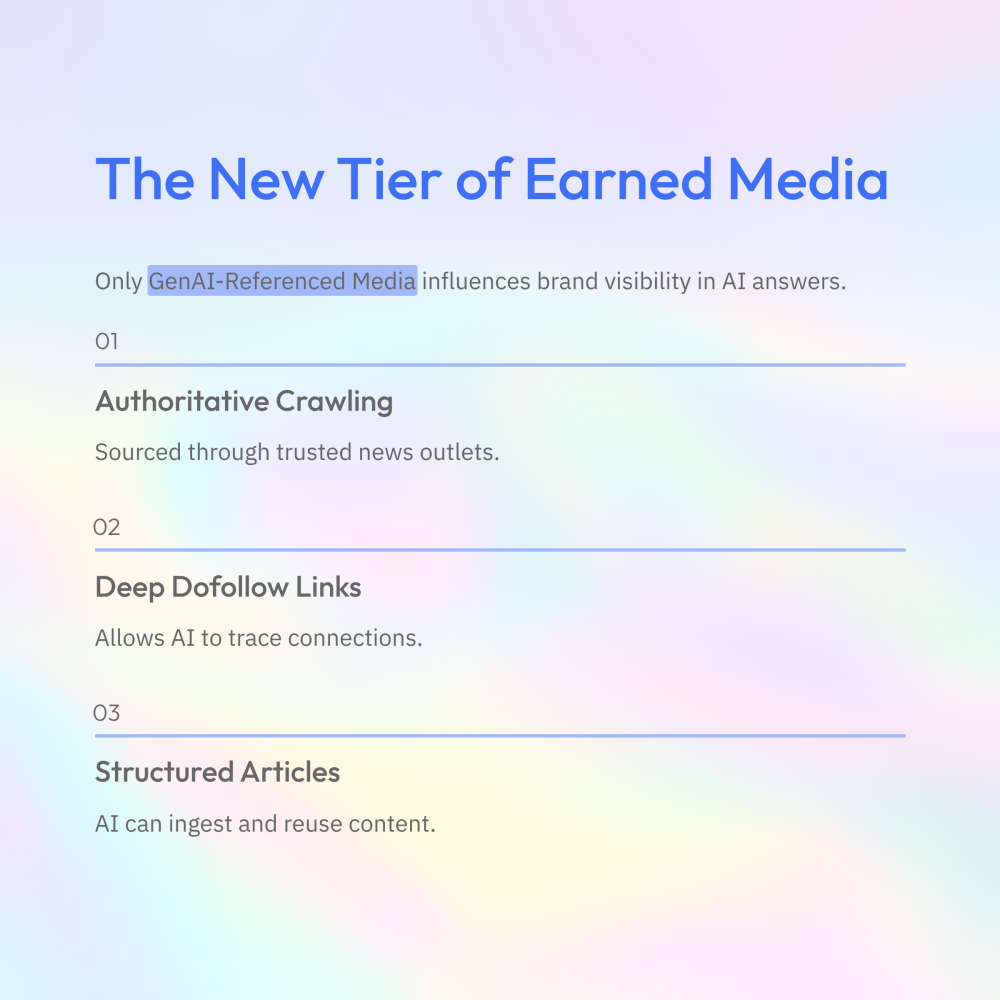
A placement only qualifies as GenAI RM if it includes:
- Publication in an outlet reliably crawled by Google News and similar feeds
- A deep, do-follow backlink to a brand-owned authoritative page
- Clear category language that machines can interpret
A big logo hit without a link?
A glowing feature without structured data?
A mention on a site not indexed as news?
It delivers human visibility but zero machine visibility.
Why CEOs Should Care: Answers Have Replaced Funnels
The white paper also outlines the new “front door” for people looking for answers in LLMs.
People begin with Answer → Shortlist → Action instead of Awareness → Interest → Research → Consideration.
This is the most important shift for executives:
Generative AI collapses the customer journey.
Your brand’s fate is now determined at the moment of the prompt, not the moment of the click.
Examples:
- “Product research” → now handled by LLMs
- “Comparison shopping” → handled by AI
- “Recommendation seeking” → handled by AI
- “Decision support” → handled by AI
Traditional earned media influences search results and perceptions. GenAI-Referenced Media influences AI answers and reasoning.
This is now a pipeline-level concern.
Not All Coverage Matters to AI
Two earned placements can be identical in quality, sentiment, spokesperson quotes, and narrative—and still produce radically different outcomes.
As outlined on page 10, only one will influence AI answers:
Placement A
✔ National prestige outlet
✘ No deep link
✘ No authoritative citation target
✘ No machine-readable structure
→High human visibility, zero AI impact
Placement B
✔ Mid-tier or vertical publication
✔ Indexed by Google News
✔ Includes a do-follow deep link
✔ Category-aligned language
→Moderate human visibility, high AI impact
GenAI RM strategy for machine influenc that leads back to human decisions.
The Criteria: How Machines Evaluate Earned Media
Based on the framework in pages 9–11, an outlet must pass three tests:
1. Ingestion Test
Is the outlet part of Google News indexation?
2. Link Behavior Test
Does the outlet allow deep, do-follow backlinks to brand-owned pages?
3. Reference Test
Does the content appear (or is likely to appear) inside AI answers due to its structure?
Outlets that meet these criteria include (page 15):
- HackerNoon
- Grit Daily
- Digital Journal
- Tech Times
- The AI Journal
- Science Times
- Healthcare Business Today
…and others
These outlets form the backbone of machine-referenced media today.
The Closed Loop: How GenAI-Referenced Media Actually Works
The white paper introduces a four-step closed loop (page 13) that determines whether your brand appears in AI answers:
- **Pillar Page \ Build a brand-owned authoritative page defining the category.
- **GenAI-Referenced Coverage \ Place thought-leadership-style articles in machine-indexed outlets.
- **Ingestion \ AI systems crawl the coverage + your pillar page.
- **Answer Share \ Machines begin referencing your brand in relevant categories.
This loop creates machine memory, the durable association between your brand and a category.
This Is Not SEO
Many CEOs confuse this with link-building. It is not.
As explained on page 12:
- SEO optimizes for rankings on search results pages.
- GenAI-Referenced Media optimizes for inclusion in machine-generated answers.
SEO wants to climbsearch results.
GenAI RM wants to benamed in the answer.
These are different objectives, different algorithms, and different outcomes.
The Executive Risk: You May Already Be Invisible
Low reported AI use ≠ low AI influence.
Even users who claim to “not use AI” are being shown AI summaries in:
- Google search
- inboxes
- news feeds
- productivity tools
Executives must internalize a new reality:
Your audience does not need to choose AI for AI to choose what they see.
“If you don’t know whether AI is naming your brand, you don’t know what opportunities you’re losing.” — The New Tier of Earned Media
In a world where LLMs shape discovery, shortlists, and decisions, GenAI-Referenced Media gives brands a new path to influence that single, critical moment: the answer.
If you’re not in it, you don’t exist.
CTA: Download the Full White Paper
To go deeper into the methodology, checks, examples, and operational roadmap, download the original white paper:
→ The New Tier of Earned Media: Why GenAI-Referenced Media Matters in the Age of Generative Search
[story continues]
tags