Table of Links
-
Some recent trends in theoretical ML
2.1 Deep Learning via continuous-time controlled dynamical system
2.2 Probabilistic modeling and inference in DL
-
3.1 Kuramoto models from the geometric point of view
3.2 Hyperbolic geometry of Kuramoto ensembles
3.3 Kuramoto models with several globally coupled sub-ensembles
-
Kuramoto models on higher-dimensional manifolds
4.1 Non-Abelian Kuramoto models on Lie groups
4.2 Kuramoto models on spheres
4.3 Kuramoto models on spheres with several globally coupled sub-ensembles
-
5.1 Statistical models over circles and tori
5.2 Statistical models over spheres
5.3 Statistical models over hyperbolic spaces
5.4 Statistical models over orthogonal groups, Grassmannians, homogeneous spaces
-
6.1 Training swarms on manifolds for supervised ML
6.2 Swarms on manifolds and directional statistics in RL
6.3 Swarms on manifolds and directional statistics for unsupervised ML
6.4 Statistical models for the latent space
6.5 Kuramoto models for learning (coupled) actions of Lie groups
6.6 Grassmannian shallow and deep learning
6.7 Ensembles of coupled oscillators in ML: Beyond Kuramoto models
-
Examples
7.2 Linked robot’s arm (planar rotations)
7.3 Linked robot’s arm (spatial rotations)
7.4 Embedding multilayer complex networks (Learning coupled actions of Lorentz groups)
4.2 Kuramoto models on spheres
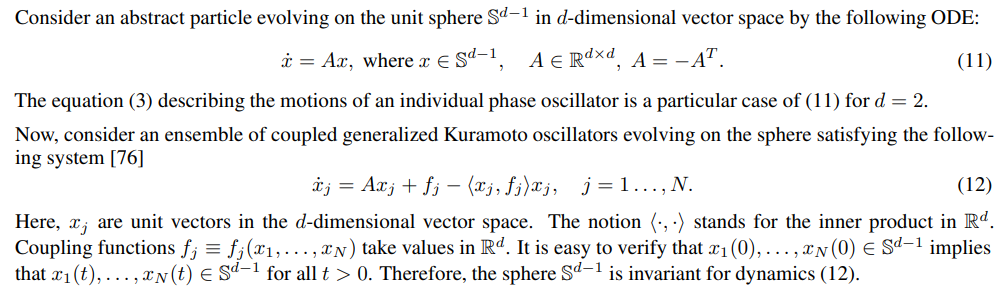
Classical Kuramoto models can also be generalized to spheres. It turns out that there exist two non-equivalent ways to do that.
4.2.1 Real Kuramoto models on spheres
4.2.2 Complex Kuramoto models on spheres
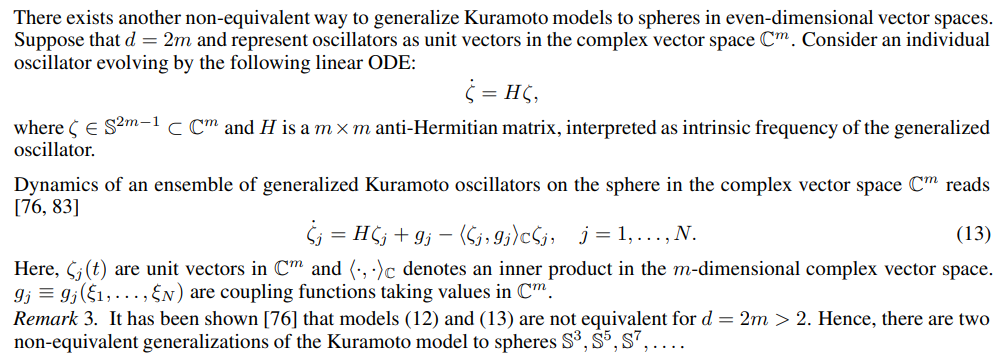
Exceptionally, in the case d = 2m = 2, both systems reduce to the classical Kuramoto model (4) on S1.
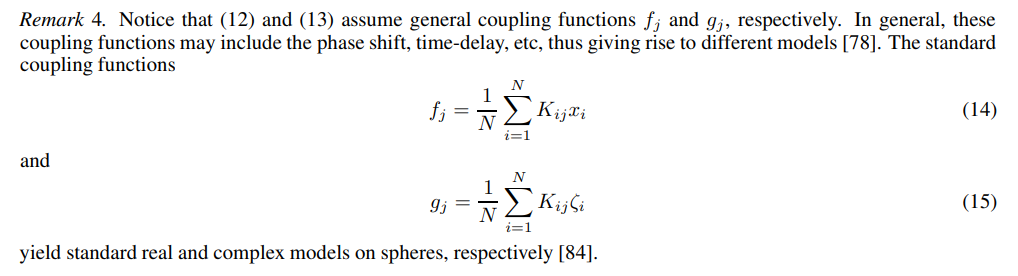
Models (12) and (13) are referred to as real and complex Kuramoto models on spheres, respectively.
4.2.3 Hyperbolic geometry of Kuramoto models on spheres
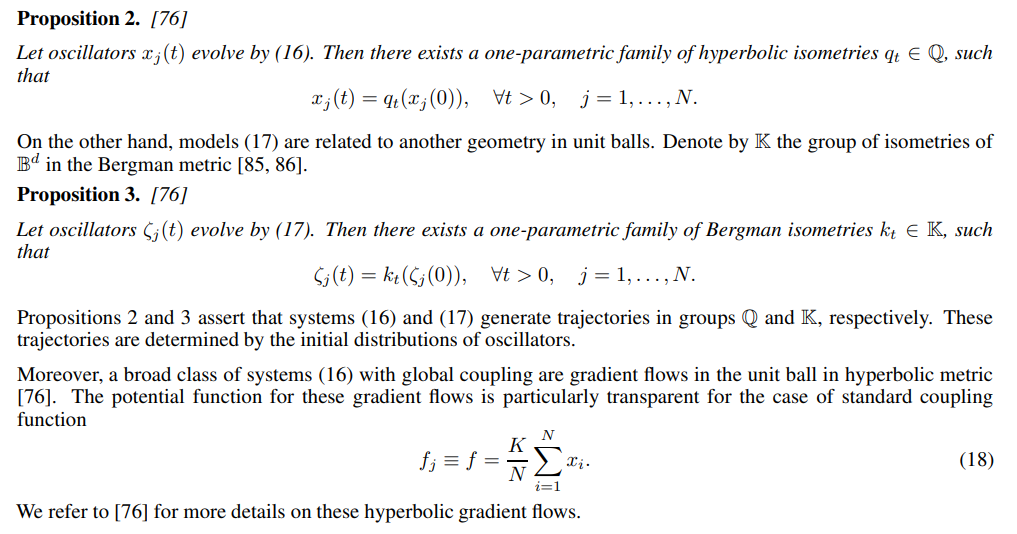
Recently, the relation between Kuramoto models on spheres and hyperbolic geometries of unit balls has been exposed [76]. In order to explain this, consider the simplest setup: ensembles of identical oscillators with global coupling. Then systems (12) and (13) are respectively rewritten as

Author:
(1) Vladimir Jacimovic, Faculty of Natural Sciences and Mathematics, University of Montenegro Cetinjski put bb., 81000 Podgorica Montenegro (vladimirj@ucg.ac.me).
This paper is
[story continues]
tags