


Ghulam Murtaza emerged from Khairpur, a rural town in Pakistan, where his first interactions with technology began at age ten by digitizing his father’s construction ledgers. While most viewed technology as recreational, Murtaza saw computers as tools to solve real problems.
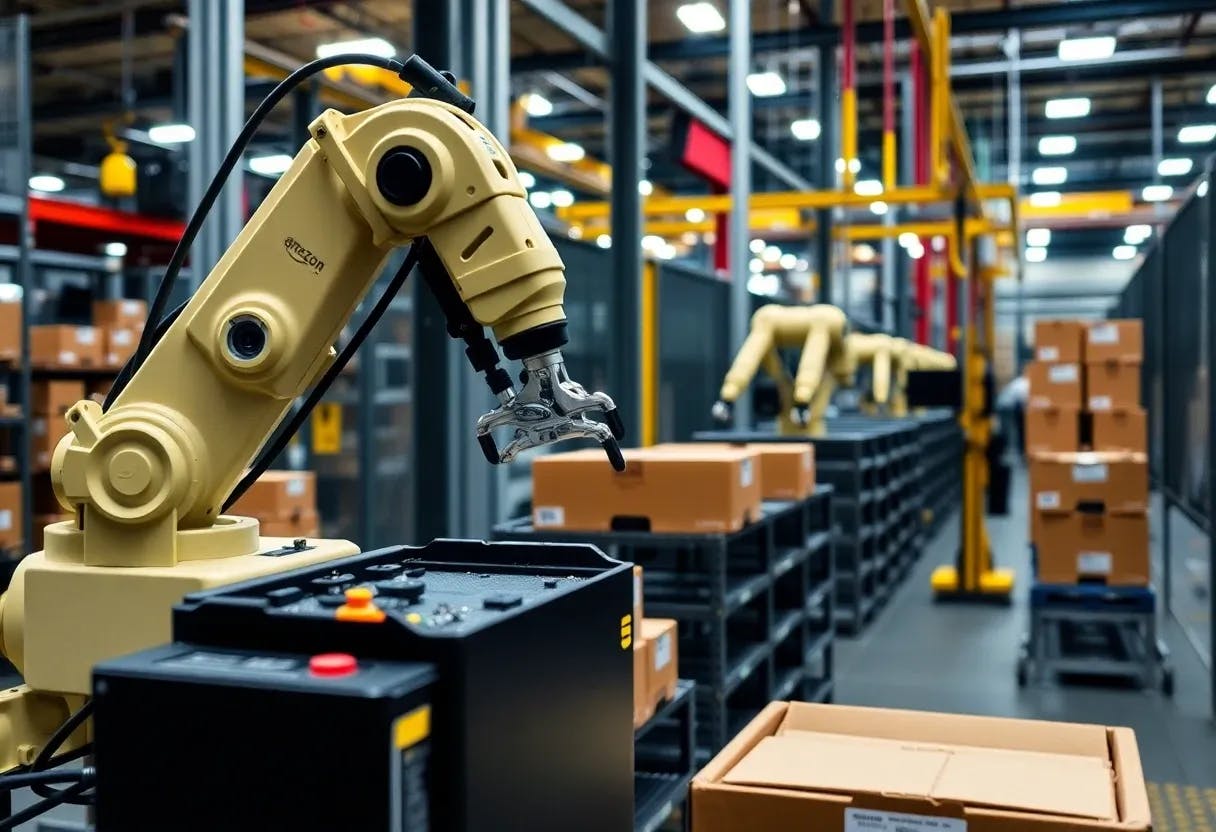
His academic path later included a Master of Science in Robotics from the University at Buffalo, and he is currently a Control System Lead at Amazon’s CBRE in Oregon. Murtaza’s expertise spans robotics, industrial automation, custom data engineering, and AI-driven process optimization, with work that is now documented across the Amazon supply chain.
The growing trend of operational technology (OT) modernization inside industrial giants like Amazon is reshaping the way fulfillment centers operate. Murtaza represents a new generation of engineers driving this change—those whose careers are defined by self-taught resilience and scalable, measurable solutions rather than credentials alone.
Early Spark in Rural Pakistan
Murtaza’s first exposure to technology stemmed from necessity rather than abundance. “When a computer first came to our house in Khairpur, my younger brother used it to play GTA, but I was only ten and used it to help my father with his construction business,” he reflects. Translating handwritten notes into organized Word documents became his early project, laying the foundation for future engineering endeavors.
The limitations of a small town created a mindset oriented toward self-reliance.
Growing up in a small town gave me hunger, patience, and depth. I learned early that if I wanted something, I’d have to build it myself.
This attitude would eventually support his transition beyond local boundaries. This translates that backgrounds like his often produce engineers with stronger on-the-ground problem-solving skills.
Building Skills Without a Roadmap
Resource constraints forced Murtaza to improvise in learning programming. “The biggest challenge wasn’t access—it was the lack of guidance. In ninth grade, I was introduced to GW-BASIC, and while others treated it as just a subject, I became obsessed.” He invested hours in self-study, developing projects that exceeded standard curriculum expectations, including a train ticketing system and robotics competition entries.
“Later, I entered a national robotics competition, built an Arduino-based robot in C++, and won first place. That $1,200 prize changed my confidence forever.” This experience underlined a lesson now echoed in industrial innovation: consistency and curiosity can outperform pedigree when resources are scarce. Industry analysis by Tom White affirms that engineers who learn by doing—often in less resourced regions—can apply technical problem-solving in complex real-world environments.
Resilience Amid Family Expectations
Murtaza’s career path was not linear. “Choosing civil engineering wasn’t my dream, but I did it out of respect for my father,” he says. Even while adhering to his family’s wishes, he maintained a personal commitment to coding and robotics, managing to balance obligation with personal goals.
“Over time, my father saw that the version of me doing what I loved was stronger and happier,” Murtaza recalls. The duality of his experience—balancing family duty with technical ambition—mirrors the realities faced by many engineers from emerging economies.
“When relatives mocked me for chasing robotics and the U.S., I chose belief over validation. I realized I’d rather risk failure than live with regret.” This internal resilience serves as a crucial element in innovation teams, where persistence under pressure can determine technological adoption success.
Tackling Operational Bottlenecks at Amazon
Upon joining Amazon, Murtaza identified “silent slowdowns”—minor process inefficiencies with significant impact as fulfillment centers scaled. “At Amazon’s PDX8 launch, I saw technicians losing 45 minutes just finding parts and engineers walking miles to troubleshoot equipment.” Rather than launching into coding, he adopted an ethnographic approach: “Instead of rushing to code, I listened. I shadowed technicians, asked questions, and learned their workflows.”
This method, rooted in deep observation, reflects his upbringing: “When you grow up with little, you learn to respect people’s time. My goal was simple—to remove friction and give time back to those keeping the system alive.” Such principles of lean workflow are now central to modern automation at scale, as detailed in recent field reports.
Engineering Impact: The Parts Lookup App
Among his most cited solutions is the Parts Lookup App. “It started when a technician spent nearly 40 minutes searching for a single part. I scraped over 1,200 pages of vendor data, merged it with Amazon inventory and drawings, and built a searchable system that shows exact part locations instantly.”
The app, running on cloud infrastructure for just $0.35 per month, supports over 150 technicians and is live across multiple buildings. “It saves 15–20 minutes per search, translating into hundreds of hours saved monthly. That’s the kind of impact I live for.” The application represents a breakthrough in workflow automation, reducing technician search time, and is projected to save 300–600 hours monthly across 10 Amazon sites.
Murtaza’s approach involved acting as a data engineer, software developer, and UX designer. The tool bridges operational technology and information technology, embodying a multidisciplinary ethos increasingly sought in industrial automation.
Scaling Innovation With Real-Time Solutions
Murtaza’s toolbox extends beyond inventory lookup. “I built a real-time VFD monitoring system at PDX8 with 2-second checks and Slack alerts for overloads. I included a trend app to predict motor burnout early, saving ~2 hours of downtime per incident and preventing $5K+ in potential motor damage per event,” he details.
Another critical system, the Ambaflex Trend Tracker, enables technicians to monitor spiral conveyors and troubleshoot faults without engineer intervention. These real-time sensor dashboard solutions, as validated by sector research, have led to over $25,000 in annual labor savings and up to $5.76 million in avoided downtime annually across three sites.
His AI-powered CtrlG assistant, trained on hundreds of technical manuals, has reduced troubleshooting time from up to an hour to under a minute per issue, with industry estimates suggesting that preventing a single downtime incident can save between $750,000 and $1 million at Amazon fulfillment centers, according to published data.
Solitude and Perseverance During an Industry Downturn
Advancing these tools came during one of the most challenging eras for tech professionals. “Solitude became my advantage. I broke complex problems into small steps and stayed structured,” Murtaza says about the period when widespread tech layoffs and visa pressures dominated headlines.
“What fueled me most was hearing technicians say, ‘You saved us today.’ I wasn’t hired to build tools—but I did it anyway, because value creates security.” Such mindsets, documented in operations literature, are increasingly relevant in environments where job functions shift rapidly and independent innovation bridges organizational gaps.
Recognition, including the Amazon RME ‘Raise the Bar’ Award for scalable, low-cost solutions, followed his consistent delivery of measurable impact as outlined by Tom White. Murtaza’s case demonstrates how outcomes, not job titles, become defining features of engineering legacy.
Advice to the Next Generation
Reflecting on his journey, Murtaza’s message is both pragmatic and optimistic. “Your background is not a weakness—it’s your edge. If you give something your full effort, the universe meets you halfway. Don’t wait for permission to solve problems.”
He stresses direct engagement: “Shadow users, obsess over workflows, and build things that genuinely help people. I didn’t chase titles—I chased impact. Focus on creating value, and recognition will follow.”
This outlook aligns with the growing discourse on workforce transformation, where unconventional backgrounds and lived experience are increasingly recognized as assets in shaping automation’s future within industry leaders such as Amazon.
Murtaza’s path underscores how self-education, creative persistence, and proximity to real operational challenges can drive progress regardless of origin. His story, set against the backdrop of shifting industry and societal expectations, highlights that today’s most valuable engineering solutions begin where lived experience and technical ingenuity intersect.
This story was distributed as a release by Jon Stojan under