Big Tech will spend over $600 billion on AI infrastructure in 2026 — a 36% jump from last year. The vast majority of that capital is flowing toward one thing: GPUs. For investors who already understand hardware-based yield and decentralized infrastructure, this represents a familiar opportunity in an unfamiliar market.
The GPU Shortage Isn't Hype. It's Structural.
Graphics processing units were originally designed to render video game graphics. Today, they are the computational backbone of artificial intelligence. Every large language model, every image generator, every autonomous driving system depends on clusters of GPUs running in parallel. NVIDIA alone posted $39.1 billion in data center revenue in a single quarter earlier this year.
The global data center GPU market was valued at approximately $14.5 billion in 2024. Analysts project it will exceed $155 billion by 2032 — a compound annual growth rate of around 30.6%. That kind of trajectory is rare outside of crypto itself.
The demand is coming from all directions. Training a single large language model can require thousands of high-end GPUs running continuously for weeks. Inference — actually running a trained model for end users — demands even more aggregate compute as AI applications scale to hundreds of millions of users.
Hyperscalers are responding with unprecedented spending. Microsoft, Meta, Google, and Amazon are collectively projected to invest more than $500 billion in AI infrastructure this year. Meta increased its capital expenditure by 111% year-over-year in a recent quarter, almost entirely on servers, data centers, and networking equipment.
Meanwhile, supply remains constrained. Advanced chip manufacturing is concentrated in a handful of foundries. Power availability is emerging as a bottleneck, with data center projects across Europe and the United States stuck in grid-connection queues. Even large-volume buyers face extended lead times for NVIDIA's most powerful GPUs.
The takeaway: GPUs are no longer semiconductor components. They are critical infrastructure — comparable to power plants, cell towers, or fiber optic networks. And like all critical infrastructure, they can be owned, deployed, and monetized.
How GPU Infrastructure Investment Works
The model is straightforward. You invest in physical GPU hardware, either directly or through a platform. That hardware gets deployed in data centers or cloud environments. AI companies, researchers, and developers rent the compute power on demand. Rental revenue flows back to investors.
If you have ever operated a mining rig, the structure will feel intuitive. You own hardware. That hardware performs computational work. You earn yield. The critical difference lies in the source of demand. In crypto mining, earnings depend on block rewards and network difficulty — both of which decline over time by design. In GPU rental for AI, demand comes from commercial workloads, and companies are willing to pay premium rates for access to scarce compute.
Industry data suggests that one hour of GPU rental for AI workloads can generate 1.5 to 4 times the revenue of the same hour spent on crypto mining, with significantly less exposure to token price volatility. A KPMG survey found that approximately 80% of investors identify generative AI as the primary reason to invest in GPU capacity.
GPUnex: A GPU Compute Marketplace Built for Three Audiences
GPUnex is a GPU compute marketplace that connects three types of participants: renters who need compute, providers who supply hardware, and investors who want exposure to GPU infrastructure economics.
For renters, the platform offers enterprise-grade NVIDIA GPUs — including H100, A100, L40S, and L4 — for AI training, inference, 3D rendering, and research workloads. Deployment takes minutes with per-second billing and full root access via SSH.
For providers, GPUnex lets anyone with idle GPU hardware list it on the marketplace, set their own pricing and availability, and receive automatic weekly payouts in USDC.
For investors — and this is the part that should interest crypto-native audiences most — GPUnex offers a structured way to participate in GPU infrastructure without physically owning or managing hardware.
The Investment Model
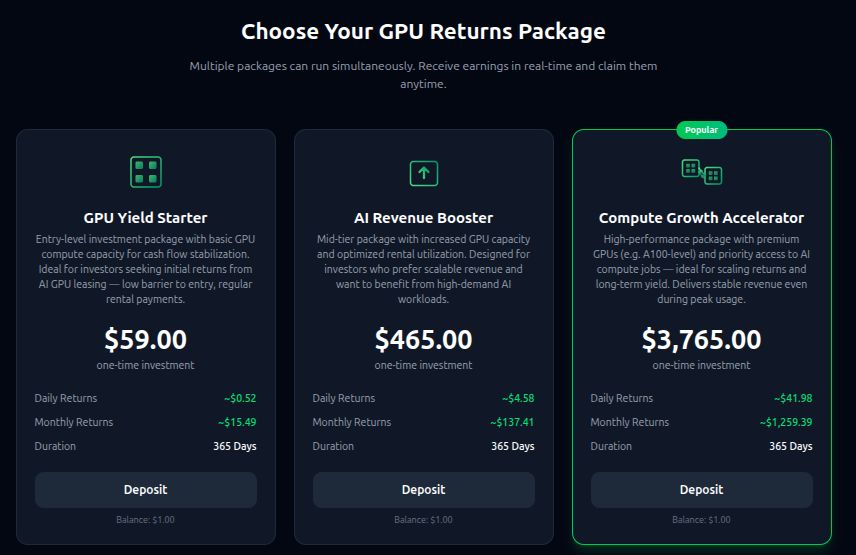
GPUnex's investment offering is designed to lower the barrier to entry for GPU infrastructure. Instead of purchasing, housing, and maintaining physical servers, investors can participate in GPU infrastructure packages and earn daily returns backed by real hardware utilization and marketplace demand.
Here is what that looks like in practice:
- Daily returns credited to your account, driven by actual GPU rental activity across the platform
- Multiple investment packages available depending on how much exposure you want
- Instant withdrawals — earnings can be claimed anytime via USDC
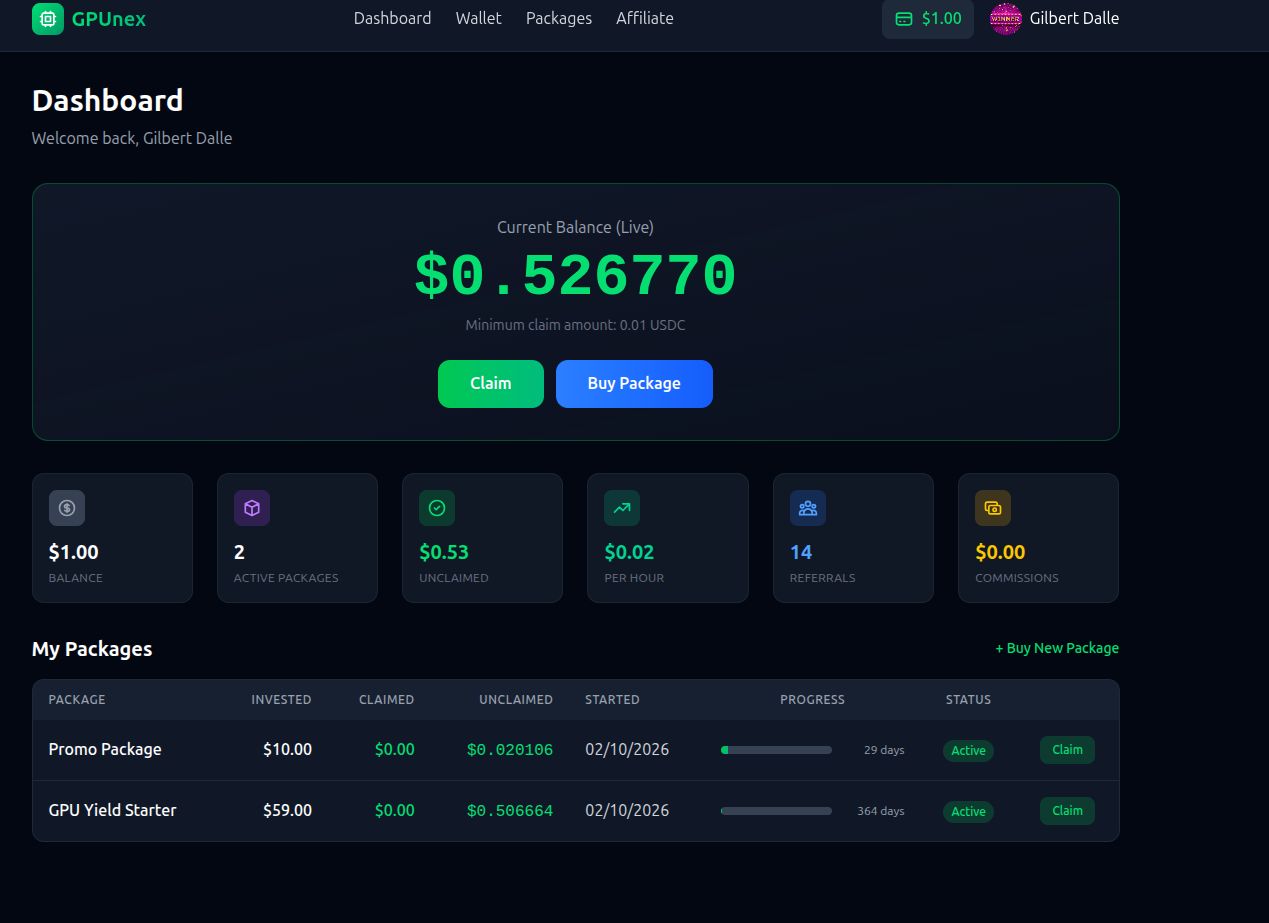
- Full transparency through a live dashboard that shows real-time earnings data and utilization metrics
The structure mirrors what DeFi users are already comfortable with — staking or lending protocols that generate yield. The difference is that the underlying revenue comes from commercial AI compute demand, not protocol emissions or token inflation.
Investor onboarding is handled through GPUnex's investor portal, with KYC verification and security built into the process.
How This Compares to Staking and Mining
To put GPU infrastructure investment in context, here is how it stacks up against two familiar income strategies in the crypto space.
|
Factor |
GPU Infrastructure Investment |
Crypto Staking |
GPU Mining |
|---|---|---|---|
|
Underlying Asset |
Physical GPU hardware |
Native blockchain tokens |
Physical GPU hardware |
|
Income Source |
AI compute rental fees |
Network validation rewards |
Block rewards + tx fees |
|
Demand Driver |
AI model training and inference |
Network security and throughput |
Blockchain consensus |
|
Market Trend (2026) |
Growing ~30% per year |
Stable, yields normalizing |
Declining profitability |
|
Entry Barrier |
Low (via platform) to High (own hardware) |
Low (any token amount) |
Medium (hardware + electricity) |
|
Key Risk |
Hardware depreciation, utilization rates |
Token volatility, slashing |
Difficulty increases, energy costs |
None of these strategies dominates in every dimension. Staking remains the lowest-friction yield option. Mining still works for those with cheap electricity. GPU infrastructure investment sits between them — higher potential returns driven by structural AI demand, but with hardware lifecycle risk that requires attention.
DePIN and the Crypto-GPU Convergence
If you follow Web3 trends, you have likely encountered DePIN — Decentralized Physical Infrastructure Networks. The idea is that instead of centralized companies owning all physical infrastructure, individuals contribute hardware to a network and earn fees or tokens in return.
GPU marketplaces and DePIN share the same thesis. Both depend on distributed hardware owners providing capacity. Both generate yield from real utilization rather than emissions. And both are gaining traction as centralized infrastructure fails to scale fast enough. Europe, for instance, has roughly 3,000 data centers operating at about 84% utilization, while over 30 gigawatts of new projects remain stuck waiting for grid connections.
For crypto investors, the mechanics are already native. Providing capacity, staking hardware, earning yield from network participation — these concepts come straight from DeFi. GPU infrastructure simply applies them to a market with accelerating commercial demand.
Platforms like GPUnex make the connection explicit: investors gain exposure to GPU compute revenue through structured packages, while the platform handles hardware deployment, maintenance, and renter relationships. The format resembles staking or lending, but the returns are driven by businesses paying for AI compute, not by inflationary token models.
What to Watch Out For
GPU infrastructure investment is not risk-free, and the risks deserve clear attention.
Hardware depreciation is the most immediate concern. NVIDIA releases new GPU architectures every 18 to 24 months, each bringing significant performance gains that can reduce the rental value of older hardware. Unlike tokens, physical GPUs lose value over time.
Utilization risk matters too. GPUs only generate revenue when they are actively rented. Periods of lower demand or oversupply push utilization rates down, directly impacting returns.
Market concentration is a structural factor. Current AI demand is driven disproportionately by a small number of hyperscalers and well-funded AI companies. A pullback from these players would ripple through the entire GPU economy.
Regulatory uncertainty around AI compute, data sovereignty, and energy consumption is growing globally and could affect where and how GPU infrastructure is deployed.
This article is not financial advice. Any investment decision should follow thorough independent research.
The Bottom Line
GPU infrastructure is emerging as a legitimate alternative asset class, supported by one of the strongest demand signals in modern technology. The AI compute market is projected to grow from $14.5 billion to over $155 billion in under a decade. Big Tech capital expenditure plans confirm this is not speculative — the spending is happening now.
For crypto investors, the parallels are striking. You already understand hardware-based yield, decentralized infrastructure, and digital asset classes. GPU investment applies those principles to a market with accelerating structural demand rather than diminishing block rewards.
Platforms like GPUnex are making this accessible by offering daily returns, instant USDC withdrawals, and transparent dashboards — a format that feels native to anyone who has used DeFi protocols. The difference is that the revenue comes from AI companies paying for compute, not from token inflation.
2026 is still early for this trend. As AI infrastructure spending intensifies and GPU supply remains constrained, investors who already understand decentralized infrastructure are positioned for what comes next.
[story continues]
tags