
This paper is available on arxiv under CC BY-NC-ND 4.0 DEED license.
Authors:
(1) Ehud Shapiro, Department of Computer Science and Applied Math, Weizmann Institute of Science, Israel and ehud.shapiro@weizmann.ac.il.
Table of Links
- Abstract and Introduction
- Grassroots Protocols
- Grassroots Implementation of Grassroots Dissemination
- Applications of Grassroots Dissemination Supporting Digital Sovereignty
- Future Work & Discussion
- References
- A. Preliminaries: Asynchronous Distributed Multiagent Transition Systems
- B. All-to-All Dissemination is not Grassroots
- C. Proofs
B All-to-All Dissemination is not Grassroots
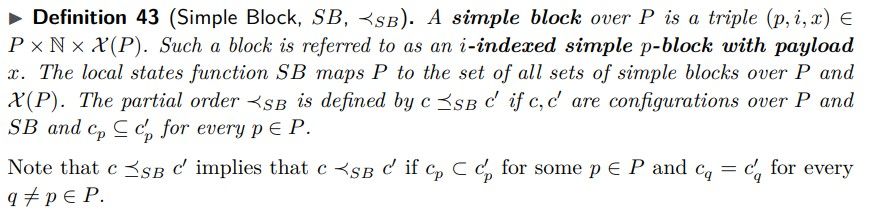
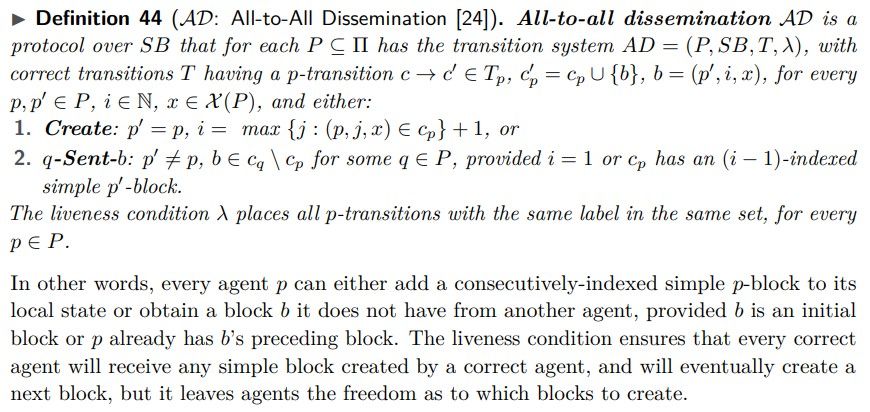
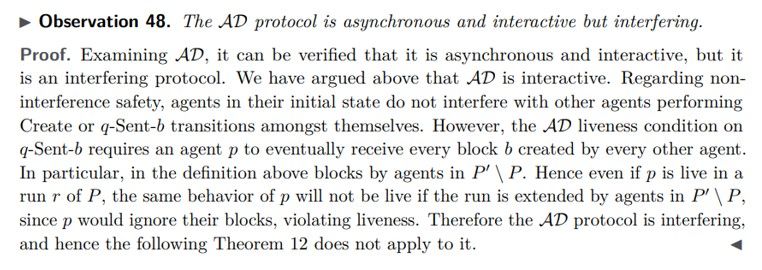
As a strawman, we recall the All-to-All Dissemination protocol AD from [24] and argue that it is not grassroots. We assume a given payloads function X that maps each set of agents P to a set of payloads X (P). For example, X could map P to all strings signed by members of P; or to all messages sent among members of P, signed by the sender and encrypted by the public key of the recipient; or to all financial transactions among members of P. Remember that here P are not ‘miners’ serving transactions by other agents, but are the full set of agents, all participating the in protocol.

[story continues]
tags