Welcome to the Proof of Usefulness Hackathon spotlight, curated by HackerNoon’s editors to showcase noteworthy tech solutions to real-world problems. Whether you’re a solopreneur, part of an early-stage startup, or a developer building something that truly matters, the Proof of Usefulness Hackathon is your chance to test your product’s utility, get featured on HackerNoon, and compete for $150k+ in prizes. Submit your project to get started!
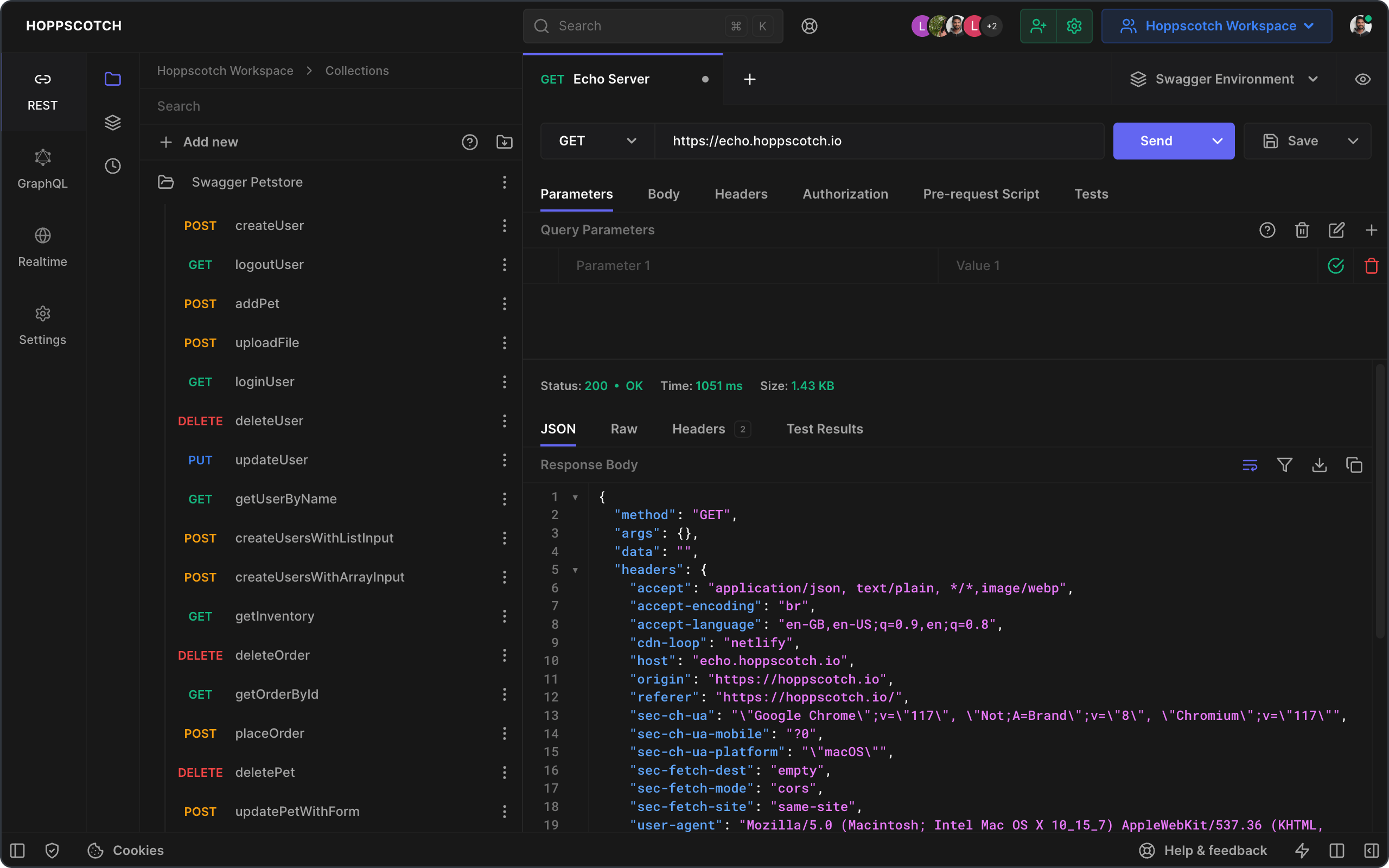
In this interview, we catch up with Liyas Thomas, the creator behind Hoppscotch. Hoppscotch is an open-source API development platform designed to help developers and teams test, document, and share APIs without the bloat of legacy tools.

What does Hoppscotch do? And why is now the time for it to exist?
Hoppscotch is an open-source, lightweight API development platform that helps developers test, document, and share APIs quickly and efficiently. It provides a clean, modern interface for working with various API types (REST, GraphQL, etc.), making it a powerful tool for developers and engineering teams looking to streamline their API workflows and collaboration.
Now’s a good time for Hoppscotch to exist because developers are increasingly seeking privacy-focused, lightweight alternatives to bloated legacy tools, and the demand for open-source, self-hosted solutions for the entire API lifecycle is at an all-time high in 2026.

What is your traction to date? How many people does Hoppscotch reach?
Over 2M+ all-time users.
More than 100,000 monthly active users.
Over 77,500 GitHub stars, indicating a strong and active open-source community following.
Who does your Hoppscotch serve? What’s exciting about your users and customers?
Individual Developers, Testers and QA Professionals and Engineering Teams.
The platform is built for collaboration, with features like workspaces, access level rules, and shared collections, making it easy for teams to build and manage APIs together. It provides a single shared API space, which can be a cost-effective alternative to other tools for scaling teams.
Few notable customers are employees from GitHub, Microsoft, Decathlon, intel, ByteDance, NASA, etc.
What technologies were used in the making of Hoppscotch? And why did you choose ones most essential to your techstack?
The platform focuses heavily on API-centric technologies to ensure it remains lightweight and versatile. By prioritizing a tech stack that supports various protocols like REST, GraphQL, and WebSockets directly in the browser or via native apps, Hoppscotch ensures speed and accessibility without the resource heaviness found in competitors.
What is traction to date for Hoppscotch? Around the web, who’s been noticing?
Hoppscotch has secured its place as a top-tier open-source project, recognized for revolutionizing API testing and development by industry observers like DailyBot and MiracleSoft. With coverage highlighting its ecosystem and integration capabilities, the project has proven itself as a serious contender in the developer tools space.
Hoppscotch scored a 133 proof of usefulness score (proofofusefulness.com/hoppscotch-report)
What excites you about this Hoppscotch's potential usefulness?
Hoppscotch is a lightweight, open-source powerhouse that lets you test almost any protocol like REST, GraphQL, or WebSockets right from your browser or a fast native app. It eliminates the bloat of traditional tools while keeping your data private and self-hosted, making it perfect for teams who want speed without sacrificing security. Its growth into a full-scale collaborative ecosystem makes it a genuine, developer-first alternative for the entire API lifecycle in 2026.
Walk us through your most concrete evidence of usefulness.
Thousands of teams (startups and enterprises alike) and 10,000s of individuals use Hoppscotch in their software development lifecycle every month. Companies like Ford Motor Company, Empower, and Ci&T use Hoppscotch every week for their 1000s of employees’ live workflows. Most of our existing customers replaced Postman with us. Although Hoppscotch has a very generous free plan, many companies paid and signed LOIs and onboarded their whole team to Hoppscotch. We've seen a bottom-up adoption in almost every company where one user turned into 100s of seats without us selling. They told us they couldn’t ship APIs without Hoppscotch.
The clearest proof is that teams use Hoppscotch in live API debugging, not demos. We see developers open Hoppscotch directly from their browser during incident response and daily backend work, and keep it open as their primary API client instead of switching to heavier desktop tools.
The strongest signal: open-source contributors and internal teams at startups have standardized on Hoppscotch links in docs and tickets. When someone shares an API issue, they share a Hoppscotch request, not a screenshot. If Hoppscotch goes down, their debugging workflow breaks.
How do you measure genuine user adoption versus "tourists" who sign up but never return? What's your retention story?
We don’t treat sign-ups as adoption. We classify real users only after they execute API requests across multiple sessions and save or share those requests, which signals intent to return. Retention is measured by repeated request execution over a constituent 3-week period, not logins, because API debugging is a recurring job to be done. What we see is consistent weekly and daily usage during work hours, with short but frequent sessions that match real debugging behaviour. Our strongest adoption signal is replacement: teams stop sharing screenshots or curl commands and instead share Hoppscotch request links as executable context. That tells us Hoppscotch has become a trusted part of their workflow, not just a tool they tried once.
If we re-score your project in 12 months, which criterion will show the biggest improvement, and what are you doing right now to make that happen?
Hoppscotch is heavily used by individual developers. The next step is making it indispensable at the team level. We’re focusing on shared workspaces, environments, collections, and access controls so teams can standardise API workflows instead of treating requests as personal artefacts. We’re also doubling down on link-based sharing and reproducibility so Hoppscotch becomes the default way API context is passed around inside teams. The goal is that when a new engineer joins, the fastest way to understand an API is through Hoppscotch, not docs or screenshots. If you rescore us in a year, the clearest change will be more teams relying on Hoppscotch daily, not just more users trying it.”
How Did You Hear About HackerNoon? Share With Us About Your Experience With HackerNoon.
I've documented my journey of building Hoppscotch along with my other projects on multiple platforms, including HackerNoon from 2019 onwards. Here's my profile.
I'd like to also mention the fact that I was recognised with 2020 Noonies Awards, specifically winning the HackerNoon Noonies 2020 awards for Contributor of the Year in both the FUNDRAISING and TESTING categories. Overall I consider HackerNoon as a developer-friendly platform to pour our thoughts, learnings and experiences out in the wild and learn from others in a verified, trustworthy way. Thanks, HackerNoon.
With over 77,500 GitHub stars and 2 million users, your community growth is outpacing many enterprise-backed tools. How has this massive open-source adoption influenced your product roadmap compared to a traditional top-down corporate strategy?
Well, we've been an open-source company from day 1. Being a tool like Hoppscotch that deals with very sensitive data like APIs consisting of sensitive tokens, usernames and passwords, private endpoints, and information in attributes, we made sure to license Hoppscotch with the MIT license (a permissive open-source software license originating from the Massachusetts Institute of Technology, allowing users to freely use, modify, and distribute code with minimal restrictions, even in proprietary software). This allowed everyone to look into the Hoppscotch source code and battle test it against all known use cases. Also, this made sure we're not locking in nor transmitting, controlling or storing the customer data in any way.
And then it's our bottom-up approach. In almost every company we've onboarded, we've seen a bottom-up adoption where one user turned into 100s or even 1000s of seats without us selling. We've better product assortment strategies (Cloud for individuals, teams and startups and Self-Hosted/On-prem for enterprises and large organisations) to offer different versions of the product to meet the differing needs of customers. We made it super simple to onboard into the platform with a free Cloud tier for Cloud users and a free Community Edition for Self-hosted/On-prem users. They often start using the software without our involvement and grow to 100s of seats even without any involvement from our end.
All this happened because we are open-source first and always embraced our open-source community's signals and feedback.
You list notable users from giants like NASA, Microsoft, and GitHub. How are you currently bridging the gap between individual developer adoption and widespread enterprise implementation for entire engineering teams?
Every enterprise customer is different from another. We've built a strong foundation to make Hoppscotch very flexible and extensible so that we could offer a very diversified product assortment across all levels of organisations. From individuals to Fortune 50s. The API development lifecycle is also very similar to the software development lifecycle that involves planning, analysis, design, implementation, testing, deployment, and maintenance. Hoppscotch has products, tools and services that integrate into all these steps under one roof. Our ecosystem of multiple tools like Hoppscotch CLI for CI/CD pipelines ensures automation, while our API client in both web and desktop integrates into the manual testing and development use cases. In-built features like API documentation help with the consumption of APIs, while features like API mocking help with the very first API designing aspects. All these available in both Cloud and Self-hosted/On-prem make many permutations of software availability. And for software distribution we have many channels, like an all-in-one container, multiple Docker images, Helm-charts, building from source, etc., to accommodate all possible infrastructure requirements.
Providing an end-to-end tool that integrates into every step in the API development lifecycle is crucial for enterprises, and that's exactly what we're doing.
In a market dominated by heavy, cloud-reliant tools, you emphasize being "lightweight" and "privacy-focused." Can you share a specific scenario where a user migrated to Hoppscotch solely because of the self-hosting capability?
Deutsche Bahn is the national railway company of Germany and a state-owned enterprise under the control of the German government. With its head office in the Berlin, it is a joint-stock company. Deutsche Bahn uses Hoppscotch Enterprise Edition with over 700 seats for their employees. They operate in a mission-critical public service like railways. They are from a regulated industry. They choose Hoppscotch due to our Self-Hosting/On-prem capabilities. They also wanted integration to SSO (Single Sign-On) and features like audit logs, which were only available in our Self-Hosted Enterprise Edition. They've a multi-year commitment signed to us and are in our close communication channel.
Due to confidentiality in the agreement, I'm afraid I can't share more details than this regarding our customers.
Meet our sponsors
Bright Data: Bright Data is the leading web data infrastructure company, empowering over 20,000 organizations with ethical, scalable access to real-time public web information. From startups to industry leaders, we deliver the datasets that fuel AI innovation and real-world impact. Ready to unlock the web? Learn more at brightdata.com.
Neo4j: GraphRAG combines retrieval-augmented generation with graph-native context, allowing LLMs to reason over structured relationships instead of just documents. With Neo4j, you can build GraphRAG pipelines that connect your data and surface clearer insights. Learn more.
Storyblok: Storyblok is a headless CMS built for developers who want clean architecture and full control. Structure your content once, connect it anywhere, and keep your front end truly independent. API-first. AI-ready. Framework-agnostic. Future-proof. Start for free.
Algolia: Algolia provides a managed retrieval layer that lets developers quickly build web search and intelligent AI agents. Learn more.
[story continues]
tags