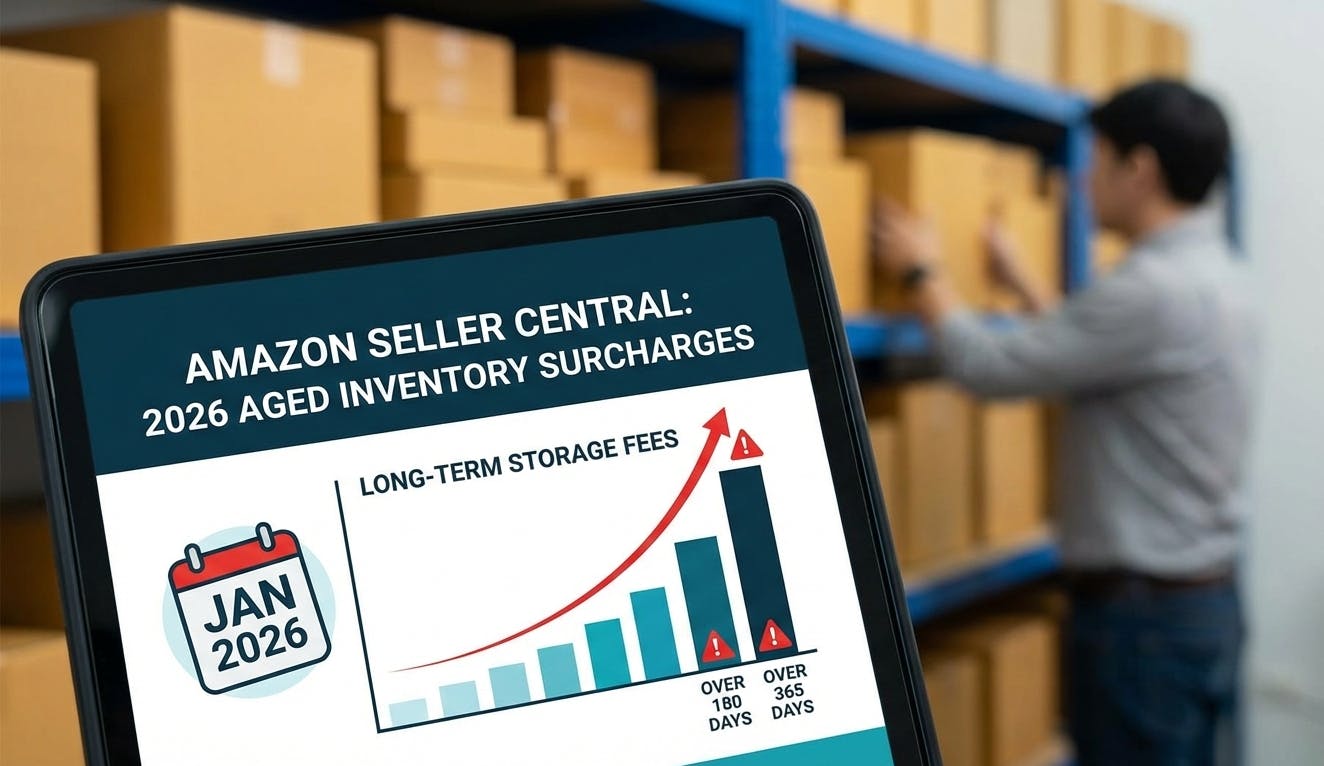
If you are selling on Amazon FBA, I know that recent updates are making 2026 look a bit scary for slow-moving inventory.
Aged inventory surcharge fees are increasing. And, I can surely tell you that if you are not careful, a few months of stock can turn into a cash-burning nightmare.
But, for this, you don’t have to panic. There are concrete, practical steps you can take to get on track.
So, What Are Aged Inventory Surcharges?
They are Amazon’s extra charges when your inventory sits in their warehouses for too long.
Starting in 2026, they are charging around,
- 12–15 months old: $0.30 per unit per month (up from $0.15)
- 15+ months old: $0.35 per unit per month or $7.90 per cubic foot, whichever is higher
The shocking truth here is, yes, this can add up fast. A slow-moving SKU can cost you over a dollar per unit in just three months! Moreover, these fees stack up monthly, so the longer your items sit, the more money you lose.
Now, Here Are 7 Simple Workflows to Cut These Fees
Use these steps as your survival toolkit for 2026.
1. Build an FNSKU Velocity Dashboard
The first step is to know which products are sitting too long. So, for this, use Excel or Google Sheets and filter stating, “Days in FBA which are greater than 240.
And then, flag items with greater than 90 days’ supply. Sort this weekly by “ IPI Risk” with Liquidate bottom to 20%.
Here, the goal is to make sure no SKU stays in FBA for more than 365 days. Ideally, get this dashboard running immediately, and then check weekly.
2. Automate 90-Day Removal Triggers
Make automation your friend. Use tools like Helium 10 or InventoryLab and set alerts for items approaching 270 days in storage. Then, if you have less than 14 days of supply per week, consider this as fulfilling by yourself (FBM). You can even use the Amazon API to automatically create removal orders when a product hits a certain age in the storage. This will help you keep inventory moving and avoid surprise fees.
3. Run a Q4 Liquidation Rule
Slow SKUs don’t fix themselves. You need to push them. Here’s a timeline example that works,
- Oct 1-15: Offer 50% off coupons on 241-365 day inventory
- Oct 16-31: Use Multi-Channel Fulfillment (MCF) to sell to email lists, which applies approx. 30% fee.
- Buy Oct 31: Donate or dispose of items, which can save approx. $0.20/unit on light SKUs.
A quick math here, avoiding a $0.35/month surcharge for 3 months saves $1.05 per unit. It is not huge individually, but it adds up fast across hundreds or thousands of SKUs.
4. Optimize Your Packaging
Amazon charges for your packaging based on cubic feet. So, even a small change from your side can save a surprising amount.
For example, if you were using 0.4 cubic feet of space, it may charge you $3.16 per month (0.4*$7.90=$3.16). Now, with a small change of reduction to 0.3 cubic feet of space, it charges you $2.37 per month (0.3*$7.90=$2.37). You are saving $0.79 per month per unit.
Even cutting off an inch or two from box dimensions will reduce fees and help your products move faster.
5. Try To Avoid West Coast Storage When Possible
On Amazon, there are some fulfillment centers that cost more. For example, West Coast storage costs around $0.57/ft³, compared to $0.48 elsewhere, which is a 19% premium.
So, here is a tip I can give you: Manage your high IPI scores, which further help Amazon favor you with efficient fulfillment centers and reduce inbound placement fees, avoiding approx. 0.7% revenue hit.
6. Use Serialized Inventory Audit (Post-Commingling Ban)
As we all know, commingling ends by March 31, 2026. Amazon now requires invoices for ALL FNSKUs that are greater than 180 days.
So, I suggest the following,
Resellers - Audit serialized UPCs weekly, and switch to wholesale only with proper invoice backing.
Private label- You are safe since you control your own FNSKUs
The immediate action to be taken is to remove all retail arbitrage serialized inventory that's been in FBA for more than 180 days.
7. Next, Use a Break-Even Calculator
When you decide on discounts or removals, always calculate the break-even price. Here’s a simple formula that can be used for liquidation discounts: Surcharge /(Selling Price - COGS - FBA Fees).
For example, a $25 item with $10 COGS and $4 FBA fees, that's $0.35/ ($25 - $10 - $4) = 17% discount to break even.
The 41% figure ignores COGS and fees, making it dangerously high. Always run this calculation before every coupon or removal order to avoid losing money on desperate clearances.
Here Is My Suggested Execution Timeline
To make all these manageable, you need to break them into weekly priorities.
Week 1- Build your FNSKU dashboard
Week 2- Plan your Q4 liquidation using the rules mentioned above
Week 3- Audit all your packaging and optimize it
Week 4: Set up 3PL relationships for hybrid fulfillment
This sequence will make sure that nothing falls through the cracks and gives you the best chance to avoid penalties in furture.
Final Words
I can clearly tell you that sellers who implement these strategies early have been able to cut aged inventory surcharges by up to 78% in Q1. It is a proactive game where the less stock you have, the less money you lose.
And, if your mid-range SKUs are moving slowly, your readers or business partners need this plan yesterday.
Taking even a few of these steps, like the dashboard, a quick liquidation push, and packaging optimization, can save hundreds or even thousands of dollars in 2026.
Remember: slow inventory isn’t just a storage problem. Now, it’s a cash problem.
[story continues]
tags