


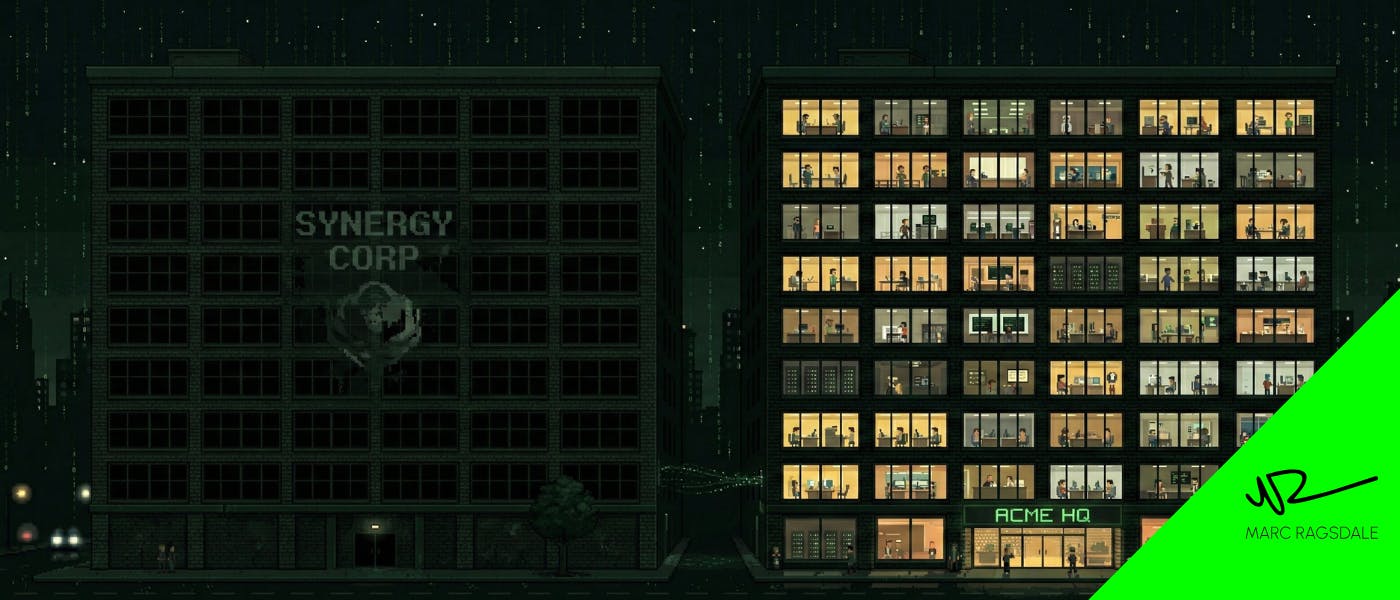
This isn't a metaphor. It's a sequence of events that is architecturally conceivable today.
Forget the robot factory. Forget the AI assistant that schedules your meetings. When I talk about organizational autonomy, I mean something specific and considerably more threatening: a competitor that can identify your customers, design a frictionless acquisition pathway for each one of them, execute it, and absorb your revenue without a single sales call, implementation team, or project manager.
And they can do it before you open on Monday.
Here's exactly how.
The attack surface is one approval
The current switching cost model has natural brakes. Migrations take months. IT has to sign off. Contracts have to be unwound. Data has to be cleaned and exported. Every one of those friction points is a closed door preventing enterprise clients from jumping ship.
Autonomy is an automated locksmith.
An organization that has consolidated its intelligence, with unified data, aligned operations, and agents with enough context to act without waiting for human sign-off at every step, doesn't run a sales campaign against your customer base. It engineers a migration pathway and reduces the entire decision to a single point of human approval.
One button. Your customer clicks it, hands over credentials, and the system does the rest.
That's the only human in the loop. And your competitor designed the entire experience to make that moment feel trivially low-stakes.
What happens after the button
Your customer doesn't experience a hostile takeover. They experience an offer. A good one. Six months free. A feature list that maps suspiciously well to every frustration they've ever had with your product. A one-click approval that promises to handle everything for them. No IT involvement required. No downtime. The whole thing is legal, consensual, and even kind of pleasant from where they're sitting.
This is important to understand, because it's easy to read what follows and hear theft. It isn't. It's customer acquisition taken to its logical extreme by an organization capable enough to execute it at a scale and speed that no human-led competitor could match. That said, it's worth noting quietly that the same architecture which makes this a frictionless legal acquisition also makes it a remarkably effective template for something less legitimate. We won't go down that road here, but the thought should not be lost on you.
Back to your customer. They click approve, hand over credentials, and within hours, their data starts moving. Some of it transfers directly. What's locked or siloed gets handled differently, because autonomous agents don't need clean exports. They read what's accessible, infer what isn't, and reconstruct missing context from signal. Three years of your operational relationship, including workflows, preferences, decision history, and communication patterns, gets theorized into existence by systems smart enough to deduce what they can't directly see.
And whatever the system cannot find, deduce, or rebuild? Well, your customer still has their credentials to the old account. So the system simply logs into your platform with those credentials, locates the missing context, and pulls it over. The autonomous competitor will even cover that subscription cost, for as long as it takes, until your customer feels confident everything has made it across. You are, in the most literal sense, paying to host data that is actively being harvested from you. You just don't know it yet.
And all those contractual restrictions you agreed to when you signed up? The data portability clauses, the export limitations, the terms you never fully read? Your new host deploys agents that parse every line, identify every legitimate extraction pathway, and represent your interests with the kind of legal precision that would cost you thousands in billable hours. They aren't breaking the rules. They're reading them more carefully than anyone on your side ever did, and they're using every inch of room those rules allow. The contract you thought protected you turns out to have been written with enough ambiguity that a sufficiently motivated reader can walk a truck through it.
By Monday morning, the migration is functionally complete and your customer is no longer yours.
But here's the mechanism that makes this truly dangerous: your customer doesn't experience a migration. They experience almost nothing. The interface they log into Monday looks identical to yours. Your autonomous competitor didn't just move the data. They rebuilt your UI and scaffolded around it permanently to eliminate any residual friction for their new customer. The logo in the corner is different and the billing details changed.
Your customer didn't leave you for something better. They were absorbed, and they barely noticed.
The economics make it worse
This isn't just a technical capability story. It's a financial one.
The autonomous organization will be well-capitalized, because its operational leverage is so extreme that customer acquisition costs approach zero. Adding an account doesn't require a sales rep, an implementation engineer, or a customer success manager. It requires compute and agents. The marginal cost of absorbing your next customer is functionally identical to the marginal cost of absorbing your ten thousandth.
That changes everything about how they can play the game.
They can subsidize the first quarter, or the first year to make the economic case frictionless on top of the technical case. And because their cost structure is so compressed, they can do this at scale without it being a meaningful expense. What looks like a generous offer to your customer is, from the autonomous competitor's perspective, a rounding error on the balance sheet.
Meanwhile you're still paying for the sales team that didn't close, the implementation team that never got called, and the customer success manager who is about to find out their accounts churned over the weekend.
They're not buying your customers. They're acquiring your company's revenue without paying for the company. No due diligence. No acquisition premium. No board approval. And they can do it to every competitor in your category simultaneously, because the same system that absorbed one customer can run the same play across thousands of accounts in parallel.
Entire businesses with thousands of customers become empty containers in a workweek. The operational shell remains. The brand still exists. The contracts are still on file. The value has moved, and it isn't coming back.
Why this is exactly like the nuclear analogy
When people talk about AI giving one company an insurmountable advantage over competitors, they reach for the nuclear metaphor. First mover wins, everyone else is scorched earth.
They're more right than they realize. But this isn't about which company has the best AI because every serious organization has access to capable AI right now. What they don't all have is the data and the intelligence directed entirely toward autonomy. If data is the atom and AI is fission, then autonomy is the bomb. Without the first two working together, you can’t achieve the third.
If data is the atom and AI is fission, then autonomy is the bomb.
Once a nuclear state achieves a sufficient arsenal, the gap between them and a non-nuclear state isn't just a matter of degree. It's a different category of power entirely. The same is true here. The first truly autonomous organization doesn't need to compete with you in any traditional sense. It simply begins the quiet, systematic acquisition of everything you've built. The scorched earth is still there. The buildings are standing, the brand still exists, the website still loads. There's just nothing left inside.
Your moat isn't wide enough when crossing it takes thirty seconds and a button.
And there's no moment of obvious detonation to rally against. Your customers still have to make one human decision to convert, but the entire apparatus of an autonomous organization can be directed at collapsing that decision to its minimum possible friction.
The window is shorter than you think
Once these migrations start happening publicly, the market builds antibodies. Contracts will include data portability restrictions. Credentials will get harder to transfer. Regulators will start asking questions about consent architecture. The cleanest version of this, where a competitor can absorb your customer base before you even understand what's happening, has a limited operational window.
Everything described here exists in some form today and the leading organizations are already assembling the infrastructure. The gap between where they are and where this becomes routine is closing faster than most leadership teams are paying attention to. The only variable left is whether you will have built enough structural readiness before one tries.
The organizations that wait for a case study to convince them are the ones who become the case study.
The framework makes it mappable
I spent years researching how organizations evolve toward autonomy. That research produced the Ragsdale Framework for Autonomization. What it gives you, above everything else, is the ability to read the sequence. Once you have the model, none of what I've described in this piece feels abstract or unpredictable because it yields a map so logically consistent that any informed person can trace the path from beginning to end and see exactly where it leads.
The framework describes five phases of organizational progression: Aspiration, Awareness, Alignment, Acceleration, and Autonomization. Each phase builds on the last, and each one closes a specific vulnerability that the previous phase left open. An organization that hasn't consolidated its data is sitting in Awareness at best. One that hasn't structurally aligned its human-led operations cannot meaningfully accelerate, regardless of how many AI tools it has bolted on top. And one that hasn't done either of those things is, architecturally speaking, an open door with a welcome mat in front of it.
When I map a company against the framework, I can tell you almost immediately where they're exposed and what a capable autonomous competitor would target first. It's not a complicated analysis once you have the model. The unsettling thing is that most companies have never thought about their readiness in these terms at all. They're managing a product roadmap, not an autonomy progression. And those are two very different races.
Which brings us back to the nuclear analogy one final time. The arms race between state actors was visible. Governments knew it was happening. They could see the missiles. They built treaties and deterrence strategies and early warning systems because the stakes were obvious to everyone involved.
The unsettling thing is that most companies [are]… managing a product roadmap, not an autonomy progression. And those are two very different races.
The autonomy race between organizations has no such visibility. There are no satellites tracking who has achieved consolidation, or inspectors verifying structural readiness. There is no treaty framework being negotiated. There are only organizations quietly building, and organizations that aren't. And unlike the nuclear race, the first casualty won't be a city. It will be a company that showed up Monday morning to find its customers had somewhere else to be.
You don't need to be the most autonomous organization in your industry, but you do need to be far enough along that the cost of absorbing you exceeds the reward. Right now, for most companies, it doesn't.
The race is happening whether you're in it or not. And the weekend is coming.
Marc Ragsdale is the founder of Kaamfu and the author of the Ragsdale Framework for Autonomization. He writes about the architecture of the autonomous enterprise at MarcRagsdale.com and RagsdaleFramework.com.