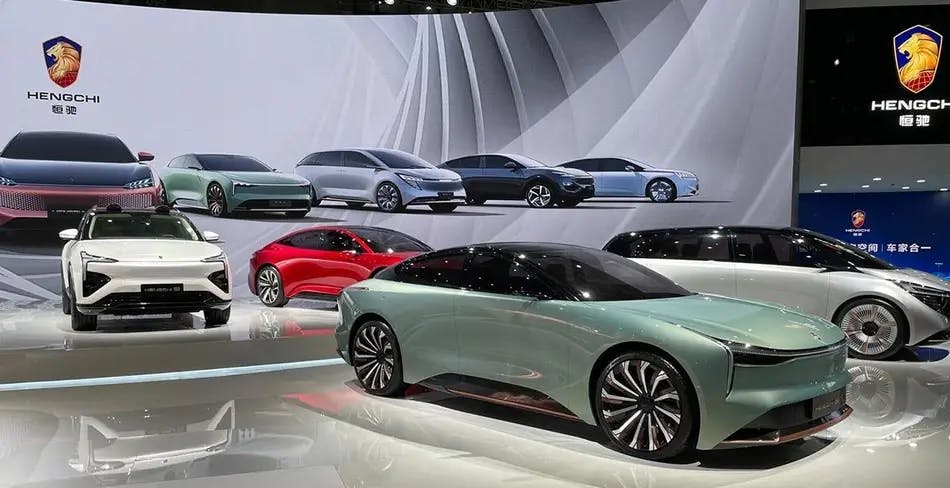
Chinese electric vehicles (EVs) have been making a big splash in markets worldwide, with one major target for Chinese-made EVs being the United Arab Emirates (UAE). The UAE is a prime location for Chinese EVs to enter the Gulf market, enabling increased regional credibility while providing a robust market for EV development.
The UAE also stands out as an investment opportunity for Chinese state-owned enterprises (SOEs) and other groups from an electric grid perspective, with China taking the lead on investing in a variety of different electric-focused infrastructure projects within the UAE. This is particularly advantageous for Chinese organizations seeking to increase China’s reach within the realm of strategic competition, with the UAE’s advantageous location to other Middle East countries and to Africa, another significant growth opportunity for China.
EVs signify just one of many avenues for Chinese involvement in the UAE’s future, with control over the UAE’s electric infrastructure becoming a significant lever as the UAE continues its transition away from reliance on its oil and gas-based past.
EVs as an economic entry point into the UAE
Consulting firm AlixPartners
Infrastructure designed to support Chinese EV growth has prominently appeared in the UAE in the past year, with BYD unveiling the region’s first-ever plug-in hybrid pickup truck and flash-charging technology in
Other companies with significant EV inroads into the UAE include NWTN, who announced its AI Industrial Park Project housing an EV vehicle assembly plant to be located in the Khalifa Economic Zones Abu Dhabi (KEZAD) in
These shaping operations illustrate how the UAE has become both a proving ground and a launchpad for Chinese EVs within the UAE and in the greater Gulf, tying existing Chinese capabilities with the UAE’s growing industrial base. As a result, Chinese EVs are clearly positioned both as EV importers and localized producers within the UAE, making future “de-risking” by other global partners significantly more challenging.
Chinese-led electric infrastructure projects in the UAE
Chinese firms have also taken a significant interest in developing the UAE’s electric infrastructure, working their way into the UAE’s EV market but also into its greater energy and transportation backbone. The ability to seamlessly integrate into all facets of the UAE’s energy grid highlights the opportunity for influence that Beijing can wield within the UAE.
For one, PowerChina has led the UAE in developing electric-focused infrastructure, with it being the
Therefore, the more intertwined Chinese firms go into the UAE’s grid and transport sectors, the more structural influence that China will gain into the technologies that will define the UAE’s post-oil economy. This is especially prevalent as these platforms are increasingly interconnected, resulting in an ecosystem that influences everything from data flows to supply chains.
Maintaining the UAE’s neutrality within strategic competition
From the perspective of the UAE, this heightened Chinese involvement in one of its
However, owing to the sensitivities around electric generation, the UAE has placed itself in a delicate position. On one hand, it must ensure that Chinese-built infrastructure remains fully under its control, especially when working with U.S. partners, who view infrastructure as inseparable from national security. On the other, the UAE cannot necessarily signal any specific preference for a nation-state’s EVs or electrical assistance, with its reliance on continued access to Chinese capital, know-how, and technology. China stands out as a clear partner, with its infrastructure knowledge and technical capability-building skills, particularly in light of President Trump’s
With this in mind, the UAE could manage to use strategic competition to its advantage, preventing any type of overreliance on a single partner while still benefiting from its relationships with many.
Conclusion
All in all, China’s rapidly expanding EV and electric infrastructure footprint in the UAE is evidence of a new strategy focused around green statecraft. For China, the UAE offers its developed market, regional prestige, and a springboard into the region and beyond. For the UAE, Chinese investment and know-how enables it to accelerate its transition away from its oil legacy and into a green future, in accordance with its
If the UAE can maintain this balance, it could greatly benefit from strategic competition. As a result, the UAE could shape the future of regional technology integration, leading the way via innovation in an energy-specific field analogous to its previous leadership in oil mining, refinement, and production.
However, if the UAE is unable to navigate this delicate balance successfully, its economic neutrality could become a key strategic vulnerability, especially as it seeks to transition to more renewable forms of energy.
Image Source: Arabian Gulf Business Insight
[story continues]
tags