1. How the Consumption Economy Works in SaaS?
A tiny economic transaction takes place each time you launch a cloud server, make an API call, or stream a gigabyte of data. The consumption economy, the unseen force behind the world's fastest-growing software companies, can be understood by multiplying that by millions of users across hundreds of services.
2. From Products to Consumption: A Fundamental Shift
Commerce was reassuringly straightforward for the majority of business history: you made something, set a price, and someone bought it. The transaction is finished. However, during the past ten years, something fundamental changed. "What did they actually use?" became the new question instead of "what did you sell?"
The previous model, which included flat subscriptions, perpetual licenses, or fixed upfront pricing, presumed that the value was in the software access. This is completely reversed in the consumption economy. Both the value and the bill are delivered in real time. You pay for compute hours, storage held, API calls, and gigabytes streamed. This is the revolution of pay-as-you-go.
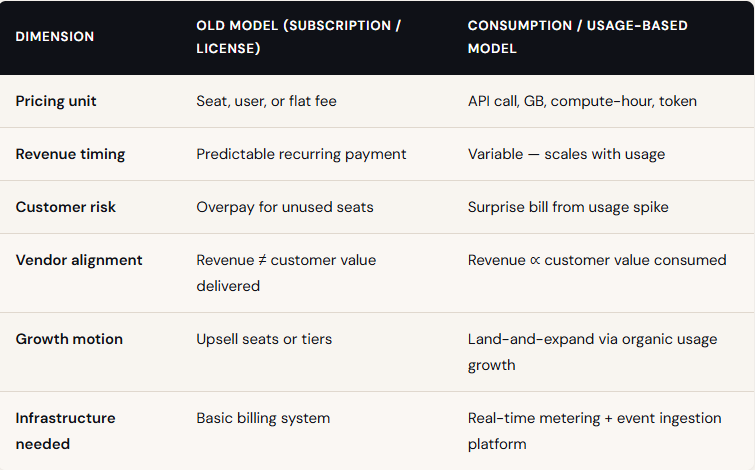
Every tier of the stack has well-known examples, such as hyper scalars, which bills by compute hour and data transfer. A portion of every transaction is taken by payment platforms. Company 'A' charges by the minute for calls and SMS. AI infrastructure companies charges for each token. Every query is measured by Cloud data lake providers.
3. The Numbers Tell the Story
- 85% of surveyed SaaS companies already have or are building usage-based pricing (2025 Metronome survey)
- 77% of the largest software companies now incorporate consumption-based pricing in their models
- 59% of software companies expect usage-based revenue to grow as a share of total revenue in 2025 — an 18% rise from 2023
- 8X year-over-year increase in revenue processed via consumption billing at Metronome in 2024 alone
The whole picture is not conveyed by these figures. Many businesses are flying the plane while still building the engine, resulting in a brutal infrastructure gap beneath the adoption wave.
The Unspoken Crisis
Although 38% of SaaS companies acknowledge that their infrastructure cannot reliably support metered billing at scale, 63% of them report faster revenue growth from consumption models. They are making money off of faith rather than measurement.
4. The Three Questions That Determine Survival
What did they Consume?
Not close. Too far away. That's right. Real money is the difference between 1,000 and 10,000 API calls. Your client will notice. Investors will take note. SLAs may be unit-specific in your contract. Inaccurate metering is a trust issue as well as a billing issue.
When did they Consume it?
time zones. systems that are dispersed. Microsecond-timestamped events from data centers around the world. A 72-hour delay in a single event may result in an incorrect billing cycle, a violation of a pricing tier threshold, or a breach of a usage contract. Inaccurate timestamps result in incorrect billing months and contract violations.
Are they thriving or dying?
Seasonality, competitor migration, or a silent product-fit failure could all contribute to a sudden decline in consumption. The customer is already halfway out the door when that signal appears in your CRM as a churn notification. The earliest churn warning signal is real-time consumption intelligence.
5. The $50 Million Lesson
A Cautionary tale: A well-funded startup with cutting-edge technology found that they had been 40% undercharging their biggest client. There was no pricing error here. Their systems were unable to precisely monitor consumption across dispersed infrastructure.
The team had to choose between sending a retroactive bill and ruining the customer relationship or accepting the loss and ruining their unit economics.
The bill was sent. The client departed. The startup failed. Their product wasn't the issue. It was their infrastructure for data.
"In the consumption economy, if you can't measure it accurately, you can't monetize it reliably. And if you can't monetize it reliably, you don't have a business, you have an expensive science project."
6. The Pricing Model Landscape
The construction of consumption models varies. Pay-as-you-go has given way to a wide range of hybrid approaches in the industry.
PAYG, or pure usage-based : A set rate is charged for each unit used. The classic example is the on-demand pricing of AWS EC2. Finance teams detest the unpredictability, while customers love the transparency.
{
  "pricing_model": "pay_as_you_go",
  "rates": {
    "api_calls":       { "unit": "per_1000_calls",  "price_usd": 0.0035 },
    "data_storage":    { "unit": "per_GB_per_month", "price_usd": 0.023  },
    "compute_minutes": { "unit": "per_minute",       "price_usd": 0.0001 }
  },
  "minimum_charge": 0,
  "billing_cadence": "monthly_in_arrears"
}
Subscription + Overage (Hybrid): The model that is currently most widely used. Consumers pay metered rates for anything above a base tier, which has predictable costs. This is used by Twilio, Datadog, and the majority of contemporary SaaS platforms. Most usage-based companies have shifted from pay-as-you-go pricing to hybrid models, particularly those that cater to smaller clients who might be more sensitive to unforeseen costs.
Credit / Token Pre-Purchase: Consumers purchase a block of credits up front and gradually deplete them. This model is used by Clay's automation platform, Twilio's messaging credits, and OpenAI's API. Both parties' cash flow predictability is resolved, and upsells that are inherently linked to value consumption are made possible.
Committed Use + True-up: Enterprise clients pledge to spend a certain amount each year. Throughout the year, actual consumption is monitored in great detail. The discrepancy between committed and actual spending is reconciled at renewal or at a predetermined interval. This strategy is demonstrated by Snowflake's enterprise contracts.
7. Three Critical Capabilities for Survival
After analyzing the architectures of dozens of consumption-driven businesses, three capabilities separate durable companies from cautionary tales. These are necessities, not extras.
Capability 1: Ingestion of Real-Time Events
The consumption economy's worst enemy is batch processing. You need to know when a customer reaches a usage limit right away, not when the overnight ETL job is finished tomorrow morning. Milliseconds count when fraud starts. Billions of events must be continuously ingested and processed by the data pipeline with subsecond latency.
# Illustrative architecture for real-time consumption metering
ingestion_layer:
  technology: Apache Kafka  # or AWS Kinesis, Google Pub/Sub
  throughput: "500k events/second peak"
  ordering_guarantee: "per-partition"
  retention: "72h  # replay window for late arrivals"

processing_layer:
  framework: Apache Flink   # stateful stream processing
  windows:
    - tumbling: "1 minute"    # live dashboards
    - sliding:  "1 hour"      # anomaly detection
    - session:  "by billing period"  # invoice generation
  exactly_once_semantics: true

storage_layer:
  hot:  Redis           # real-time counters & limit checks
  warm: ClickHouse      # analytics queries on recent data
  cold: S3 + Parquet    # archival & audit trail
Capability 2: Single source of truth
The fact that engineering and finance have different consumption and customer success metrics is one of the most frequent reasons for billing disputes. Everything downstream, including forecasting, churn detection, and invoicing, breaks down when teams are unable to agree on the canonical number.
Engineering's raw events, finance's billing logic, and customer success's usage insights must all come together in a single system called a consumption data platform. Just one figure. One version of reality. Regular at 8 a.m. and 8 p.m.
The "Who Do You Believe?" Problem: A common scenario: an enterprise customer disputes their invoice. Engineering pulls raw logs and gets $47,200. Billing pulls the invoice and sees $52,800. Customer success shows their dashboard — $44,100. All three numbers are "correct" in their own context. Without a unified ledger, you cannot resolve disputes, and you will lose them.
Capability 3: Predictive Intelligence
The rearview mirror is insufficient. True consumption intelligence looks ahead. Using their metering data, top teams:
Predict budget overruns in advance, allowing for proactive customer conversations rather than unexpected bills. Identify silent churn signals: a 20% weekly decrease in consumption is the first indication that a customer is considering other options. Before the customer even realizes it, flag unusual usage patterns that could point to fraud, API abuse, or integration failure 💰 Find areas for growth; clients who are getting close to a tier threshold are good candidates for discussions about upgrades.
8. Why AI is Accelerating Everything
Artificial intelligence has emerged as the most potent stimulant for the consumption economy. The seat does not sell AI. It is not possible to pre-negotiate a flat subscription for the number of times a large language model will be called. Each embedding, token, and inference is a distinct, measurable, and chargeable event.
AI tools rely on flexible infrastructure and on-demand computing, which demands more resources; pricing varies with usage, whether it is hybrid or pure consumption. Spending on AI-native applications increased by 108% year over year.
According to Nvidia's Jensen Huang, there will soon be a "$100 trillion AI token revolution," in which computing power will be traded like electricity and cloud and AI services will increasingly shift to metered models where usage will be monitored, valued, and charged like energy kilowatt-hours.
This implies that event ingestion, metering ledgers, and real-time billing—the back-office issues that underpin the consumption economy—no longer exist. For every AI company that enters the market, it is the product itself.
9. Build the Platform First, Not the Skyscraper
Building the product before developing the infrastructure to precisely measure and monetize it is a tempting trap in the consumption economy.
Infrastructure for consumption powers the AI revolution. Only metering platforms are compatible with cloud migration. Without data governance, digital transformation is unsuccessful. The businesses that will still be in business in ten years are constructing what looks uninteresting from the outside: the foundation, the platforms, and the pipes.
The discrepancy between where they are and where they should be is a prioritization issue rather than a technological one. Product roadmaps rarely include metering infrastructure until a crisis compels them to do so.
10. Conclusion: The Invisible Becomes the Infrastructure
Pricing is not a trend in the consumption economy. The way that software generates and extracts value has been structurally reorganized. The systems that monitor those moments become just as strategically significant as the product itself when every gigabyte, every API call, and every compute second turns into a billable moment.
Three indisputable truths have been absorbed by the winning businesses in this paradigm:
Measurement is monetization.
If you can't measure it precisely, you can't charge for it consistently. Metering accuracy is a matter of product integrity, not accounting.
Real-time is the only time.
The consumer economy is incompatible with batch processing. Decisions made today are already flawed by the time yesterday's data is processed.
Usage data is intelligence.
For product creation, fraud detection, revenue growth, and churn avoidance, consumption patterns are your company's most valuable indicator. It would be like mining for gold and discarding the diamond if you only treated them as billing data.
So yes, build the AI model. Chase the innovation. Launch the product. But first, build the data platform that will let you measure every bit of it.
[story continues]
tags