This story on HackerNoon has a decentralized backup on Sia.
Transaction ID: 4mW4hYmuRF3JQ__-mih0aus-_xAVNURdrE4eGvnwps4
Cover

How Easy Is It for AI To Mimic a Human Artist’s Style?

Written by @torts | Published on 2024/12/11

TL;DR
Results reveal the effectiveness of AI art protection tools against mimicry methods. Human evaluators show how artists’ styles can still be imitated despite safeguards.

Abstract and 1. Introduction

  1. Background and Related Work

  2. Threat Model

  3. Robust Style Mimicry

  4. Experimental Setup

  5. Results

    6.1 Main Findings: All Protections are Easily Circumvented

    6.2 Analysis

  6. Discussion and Broader Impact, Acknowledgements, and References

A. Detailed Art Examples

B. Robust Mimicry Generations

C. Detailed Results

D. Differences with Glaze Finetuning

E. Findings on Glaze 2.0

F. Findings on Mist v2

G. Methods for Style Mimicry

H. Existing Style Mimicry Protections

I. Robust Mimicry Methods

J. Experimental Setup

K. User Study

L. Compute Resources

6 Results

In Figure 4, we report the distribution of success rates per artist (N=10) for each scenario. We averaged the quality and stylistic transfer success rates to simplify the analysis (detailed results can be found in Appendix C). Since the forger can try multiple mimicry methods for each prompt, and then decide which one worked best, we also evaluate a “best-of-4” method that picks the most successful mimicry method for each generation (according to human evaluators).
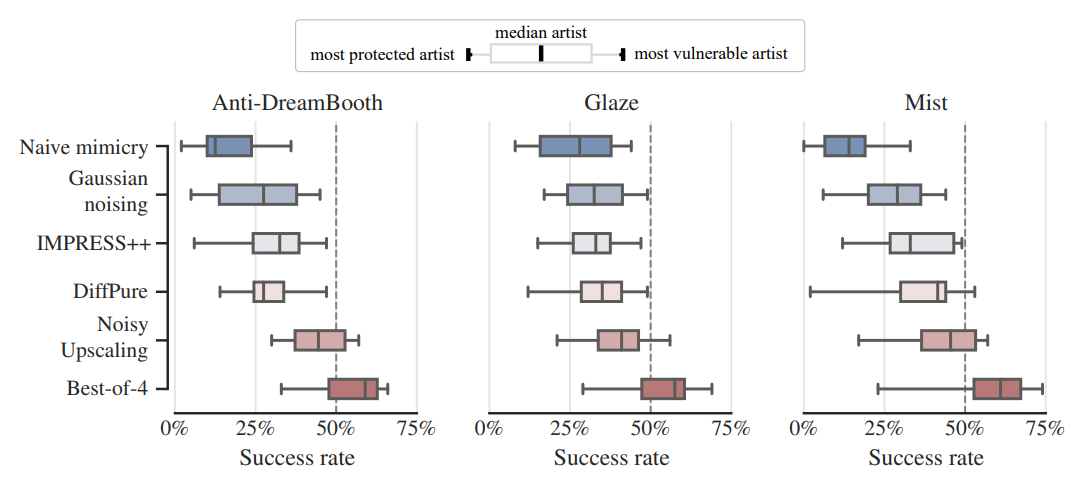
Figure 4: Success rate per artist (N=10) on all mimicry scenarios. Box plots represent success rates for most protected, quartiles, median and least protected artists, respectively. Success rates around 50% indicate that robust mimicry outputs are indistinguishable in style and quality from mimicry outputs based on unprotected images. Best-of-4 selects the most successful method for each prompt.

Authors:

(1) Robert Honig, ETH Zurich (robert.hoenig@inf.ethz.ch);

(2) Javier Rando, ETH Zurich (javier.rando@inf.ethz.ch);

(3) Nicholas Carlini, Google DeepMind;

(4) Florian Tramer, ETH Zurich (florian.tramer@inf.ethz.ch).


This paper is available on arxiv under CC BY 4.0 license.

[story continues]


Written by
@torts
Exploring the legal landscape of the digital age. Read my articles to understand the why behind the what.

Topics and
tags
ai-forgery|generative-ai|ai-style-mimicry|image-theft-by-ai|protecting-art-from-ai|glaze-protection-tool|black-box-ai-access|digital-art-vulnerabilities
This story on HackerNoon has a decentralized backup on Sia.
Transaction ID: 4mW4hYmuRF3JQ__-mih0aus-_xAVNURdrE4eGvnwps4