


Coffee!! Most of us start with a cup of coffee to start our day. This is no different for a GenAI-native technical writer as well.
As a technical writer, you attend the first meeting of the day whereby a product manager narrates a product feature scope along with some UI mockups. As an inquisitive technical writer, you are asking many questions during the meeting. Product managers and UX designers are sharing more information about purpose of the product feature, use cases that it is trying to solve and how it is designed for ease of use. You are not taking notes in a notebook or capture all information in digital form. Instead, you are probing all stakeholders to cover all aspects of that product feature.
Then you feel the breeze after this meeting. A break for 15 minutes before you jumps in another meeting with customer support team. Suddenly, a ping came from your manager saying that product feature is shipping tomorrow and she wants to review feature documentation before noon.
Without sweating, you power up your AI CoPilot and upload the meeting recording. All your organizational style guides, content structure for feature documentation, and other instructions are already stored in skills.md file of AI CoPilot. You give a prompt to AI CoPilot to ensure it produces a “feature documentation” and give directions to AI CoPilot on any clarifications it seeks. You take a glimpse at the CoPilot to ensure it starts working.
Once it comes back with a draft which is 100% compliant with your style guide, you review it for content accuracy
Once it comes back with a draft which is 100% compliant with your style guide, you review it for content accuracy. You are not checking grammar, tone, or formatting—those are already taken care of by the AI CoPilot. Your attention is on something more valuable: Does this content truly help the user accomplish the task?
You verify whether the steps align with the UI mockups shared in the meeting. You check if the explanations capture the real intent behind the feature. Occasionally, you add a small clarification that only a human who participated in the discussion would know. In some places, you simplify the language even further because you understand the mindset of your users.
Within minutes, the document evolves from a technically correct draft into a user-centered guide.
You then ask the AI CoPilot to generate a few additional assets:
- A short release note summary
- A tooltip description for the UI
- A knowledge base snippet for customer support
- A few search-friendly FAQs
All of them follow the same style guide and reuse the same core explanation of the feature. What used to take several hours of manual writing and editing now takes less than thirty minutes.
Before sending the document to your manager, you run one more prompt:
“Highlight any ambiguous statements or assumptions that may confuse the user.”
The CoPilot flags two areas where the workflow might not be clear. You refine the wording, confirm the steps with the UX designer on chat, and finalize the document.
By noon, the documentation is ready for review.
Your manager responds with a simple message: “Looks good. Ship it.”
But the day of a GenAI-native technical writer does not stop there.
You then ask the AI CoPilot to convert the same feature documentation into multiple formats:
- A how-to article
- A short tutorial script for a product video
- A GenAI-optimized knowledge article so that AI assistants can retrieve it accurately
- A structured dataset that can power the product’s in-app AI help
In the past, technical writers were primarily document creators.
Today, GenAI-native technical writers are knowledge architects.
They do not just write content.
They design information so that humans, search engines, and AI systems can all understand it.
The real skill of a GenAI-native technical writer is not typing faster.
It is asking the right questions, structuring knowledge clearly, and using AI to amplify their thinking.
The coffee may start the day.
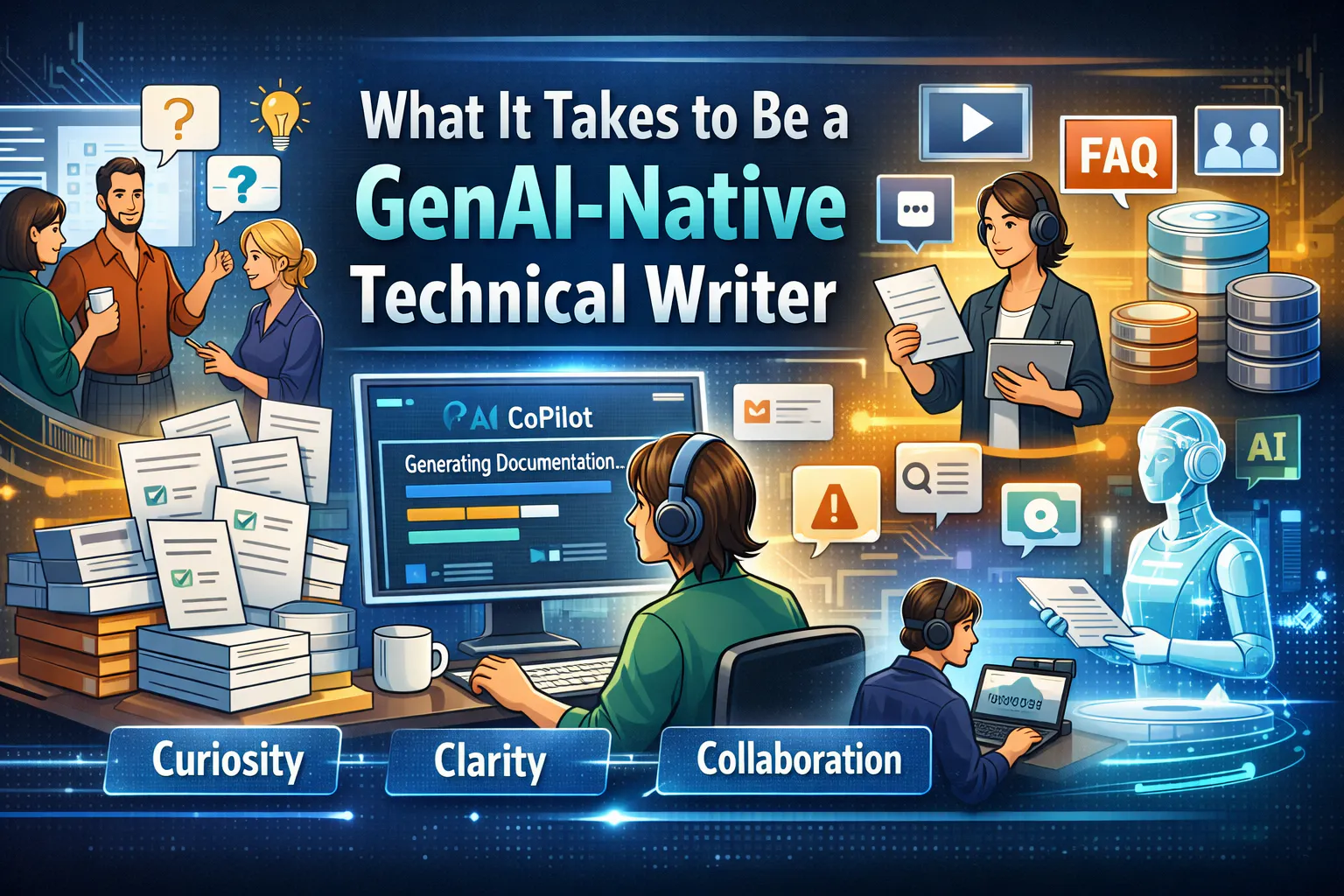
But curiosity, clarity, and collaboration are what truly power a GenAI-native technical writer.