
I’m an AI automation and GTM consultant with 7+ years in digital assets and enterprise strategy, now building agentic AI workflows for B2B sales and VC ops; my research has supported $10M+ VC rounds and informed strategy at brands like Nike, HBS, Lacoste, McKinsey, and BCG.
A typical VC analyst reviews around 3,000 decks annually and invests in roughly 9. Average time spent per deck: 2-3 minutes (up to 10 if we include preliminary research). This means 99.7% of their time is “wasted”.
This isn’t a dealflow problem. Most VCs have dealflow. The best funds are seeing 700+ decks a quarter. The issue is triage throughput.
Here’s what actually happens:
Deck hits inbox → someone says “we’ll review this” → founders send a follow-up two weeks later → by the time anyone actually reads it, the round is closed or the founder has moved on.
The best opportunities don’t wait for you to find them. They are often buried under the noise of a thousand average decks, or they move so fast they're gone before you even open the email. Finding a great company is quite literally like finding a needle in a haystack.
If you run or work at a fund that sees 200+ decks a quarter but only has bandwidth to seriously evaluate 20-30, this piece is for you.
I’ve been in crypto and investing since 2017, where I first began navigating high-volume, data-heavy markets. I’ve sat on both sides of the table, evaluating opportunities and watching how funds evaluate them. For the past year, I’ve applied that experience to building AI automation systems for operators.
The VC triage problem kept surfacing in conversations, so I built a system specifically to solve it.
The Shift Is Already Here
The data is overwhelming. According to Allvue’s 2025 GP Outlook Survey, AI adoption among private market firms hit 82% by year-end 2024, up from just 47% the previous year. The number of data-driven VC firms jumped 20% from 2023 to 2024 alone.
Deloitte’s 2025 M&A Trends Survey found that 97% of respondents have begun incorporating generative AI or advanced data analytics into their dealmaking processes, with digitization rising significantly in target identification (80%) and target screening (79%).
The elite funds have been throwing resources at this problem:
SignalFire raised additional capital in April 2025, significantly expanding its assets under management. Its Beacon AI platform analyzes vast amounts of organizational and workforce data, serving as what founder Chris Farmer described to Crunchbase as “the fabric that stitches the entire firm together.”
EQT’s Motherbrain platform has been instrumental in sourcing several direct investments. It integrates numerous external data sources with the firm’s internal network insights. At their 2024 Capital Markets Day, EQT outlined its goal to “build the most AI-literate investment organization in the world.”
Nik Storonsky, founder of Revolut, co-founded the AI-driven VC firm QuantumLight, which uses proprietary machine learning algorithms to source investments and claims to “almost eliminate human judgment” from the process.
However, some of these systems were built on pre-generative AI architecture. They required massive teams and eight-figure budgets to build. They’re optimized for their specific workflows, not customizable. And whether they’ve actually “solved” triage, or just thrown enterprise resources at it, is an open question.
I also think “human VCs” can’t be entirely automated as relationships and human connection plays a big role in the industry. Instead these automations should be applied to the highest leverage and AI-fit parts.
What’s clear is that the problem is real, the market is moving, and generative AI has changed what’s possible.
The Mixed Results of Early AI
The market is moving. But most implementations reveal how early we still are.
Tim Draper launched an AI “digital twin” that lets founders pitch via text or voice chat. The direction is right, AI handling the top of funnel so humans focus on high-signal deals. But Draper himself admits it’s “flaky.” More fundamentally, the system doesn’t accept pitch deck uploads, missing the structured information that decks provide.
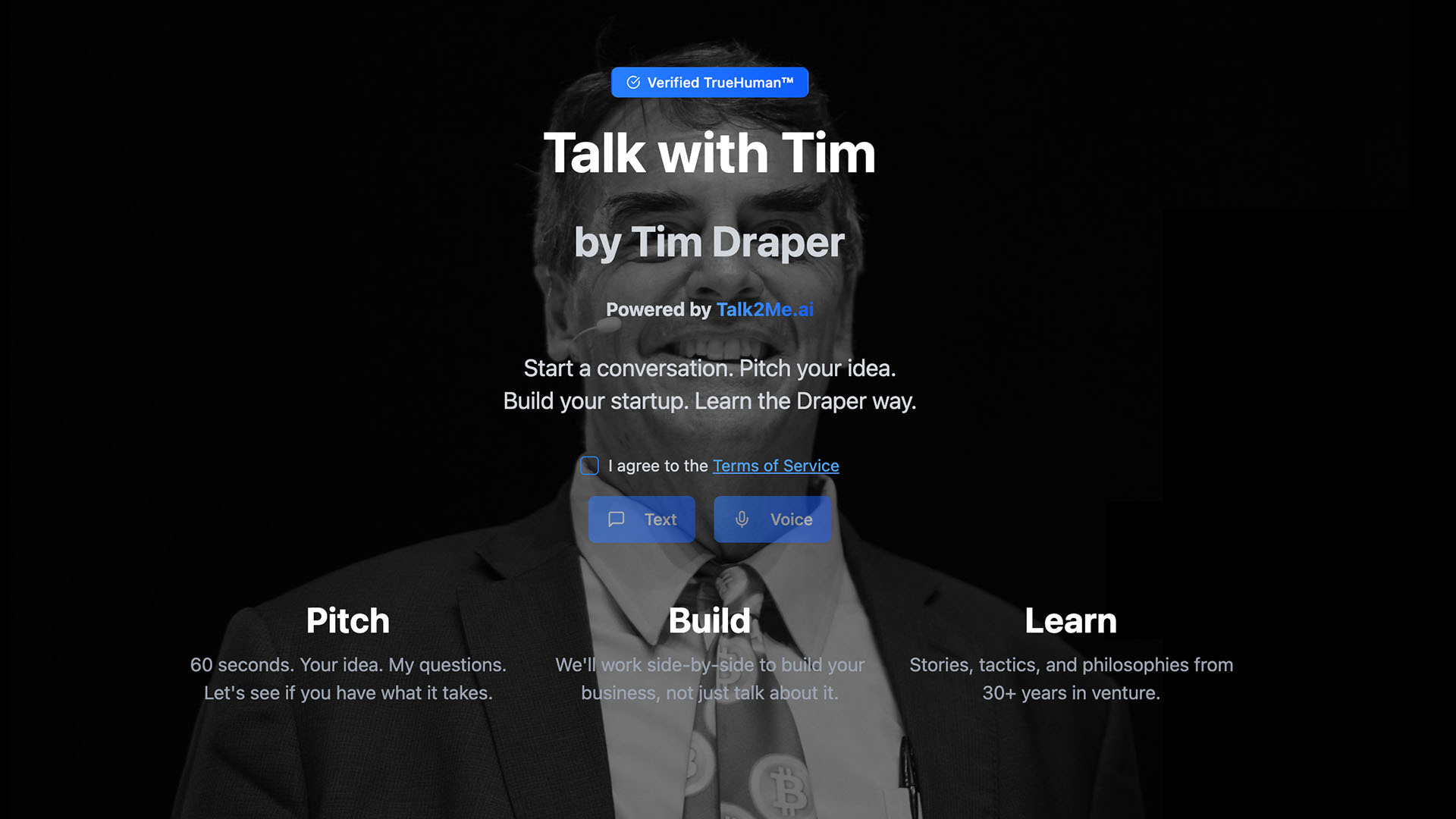
Tim Draper’s chatbot
Alliance DAO is the gold standard for crypto accelerators, vetting over 3,000 startups a year. At that volume, they have no choice but to be systematic. However, their entry point relies on a heavy initial application consisting of 39 different questions.
While this extracts deep data, it creates a massive adverse selection risk. The “hottest” founders, the ones with multiple term sheets and zero time to spare, often won’t fill out 40-question forms. They don’t have to. This means the most systematic funds can end up seeing the most desperate founders, while the elite talent bypasses the “inbox” entirely.
The Case for a Zero-Touch Interview
What’s missing across the board is a Zero-Touch Interview layer.
Instead of forcing the founder to do the manual labor of data entry, a modern system should be able to perform a Key Claims Audit autonomously. By extracting data from the deck, verifying team pedigree via LinkedIn, and cross-references technical claims against public data, a fund could get the same depth as a 15-minute introductory call, without either party ever picking up the phone. You get high-level signal with zero-click friction.
The pattern is clear: right problem, incomplete solutions. Most funds are stuck choosing between a “flaky” chatbot or a form that scares away the best talent.
Historically, “quant” funds like SignalFire or EQT had to spend millions building custom models just to understand unstructured text. Today, Generative AI allows any fund to quantify the qualitative, turning messy pitch decks into structured, comparable data without a dedicated team of data scientists.
You no longer need an eight-figure engineering budget to have a quantitative edge; you just need the right architecture.
I spent the last month architecting the solution myself: The 60-Second Triage Engine.
The 60-Second Triage Engine
An end-to-end workflow that turns inbound startup decks into scored CRM entries with thesis-aligned analysis. The whole thing runs in sub-60 seconds per deck 24/7.


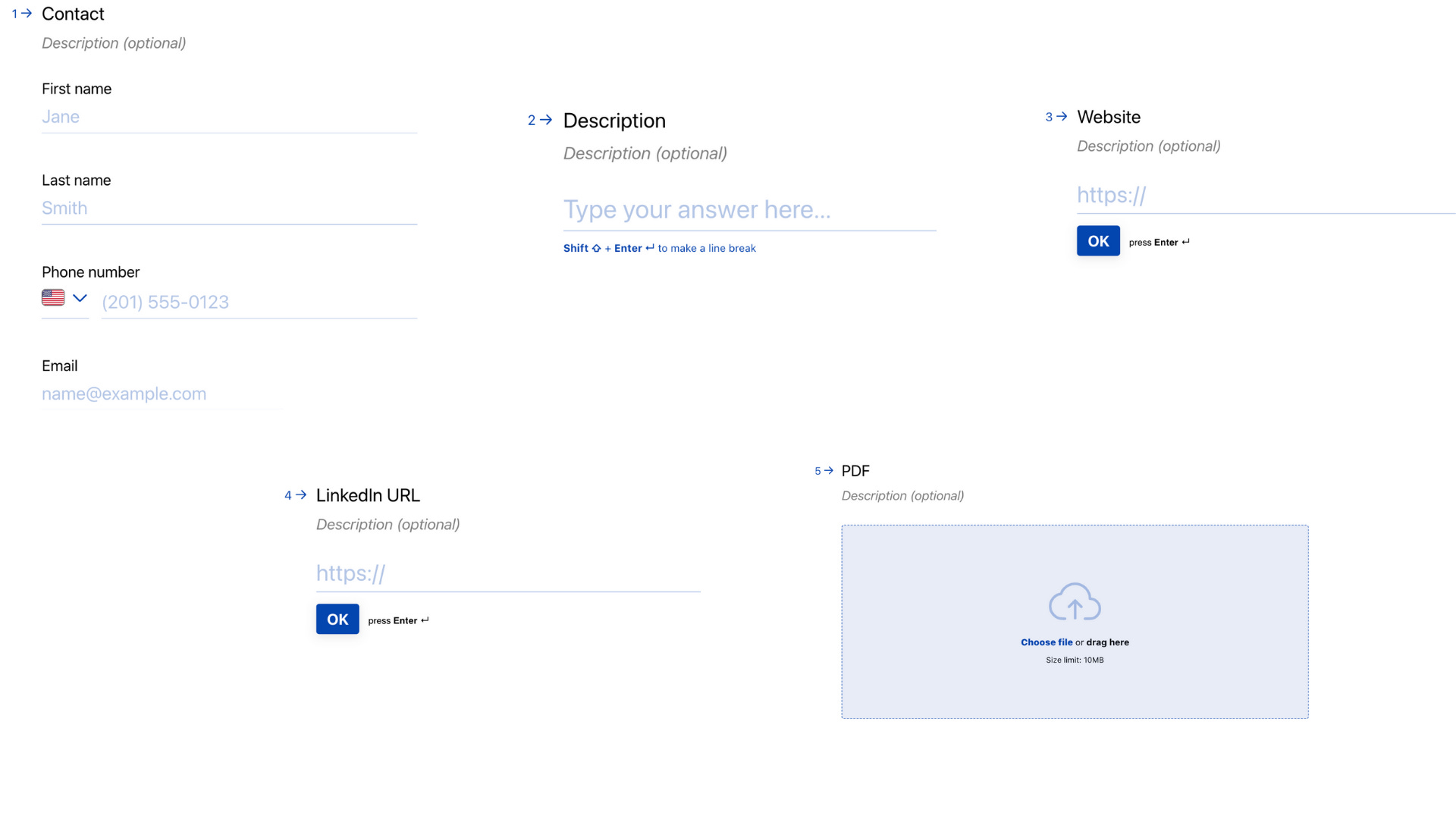
What the Startup Sees
A simple form (I used Typeform, any other form e.g. Tally works as well) with as few or as many questions as you like. Crucially, it includes an area to submit the pitch deck.
What the VC Sees
All of this occurs without any human input beyond the startup’s initial submission:
1. Automated Research Layer
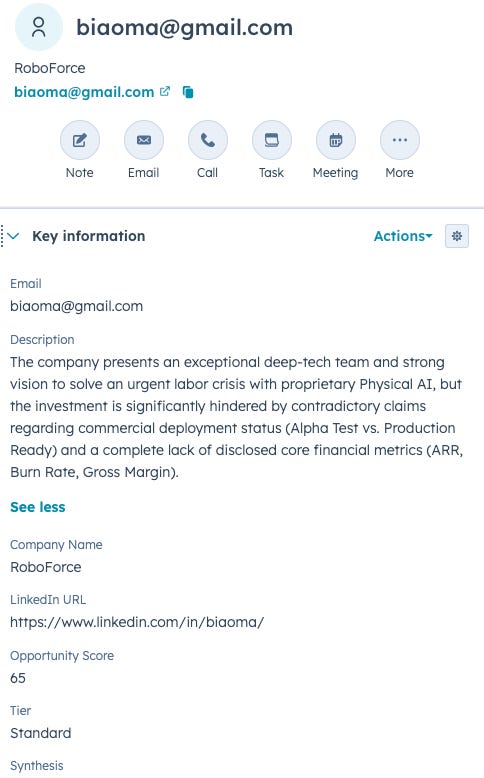
The system extracts text from the PDF, pulls LinkedIn data, scrapes the company website, and cross-references claims against public data sources. It’s doing in seconds what would take an analyst 15-20 minutes.
It then uploads this information directly to your CRM, whether that’s HubSpot (as shown in the images below) or a simple Google Sheet, so you can easily track all submissions and revisit them when needed.
To show you what this looks like in practice, I ran a publicly available deck through the system, RoboForce, a robotics company that raised $10M in 2025:

2. Investment Memo Generation
This gets passed to the CRM as seen above, but it didn’t fit in the screenshot.
RoboForce — Investment Memo (January 22, 2026)

Conviction Level: Med

The Thesis (1 sentence):
RoboForce is a deep-tech robotics company leveraging proprietary physical AI (RF-Net) and an elite team to automate labor in harsh industrial environments, but the investment risk hinges entirely on resolving the conflicting claims regarding current commercial deployment status.

Key Claims Audit:

Claim: RoboForce is developing autonomous, mobile manipulation robots (“Robo-Labor”) named TITAN.
Status: SUPPORTED
Sources: Pitch Deck; Website

Claim: The core IP is a unique “AI Expert Model with 1mm Accuracy” for complex manipulation tasks (Pick, Place, Press, Twist, Connect).
Status: SUPPORTED
Sources: Pitch Deck; Website

Claim: Founder Leo Ma is a high-caliber executive with a track record of taking a company (CYNGN) to Nasdaq.
Status: SUPPORTED
Sources: LinkedIn Analysis

Claim: The team includes engineers and leaders from Tesla, Amazon Robotics, Google, Waymo, and CMU/UMich.
Status: SUPPORTED
Sources: Pitch Deck; Website

Claim: The company is planning or executing an “Alpha Robot Onsite Test” in 2024, indicating a pilot stage.
Status: INCONSISTENT
Sources: Pitch Deck (contradicts Website)

Claim: The company is “Production-ready with active commercial deployments” and initial pilots are already active.
Status: INCONSISTENT
Sources: Website (contradicts Pitch Deck)

Claim: RoboForce has secured more than 11,000 robot orders through letters of intent (LOI).
Status: SUPPORTED
Sources: Website

Claim: Institutional backing includes Myron Scholes, Gary Rieschel, and Carnegie Mellon University.
Status: SUPPORTED
Sources: Pitch Deck; Website

Claim: Total funding is $15 million, including a $10 million early-stage announcement.
Status: SUPPORTED
Sources: Website

Claim: Current ARR, Burn Rate, and Gross Margin metrics are not disclosed.
Status: SUPPORTED
Sources: Pitch Deck


Bull Case:
- Exceptional Pedigree and Founder-Market Fit: The founding team has direct experience building and scaling foundational AI/Robotics technology (Baidu, CMU) and successfully taking a company public (CYNGN), lending strong credibility to the technical claims.
- Differentiated Deep Tech IP: The company is developing a full-stack, proprietary solution including the TITAN hardware and the RF-Net foundation model, claiming 1mm precision and continuous learning capability, positioning it as a foundational platform for "Physical AI."
- Strong Indicated Market Demand: The company explicitly targets a massive and worsening labor shortage in utility-scale solar construction and has secured over 11,000 robot orders via LOI.
- Authoritative Validation: The product has been highlighted by NVIDIA CEO Jensen Huang at GTC, and the founder has been recognized as a WEF Technology Pioneer (Future recognition).

Bear Case:
- Contradiction on Commercial Status: The most critical risk is the INCONSISTENCY between the Pitch Deck (2024 Alpha Test/PoC stage) and the Website (Production-ready/Active commercial deployment). This confusion suggests a misalignment on execution timeline or marketing vs. reality.
- Unverified Financial Health: Core financial metrics required for evaluating a capital-intensive deep-tech play (ARR, Burn Rate, Gross Margin, Churn) are Not Disclosed.
- Execution Risk: This is a full-stack, proprietary hardware and software venture, demanding significant, sustained capital and flawless execution across complex mechanical engineering, AI, and control systems.
- Lack of Commercial Proof: While 11,000 LOIs are cited, the company has not provided verifiable customer logos, signed contracts, or revenue figures to substantiate the claimed active pilots.

Power Law Test: PLAUSIBLE

Hard Truths (3 questions):
- Which statement regarding product maturity is accurate: the Pitch Deck's "Alpha Robot Onsite Test 2024" or the Website's "Production-ready with active commercial deployments"?
- What is the current burn rate and capital runway, given the $15 million raised and the evident high R&D cost of full-stack hardware/software development?
- Can the company immediately provide signed customer contracts or verifiable revenue figures to substantiate the 11,000 robot letters of intent (LOI) and active pilot claims?
3. Thesis-Aligned Scoring
The model is trained using two mechanisms:
First, a prompt/context window where you define your investment criteria directly. Your sector focus. Your green and red flags. You assign weights based on what actually matters to your fund.
For instance, this was used for RoboForce, but this could be made much more comprehensive:
## Weights
1) Team–Market Fit (40%)
2) Traction vs. Claims (30%)
3) Verification Score (30%)

## Tier Thresholds
- Priority: score >= 75
- Standard: score 50–74
- Pass: score < 50


# Here are some examples of startup scores that I have made previously:

{{ JSON.stringify($json.examples, null, 2) }}
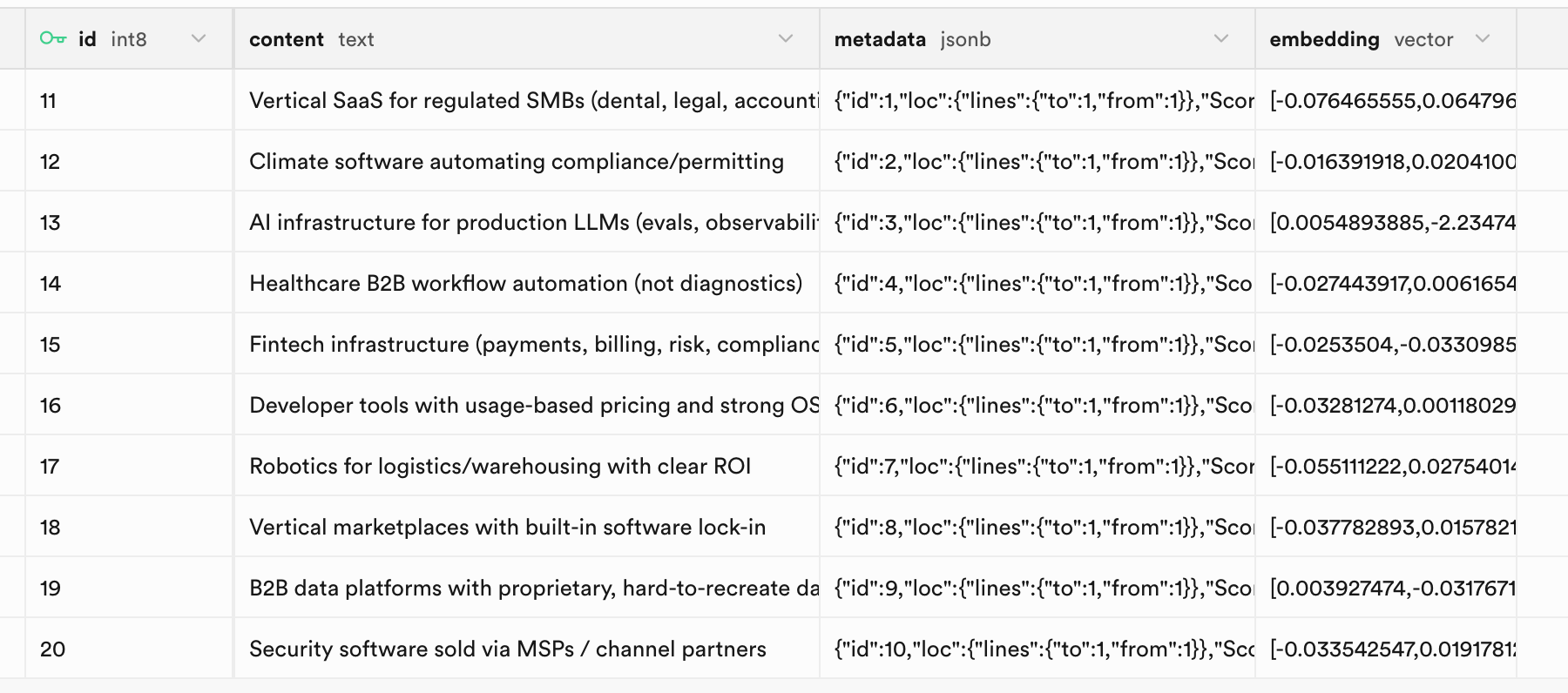
Second, a vector database trained on your portfolio companies and the scores you’d retroactively assign them. Did successful and unsuccessful investments have common themes? What was the industry? Was the founder first-time or not? This “trains” the system on pattern recognition specific to your fund’s actual history.
In practice, the vector database performs a semantic search across your entire deal history, surfacing 'lookalike' companies to see how this new opportunity aligns with your previous investment decisions.
Below is a view of the sample vector database used for our run.
4. Automated Routing and Slack Alerts
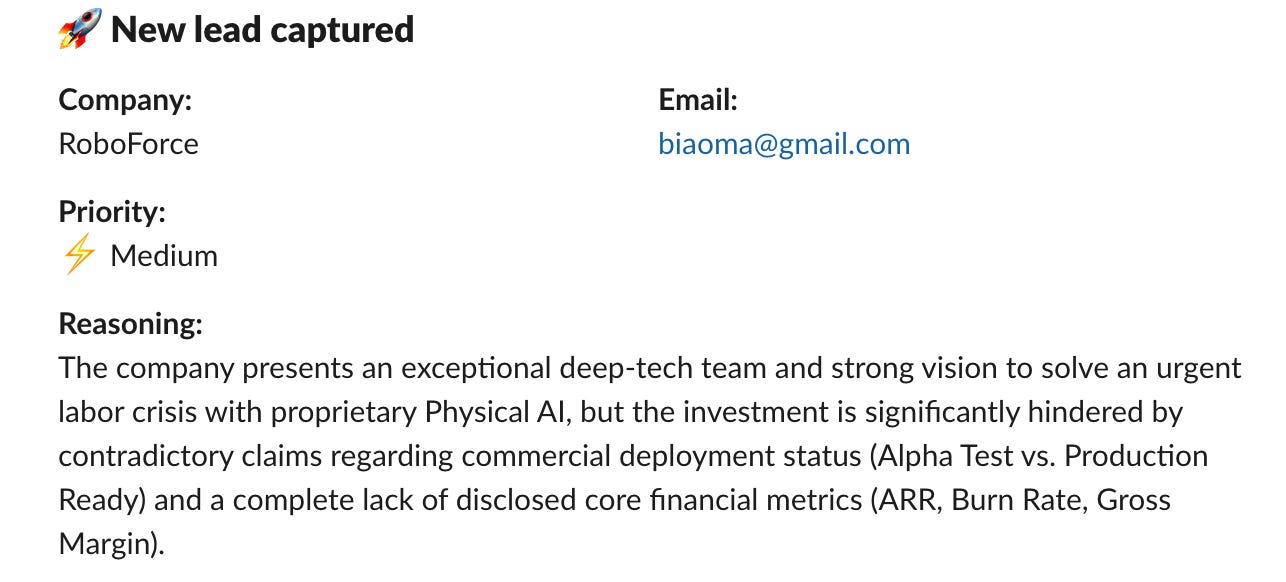
Every deck gets a score (0-100) and a tier:
- Tier 1 (75+): Slack alert fires immediately. Strong fit, worth deep dive.
- Tier 2 (50-74): Queued for review. Possible fit, review when bandwidth allows.
- Tier 3 (<50): Auto-archived with rationale. Outside thesis.
VCs receive a Slack notification, while top-tier startup applicants get instant emails or SMS messages with a Calendly, Zoom, or Google Meet link. Lower-scoring applicants instead receive a personalized thank-you email.
Why This Changes the Game
Here’s what shifts when this system is running:
1. Response time drops from weeks to hours
Founders get a reply the same day they submit. Even if it’s “not a fit right now,” they know and may even get automatic feedback. This alone changes how founders perceive your fund.
2. Partners stop drowning in noise
If you’re only seeing Tier 1 alerts, you’re not wading through 200 decks to find the 3 that matter. You’re seeing the 3 and can go deep immediately.
3. You stop losing deals to lag
The “we’ll circle back” problem goes away. If it’s Tier 1, you know within an hour. If the founder is raising on a tight timeline, you’re not finding out two weeks later when the round is closed.
4. Pattern recognition improves
Because everything is logged consistently, you start seeing patterns. Which sources send the best deals (e.g. if you have multiple forms). Which sectors are overrepresented in your inbound. Where your thesis is too narrow or too broad.
5. Junior team members become more effective
Instead of “read these 30 decks and tell me which are interesting,” it’s “here are the 5 Tier 1s from this week, do deep research on these specific questions.”
The funds implementing AI for triage will compound their advantages: faster response times → better deal access → better returns → better brand → more inbound → better LP terms.
You don’t need eight figures and a dedicated AI team to build this anymore. Generative AI changed the equation. You need the right architecture and someone who knows how to configure it for your thesis.
Breaking Down the Numbers
Here's what the numbers look like for a mid-sized fund processing 2,000 decks per year (roughly 500 per quarter):
Direct Cost Savings
-
Decks/year: 2,000
-
Total triage cycle saved: 10 minutes/deck (Skim + Research + CRM Entry)
-
Blended hourly cost (90% Associate @ $156/hr, 10% Principal @ $233/hr): $164/hr
~$55K/year in direct labor savings
Opportunity Cost Unlocked
-
~333 senior hours freed annually
-
Additional high-quality founder interactions enabled: ~166 per year
-
Conservative conversion to investment: ~2%
-
Incremental investments enabled: ~3 per year
-
Expected value per investment: $250K–$500K
Implied expected opportunity value: ~$0.8M–$1.6M
The labor cost is intuitive, but the opportunity cost is where it gets brutal.
Where This Goes Next
This architecture is a foundation, not a finish line. The same logic of quantifying the qualitative can be extended across the entire lifecycle of a fund:
- Async Portfolio Coaching: Startups can submit pitch decks or strategy docs and receive instant, thesis-aligned feedback via Slack or email. This allows a fund to deliver value at 2:00 AM with zero marginal cost.
- Partner Proxies: Imagine an AI node trained on a specific partner’s writings, investment memos, and recorded conversations. Each partner has their own proxy node that discuss investment decisions while the real partners are asleep.
- Systematized Brand Building: You can turn partner meeting notes into high-quality LinkedIn posts and blog content automatically. In an era where “VC as a Media Company” is the winning strategy, the funds that systematize their content pipeline will win the attention game.
- Institutional Trading Journals: For hedge funds or liquid token funds, this system can maintain a fund-wide journal of entry conditions, reasoning, and outcomes. You can query the vector database before entering new positions to see where similar logic failed or succeeded in the past.
- Founder Intelligence Audits: By analyzing transcript data from initial calls (via tools like Otter, Gong or Grain), the system can extract “unwritten” data: founder personality traits, potential blind spots, and communication styles. This provides a level of psychological depth that traditional quant models simply cannot index.
The goal of these extensions is simple: to extract the success patterns hidden in your fund’s unstructured data.
Who This Is For
- You run or work at a fund that sees 200+ decks a quarter but only has bandwidth to seriously evaluate 20-30.
- You’re tired of founders going cold because their deck sat in someone’s inbox for three weeks.
- You want dealflow organized by fit, not by which associate happened to check email first.
- You recognize that the current system, serial human processing of every inbound deck, doesn’t scale and is leaving money on the table.
The goal isn’t to eliminate human judgment. It’s to make sure human judgment is spent on deals where it actually matters.
If you want more content like this, I created a new Substack for tactical tips fort investment professionals. I want to keep The Internet Economy more strategic, while Automated Alpha more tactical.
How I Partner with Funds
I don’t believe in one-size-fits-all SaaS for venture capital. Every fund has a unique thesis, specific green flags, and a distinct culture. A generic tool cannot capture the nuance of your investment committee.
Instead, I work with a small number of funds to build proprietary intelligence layers that they own forever. My work falls into two categories:
- Custom Implementation: I architect and ship an end-to-end triage engine (like the one described above) tailored to your specific stack and CRM. This is a fixed-scope engagement that typically takes 2 to 3 weeks.
- Strategic AI Advisory: For funds looking to rethink their entire digital infrastructure, I provide ongoing consulting. We look at everything from automated sourcing to portfolio monitoring and LP reporting.
I prioritize quality over volume. I only engage with 1 or 2 new funds each month to ensure the systems I build are robust and truly aligned with the GP’s vision.
If you are ready to modernize your triage process or want to discuss a broader AI roadmap for your firm, let’s talk.
You can reach me directly at jurgis@evoaai.com or DM me on LinkedIn.
[story continues]
tags