


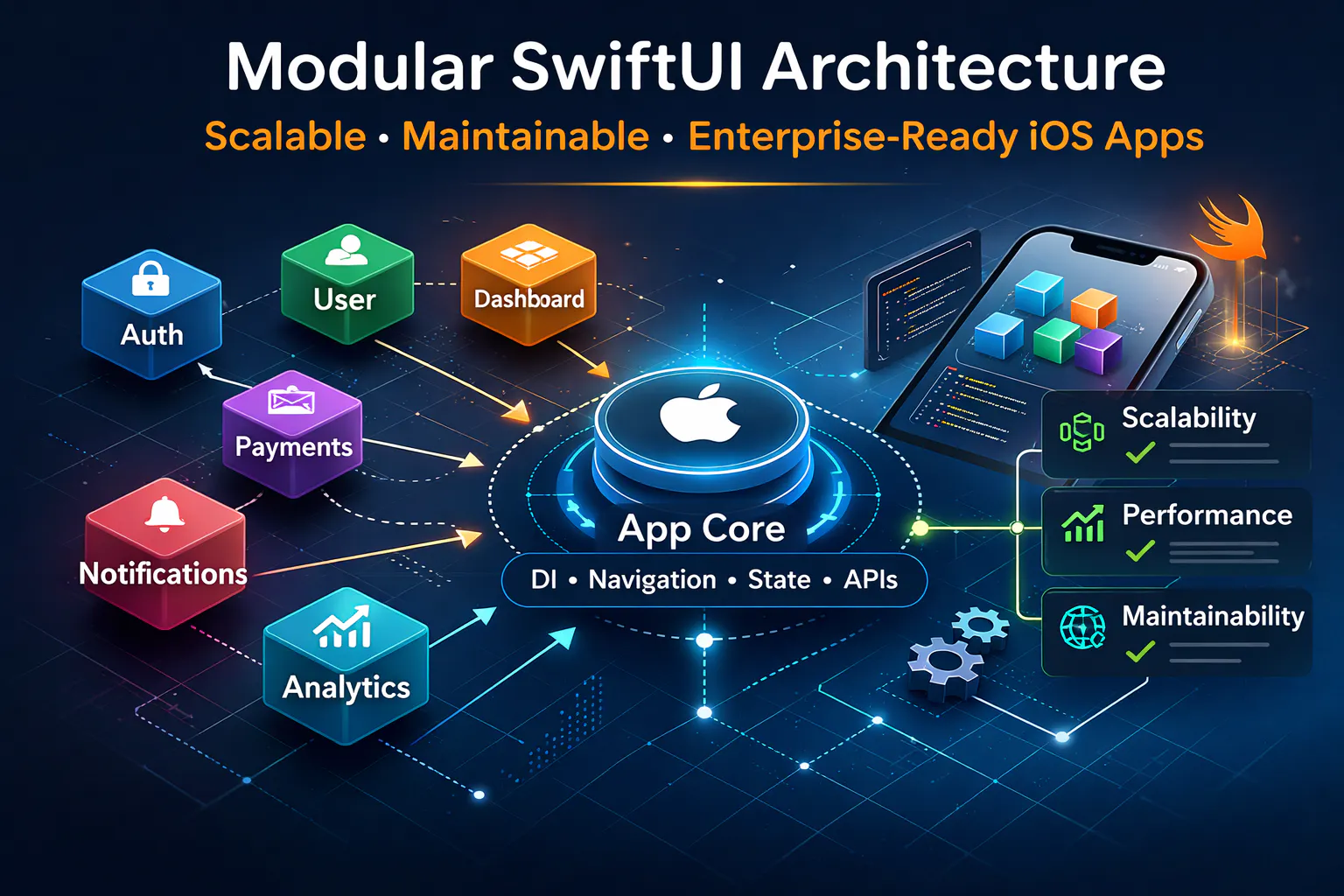
Executive summary
Enterprise SwiftUI succeeds when you modularize around things that change together, keep dependencies explicit, and measure flows. This blueprint uses Swift packages so each feature ships as an entry View + dependency protocol, while the app shell owns navigation, observability, and release controls. It’s designed for payments-grade reliability and security.
Problem, target audience, and assumptions
Problem statement
At scale, a UIKit/SwiftUI monolith becomes a coupling trap as a checkout UI tweak touches networking, analytics, and auth, eventually build times rise and regressions ship because quality gates vary. Modular SwiftUI turns the app into composable systems with enforceable boundaries, making it realistic to gate releases on measurable signals.
Reference architecture for modular SwiftUI
Boundary rule: hide volatile decisions behind stable interfaces
Decompose by design decisions likely to change, not by generic layers as this enables independent work streams and safer change.
Package layout using Swift packages
Swift packages let Xcode manage dependencies and enforce build boundaries. Use:
- AppShell (app target): bootstrap, DI composition root, typed navigation, feature flags.
- Feature packages:
PaymentsFeature,AuthFeature,ProfileFeature. - Core packages:
CoreNetworking,CoreSecurity,CoreObservability,CoreDesignSystem. - Interface packages (optional):
PaymentsAPI,TelemetryAPIto avoid feature→feature imports.
Put the design system such as tokens, components, strings/assets in CoreDesignSystem. Swift packages support resources/localization, so features share UI primitives without importing each other.
Modularization strategies and trade-offs
|
Strategy |
Pros |
Cons |
Fits when |
|---|---|---|---|
|
Feature-first packages (recommended) |
Team autonomy; smaller builds; clear ownership |
Requires dependency discipline |
3+ teams and requires frequent changes |
|
Layered modules (UI/Domain/Data) |
Familiar mental model |
Coupling reappears across features |
Small org but has a stable roadmap |
|
Shared mega-module |
Fast to start |
Becomes a second monolith |
Avoid except stable utils |
Step-by-step implementation playbook
Step: define the only public surface of a feature
Expose an entry View plus a dependency protocol and everything else stays internal to the package. This makes the boundary obvious in review and easy to mock in tests.
public protocol PaymentsDependencies {
  var paymentsAPI: PaymentsAPI { get }
  var telemetry: TelemetryClient { get }
  var riskSignals: RiskSignalClient { get }
}

public struct PaymentsEntryView: View {
  private let deps: PaymentsDependencies
  public init(deps: PaymentsDependencies) { self.deps = deps }
  public var body: some View { CheckoutView(model: .init(deps: deps)) }
}
Step: keep SwiftUI views pure; move behavior into observable models
Use Observation (@Observable) so SwiftUI tracks the properties a view reads, and funnel mutations through methods you can instrument. Prefer one “state owner” per screen and avoid global mutable singletons.
import Observation

@Observable final class CheckoutModel {
  var state: CheckoutState = .idle
  private let deps: PaymentsDependencies
  init(deps: PaymentsDependencies) { self.deps = deps }

  @MainActor func submit() async {
    deps.telemetry.span("checkout.submit") {
      state = .submitting
      do { try await deps.paymentsAPI.charge(); state = .success }
      catch { deps.telemetry.error("checkout.failed", error); state = .failure }
    }
  }
}
Step: centralize cross-feature navigation in AppShell
Use typed routes with NavigationStack and navigationDestination so deep links and state restoration are consistent. Keep feature packages navigation-agnostic unless the feature owns internal subflows.
Step: enforce dependency direction with ports-and-adapters
Define “ports” (protocols) in interface packages and implement adapters in core packages (for example, URLSessionPaymentsAPI, telemetry adapters, crypto providers). This keeps features testable with mocks and limits vendor lock-in.
Observability, CI/CD, and performance
Observability and monitoring
Instrument flows, not screens:
checkout start → auth → risk signals → charge → receipt.
Use os_signpost signposts to measure durations and catch regressions.
import os.signpost

let poi = OSLog(subsystem: "app.payments", category: .pointsOfInterest)
os_signpost(.begin, log: poi, name: "checkout.total")
// ... checkout flow ...
os_signpost(.end, log: poi, name: "checkout.total")
If you use Datadog, configure the iOS SDK with a client token, not an API key, because keys embedded client-side are exposed in the app binary.
CI/CD and testing checklist
Tooling is unspecified, but enforce these gates:
- Package unit tests + protocol contract tests per feature.
- UI tests for critical payment flows on real devices.
- Dependency checks.
- Performance + security smoke tests: P95 latency thresholds, ATS exception audit, secrets scanning, log-redaction tests.
Performance implications and mitigations
SwiftUI regressions often come from expensive work in body, overly broad observation, and redundant updates. Measure hangs/hitches first, then narrow invalidations, make subtrees equatable() when meaningful, and avoid heavy work on the main actor.
Security and privacy for payments and fraud
Treat the device as adversarial: assume binaries can be inspected and logs harvested. Store tokens in Keychain (not UserDefaults), never log PAN/CVV, and keep risk decisions server-side.
Enforce App Transport Security and treat every exception as a reviewed policy decision.
For fraud resistance, consider App Attest/DeviceCheck signals to detect modified or automated clients and verification belongs on your backend.
Real-world outcomes, editor pitch, and further reading
Anonymized lessons and metrics
In a payments-scale app, modularizing checkout into a feature package plus end-to-end flow instrumentation enabled ~60% P95 checkout latency reduction (≈8s → ≈3s) after removing synchronous rendering work and gating releases on that metric and crash rate held steady within normal variance.