


AI assistants don’t have “bad memory.” They have bad governance.
You’ve seen it:
- You wrote a meticulous architecture guide. The model ignores it.
- You said “4-layer architecture.” It outputs 3 layers.
- You said “no
el-input.” It drops<el-input v-model="value" />like it’s doing you a favor.
This isn’t about intelligence. It’s about incentives.
In Claude Code, Skills are available context, not a hard constraint. If Claude “feels” it can answer without calling a Skill, it will. And your project handbook becomes decoration.
On our team, building a RuoYi-Plus codebase with Claude Code, we tracked it:
Without intervention, Claude proactively activated project Skills only ~25% of the time.
So 3 out of 4 times, your “rules” aren’t rules. They’re a suggestion.
We wanted something stricter: a mechanism that makes Claude behave less like a clever intern and more like a staff engineer who reads the playbook before writing code.
The fix wasn’t more prompting.
The fix was Hooks.
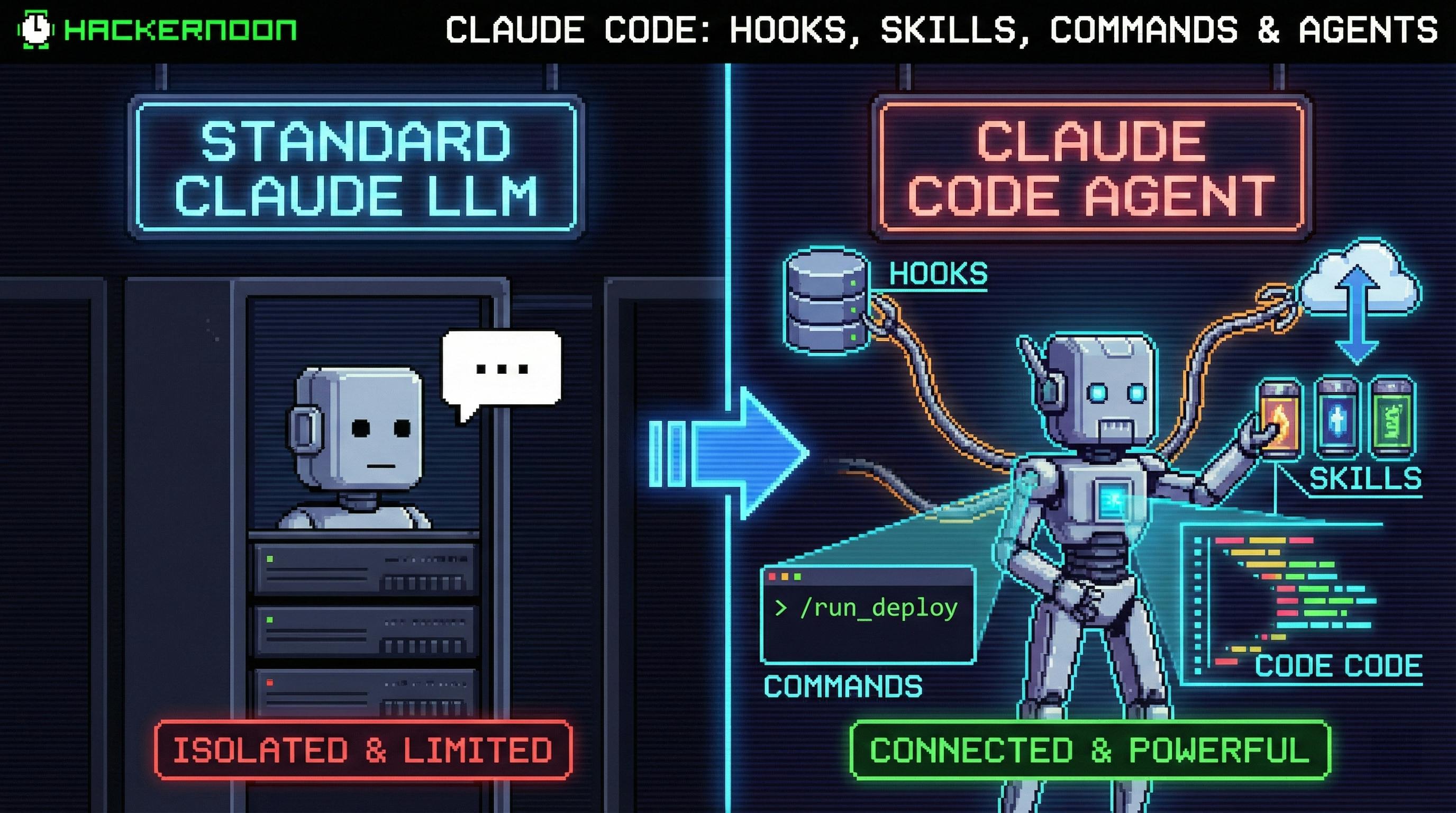
After ~1 month of iteration, we shipped a .claude configuration stack:
- 4 lifecycle hooks (governance)
- 26 domain Skills (knowledge)
- slash commands (process orchestration)
- agents (parallel specialists)
Result:
Skill activation for dev tasks: ~25% → 90%+ Less rule-violating code, fewer “please redo it” cycles, and far fewer risky tool actions.
This article breaks down the architecture so you can reproduce it in your own repo.
1) Why Claude Code “forgets”: Skills are opt-in by default
Claude Code’s default flow looks like this:
User prompt → Claude answers (maybe calls a Skill, maybe not)
That “maybe” is the problem.
Claude’s internal decision heuristic is usually:
- “Can I answer this quickly without extra context?”
- not “Do I must comply with repo rules?”
So the system drifts toward convenience.
What you want is institutional friction: a lightweight “control plane” that runs before Claude starts reasoning, and shapes the work every time.
2) The breakthrough: a forced Skill evaluation hook
We implemented a hook that fires at the earliest moment: UserPromptSubmit.
It prints a short policy block that Claude sees before doing anything else:
- Evaluate each Skill: yes/no + reason
- If any “yes”: call Skill immediately
- Only then: proceed to implementation
The “forced eval” hook (core logic)
We keep it deliberately dumb and deterministic:
- detect slash commands (escape hatch)
- otherwise print the evaluation protocol
// .claude/hooks/skill-forced-eval.js (core idea, simplified)
const prompt = process.env.CLAUDE_USER_PROMPT ?? "";
// Escape hatch: if user invoked a slash command, skip forced eval
const isSlash = /^\/[^\s/]+/.test(prompt.trim());
if (isSlash) process.exit(0);
const skills = [
"crud-development",
"api-development",
"database-ops",
"ui-pc",
"ui-mobile",
// ... keep going (we have 26)
];
const instructions = [
"## Mandatory Skill Activation Protocol (MUST FOLLOW)",
"",
"### Step 1 — Evaluate",
"For EACH skill, output: [skill] — Yes/No — Reason",
"",
"### Step 2 — Activate",
"If ANY skill is Yes → call Skill(<name>) immediately.",
"If ALL are No → state 'No skills needed' and continue.",
"",
"### Step 3 — Implement",
"Only after Step 2 is done, start the actual solution.",
"",
"Available skills:",
...skills.map(s => `- ${s}`)
].join("\n");
console.log(instructions);
What changes in practice
Before (no hook):
“Build coupon management.” Claude starts coding… and ignores your 4-layer architecture or banned components.
After (forced eval hook):
Claude must first produce an explicit decision table, then activate Skills, then implement.
The behavioral shift is dramatic because you’re eliminating “optional compliance.”
3) Why 90% and not 100%?
Because we intentionally added a fast path.
When a user knows what they want, typing a command like:
/dev build coupon management/crud b_coupon/check
should be instant. So the hook skips evaluation for slash commands and lets the command workflow take over.
That’s the tradeoff:
- Governance for free-form prompts
- Speed for structured commands
4) Hooks as a lifecycle control plane (the 4-hook stack)
Think of hooks as a CI pipeline for an agent session—except it runs live, in your terminal.
We use four key points:
4.1 SessionStart: “look at the repo before you talk”
When a session starts, we show:
- current git branch
- uncommitted changes
- open TODOs / status
- common commands
Example output:
🚀 Session started: RuoYi-Plus-Uniapp
Time: 2026-02-16 21:14
Branch: master
⚠️ Uncommitted changes: 5 files
📋 TODO: 3 open / 12 done
Shortcuts:
/dev build feature
/crud generate module
/check verify conventions
Why it matters: Claude stops acting like it’s entering a blank room.
4.2 UserPromptSubmit: forced Skill evaluation (discipline)
This is the “must read the handbook” gate.
4.3 PreToolUse: the safety layer (tool governance)
Claude Code is powerful because it can run tools: Bash, write files, edit code.
That’s also how accidents happen.
PreToolUse is your last line of defense before something irreversible.
We block a small blacklist (and warn on a broader greylist):
// .claude/hooks/pre-tool-use.js (conceptual)
const cmd = process.env.CLAUDE_TOOL_INPUT ?? "";
const hardBlock = [
/rm\s+(-rf|--recursive).*\s+\//i,
/drop\s+(database|table)\b/i,
/>\s*\/dev\/sd[a-z]\b/i,
];
if (hardBlock.some(p => p.test(cmd))) {
console.log(JSON.stringify({
decision: "block",
reason: "Dangerous command pattern detected"
}));
process.exit(0);
}
// Optionally: warn/confirm on sensitive actions (mass deletes, chmod -R, etc.)
This isn’t paranoia. We’ve seen models “clean temp files” with rm -rf in the wrong directory. You want a guardrail that doesn’t rely on the model being careful.
4.4 Stop: “close the loop” with next-step guidance
When Claude finishes, we:
- summarize file changes (new vs modified)
- suggest next actions (run tests, docs updates, commit)
- optionally trigger agents (code review)
Example:
✅ Done — 8 files changed
Next steps:
- @code-reviewer for backend conventions
- SQL changed: sync migration scripts
- Consider: git commit -m "feat: coupon module"
The goal: eliminate the “it worked in the chat” gap.
5) Skills: the knowledge layer you can actually enforce
Once activation is deterministic, Skills become what they were supposed to be: a domain-specific knowledge base.
We built 26 Skills across:
- backend (CRUD, API, DB, annotations, error handling)
- frontend (PC component policy, state management)
- mobile (UI kits, uniapp platform constraints)
- integrations (payments, WeChat, OSS)
- quality (perf, security, bug detective)
- engineering management (architecture, git workflow, tech decisions)
A Skill file structure that scales
Every SKILL.md follows the same skeleton:
# Skill Name
## When to trigger
- Keywords:
- Scenarios:
## Core rules
### Rule 1
Explanation + example
### Rule 2
Explanation + example
## Forbidden
- ❌ ...
## Reference code
- path/to/file
## Checklist
- [ ] ...
This consistency matters because the model learns how to consume Skills.
6) Commands: workflows, not suggestions
Skills solve “what is correct.”
Commands solve “what is the process.”
6.1 /dev: a 7-step development pipeline
We designed /dev as an opinionated workflow:
- clarify requirements
- design (API + modules + permissions)
- DB design (SQL + dictionaries + menus)
- backend (4-layer output)
- frontend (component policy + routing)
- test/verify
- docs/progress update
It’s basically: “how seniors want juniors to work” encoded as a runnable script.
6.2 /crud: generate a full module from a table
Input:
/crud b_coupon
Output (example set):
- Entity / BO / VO
- DAO + Query wrapper rules
- Service + Controller (no forbidden patterns)
- Mapper
- Frontend API + page scaffold
Manual effort: 2–4 hours Command-driven: 5–10 minutes (plus review)
6.3 /check: full-stack convention linting (human-readable)
This is where we turn Skills into a verifier:
- backend: layering rules, forbidden inheritance, query wrapper policy
- frontend: banned components, wrapper usage
- mobile: component kit, units, imports
7) Agents: parallel specialists (don’t overload the main thread)
Some tasks should be handled by a dedicated subagent:
@code-reviewer: convention checks with a strict checklist@project-manager: update status docs, TODOs, progress metrics
The advantage isn’t “more intelligence.” It’s separation of concerns and reduced context pollution in the main session.
A practical pattern:
- main agent generates code
- Stop hook suggests review
- you invoke
@code-reviewer - reviewer returns a structured diff + fixes list
8) The full system: governance + knowledge + process + division of labor
This is the architecture in one sentence:
Hooks enforce behavior, Skills provide standards, Commands encode workflows, Agents handle parallel expertise.
And yes—this is how you turn a “general AI assistant” into a “repo-native teammate.”
9) Minimal reproducible setup (copy-paste friendly)
If you want the smallest version that still works, build this:
.claude/
  settings.json
  hooks/
    skill-forced-eval.js
    pre-tool-use.js
  skills/
    crud-development/
      SKILL.md
Minimal settings.json (UserPromptSubmit hook)
{
  "hooks": {
    "UserPromptSubmit": [
      {
        "matcher": "",
        "hooks": [
          {
            "type": "command",
            "command": "node .claude/hooks/skill-forced-eval.js"
          }
        ]
      }
    ],
    "PreToolUse": [
      {
        "matcher": "",
        "hooks": [
          {
            "type": "command",
            "command": "node .claude/hooks/pre-tool-use.js"
          }
        ]
      }
    ]
  }
}
Then iterate:
- add SessionStart
- add Stop
- grow Skills only when you catch repeated “wrong behavior”
- encode repeat workflows as commands
- offload review/PM tasks to agents
Closing: “ability” isn’t the bottleneck — activation is
Your model is already capable.
What’s missing is a system that makes the right behavior automatic.
A smart new hire without a handbook will freestyle. A smart new hire with:
- enforced checklists
- clear forbidden patterns
- repeatable workflows
- specialists for reviews and PM
…becomes consistent fast.
Claude is the same.