The Invisible Wall in Your Codebase
Imagine a new senior engineer joins your team. They are brilliant, experienced, and eager to push code. But for the first three weeks, their most common contribution is a question:
"Hey, does anyone know why we used a custom hook here instead of a library?"
or
"Where is the doc explaining the database schema?"
This is the Unsearchable Knowledge Problem.
In most engineering organizations, knowledge exists in fragmented silos that don't talk to each other. When you search for "database schema" in Slack, you get 500 noise results. When you search in GitHub, you get raw SQL files but zero context on why it was designed that way.
The High Cost of "The Context Tax"
When knowledge isn't searchable, you pay a tax on every single task. It isn't just annoying; it is expensive.
Let's look at the math your CFO cares about: If you have a 20-person engineering team and they spend just 20% of their time (8-10 hours/week) searching for answers or waiting for replies, you are burning roughly $600,000 a year in lost productivity.
But the cultural cost is worse than the money:
- Slow Onboarding: New hires take months to "osmose" context because it's locked in senior engineers' heads.
- Repeated Mistakes: "We tried that two years ago and it failed" is often said two weeks after someone started rebuilding it.
- Senior Bottlenecks: Your best devs spend their day acting as human routers instead of solving hard problems.
The 4 Pillars of Engineering Knowledge
To fix this, we first need to define what we are actually looking for. Engineering knowledge isn't just code; it is the sum of four pillars:
- The Code (The What): Lives in GitHub. Easy to find.
- The Context (The Why): Lives in Meetings, Slack, and PR comments. Hard to find.
- The Process (The How): Lives in scattered Runbooks or READMEs.
- The History (The When): Lives in Jira tickets and Git logs.
The problem is that most teams only have search tools for Pillar #1. The other three are effectively black holes.
The Solution: Building a Knowledge Graph
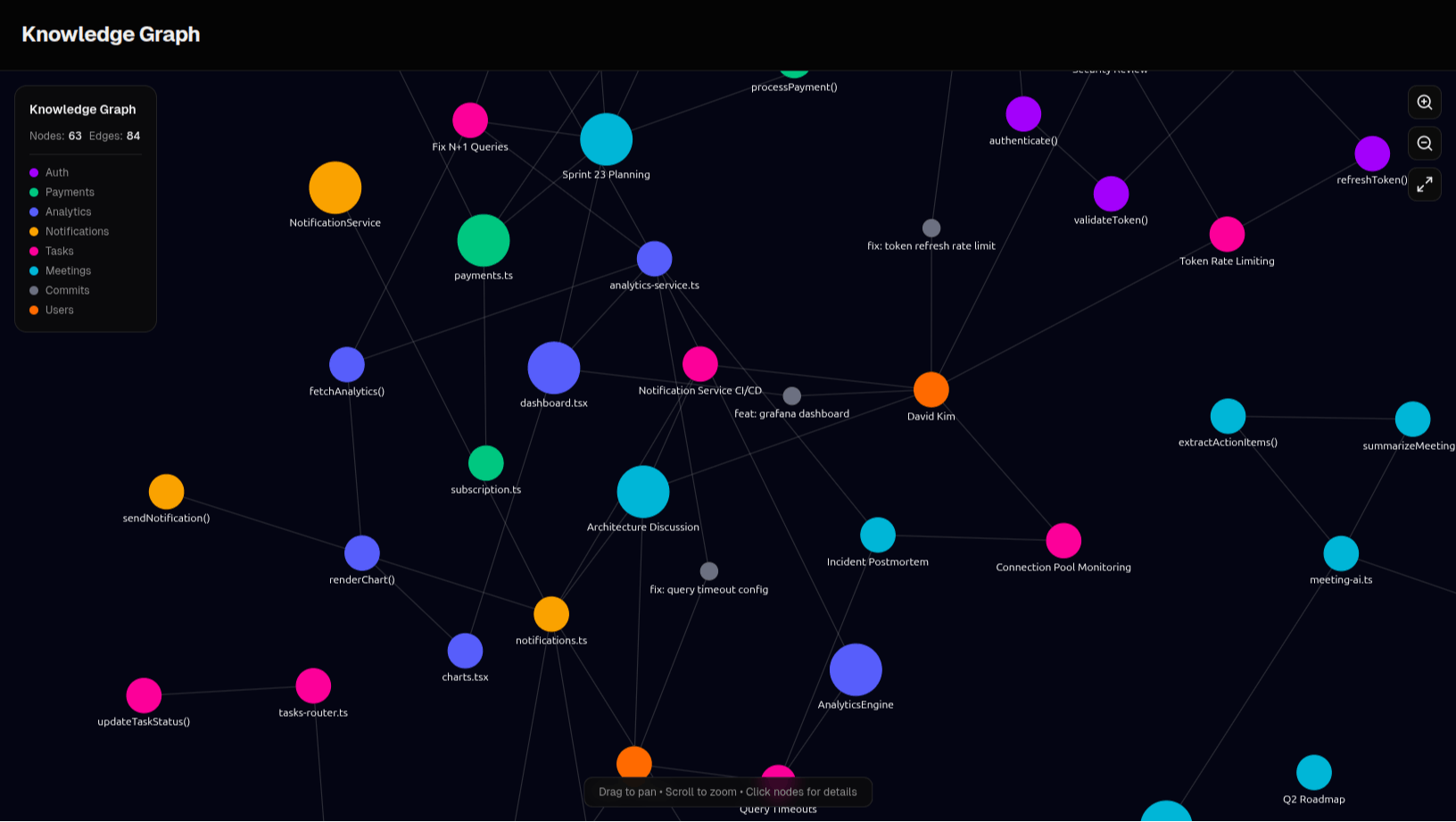
Making engineering knowledge searchable requires a shift from "organizing folders" to "connecting nodes." You need an architecture that links these distinct pillars together.
Here is the roadmap to solving it:
Phase 1: Centralize and Index
You can't search what you can't access. The first step is to bring your data sources into a unified index. This means indexing your codebase semantically (understanding concepts, not just keywords) and, crucially, transcribing meetings. You cannot Ctrl+F a video file, but you can search a transcript for a decision.
Phase 2: Create Semantic Links
This is the magic step. A search for a file shouldn't just show the code. It should show the Knowledge Graph:
-
The PR that created it.
-
The Jira ticket that requested it.
-
The Meeting where the design was decided.
We actually built Syncally specifically to handle this orchestration—automatically linking code commits to discussions and decisions so you don't have to do it manually. But whether you use a dedicated tool or build your own RAG pipeline with LangChain, the principle is the same: Context requires connection. Without these links, you just have four separate piles of data.
Phase 3: "Ask, Don't Search"
Traditional search requires you to know the right keywords. If you don't know the file name, you are stuck.
The future of engineering search is Context-Aware Retrieval.
- Old Way: Search "migration error," browse 15 files, read 3 docs, give up, ask in Slack. (Time: 45 mins)
- New Way: Ask "Why is the database migration failing on the user table?" The system analyzes the error, finds the relevant PR, and pulls the meeting summary where the schema change was discussed. (Time: 10 seconds).
Conclusion
Documentation expires the moment it is written. Relying on humans to manually update wikis is a losing battle.
The only way to solve the Context Tax is to treat your work artifacts and your code, your meetings, and your tickets are as living documentation. By connecting these silos, we can stop playing archaeologist in our own codebases and get back to building.
[story continues]
tags