


As Southeast Asia’s
This tension was brought in front of the world stage on
That ecosystem includes global industry heavyweights like
However, open-source technologies do not automatically translate to digital sovereignty. Despite the need for foreign partnerships, Indonesia must determine whether leveraging Chinese platforms enhances its own autonomy or simply consolidates its dependencies, a particularly important nuance given the dual-use nature of artificial intelligence and the increasingly intertwined relationship between technological advancement and national security .
Domestic Indonesian efforts to support AI development
Subsequently, Indonesia has launched an aggressive campaign to internalize and grow its critical AI tech capabilities, with a focus on key infrastructure like semiconductors and human capital.
On
Just several months prior, in
When put together, these initiatives reflect a broader industrial policy shift that highlights Indonesia’s desire to move higher in the world’s AI value chain from its current position as a downstream consumer of AI technologies.
The importance of strategic foreign partnerships
Despite its desire to establish AI independence, Indonesia knows that it cannot build an entire technological ecosystem without assistance from other countries. China stands out as a crucial partner for Indonesia, though Indonesia is currently attempting to diversify its AI capabilities through other regional partners as well.
Indonesia is
Chinese firms like
This integration carries significant national security implications for Indonesia. Digital infrastructure encompassing all-things-AI and cloud technologies are inherently dual-use technology. As a result, a reliance on Chinese-built data centers, algorithms, hardware, and software introduce the potential of vulnerabilities from the data sovereignty and cybersecurity perspectives. Additionally, deep integration of exclusively Chinese digital ecosystems risks Indonesia’s status in terms of partnering with the United States and other non-Chinese partners, particularly from the military and intelligence perspectives.
Recognizing this, Indonesia has also been expanding its technological relationships beyond just China. Manda Royal Hospital Puri, a private hospital in Banten just a stone’s throw west of Jakarta,
The diversification of partnerships highlights how Indonesia is attempting to balance interdependence between different partners to achieve the growth it wishes to achieve in the AI space while addressing any potential strategic vulnerabilities.
Future challenges for regulating the unknown
As AI adoption increases, the Indonesian government is hastily seeking to establish its own crucial legal frameworks to manage the societal and national security risks of AI.
On
The necessity of this governance is easily highlighted through the recent controversies surrounding AI in the region. On
This rapid reversal suggests that Indonesia’s regulatory environment is still finding its footing, highlighting the need to keep communication channels and technologies open.
Conclusion
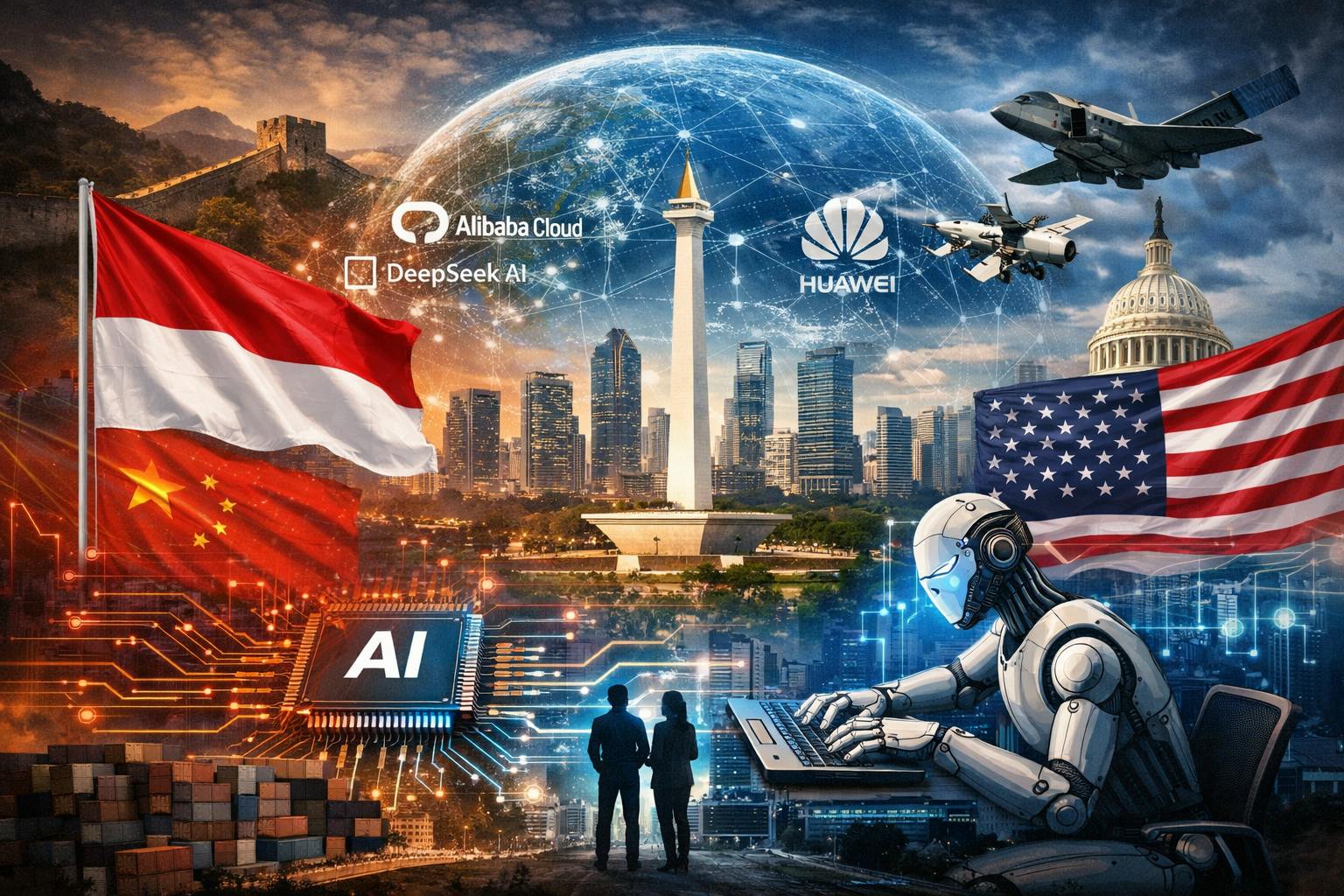
Indonesia’s journey to becoming a digital power is characterized by its current predicament of balancing its AI future alongside foreign partnerships. Its simultaneous investment into physical and digital infrastructure alongside human capital, contrasted with its partnership with giants like China highlight the delicate balance that Indonesia is striking to establish its future.
The real test will be whether Indonesia can leverage Chinese technological scale and financing without replicating new forms of dependency and comprising its national security. In an era increasingly shaped by strategic competition between the U.S. and China, Indonesia’s approach may offer a preview of how middle powers attempt to chart a path between competing digital spheres of influence.