
Introduction: The Digital Iron Curtain Falls
In January 2026, as protests and a state-imposed digital blackout grip Iran, a critical failure is unfolding in the "unblockable" Starlink satellite internet system. Despite being designed to circumvent censorship, reports from the ground show a "near-total" disruption, with urban connection rates plummeting by 80%. This sophisticated electronic warfare is a watershed moment, proving that military-grade jamming can overwhelm LEO constellations. The situation poses urgent questions about the physics of radio frequency combat.
To understand this conflict, we must look beyond the headlines and into the electromagnetic spectrum itself. We must disassemble the machinery of the Starlink user terminal, analyze the signal architecture of the Ku-band, and inspect the formidable jamming trucks rolling through the streets. This is a story of signal-to-noise ratios, orbital mechanics, and the relentless cat-and-mouse game between those who build the networks and those who seek to destroy them.
Part I: The Anatomy of the Signal
The Architecture of a Constellation
To appreciate how Iran is breaking the connection, one must first understand how the connection is made. The Starlink system is a radical departure from the satellite internet of the past. Traditional communications satellites sit in geostationary orbit (GEO), 35,786 kilometers above the equator. From the ground, a GEO satellite appears fixed in the sky. Your TV dish points at it once, is bolted down, and never moves. The signal is stable, but the latency—the time it takes for data to travel up and back—is agonizingly slow, often half a second or more.
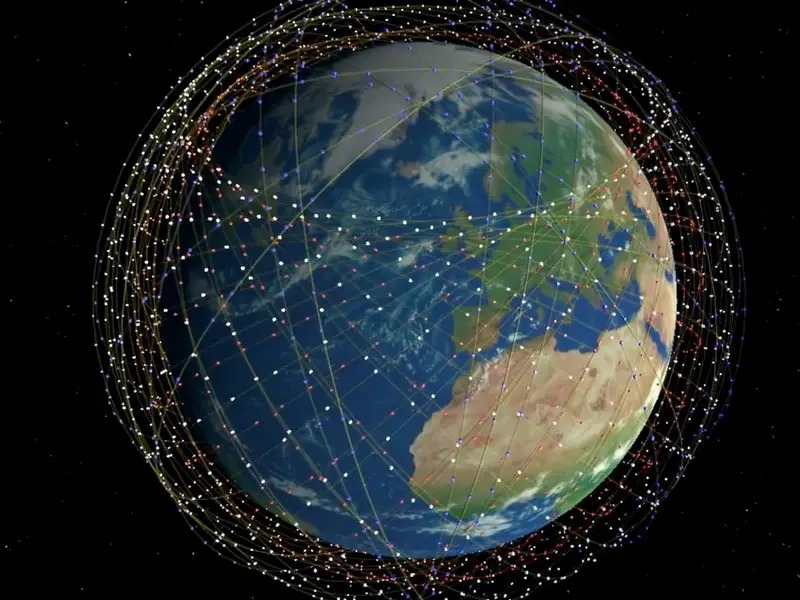
Starlink is different. It is a Low Earth Orbit (LEO) constellation. As of early 2026, the network comprises over 9,000 active satellites orbiting at altitudes between 340 km and 550 km.6 At this altitude, the satellites are not fixed points; they are racing across the sky at 17,000 miles per hour, completing an orbit every 90 minutes.
For a user on the ground, a single satellite is visible for only a few minutes before it dips below the horizon and the connection must be handed off to the next satellite in the train. This requires a level of precision that makes terrestrial 5G networks look simple. The user terminal—affectionately known as "Dishy"—cannot simply point and shoot. It must track.
Inside the Phased Array: The Electronic Eye
The flat, rectangular face of a Starlink terminal is a marvel of consumer electronics. It contains no moving parts tracking the satellite. Instead, it uses phased array beamforming. Beneath its waterproof hood lies a honeycomb grid of over 1,000 tiny copper antenna elements.8
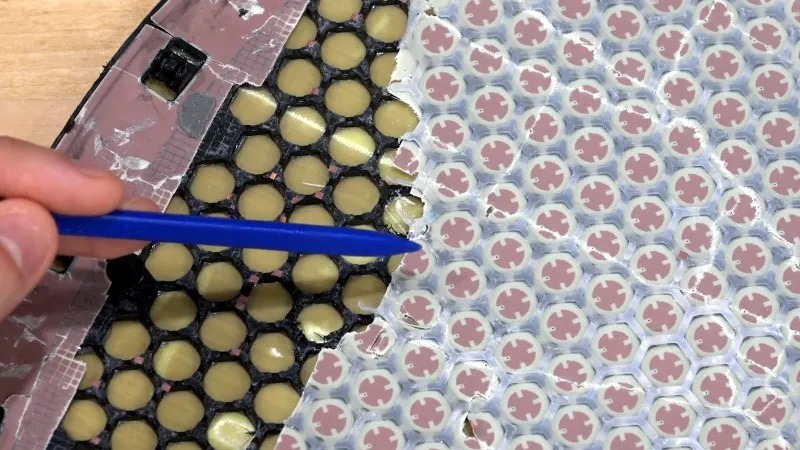
In a conventional antenna, a parabolic dish reflects radio waves to a single focal point. In a phased array, the computer controls the timing of the signal sent to each of the 1,000 elements individually. By delaying the signal to some elements by a fraction of a nanosecond relative to others (shifting the phase), the terminal creates an interference pattern in the air.
- Constructive Interference: In the direction of the target satellite, the radio waves from all 1,000 elements line up perfectly, crest-to-crest and trough-to-trough. Their energy combines, creating a strong, focused beam.
- Destructive Interference: In all other directions, the waves are out of sync. A crest meets a trough, and they cancel each other out.
This electronic steering allows the terminal to sweep the sky, locking onto a satellite rising in the west and tracking it until it sets in the east, then instantly snapping back to pick up the next one. This happens in milliseconds. Crucially, this technology also provides a theoretical defense against jamming. If the antenna focuses its "ears" only on the satellite, it should be deaf to the noise shouting from the ground. This capability is known as spatial filtering.
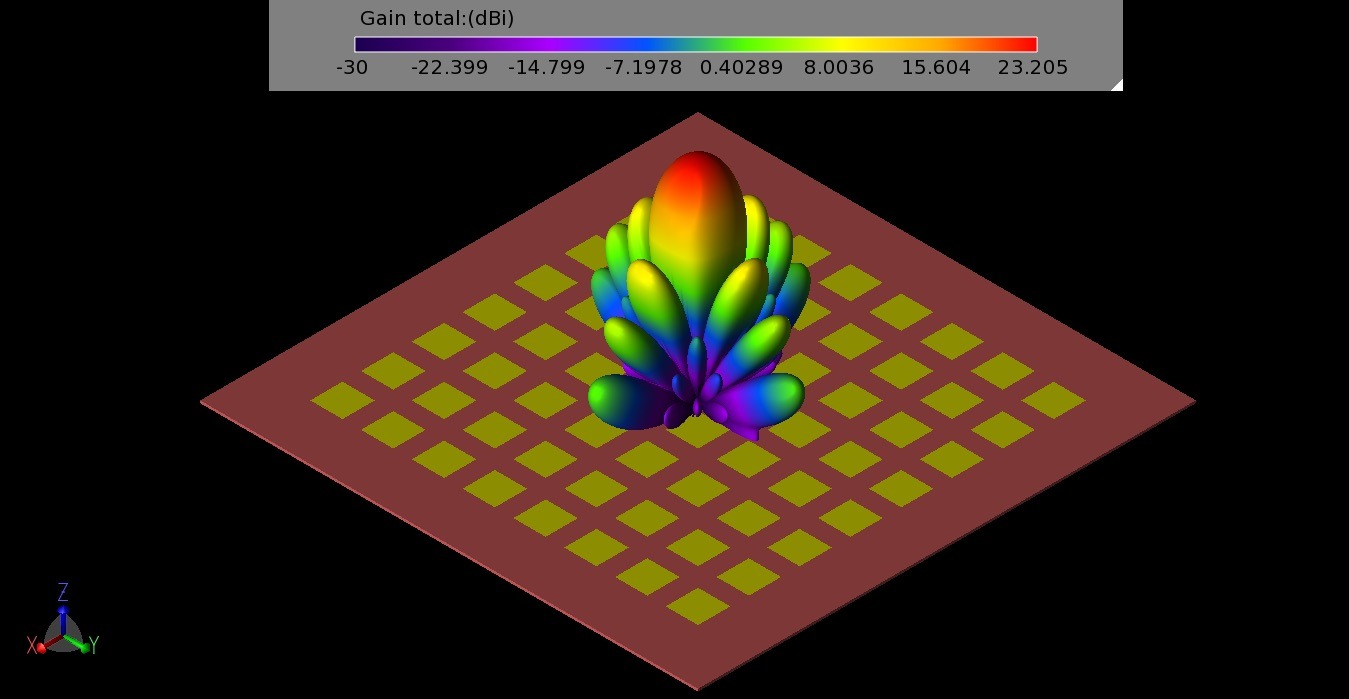
However, the physics of RF energy dictates that no antenna is perfect. Every beam has sidelobes—unintended directions where the antenna is still slightly sensitive. Think of it like a flashlight: you have a bright main beam, but there is also a faint halo of light spilling out to the sides. If a jammer on the ground is loud enough, or close enough, it can blast noise into these sidelobes, overwhelming the delicate whisper of the satellite signal.10
The Frequencies of Freedom
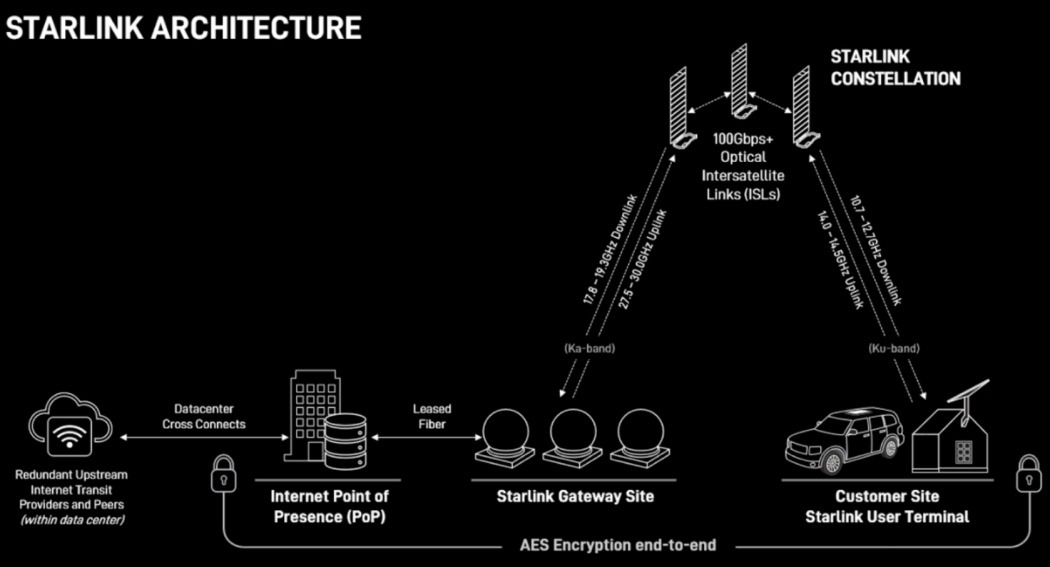
Starlink operates primarily in the Ku-band (12–18 GHz) for user downloads and uploads, and the Ka-band (26.5–40 GHz) for gateway connections to the ground.8 These are microwave frequencies. They behave much like beams of light; they travel in straight lines and cannot pass through solid rock or heavy metal. They require a direct line of sight to the sky.
This frequency choice is a double-edged sword. On one hand, the Ku-band allows for high bandwidth—speeds of 200 Mbps or more.14 On the other hand, it is a crowded neighborhood. It is shared with terrestrial microwave links, geostationary TV satellites, and military radar. This makes it susceptible to interference, both accidental and intentional. If you flood this neighborhood with enough noise, no conversation can take place.
Part II: The Attack Vectors
The Starlink disruption in Iran is not a singular technical event. It is a layered attack, utilizing multiple vectors to dismantle the necessary conditions for satellite communication. Analysis of reports from January 2026 indicates a "kill chain" involving three distinct mechanisms: the blinding of GPS, the saturation of the Ku-band, and the physical targeting of hardware.
Vector 1: The GPS Kill Switch
The most immediate and sophisticated vulnerability being exploited is not the satellite signal itself, but the map required to find it.

The Dependency Dilemma
Starlink terminals are functionally blind without GPS. To perform the complex mathematical gymnastics required to steer a beam at a moving target, the terminal must know its own location on Earth with high precision. It needs to calculate the azimuth (compass direction) and elevation (angle up from the horizon) to the satellite relative to its own position.
The geometry is unforgiving. If the terminal thinks it is in Tehran, but the GPS says it is in London—or nowhere at all—the beam steering algorithm fails. The terminal points its beam in the wrong direction, listening to empty space while the satellite passes by unheard. Without a location lock, the terminal cannot even begin the "handshake" process to establish a connection.1
The 12-Day War and the Rise of GPS Spoofing
The context for this capability lies in the recent past. In June 2025, Iran engaged in a brief but intense conflict known as the "12-Day War" with Israel.16 During this conflict, and in the months following, Iran aggressively expanded its electronic warfare capabilities, specifically targeting Global Positioning System (GPS) signals.
Originally, this was a counter-drone measure. Modern loitering munitions and surveillance UAVs rely on GPS to find their targets. By jamming GPS, Iran hoped to create a defensive dome over its sensitive sites. But the technology employed goes beyond simple noise jamming (which just drowns out the GPS signal). Iran utilizes GPS spoofing—broadcasting fake GPS signals that are stronger than the real ones from orbit.
These false signals effectively "hijack" the receiver. Instead of reporting an error, the GPS chip confidently reports a false location. Reports from Tehran indicate users opening map applications and finding themselves located at Mehrabad Airport, in the middle of the Persian Gulf, or even in other countries like Canada or Europe.17
For a Starlink terminal, this is fatal. A spoofed location feeds incorrect variables into the phased array controller. The terminal steers its beam toward where it thinks the satellite is, based on the fake location. The link is never established. This "soft kill" is efficient; it requires far less power than jamming the Ku-band directly and covers vast areas of the city with a single transmitter.5
Impact on Civil Infrastructure
The collateral damage of this GPS warfare is immense. It is not just Starlink.
- Aviation: Pilots flying near Iranian airspace have reported losing GPS reliability, forcing reliance on older inertial navigation systems.19
- Maritime: Ships in the Persian Gulf have reported position errors, leading to near-collisions in one of the world's busiest shipping lanes.19
- Daily Life: Ride-sharing apps, food delivery services, and digital maps in Tehran have become unusable, with users pinned to incorrect locations.21
Vector 2: Screaming at the Sky (RF Jamming)
While GPS denial prevents the lock, direct RF jamming breaks the link. Reports from digital rights experts and packet loss analysis indicate that Iran is flooding the Ku-band frequencies with high-power noise. Packet loss rates—the percentage of data chunks that fail to arrive—have spiked from 30% to over 80% in some neighborhoods.4
The Inverse Square Law in Reverse
Satellite signals are incredibly weak when they reach Earth. A Starlink satellite transmits with limited power (constrained by its solar panels and batteries) from 550 km away. As the signal travels through the vacuum and atmosphere, it spreads out, losing intensity according to the inverse square law. By the time it hits a user’s dish, it is a faint whisper, barely distinguishable from the background noise of the universe.22
A ground-based jammer, however, has the advantage of proximity and power. A military jamming truck parked just a few kilometers away can pump kilowatts of noise directly into the local environment. Even if the Starlink dish is pointing up, the sheer volume of RF energy bouncing off buildings, terrain, and atmospheric particles can enter through the antenna's sidelobes.10
Imagine trying to listen to a whisper from a person on a roof (the satellite) while someone stands next to you screaming through a megaphone (the jammer). Even if you cup your hands around your ears to focus on the roof, the screaming is simply too loud. The Signal-to-Noise Ratio (SNR) drops below the threshold required to decode the digital information. The modem sees only static.
The Hardware: Russian Imports and Indigenous Clones
The sophistication of the jamming suggests state-level hardware. Intelligence reports and analysis point to specific systems operating within Iran, many supplied by Russia in the wake of the 2025 conflict.
1. Krasukha-4: The Broadband Beast
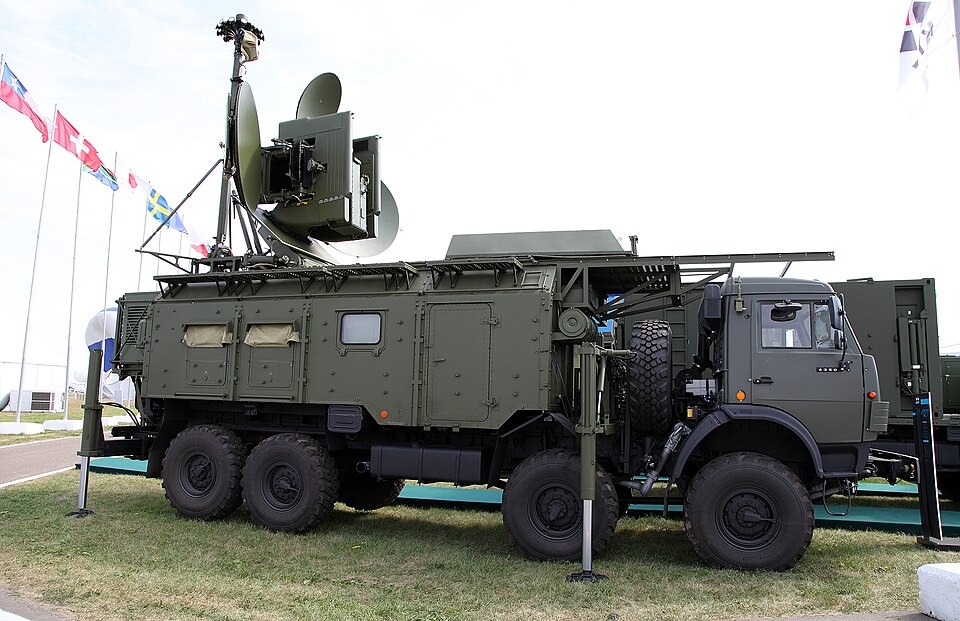
The Krasukha-4 (1RL257) is an electronic warfare titan. Mounted on an 8x8 BAZ-6910 chassis, it is a mobile jamming station designed to create a "dead zone" for radars and satellites.
- Frequency Range: It operates in the X and Ku bands—directly overlapping with Starlink’s downlink frequencies.
- Range: It has an effective jamming radius of up to 300 km.
- Capabilities: Originally designed to blind AWACS aircraft and radar-guided missiles, it is fully capable of disrupting Low Earth Orbit satellites. It can cause permanent damage to sensitive radio-electronic equipment if focused intensely.23
- Deployment: Intelligence sources indicate Russia supplied these systems to Iran to bolster its air defenses, but they are now being repurposed for domestic information control.24
2. Tirada-2: The Uplink Specialist
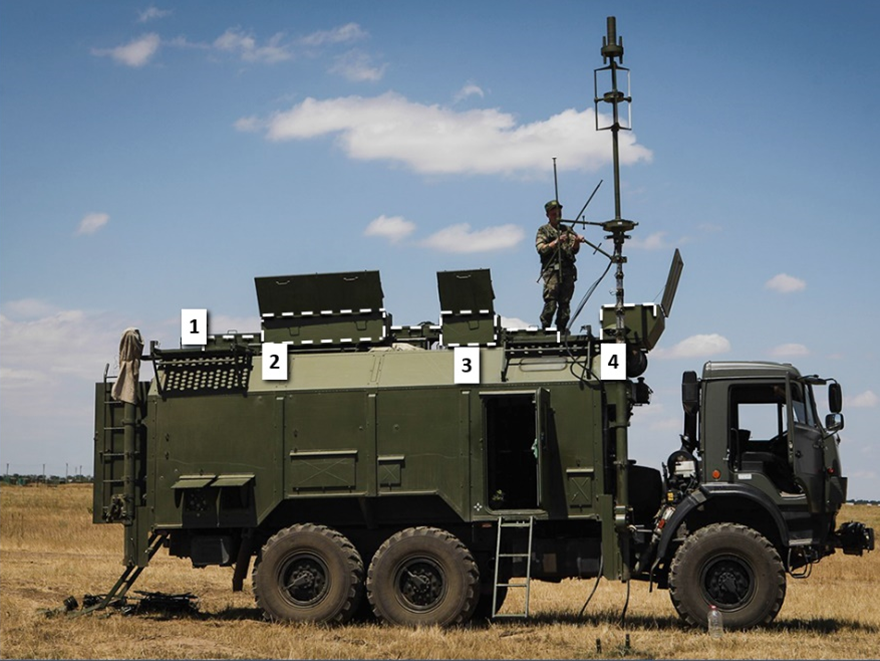
Another Russian system rumored to be in play is the Tirada-2s. While the Krasukha jams the receiver on the ground (downlink jamming), the Tirada is designed for uplink jamming. It blasts a high-power signal up at the satellite itself.
- The Mechanism: By overwhelming the satellite's own receiver, the Tirada prevents the satellite from hearing the requests from user terminals. This is a "denial of service" attack on the spacecraft itself.
- Effectiveness: This is harder to do because the satellite is moving fast and is far away, but it affects every user in the satellite's footprint, not just those near the jammer.25
3. Sepehr and Indigenous Innovation
Iran possesses a robust domestic military-industrial complex. The Sepehr system, originally an over-the-horizon radar with a range of 2,500 km, demonstrates Iran's capability to manipulate long-range RF signals.27 More relevant to the street-level battle are smaller, truck-mounted mobile jammers—likely reverse-engineered from Chinese or Russian tech—that can be deployed to specific neighborhoods to create localized bubbles of silence. These "tactical jammers" allow the regime to target protest hotspots without blinding the entire city's GPS or military comms.4
Vector 3: The Ground Relay Choke Point
Internet traffic from a Starlink satellite must eventually touch the ground. In the standard "bent-pipe" architecture, the satellite acts as a mirror: it catches the signal from the user and bounces it immediately down to a gateway station (a massive ground antenna connected to the fiber backbone).
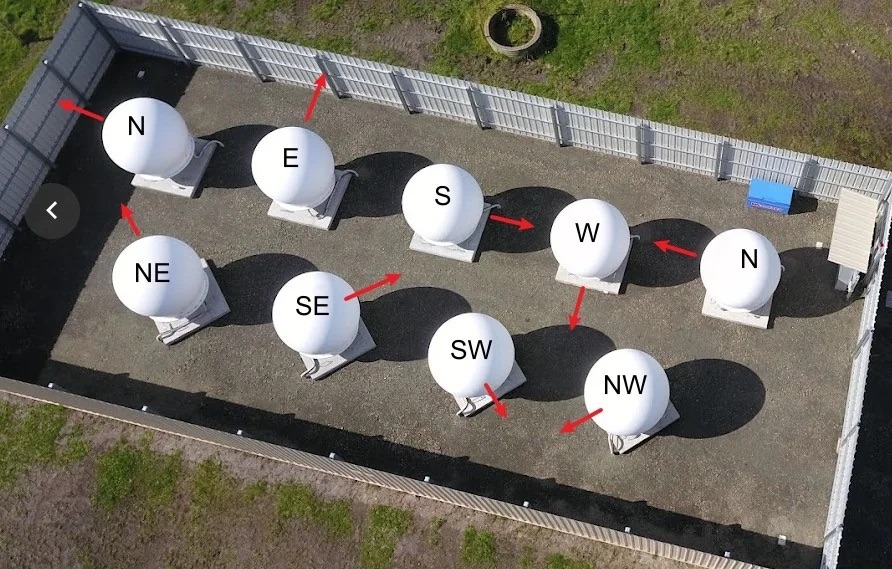
For Starlink to work in Iran, the satellite must be able to see both the user in Tehran and a gateway station in a friendly country simultaneously. Given the orbital altitude of ~550 km, the "footprint" of a Starlink satellite is roughly 1,000 km in diameter. This puts gateways in Turkey, Kuwait, or potentially Israel within range.1
However, this creates a strategic chokepoint. If Iran can jam the specific frequencies used for the gateway downlink (Ka-band), or if they can exert diplomatic pressure on neighbors to shut down gateways servicing Iranian cells, the system fails. While less technical than jamming the user terminal, this vector is a critical vulnerability in the network's physical geography.
Comparison of Jamming Systems
|
System Name |
Origin |
Type |
Primary Targets |
Frequency Bands |
Effective Range |
Key Capability |
|---|---|---|---|---|---|---|
|
Krasukha-4 |
Russia |
Mobile EW Station |
Airborne Radar, LEO Sats |
X-Band, Ku-Band |
~300 km |
Broad-spectrum noise jamming; can damage electronics. |
|
Tirada-2 |
Russia |
Satellite Jammer |
LEO/Comms Satellites |
Specialized Uplink |
Orbital Altitude |
Uplink jamming (blinding the satellite). |
|
Sepehr |
Iran |
OTH Radar/Jammer |
Stealth Aircraft, Signals |
Varies (HF/VHF/UHF) |
~2,500 km |
Long-range detection and signal flooding. |
|
Murmansk-BN |
Russia |
Strategic EW |
HF Comms (NATO) |
HF (High Frequency) |
~5,000 km |
Disrupting global communications (supplied to Iran). |
|
GPS Spoofer |
Iran (Local) |
Area Denial |
GPS Receivers |
L1/L2/L5 |
City-wide |
Broadcasting fake coordinates to break the lock. |
Part III: The Physics of Interference and Mitigation
The battle between Starlink and the jammers is a contest of physics. It is played out in decibels and degrees, in the nanosecond timing of phased arrays and the brute force of kilowatts. Despite the Iranian blackout's effectiveness, the system is not defenseless. SpaceX and user groups have developed a suite of countermeasures—some software-based, some physical, and some relying on the next generation of orbital hardware.
1. The Power of Nulling: Electronic Aikido
The primary defense a phased array has is adaptive nulling. Just as the antenna can mathematically combine signals to create a beam of sensitivity (gain) in one direction, it can also do the math to create a "null"—a point of zero sensitivity—in another direction.12
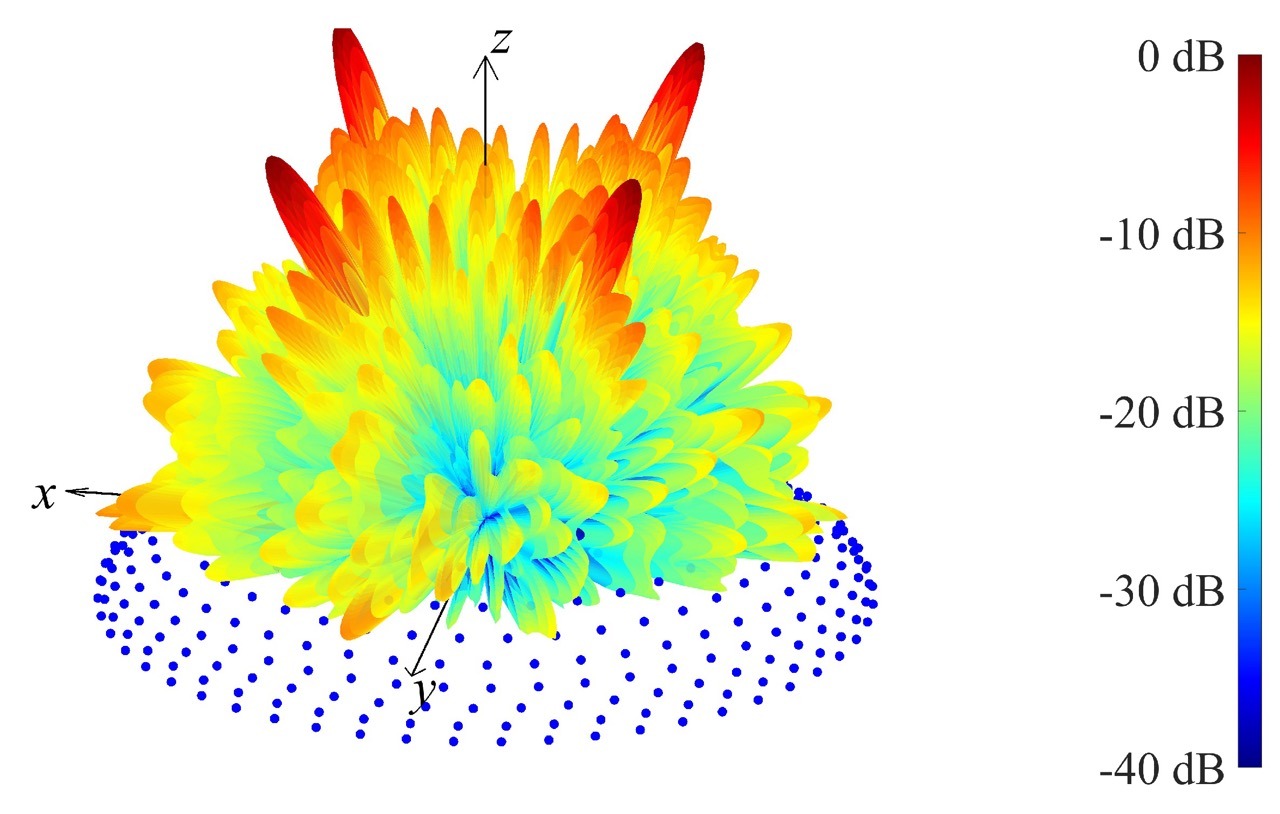
Imagine the antenna pattern like a balloon. Steering the beam stretches the balloon in one direction toward the satellite. Nulling involves poking a finger into the balloon to create a dent (a null) where the interference is coming from.
- The Algorithm: The processor inside the Starlink dish constantly samples the noise environment. If it detects a screaming jammer coming from the north, it adjusts the phase of the antenna elements to cancel out signals from that specific angle.
- The Limit: An antenna has only so many "degrees of freedom." It can only create as many nulls as it has independent elements (minus one). While Starlink has over 1,000 elements, calculating the optimal nulling pattern for multiple powerful jammers in real-time requires immense computational power. If the jammer is moving, or if there are dozens of jammers (a "distributed jamming" attack), the terminal struggles to keep up.29
2. The Laser Mesh: Bypassing the Ground
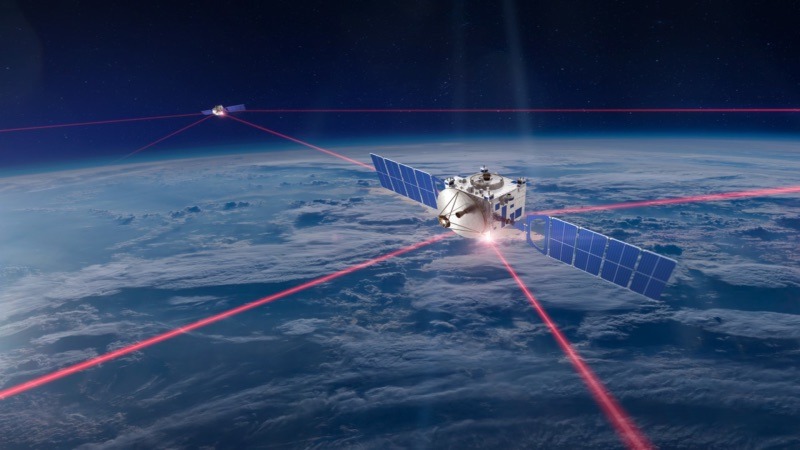
Perhaps the most significant technological trump card for Starlink in 2026 is the full operational capability of Optical Inter-Satellite Links (ISLs), or "space lasers".32
In the early days of the constellation, a satellite had to bounce data straight down to a gateway. If no gateway was nearby, or if the gateway was jammed, the link failed. The new V2 and V3 satellites are equipped with laser communications terminals that allow them to transmit data to each other in the vacuum of space at speeds approaching the speed of light.
- The Mitigation: This breaks the "bent-pipe" constraint. A user in Tehran sends data up to a satellite. Instead of bouncing it back down to a potentially hostile or jammed environment, the satellite shoots the data via laser to another satellite over Europe or the Indian Ocean. The data "hops" through the constellation until it finds a safe, un-jammed gateway thousands of kilometers away.
- Why it Matters: This renders ground-based jamming of gateways irrelevant. It means the only way to stop the signal is to jam the user terminal directly.34
3. Decoupling from GPS: The Firmware Fix
The GPS vulnerability is critical, but solvable. SpaceX engineers have previously deployed software updates in Ukraine to counter similar Russian tactics.36
- Manual Override: Firmware updates can allow terminals to operate with "coarse" location data or manual entry. If a user knows their location is Tehran, they can pin it on a map in the app. The terminal can then ignore the spoofed GPS data and use the manual coordinates for its initial beam steering calculations.
- Orbital Navigation: The Starlink constellation itself can function as a navigation system. Because the satellites' orbits are known precisely, the terminal can theoretically calculate its own position based on the Doppler shift and timing of the Starlink signals themselves, bypassing GPS entirely. This requires complex calculation but makes the system immune to GPS jammers.37
4. Frequency Hopping and Spread Spectrum
To combat the brute force of RF noise, Starlink employs Frequency Hopping Spread Spectrum (FHSS) techniques.
- The Dance: The satellites and terminals do not stay on one frequency. They hop rapidly between different channels within the Ku-band (e.g., 12.2 GHz to 12.7 GHz).
- The Effect: A jammer must either jam the entire band (which requires spreading its power out, making it weaker at any specific point) or try to follow the hops. Since the hopping pattern is encrypted and pseudo-random, the jammer cannot predict where the signal will go next.40
5. The "Shovel Solution": Physical Shielding
Sometimes, the best technology is dirt. During the war in Ukraine, soldiers discovered a low-tech but highly effective way to defeat ground-based jammers: dig a hole.36
- The Physics: Jammers are terrestrial; they are located on trucks or towers on the horizon. Starlink satellites are orbital; they are high in the sky.
- The Shield: By placing the Starlink terminal in a pit, or surrounding it with sandbags or a metal mesh barrier that is open only at the top, users can create a physical Faraday shield. The earth walls block the radio waves coming from the horizon (where the jamming trucks are), but leave the view of the sky open for the satellites.
- Effectiveness: This physically filters out the jamming signal before it even hits the antenna. It exploits the geometry of the attack. While it limits the field of view (the terminal sees fewer satellites), it often reduces the noise floor enough to establish a connection.36
6. The Starlink V3 Response
SpaceX’s answer is Starlink V3 satellite. Launching aboard the massive Starship rocket, these next-gen satellites are larger, more powerful, and equipped with massive antennas capable of forming smaller, tighter beams.
- Power: V3 satellites have 10x the downlink capacity and 24x the uplink capacity of previous models. A stronger signal from space is exponentially harder to jam.
- Direct-to-Cell: The ultimate endgame is bypassing the dish entirely. Starlink's Direct-to-Cell capabilities (operating on standard LTE frequencies like 1.9 GHz) allow phones to connect directly to satellites. While slower, this decentralizes the target. Jamming millions of cell phones is harder than jamming thousands of dishes, as the "receiver" is now in every pocket.
For a more speculative and humor-filled prediction of Starlink's future, you can read the author’s 2020 article “
Conclusion: The (Un)Winnable War?

Jamming Starlink proves that no technology is magic. The laws of physics—specifically the inverse square law and the principles of interference—apply to everyone, even the world's most advanced satellite network. A committed adversary with military-grade EW equipment can degrade, if not destroy, satellite connectivity in a local area.
However, the dynamic nature of LEO constellations makes this a war of attrition that favors the agile. While Iran can jam a city block or spoil a GPS signal, they cannot jam the entire sky without blinding their own military and crippling their economy. Mitigation strategies like laser inter-satellite links, manual GPS overrides, and physical shielding offer a path through the noise.
The "Silent Sky" over us is not empty. It is filled with the invisible clash of beams and nulls, lasers and noise. It is a high-tech version of an ancient struggle: the effort to speak against the effort to silence. As 2026 unfolds, the outcome of this battle will determine whether the internet remains a global commons or fractures into a patchwork of digital fortresses.
References
- As Iranian regime shuts down internet, even Starlink seemingly being jammed,
https://www.timesofisrael.com/iran-appears-to-jam-starlink-after-shutting-down-comms-networks/ - As protests rage, Iran pulls the plug on contact with the world,
https://apnews.com/article/iran-protests-economy-starlink-internet-disconnect-8d944601e7bfeae6753ec0645f5a7139 - Iran’s internet shutdown is chillingly precise and may last some time,
https://www.theguardian.com/world/2026/jan/10/irans-internet-shutdown-is-strikingly-sophisticated-and-may-last-some-time - Why There's No Starlink Access During Nationwide Shutdown in Iran?,
https://iranwire.com/en/features/147476-why-theres-no-starlink-access-during-nationwide-shutdown-in-iran/ - Iran uses military jamming to block Starlink, tightening grip on internet access amid protests,
https://www.ynetnews.com/tech-and-digital/article/skz11qigr11l - Starlink: Here's what we did in 2025, & what's up in 2026: 10x downlink/24x uplink boost; lowering orbit for solar minimum - Space Intel Report,
https://www.spaceintelreport.com/starlink-heres-what-we-did-in-2025-lowering-orbit-for-solar-minimum/ - Starlink Just Had A Massive 2025 — And 2026 Could Be Even Bigger | DISHYtech,
https://www.dishytech.com/starlink-just-had-a-massive-2025-and-2026-could-be-even-bigger/ - On Starlink - National Security,
https://www.dirittoue.info/on-starlink/ - Learn About Starlink Phased Array Antenna Terminal - two way radio disassembly and repair - News - ETMY ASIA Co., Limited,
https://www.radiowalkietalkie.com/news/learn-about-starlink-phased-array-antenna-term-85224216.html - As Iranian regime shuts down internet, even Starlink seemingly being jammed - Reddit,
https://www.reddit.com/r/Starlink/comments/1q9toxo/as_iranian_regime_shuts_down_internet_even/ - Adaptive Phase-Shifter Nulling Techniques for Large-Aperture Phased Arrays - DTIC,
https://apps.dtic.mil/sti/tr/pdf/ADA199950.pdf - Designing Phased Arrays: Key Principles, Challenges, and Solutions | Keysight Blogs,
https://www.keysight.com/blogs/en/tech/sim-des/designing-phased-arrays-key-principles-challenges-and-solutions - SPACEX ANALYSIS OF THE EFFECT OF TERRESTRIAL MOBILE DEPLOYMENT ON NGSO FSS DOWNLINK OPERATIONS - Starlink,
https://starlink.com/public-files/12GHzInterferenceStudy_062022.pdf - Network Update - Starlink,
https://starlink.com/updates/network-update - GPS Antenna Mods Make Starlink Terminal Immune To Jammers - Hackaday,
https://hackaday.com/2024/03/06/gps-antenna-mods-make-starlink-terminal-immune-to-jammers/ - Iran Update, January 11, 2026 | ISW - Institute for the Study of War,
https://understandingwar.org/research/middle-east/iran-update-january-11-2026/ - Iran confirms GPS jamming, eyes switch to Chinese system,
https://www.iranintl.com/en/202507149948 - Tehran Reloads: Examining the Current and Future Threat of Iran's Missile Programs | MENA Defense Intelligence Digest | Hudson Institute,
https://www.hudson.org/missile-defense/tehran-reloads-examining-current-future-threat-irans-missile-programs-can-kasapoglu - GPS Jamming during Israel-Iran War Demonstrates Risks to Civilian Operations | Steptoe,
https://www.steptoe.com/en/news-publications/stepwise-risk-outlook/gps-jamming-during-israel-iran-war-demonstrates-risks-to-civilian-operations.html - Israel-Iran War: Ships Experiencing GPS Jams Near Iran: Navy Monitoring Firm | WION,
https://www.youtube.com/watch?v=Ac4elvrwVcU - Minister says Iran's GPS disruptions stem from drone threats,
https://www.iranintl.com/en/202508201476 - Countering constellations: Jamming – SatelliteObservation.net,
https://satelliteobservation.net/2024/03/13/countering-constellations-jamming/ - Krasukha - Wikipedia,
https://en.wikipedia.org/wiki/Krasukha_(electronic_warfare_system) - Deployment of Advanced Russian EW Systems in Iran Being Watched Closely by Israel - Raksha Anirveda,
https://raksha-anirveda.com/deployment-of-advanced-russian-ew-systems-in-iran-being-watched-closely-by-israel/ - Intelligence agencies suspect Russia is developing anti-satellite weapon to target Starlink service | PBS News,
https://www.pbs.org/newshour/world/intelligence-agencies-suspect-russia-is-developing-anti-satellite-weapon-to-target-starlink-service - Kremlin uses secret weapon against Starlink in Ukraine | Ukrainska Pravda,
https://www.pravda.com.ua/eng/news/2023/04/19/7398454/ - Sepehr (radar) - Wikipedia,
https://en.wikipedia.org/wiki/Sepehr_(radar) - Iran presents new radar system Sepehr - Report.az,
https://report.az/en/region/iran-presents-new-radar-system-sepehr - Deep Reinforcement Learning-Based Adaptive Nulling in Phased Array Under Dynamic Environments - IEEE Xplore,
https://ieeexplore.ieee.org/iel8/6287639/10820123/11088112.pdf - AnAdaptive Nulling - Antenna for Military Satellite Communications - MIT Lincoln Laboratory,
https://archive.ll.mit.edu/publications/journal/pdf/vol05_no2/5.2.1.nullingantenna.pdf - Investigating jammer suppression with a 3-D staring array - CERES Research Repository,
https://dspace.lib.cranfield.ac.uk/server/api/core/bitstreams/c3221eb2-5b3e-4cb2-8e83-5b8c88837db5/content - Inter-Satellite Links (ISLs) and Their Role in Enhancing Global Connectivity - Medium,
https://medium.com/@RocketMeUpNetworking/inter-satellite-links-isls-and-their-role-in-enhancing-global-connectivity-9392e792bfe3 - Problems with Starlink laser-links? - Advanced Television,
https://www.advanced-television.com/2023/08/31/problems-with-starlink-laser-links/ - Key Takeaways from Starlink's 2025 Progress Report - Quilty Space,
https://www.quiltyspace.com/post/key-takeaways-from-starlink-s-2025-progress-report - Bypassing Nearest Ground Station via Laser (Routing) : r/Starlink - Reddit,
https://www.reddit.com/r/Starlink/comments/1ga7fxa/bypassing_nearest_ground_station_via_laser_routing/ - Using Starlink Paints a Target on Ukrainian Troops - Defense One,
https://www.defenseone.com/threats/2023/03/using-starlink-paints-target-ukrainian-troops/384361/ - Signal Structure of the Starlink Ku-Band Downlink - The University of Texas at Austin,
https://radionavlab.ae.utexas.edu/wp-content/uploads/starlink_structure.pdf - Starlink by the nature of how it works, knows exactly where receivers are | Hacker News,
https://news.ycombinator.com/item?id=44791463 - NAVAL POSTGRADUATE SCHOOL THESIS - DTIC,
https://apps.dtic.mil/sti/trecms/pdf/AD1225335.pdf
[story continues]
tags