


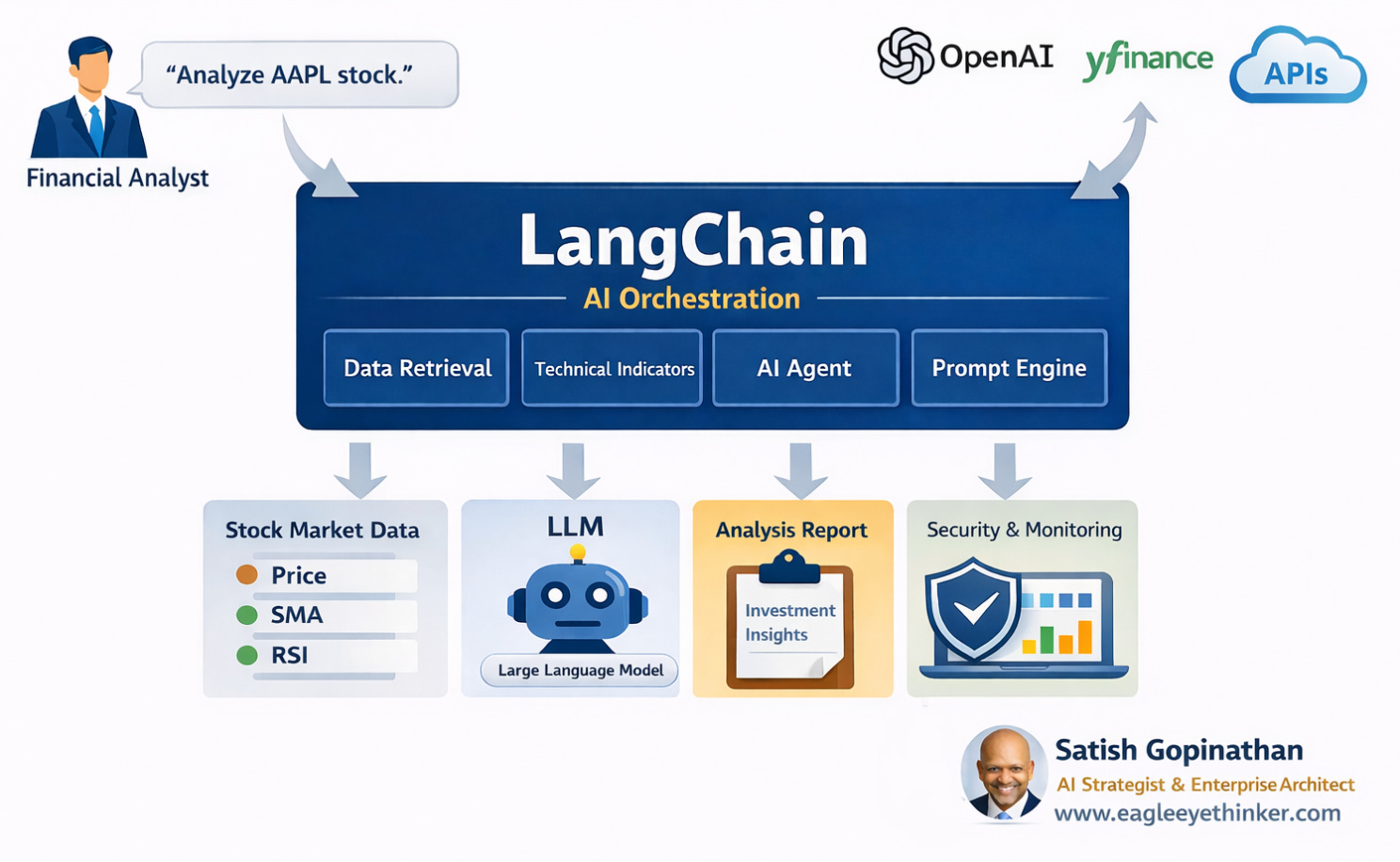
An LLM can generate text, summarize documents, and answer questions — but real enterprise applications need far more:
→ Accessing live data sources
→ Calling external APIs
→ Executing multi-step workflows
→ Integrating with enterprise systems
This is where LangChain comes in. LangChain is the orchestration layer that transforms a raw LLM into a real, production-grade application.
The Core Idea: Think in Pipelines, Not Prompts
At its heart, LangChain executes tasks step by step in a linear pipeline. Each step receives the output of the previous one.
Input → Retrieve Data → Build Prompt → Call LLM → Output
This is why it’s called LangChain — it literally chains operations together. Every stage runs in order. That determinism is exactly what enterprise systems demand.
A Real-World Example: Financial Research Assistant
Let’s make this concrete.
Imagine an analyst types: “Analyze AAPL stock and provide investment insights.”
Here’s what happens under the hood:
Step 1 — Retrieve Market Data Pull one year of real price history using the yfinance library. Raw data in, structured dataset out.
Step 2 — Compute Technical Indicators Calculate the 50-day SMA, 200-day SMA, and RSI. These reveal trend direction, momentum, and whether a stock is overbought or oversold.
Step 3 — Construct the AI Prompt Insert those metrics into a structured template addressed to a “senior Wall Street analyst” — requesting trend analysis, short-term outlook, and long-term perspective.
Step 4 — LLM Analysis The model synthesizes everything into plain-language insights:
“Apple is trading above its 50-day moving average, indicating bullish momentum. RSI near 65 suggests the stock may be approaching overbought territory. Long-term trend remains intact.”
Want to Try the Financial AI Assistant?
I published the complete runnable project in github https://github.com/eagleeyethinker/enterprise-langchain-financial-assistant The repository includes real US stock market data, LangChain tools and agents, financial technical analysis, a FastAPI API layer, and C4 architecture diagrams to illustrate the system architecture.
Run locally: (For detailed instructions, refer to the repository.)
Install dependencies:
pip install -r requirements.txt
Start the API:
uvicorn src.api.main:app --reload
Test the assistant:
http://127.0.0.1:8000/analyze/AAPL
The system will fetch market data and generate AI-driven financial insights.
The Full Architecture at a Glance
User Request
     ↓
API Gateway (FastAPI)
     ↓
LangChain Orchestrator
     ↓
Stock Data Tool
     ↓
Technical Indicator Engine
     ↓
LLM Analysis
     ↓
Investment Report
Clean. Auditable. Composable. Each component is independently testable. Each step has a defined input and output. Nothing is a black box.
Why This Matters for Architects
LangChain introduced a simple but powerful reframe:
AI applications are workflows — not magic.
Once you see it that way, everything becomes clearer:
- You design components, not prompts
- You test each step independently
- You replace parts without rebuilding everything
- You audit what happened at every stage
The sequential model makes AI systems easier to design, debug, and operate at scale.
The Key Takeaway
LLMs are not applications. They are components inside orchestrated AI systems.
Understanding the orchestration layer — how data flows, how prompts are constructed, how results are structured — is now a foundational skill for anyone building enterprise AI.
LangChain is one of the clearest expressions of that idea.
What orchestration patterns are you using in your AI systems? Drop a comment below — I’d love to compare notes.