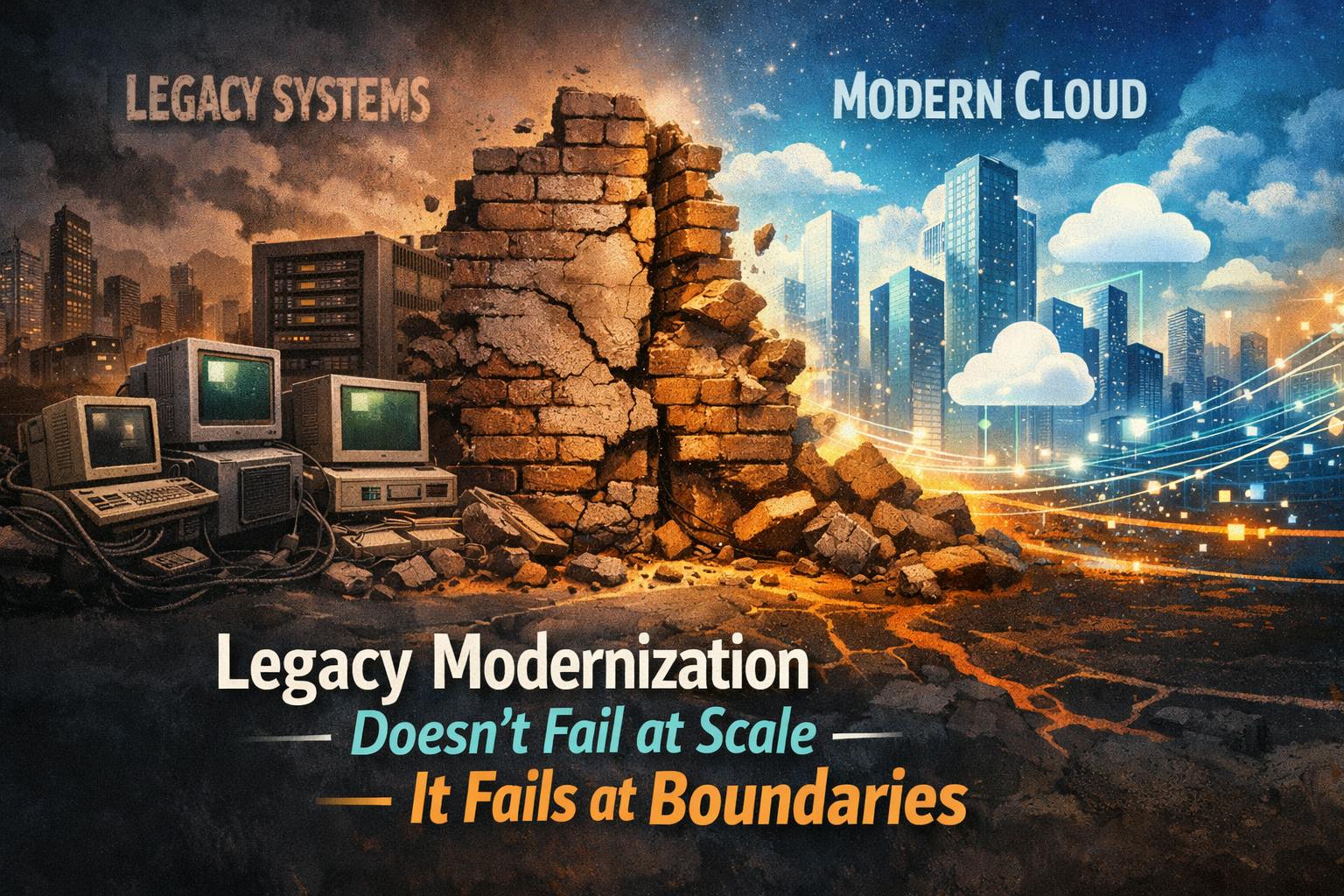
Legacy Modernization Doesn’t Break Systems — It Reveals Them
Legacy systems rarely fail in dramatic ways. They don’t go offline overnight, and they don’t suddenly stop serving users. They erode.
Small changes become risky. Simple features take weeks. Engineers hesitate before touching code they don’t fully understand.
When modernization finally begins, the focus is predictable: scalability, performance, frameworks, cloud infrastructure. These are visible problems, easy to justify, and straightforward to measure.
Yet in project after project, I’ve seen modernized systems fail for a quieter reason: their boundaries were weak, implicit, or misunderstood—not their ability to scale.
The system technically worked. APIs responded. Deployments succeeded. Monitoring dashboards looked healthy. And still, downstream systems broke, integrations behaved unpredictably, and teams lost confidence in making changes.
This article is about that failure mode. Not theory, not best practices in isolation, but the practical reality of modernizing legacy systems that must remain live while they evolve. If you’ve ever rebuilt part of a system only to discover that everything depends on it in ways no one documented, this will feel familiar.
Why Legacy Systems Feel Stable Even When They’re Already Fragile
Legacy systems often appear more stable than they truly are.
They survive traffic spikes. They continue processing data. Teams learn where the fragile parts are and quietly avoid them. Over time, this creates a false sense of resilience.
That stability usually comes from tight coupling.
Frontends know how backend quirks behave. Database oddities are compensated for in application logic. APIs return data that is “mostly” consistent, and consumers quietly work around the exceptions.
Nothing is isolated, but everything is adjusted.
Modernization disrupts this equilibrium. The moment you attempt to introduce separation—an API layer, a mobile app, a new integration—the system’s hidden dependencies surface. What once worked because everything was entangled now fails because those entanglements are exposed.
This is where many modernization efforts begin to struggle, not because of scale, but because boundaries were never clearly defined in the first place.
Boundaries Are the Architecture — Everything Else Is Implementation
Architecture diagrams tend to emphasize components—services, databases, queues, gateways—while hiding the rules that actually determine system behaviour. What they often miss is the most important part—the rules governing how those components interact.
Boundaries define:
- What a system promises to consumers
- What is allowed to change independently
- Where responsibility ends
- How failure propagates
In legacy systems, boundaries exist implicitly. Code crosses layers freely. Data leaks from storage into business logic into presentation. Error handling evolves organically.
Modern systems don’t remove complexity; they constrain it. Boundaries are the mechanism that makes change survivable.
When boundaries are weak, scale accelerates failure rather than success.
The API Layer Is Where Most Modernizations Quietly Break
APIs are usually introduced to bring order. They decouple frontends from backends, enable integrations, and allow systems to evolve independently.
Ironically, they often become the most fragile part of the modernized system.
Why?
Because APIs are treated as implementation details when they are, in practice, long-lived contracts.
Endpoints are shaped around current UI needs. Response payloads include convenience fields. Error formats vary. Side effects sneak into read operations. Over time, clients adapt to behavior that was never intentional.
Once multiple consumers rely on an API—web, mobile, partners, internal tools—it stops being flexible. Every undocumented assumption becomes permanent.
At that point, even well-intentioned improvements can cause failures that are hard to detect and harder to trace.
Why “The Endpoint Still Works” Is the Most Misleading Signal in Production
One of the most misleading signals during modernization is that APIs continue to respond.
In one system, an endpoint was cleaned up to return consistent data types. The structure didn’t change. No fields were removed. From a code perspective, it was an obvious improvement.
In production, it caused quiet damage.
A mobile client misinterpreted state. A scheduled job stopped triggering workflows. Analytics reports drifted from reality. Nothing crashed. No alerts fired.
The API was technically “working,” but its behavioral contract had changed—and no monitoring system noticed.
API contracts are not just schemas. They include semantics, defaults, edge cases, and historical quirks. Breaking those is still breaking the contract, even if the JSON validates.
How “Internal” APIs Quietly Become External Dependencies
Teams often justify loose API design by calling endpoints “internal.” That distinction rarely holds for long.
Internal APIs spread quickly:
- A frontend consumes them
- A background worker reuses them
- A reporting script depends on them
- A partner integration hooks in temporarily
Before long, no one knows how many consumers exist or what they rely on. Changes ripple through the system unpredictably.
Internal APIs deserve the same discipline as public ones, because their failure modes are often worse. They break silently, cascade internally, and surface far from the source of the change.
If an API exists, it needs boundaries.
Why Delaying API Versioning Is One of the Riskiest Modernization Moves
Many teams postpone API versioning until the system feels “stable.” In modernization projects, that moment never arrives.
Legacy modernization involves partial rewrites, parallel systems, evolving data models, and incremental cutovers. Without versioning, every improvement risks breaking something already in production.
Introducing versioning early forces intentional change. Breaking changes require explicit decisions. Experiments can happen without destabilizing existing consumers.
In practice, simple URI-based versioning works best. It’s visible in logs, easy to reason about operationally, and removes ambiguity during incidents.
Versioning doesn’t slow development. It prevents accidental damage.
Backward Compatibility Is the Price of Reuse
Backward compatibility is often framed as technical debt. In reality, it’s the price of reuse.
Every consumer that relies on an API is trusting that changes will not invalidate their assumptions without warning. Preserving that trust requires discipline:
- Fields are rarely removed
- Meanings don’t change silently
- Improvements are additive
- Deprecations are communicated
This often leads to payloads that feel inelegant. That discomfort is preferable to instability.
Teams that ignore backward compatibility pay later, usually during outages or emergency rollbacks. I explored this problem in more depth in an earlier piece on designing API contracts during legacy system modernization.
Why Strict Boundary Validation Prevents Silent Failure
Legacy systems tend to accept anything. Modern APIs cannot afford to.
Strict request validation at the boundary protects the entire system. It prevents bad data from propagating, reduces undefined behaviour, and shortens debugging cycles.
Validation is not about being restrictive. It’s about being explicit.
When expectations are clear at the boundary, everything downstream becomes simpler.
Error Handling Is Where Contracts Are Usually Broken
Error responses are often an afterthought. In production systems, they define developer experience more than success paths.
Standardizing error formats—status codes, identifiers, traceability—dramatically improves observability. Frontends behave predictably. Support teams trace issues faster. Logs correlate cleanly.
Poor error contracts don’t just frustrate developers. They obscure failure, making systems harder to operate safely.
Why Database Changes Leak Through API Boundaries
One of the most painful lessons in modernization is that database changes are never purely internal.
Altering nullability, defaults, triggers, or relationships almost always affects API behavior. Even when endpoints remain unchanged, semantics shift.
Treating the database as part of the system’s boundary—not a hidden implementation detail—prevents subtle regressions that otherwise surface weeks later in production.
Why Scale Exposes Boundary Failures Long Before It Exposes Bugs
Interestingly, many systems tolerate weak boundaries at small scale.
Problems emerge when:
- Multiple teams work in parallel
- Mobile and web clients diverge
- Partners integrate independently
- Automation and analytics are introduced
Scale doesn’t break systems. It reveals where boundaries were never enforced.
This is why modernization often feels successful early and painful later.
Why Organizational Boundaries Decide Whether APIs Survive Change
Technical boundaries reflect organizational ones.
Unclear ownership leads to drifting contracts. Parallel teams modify APIs independently. Hotfixes bypass review under pressure.
Solving this requires process as much as code. Clear ownership, enforced reviews, and shared responsibility for stability matter more than architectural purity.
API contracts are social agreements enforced by technology. These patterns tend to emerge in production environments where teams, APIs, and operational practices evolve together over time.
What I’d Do Differently If I Were Modernizing a Legacy System Today
I would introduce contract testing earlier, especially consumer-driven tests that validate assumptions from the client’s perspective.
I would define error models before success responses.
I would document behavioral expectations, not just schemas.
I would plan deprecation timelines explicitly, even when breaking changes felt distant.
And I would budget time for compatibility work as a first-class concern, not a tax paid later.
Modernization Fails at Boundaries — Not at Scale
Legacy modernization does not fail because systems can’t scale. It fails because boundaries collapse under change.
When APIs are treated as contracts, when data flow is intentional, and when change is constrained at clear edges, modernization becomes predictable rather than fragile.
Systems endure not because they are modern, but because they can evolve without breaking everything that depends on them.
That is the difference between software that merely runs and software that survives change.
[story continues]
tags