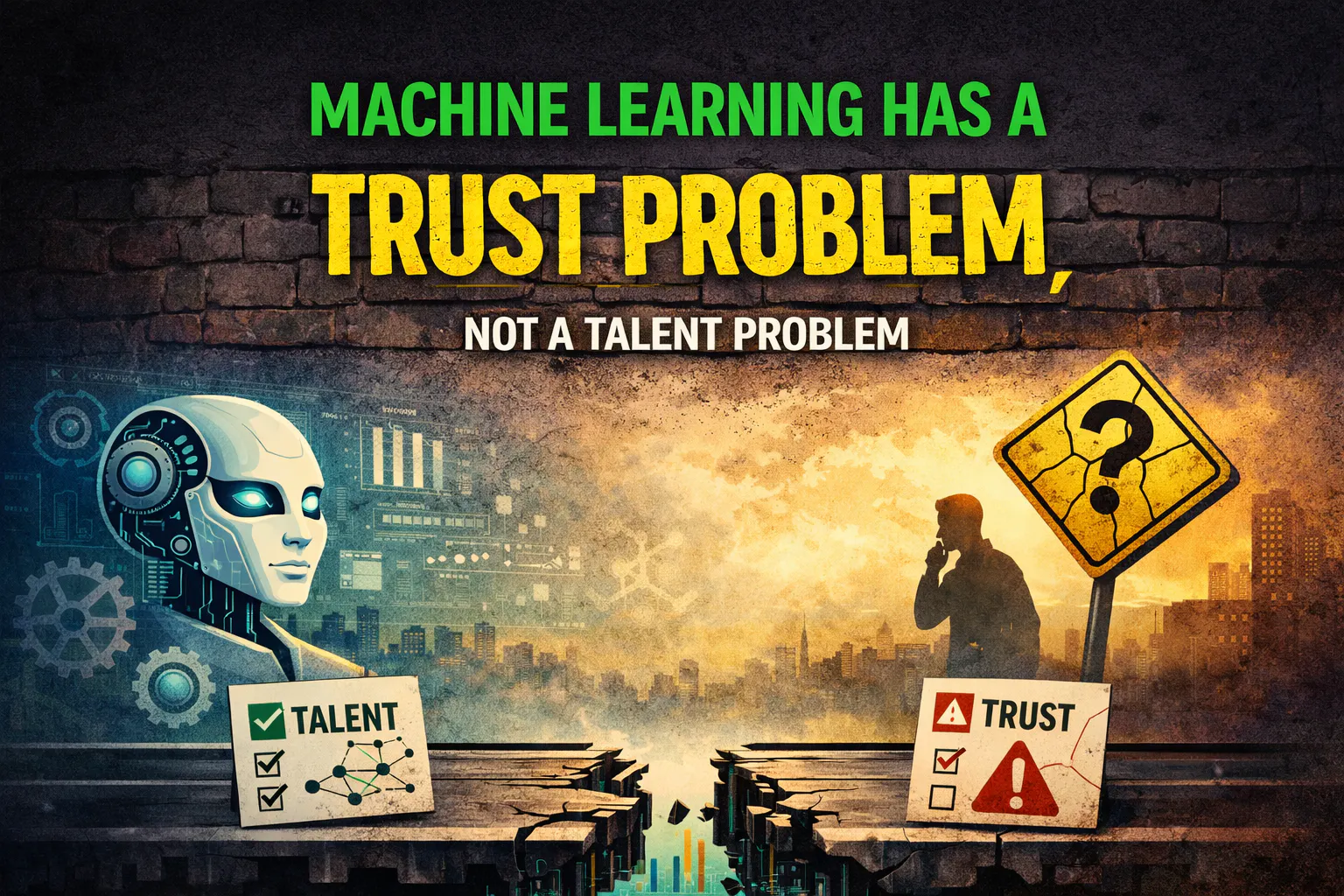
Machine learning is not struggling because the world lacks smart people.
It is struggling because the world still does not fully trust what these systems are doing.
That is an uncomfortable thing to admit, especially after years of excitement around AI, data science, and model innovation. We have more talent than ever. More engineers are learning ML. More companies are building with it. More tools are available. More startups are promising that machine learning can optimize, predict, classify, automate, and transform almost everything.
And yet, even with all of that progress, a quiet problem keeps slowing the whole space down.
People do not always trust the output.
They do not trust how the model reached its conclusion. They do not trust whether the data was clean. They do not trust whether the system will behave the same way tomorrow. They do not trust whether bias is hiding inside the logic. They do not trust whether the result is truly intelligent or just statistically convincing.
That trust gap matters more than many people in tech want to admit.
Because in machine learning, talent can build a system. But trust is what allows people to actually use it.
The Industry Has No Shortage of Talent
There was a time when machine learning talent was rare and expensive in a way that made the field feel almost inaccessible. Only big labs, top research teams, and well-funded companies could really compete. The tooling was harder, the infrastructure was more limited, and the knowledge barrier was higher.
That era has changed.
Today, there are more courses, frameworks, open-source libraries, pretrained models, and cloud tools than ever before. A small team can build something that would have looked impossible a few years ago. Students can train models on laptops. Founders can plug machine learning into products much faster. Even non-experts can now experiment with ML-powered workflows.
So when people say machine learning is being held back because there are not enough talented people, that explanation feels less convincing than it used to.
The deeper issue is not whether we can build models.
It is whether people believe those models deserve a place in decisions that matter.
That is a very different problem.
Accuracy Alone Does Not Create Confidence
One of the most common mistakes in machine learning culture is assuming that better performance numbers automatically solve adoption problems.
But people do not trust systems just because a dashboard says the accuracy has improved by three percent.
A team can present a model with strong metrics, beautiful charts, and a confident demo. Everyone in the room nods. The prototype looks impressive. The output feels sharp. The technical story sounds convincing.
Then the system touches the real world.
That is where things get messy.
Maybe the model performs well on test data, but becomes inconsistent in production. Maybe edge cases start appearing. Maybe users do not understand why one case was approved and another was rejected. Maybe support teams cannot explain the result. Maybe leadership gets nervous when an important recommendation looks wrong, but no one can clearly explain why it happened.
At that point, it no longer matters how elegant the architecture is.
Trust begins to collapse the moment people feel the system is acting like a black box; they are expected to believe without question.
And that is exactly where many machine learning systems fail.
The Black Box Problem Is Still Very Real
The machine learning world often talks as if explainability is a side feature. In reality, it is much closer to a survival requirement.
When a model influences hiring, lending, pricing, healthcare, moderation, fraud detection, customer support, logistics, or business forecasting, people need more than output. They need reasoning they can follow.
Not everyone wants mathematics. Most users do not need the internals of gradient descent or feature embeddings explained to them. But they do need enough clarity to feel that the system is not arbitrary.
That is the heart of the issue.
Trust is not built by making everyone into an ML expert. Trust is built by reducing the distance between model behavior and human understanding.
If a system keeps making decisions that users cannot interpret, then even a strong model starts to feel risky. And once something feels risky, people stop depending on it. They override it. They ignore it. They treat it like a novelty instead of infrastructure.
That is how machine learning gets stuck in the demo stage.
Real Businesses Do Not Want Magic
Tech culture sometimes loves mystery a little too much. It celebrates systems that feel almost magical. It rewards products that surprise people. It leans into the idea that the smartest software should seem almost beyond explanation.
But businesses do not really want magic.
They want predictability.
They want tools that behave well under pressure. They want systems that can be monitored, audited, improved, and understood. They want to know what happens when something goes wrong. They want to know who is responsible. They want confidence that the model will not quietly drift into bad decisions while everyone assumes it is still working.
That is why trust matters more than raw ML sophistication.
A slightly less advanced model that is stable, interpretable, and well-governed is often more useful than a brilliant model that no one fully understands and no one feels safe scaling.
This is not a glamorous truth, but it is a practical one.
In the real world, reliability often beats brilliance.
Trust Breaks Faster Than It Builds
Another reason machine learning has a trust problem is that trust behaves differently from performance.
Performance can improve steadily over time. Trust does not.
Trust builds slowly, but breaks instantly.
A system may work well for months. Teams may begin relying on it. Users may become comfortable with it. Stakeholders may finally relax. Then one highly visible failure happens, and suddenly all that confidence disappears.
That is especially dangerous in ML because model failures often feel unpredictable to non-technical users. When a human makes a mistake, people usually understand that humans are imperfect. When a machine makes a strange mistake, people often react more strongly because the machine was expected to be objective, consistent, and smart.
A single bad recommendation can raise bigger questions.
What else is it getting wrong?
How often does this happen?
Has it been wrong before?
Why did no one catch it?
Can we trust it at all?
That chain reaction is hard to stop once it begins.
It is not enough for machine learning systems to be impressive. They have to be dependable enough that mistakes do not destroy the entire relationship.
Trust Is Also a Product Design Problem
Many people treat trust in machine learning as purely a technical issue. It is not.
It is also a product problem, a communication problem, and a leadership problem.
A model may be good, but if the interface gives users no context, trust will stay low. A prediction may be useful, but if people cannot see confidence levels, relevant factors, or fallback options, they will hesitate. A system may be powerful, but if teams do not know when to trust it and when to question it, adoption stays fragile.
This is where many ML products still feel immature.
They are built by people who understand models, but not always by people who understand what makes users feel safe.
That gap matters.
A trusted machine learning product does not just generate output. It helps people understand what the output means, how strongly the system believes it, and what to do next.
In other words, good ML products do not just predict. They guide.
The Trust Problem Gets Bigger at Scale
Trust issues become even more serious when machine learning moves beyond internal experiments and into systems that affect many people.
At a small scale, teams can manually check outputs. They can correct weird behavior quickly. They can add a human review. They can explain away mistakes as early-stage issues.
At scale, that stops working.
Now the model influences thousands or millions of interactions. Now its mistakes are harder to catch. Now its inconsistencies matter more. Now bias becomes reputational damage. Now, confusion becomes customer frustration. Now internal uncertainty becomes legal, ethical, and operational risk.
That is when the trust problem stops being philosophical and becomes expensive.
And once money, reputation, and public scrutiny are involved, nobody is impressed by a model just because it is technically advanced.
They want proof that it can be trusted under real conditions.
Trustworthy ML Looks Less Exciting From the Outside
There is a strange irony in machine learning.
The systems that deserve the most trust often look less dramatic than the ones that get the most attention.
A trustworthy ML system usually comes with constraints, guardrails, monitoring, review processes, retraining discipline, documentation, and clear boundaries. It may not feel flashy. It may not sound revolutionary. It may even seem conservative.
But that is often the point.
Trustworthy systems are designed not just to impress, but to hold up.
That kind of work is less glamorous than launching a bold new model and calling it the future. It involves patience. It involves accountability. It involves admitting that real adoption depends on the boring parts almost as much as the clever parts.
And yet those boring parts are exactly what turn machine learning from an experiment into a dependable layer of a product or business.
The Future of ML Will Belong to the Teams That Earn Trust
The next wave of machine learning winners may not be the teams with the most talent. Talent is already everywhere.
The winners will be the teams that understand something deeper: people do not adopt machine learning just because it is powerful. They adopt it because it becomes believable.
That means building systems that are not only accurate but understandable. Not only fast, but accountable. Not only impressive, but dependable.
The ML teams that win long term will treat trust as a core feature, not a secondary concern. They will think about model behavior in production, not just performance in training. They will design for human confidence, not just technical possibility. They will know that machine learning is no longer competing only on intelligence.
It is competing on credibility.
And credibility is harder to fake.
Final Thought
Machine learning does not have a talent shortage.
It has a trust shortage.
That is the real bottleneck now.
We already know how to build powerful systems. The harder challenge is building systems people feel safe using repeatedly, seriously, and at scale.
That is what will define the next era of machine learning.
Not who can build the smartest model.
But who can build the one people actually trust?
[story continues]
tags