Table of Links
Supplementary Material
-
Image matting
-
Video matting
9.3. Quantitative details
Our ablation study, detailed in Table 13, focuses on various temporal consistency components. The results demonstrate that our proposed combination of Bi-Conv-GRU and forward-backward fusion outperforms other configurations across all metrics. Additionally, Table 14 compares our model’s performance against previous baselines using various error metrics. Our model consistently achieves the lowest error rates in almost all metrics.
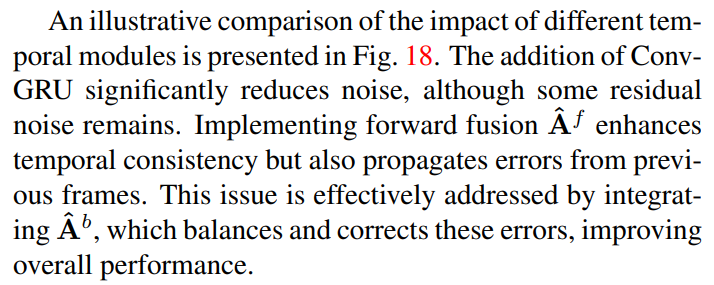
In an additional experiment, we evaluated trimappropagation matting models (OTVM [45], FTP-VM [17]), which typically receive a trimap for the first frame and propagate it through the remaining frames. To make a fair comparison with our approach, which utilizes instance masks for each frame, we integrated our model with these trimappropagation models. The trimap predictions were binarized and used as input for our model. The results, as shown in Table 15, indicate a significant improvement in accuracy when our model is used, compared to the original matte decoder of the trimap-propagation models. This experiment underscores the flexibility and robustness of our proposed framework, which is capable of handling various mask qualities and mask generation methods.
Authors:
(1) Chuong Huynh, University of Maryland, College Park (chuonghm@cs.umd.edu);
(2) Seoung Wug Oh, Adobe Research (seoh,jolee@adobe.com);
(3) Abhinav Shrivastava, University of Maryland, College Park (abhinav@cs.umd.edu);
(4) Joon-Young Lee, Adobe Research (jolee@adobe.com).
This paper is
[story continues]
tags