


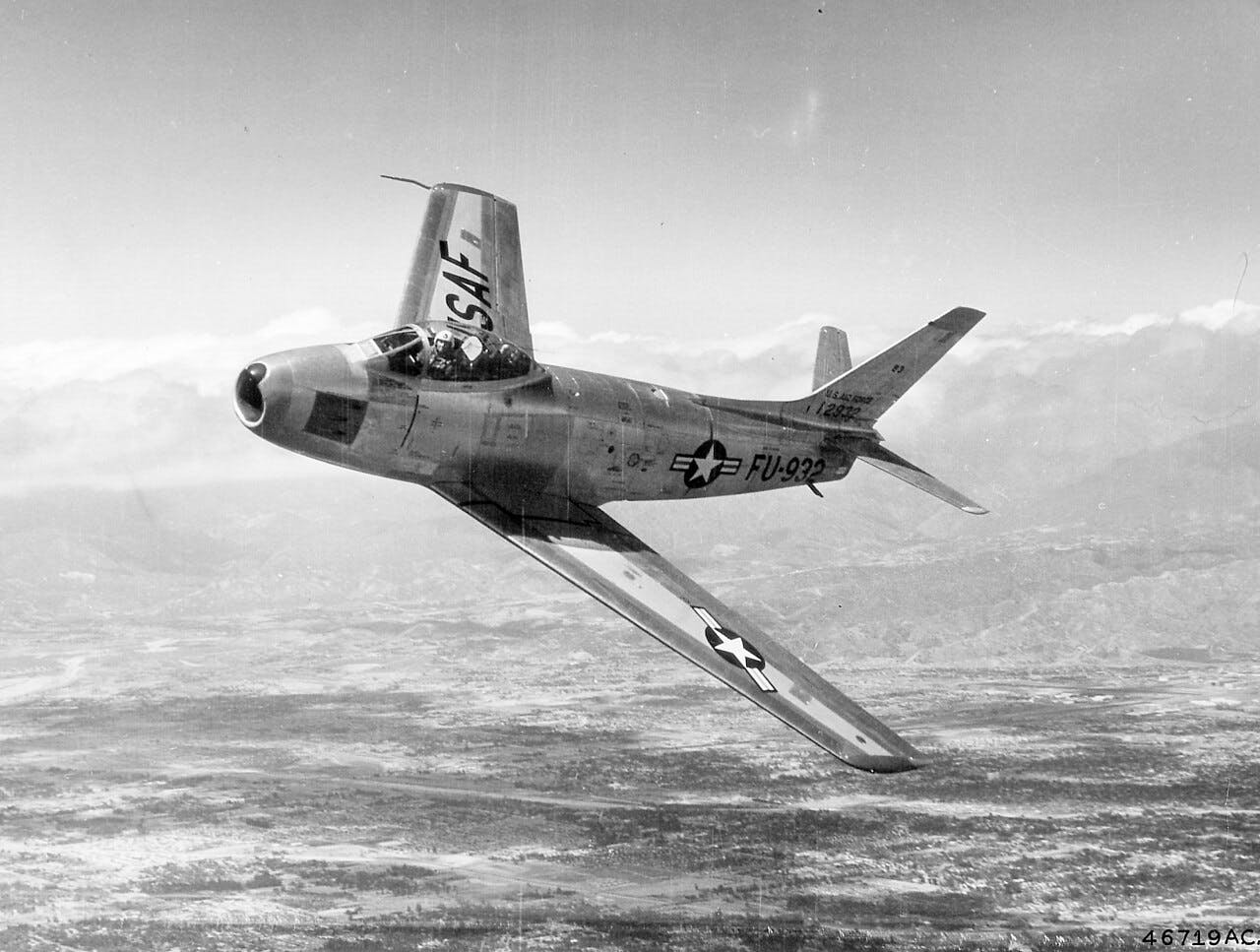
Featured Image: North American F-86 Sabre in flight (Source: Wikipedia)
At some point in the last 10 years, I started viewing Colonel John Boyd as one of my heroes. It was exactly the moment i perceived an understanding of his clarion call through time: ‘What’s it going to be, tiger? Do you want to be somebody, or do you want to do something?”
We all develop personal heroes over time, or adopt them. Often people go looking for them, sometimes you just fly into them.
This hero story necessarily starts with boys and their toys. I found some of my heroes playing with my toys, trying to be a better fighter pilot (in WW2-era VR flight sims, that is).
Air-to-air combat at visual range has always had a boyish appeal to me. Somewhere deep in me, the lines of winged, piston-driven predators just move me. I run outside to stare into the sky when I hear a low bypass jet engine or high-performance pistons.
Now understand, playful hobby as it is, combat flight sims are vicious worlds of dogs fighting dogs in seemingly random, suddenly developing, evolving, and disappearing furballs in the sky.
So, you seek out experienced folks, and you lean into their knowledge.
There are some great social media stars who clinically (and charmingly) dissect effective methods, shout out to Requiem’s work.
Many of us also join up with others to get some personal experience. I got lucky and fell in with a grizzled old group, including a bunch of real pilots with a lot of years together. In the arena we flew in, it takes a few months just to gather the skills to take off and navigate to an intended point, somewhat like real life. A former Vietnam War helicopter pilot leads the group.
After probably a year or two of getting pretty good at hitting stuff, I boyishly asked him one night, ‘How can I get better as a fighter pilot?’
He told me the best advice about getting good I ever got:
“You’re gonna need to burn a lot of gas.”
(Just to stay intellectually calibrated through this personal relation, let me point out that the climate implications of this theory are worth exploring, and I intend to later. Please stay with me in this combustion-driven nose-dive for now.)
So the first point here is, when the stakes are high, there is no substitute for practice. There is just no shortcut in competitive environments to spending the time mastering the skills you need to, and learning from the best available sources.
But the second point is, you might also look for the best and try to learn from them.
Enter Col. John Boyd (1927-1997). Boyd enlisted in the Army late in World War 2. Let me just point to this early episode to set the stage:
Boyd opened his military career as a 19-year old draftee in the U.S. Army occupying Japan during the cold, wet winter of 1945-46. Morale was terrible. The soldiers froze in damp tents, often eating uncooked K-rations, while their officers indulged themselves with hot food in warm quarters. Boyd led the inevitable revolt—the mud soldiers chopped down a wooden hangar and burned it to keep warm. The Army, being the Army, court-martialed Boyd for destroying government property, but Boyd, being Boyd, converted the trial into a referendum on leadership and responsibility. The officers lost, the troops got hot chow, and the military got its first look at John Boyd.
Franklin ‘Chuck’ Spinney, 1997.
After completing his enlistment, he went to college, graduating from the University of Iowa with a bachelor’s in economics, and then commissioned into the Air Force and became an F-86 Sabre pilot. He flew briefly in combat in Korea, then earned his first professional marks of distinction and one of his nicknames, ‘40-second Boyd,’ as a flight instructor with a standing bet that he could beat any other pilot, starting himself from a position of disadvantage, within 40-seconds - a bet he apparently never lost.
We can say here that he must have burned a lot of gas.
Boyd was a fervent American patriot, and we should recall he perfected his piloting skills during a time when the notion of Soviet bombers pouring over the US, obliterating freedom, was the realest concern he could know.
Boyd took his personal skill and, with uncompromising rigor and precision wrote the literal book on dogfighting.
In The Aerial Attack Study, published classified c. 1960, Boyd charts the appropriate tactics for all possible scenarios for a fighter pilot. Boyd effectively engineered a manual from what had previously been understood only as art. It is no exaggeration to say that this piece still stands as the foundational manual for air-to-air combat throughout the world today.
Recognize that in 2026 and counting, this is a pinnacle achievement of still-rising significance.
The kind of thing you could make a life off of; be a general, be famous. But this is John Boyd, so that is not where the story goes.
Instead, he goes back to college.
Not content with having explained to the best of the best how to be much better, Boyd went to Georgia Tech and started really studying.
Story goes, barred from accessing the critical compute resources (have they ever been properly allocated?!) he needed to run millions of calculations comparing US and Soviet aircraft flight dynamics in order to test his ideas, Boyd ended up stealing time on an IBM 704 with an access code from a supportive mentor. Boyd hacks his way to the testing needed to prove the energy-maneuverability theory, which he and colleagues published in two volumes in 1964.
Turns out, the energy-maneuverability theory…“is useful in describing an aircraft's performance as the total of kinetic and potential energies or aircraft specific energy. It relates the thrust, weight, aerodynamic drag, wing area, and other flight characteristics of an aircraft into a quantitative model. This enables the combat capabilities of various aircraft or prospective design trade-offs to be predicted and compared.”
Specific to the Air Force’s then-existing paradigm comparing the US F-4 to the Soviet MiG-21, Boyd showed that in realistic combat flight situations (or envelopes), the MiG-21 actually had superior performance characteristics. In a turn generating 5g (5-times the 'normal' force of gravity on the plane and pilot, stronger than standard roller-coasters but which combat pilots are expected to handle routinely), the F-4 was only really superior in supersonic regimes and at lower altitudes, which is not most dogfighting.
So basically, having already written the book on dogfighting, Boyd has now helped write the book on dogfighters.
I’m not even going to get into the whole fascinating history of his Fighter Mafia, their Pentagon Wars with the Bomber Mafia, the development of icons of modern American air power in the F-15, F-16, and F-18, and other aspects of this story.
Boyd’s co-writer and mentor in the energy-maneuverability theory, civilian mathematician Thomas Christie, made a noble career in industry and government out of this theory. Billions of dollars were allocated and re-allocated in reaction to this theory. There are a lot of things John Boyd could have chosen to be at the center of this theory. So what did he choose?
It’s worth a segue here to discuss hero-worship. The only heroes I hold flawless or nearly perfect are those really close to me. So close that I can’t see around their shining parts to the imperfections. We assess distant objects more…objectively. It seems clear John Boyd had many difficult, undesirable, and offensive traits. Read about him stalking food courts to chase down and berate people he felt had disrespected him. He appears to have destroyed relationships everywhere he went, most of all his family. I might have been repulsed by him personally, and I’m pretty sure he wouldn’t have liked me.
Please let me be clear; I don’t worship this hero completely, by telling this story. I really think, the closer people get to greatness, the more likely they are to have left a wake of personal destruction in pursuit of that greatness. Maybe that was the point Alexander the Great was making, but that also belongs in a separate piece I’ll get to later. Let me now continue with the story of the greatness of John Boyd, mindful of reality and imperfection.
Boyd is remembered for his combative, defiant nature. After publishing this work, it appears Boyd went to war in or even with the Pentagon. There are all kinds of rich stories of ‘Genghis John’ poking lit cigars into the pressed uniforms of senior generals while informing them of the impropriety of their ideas, and secretive late-night gatherings of wide-eyed inspired junior officers, hungry for a cause they should believe in. Boyd acquired nicknames like ‘the Mad Major’ and ‘the Ghetto Colonel’ for his shabby appearance and irate demeanor, living out of a bare and squalid apartment and fretting away the problems he couldn’t compute.
Discontent without the necessary deeper understanding, Boyd dug further. He immersed himself in Gödel's incompleteness theorems, Heisenberg’s uncertainty principle, and the second law of thermodynamics. Perhaps for the first time, Boyd synthesized these distinct scientific pillars to form an underlying epistemology.
Gödel, if I may attempt an explanation without the appropriate PhD, proved that any consistent formal system cannot demonstrate its own consistency from within; you must step outside the system to verify it. Boyd translated this to cognitive architectures and organizational logic. He argued that you cannot validate your own mental models or rulesets by strictly referencing those same models. To know if your framework actually maps to reality, you are forced to look outward, interact with the environment, and test the system against external, independent variables.
Heisenberg demonstrated that the act of observing a quantum system inevitably alters its state, meaning perfect, simultaneous measurement of all variables is impossible. Boyd applied this to strategic and cognitive observation. He noted that the environment is never static, and the very act of interacting with an adversary or an environment fundamentally changes it. Certainty is a physical impossibility. Therefore, a system cannot rely on a fixed snapshot of reality. It must assume that its very presence makes previous observations obsolete.
Thermodynamics dictates that in any closed system, entropy inevitably increases. Entropy is understood as disorder, chaos, and the loss of usable energy. Boyd viewed this as the ultimate existential threat to any decision-making apparatus. If an individual, organization, or recursive system stops pulling in new, unpredicted data from the outside world, it becomes a closed system. Without constant external friction, its internal models will suffer ‘mental entropy,’ becoming perfectly internally consistent but completely detached from the reality of the external environment.
By c. 1975, Boyd retired from service and distilled these thoughts into a short essay, ‘Destruction and Creation.’ He proposes
a Dialectic Engine that permits the construction of decision models needed by individuals and societies for determining and monitoring actions in an effort to improve their capacity for independent action.
I believe by this point, our hero (have you not joined me?) is hacking solutions to society itself; solutions we might still pay attention to.
Long story short, Boyd kept to his nature until the end. Instead of publishing or following endless lucrative opportunities, he nestled almost into an intellectual mortar hole, lobbing intellectual munitions into groups of acolytes. His work transitioned to a legendary presentation that he refined over the last decades of his life, offered over and over to various groups. There is no original recording of the presentation itself that I can find, but there are numerous descriptions.
Boyd’s most famous contribution came in this late period, with the ‘OODA loop.’
OODA is a decision-making framework for individuals or systems: Observe-Orient-Decide-Act. It has often simplistically been described as a loop or sequential circle, which I believe is an underappreciation. In Science, Strategy and War, Frans Osinga dismantles the corporate ‘stopwatch’ misinterpretation. Osinga shows that the OODA loop is a highly non-linear, recursive network weighted almost entirely towards the ‘orient’ phase.
Orientation is so much more than situational awareness. Boyd described orientation as a complex, active filter - in his terms as the repository of genetics, cultural predispositions, past experiences, and existing knowledge (Boyd’s now-dated frame of reference for orientation is quite evident here).
Boyd described the orientation phase as preventing the mental entropy demanded by the laws of physics, by constantly executing a process of destruction and creation. When an observation does not match the predicted outcome of the current mental model, the system must shatter it, breaking its own rules down into constituent parts: Destruction. The system then takes those shattered fragments and combines them with the new, anomalous observations and synthesizes a new framework that better maps to the current reality: Creation.
This is essentially an engine for continuous epistemic updating.
I left this until late because if you take anything away from this story, please don’t go chasing all the copious interpretations of the OODA concepts in business, litigation, and other domains. I haven’t read most of it, and I do not endorse it.
Also, I don’t hold this up as a perfect modern solution for systems. It seems outmoded by some aspects of modern complexity theory. But, for the time and place and overall context, the OODA-loop framework is a heroic achievement.
“Genghis John” influenced generations of strategic thinkers, probably some war strategies, lets not moralize it but he had a big impact. He may have inspired a young Dick Cheney to a warped and greedy view of the world, but he also may have helped keep some wars shorter than they could have been, which is generally better. Maybe some wars never fought because enough people were observing and orienting appropriately?
What I think I like most about John Boyd, is the legendary lecture or briefing he developed in his later life. It came to be known, like him, by various names: the ‘Fast Transients Brief,’ ‘Patterns of Conflict,’ and later ‘A Discourse on Winning and Losing.’ There’s no recording of it that I can find, just second-hand accounts. Although no Principia, this briefing may be considered Boyd’s magnum opus.
Picture this cigar-chomping legend in a dark basement before a small group of nervous young leaders.
It’s attributed that in the culminating point of this talk, Boyd would stare hard into the eyes of the would-be observant
Tiger, one day you will come to a fork in the road and you’re going to have to make a decision about which direction you want to go. He raised his hand and pointed. “If you go that way you can be somebody. You will have to make compromises and you will have to turn your back on your friends. But you will be a member of the club and you will get promoted and you will get good assignments.” Then Boyd raised his other hand and pointed in another direction. “Or you can go that way and you can do something- something for your country and for your Air Force and for yourself. If you decide you want to do something, you may not get promoted and you may not get the good assignments and you certainly will not be a favorite of your superiors. But you won’t have to compromise yourself. You will be true to your friends and to yourself. And your work might make a difference. To be somebody or to do something. In life there is often a roll call. That’s when you will have to make a decision. To be or to do? Which way will you go?
This quote is not really attributed, and possibly apocryphal. Heroes can be termed legends when this happens.
If Descartes said anything useful, it was cogito ergo sum, I think therefore I am. If Boyd said anything useful, it was this - to be somebody or to do something, that is the call. To be or to do.
Robert Frost gave us the poetry of this fundamental choice in life; Boyd lived it and proved an optimization of it, in ways.
This story was about my interaction with the work of John Boyd, and it’s a hero story. It’s meant to be implied that there are many heroes, although I focused on one.
I learned from Boyd that we can get inside our opponents’ decision loops, which does lead to a competitive advantage. Personally, I never became anything like ‘40-second Boyd’ in my combat flight sims, but I became known as a ‘good stick’ by people whose opinion I respected. My objective was never to be a fighter pilot, though, was it?
I also learned about the dogged pursuit of intellectual honesty and rigor. Continuous learning principles. Thermodynamics! The doing is the magic. Look how a playful hobby and wanting to get better at helping my buddies, in this game we played together, led to all this. Doing, even in games with friends, is where I think we find meaning. A little engine for continuous epistemic updating. Anyway, it's an easy choice when you think about it.