


Pop quiz: What do dark matter detectors and voice AI have in common? If you answered 'absolutely nothing,' you might be wrong.
Welcome to another Company of the Week feature! Every week, we share an awesome tech brand from our tech company database, making their evergreen mark on the internet. This unique HackerNoon database ranks S&P 500 companies and top startups of the year alike.
This week we're highlighting a company that proves the best tech founders are the ones interesting enough to pivot from physics to voice APIs.
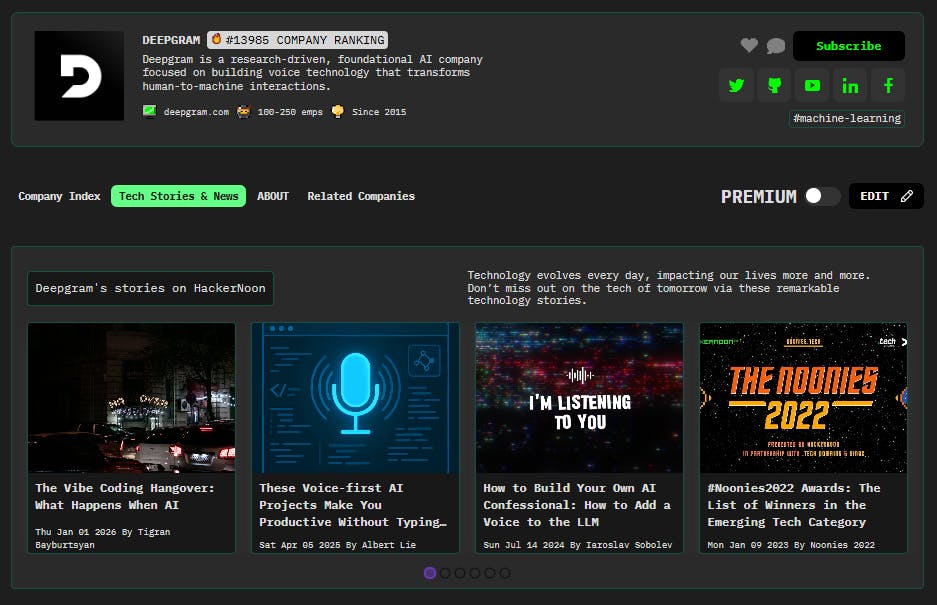
Introducing Deepgram - a voice AI platform that's teaching machines to actually understand how humans speak.
Want to be featured on HackerNoon’s Company of the Week?
From Hunting Dark Matter to Capturing Dark Audio
Picture this: It's somewhere around 2015, and Scott Stephenson is working in what he describes as a "James Bond lair" deep underground - yellow railings, cranes, hard hats, the whole nine yards. He's building ultra-sensitive detectors to catch dark matter, training neural networks to pick signals out of noise in waveforms. Sounds intense, right? Well, that experience would become the secret sauce for something completely different.
During those brief moments when Scott wasn't hunting for the building blocks of the universe, he had a side project: recording audio from his life 24/7. Hundreds of hours of it. When he tried to search through all that audio to find specific moments, he hit a wall. There wasn't a good tool for it. So naturally, he thought: "Hey, we're already using AI to analyze waveforms for dark matter. Why not use the same techniques for audio?"
And just like that, Deepgram was born on August 18, 2015, at 12:52 PM EST. Yes, they know the exact time. That's the kind of precision you'd expect from particle physicists turned tech founders.
The Numbers That Make You Say "Wait, What?"
Let's talk scale, because Deepgram isn't playing small ball:
- 200,000+ developers are currently building with Deepgram's APIs
- They've processed over 50,000 years of audio (wrap your head around that one)
- 1 trillion words transcribed and counting
- Just raised a $130 million Series C at a $1.3 billion valuation this January
- Ended 2024 cash-flow positive with 400+ enterprise customers.
When they say "there is no organization in the world that understands voice better than Deepgram," they might actually have the receipts to back it up.
Fresh Off the Press
Just weeks ago, Deepgram announced their $130 million Series C funding round led by AVP, with participation from some heavy hitters including Alkeon, In-Q-Tel, Madrona, Tiger, Wing, Y Combinator, and new investors like Twilio, ServiceNow Ventures, SAP, and Citi Ventures.
The timing makes sense. The voice AI market is projected to hit $50 billion, and Deepgram is positioning itself as the only end-to-end speech-to-speech solution built for enterprise demands.
Deepgram🤝 HackerNoon Newsletter Ads
Deepgram partnered with HackerNoon to promote its Voice AI Agents Virtual Workshop campaign via the
This partnership put Deepgram’s “Building and Scaling Voice AI Agents“ messaging in front of 325k+ tech professionals and enthusiasts who follow the HackerNoon Newsletter, targeting the most relevant technology categories on HackerNoon to maximize effectiveness.
How does ad placement by content relevancy work at HackerNoon?
- HackerNoon has curated 50,000+ technology tags to date
- These tags are grouped into the relevant parent categories like AI, Web3, Programming, Startups, Cybersecurity, Finance, and more!
- Every story organically gets eight relevant tech tags and a parent category
- Sponsors buy multimodal placements on relevant categories with all the tags and stories.
- These Ad placements include Banners, Logos, Newsletter ADs, and Audio ADs - truly AIO (Activities, Interests, and Opinions)
- Optimized For: Brand Recall and Clickability (Get 3x clicks for the same impressions compared to elsewhere)
- Get quality leads at unbeatable prices, with CPM ~ $7 and CPC ~ $5.
And that’s all for this week, hackers.
Stay creative, Stay iconic.
HackerNoon Team