


Recap
Let’s quickly recap what we discussed in my previous post. We talked about the tree data structure and how it represents a hierarchy consisting of nodes classified as root, children, and leaf. We then went on to define and discuss a special type of tree, a Merkle tree.
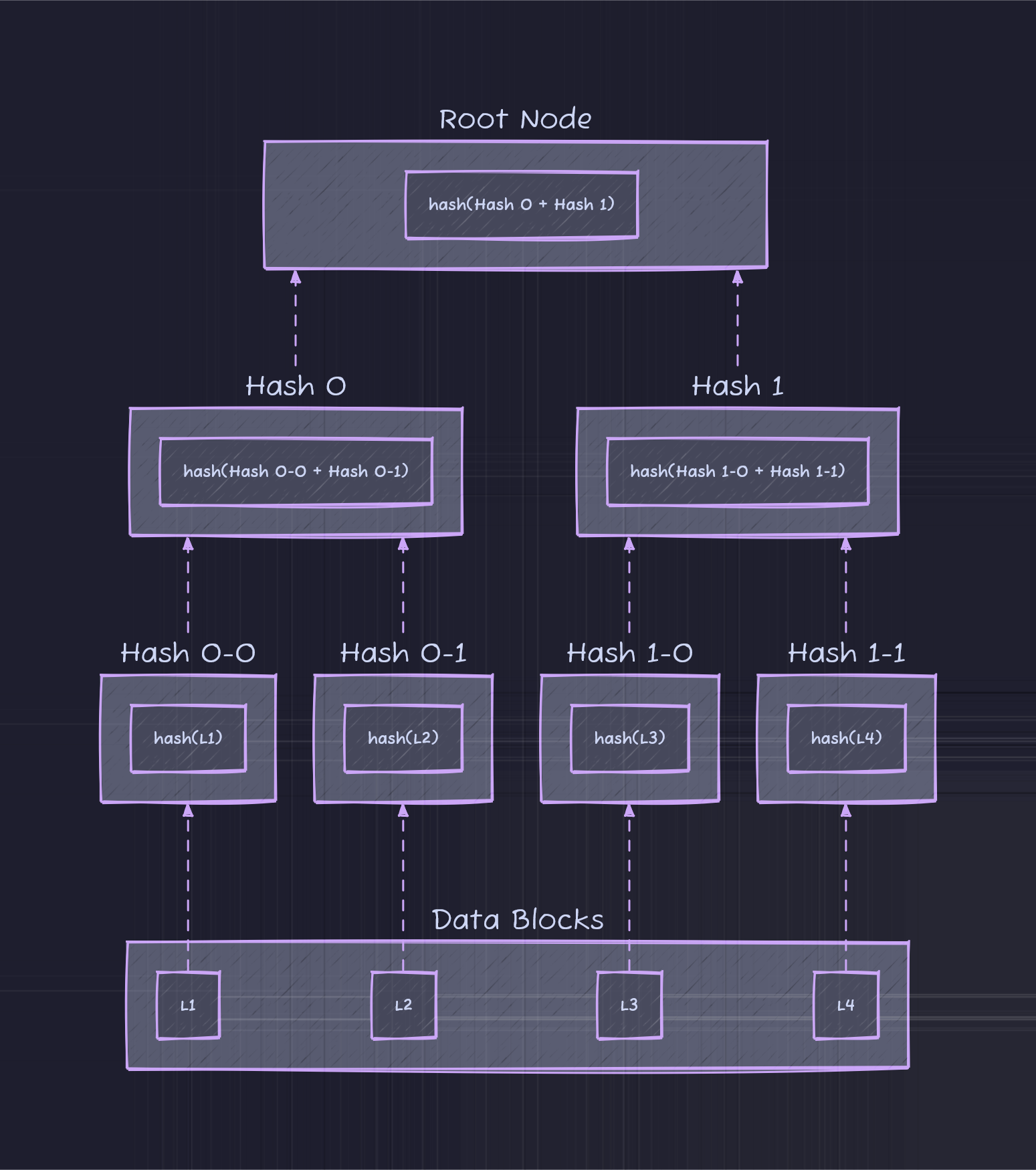
We defined a Merkle tree as a binary tree in which every leaf node contains the cryptographic hash of a data element, while every non-leaf node contains the cryptographic hash of the sum of cryptographic hashes of its children. Below is our definition in a visual format:
Implementation
Let’s get started implementing the Merkle Tree. We’ll start by defining our high-level data structures:
- MerkleNode: this will represent a singular node. As we’ve outlined, a node can have a left child and a right child. Secondly, a node either contains the hash of a data element or the hash of the concatenation of its children's hashes.
- MerkleTree: the tree itself is represented by the root node, the MerkleRoot
// Let's define a Node N
// A node can have a left child and a right child
// A node also contains the cryptographic hash
type MerkleNode struct {
 LeftChild  *MerkleNode
 RightChild *MerkleNode
 Hash       string
}

type Tree struct {
 MerkleRoot *MerkleNode
}
Above, we've defined the MerkleNode, which contains the members LeftChild, RightChild, and Data. We've also defined the Tree itself. The Tree struct only has one member...the MerkleRoot.
With our data structures set up, let’s now tackle actually creating a node. As stated above, a node can have children, and that determines what is hashed and stored.
func NewMerkleNode(leftChild, rightChild *MerkleNode, data []byte) *MerkleNode {
 node := MerkleNode{}

 if leftChild != nil && rightChild != nil {
  oldHash := leftChild.Hash + rightChild.Hash
  newHash := sha256.Sum256([]byte(oldHash))
  node.Hash = hex.EncodeToString(newHash[:])
 } else {
  hash := sha256.Sum256(data)
  node.Hash = hex.EncodeToString(hash[:])
 }
 node.LeftChild = leftChild
 node.RightChild = rightChild
 return &node
}
Our function NewMerkleNode takes in three inputs: the left child, the right child, and the data itself. We then create an empty MerkleNode and explicitly check if we passed in valid values for left and right child. If we did, we would update the hash accordingly. We then return the memory address of the node.
To highlight how this would work, imagine if we wanted to create a brand new leaf node, the way we would do that is:
leafNode := NewMerkleNode(nil, nil, []byte("data"))
Similarly, if we wanted to create a regular node with left and right children, it would look something like this (assuming the left and right children have already been created):
node := NewMerkleNode(leftChild, rightChild, []byte(""))
Now that we’ve got a way to create nodes, we need a way to construct the tree itself. The gist of constructing a tree is that you climb up the tree, creating new levels until you reach the top, the root node.
As a thought exercise, let’s imagine we’re given a bunch of data blocks, and we’re asked to construct the Merkle Tree. It would look something like this:
- Create a leaf node corresponding to each data block
- Go up one level, creating nodes corresponding to the lower-level leaf nodes
- Go up one level, creating nodes corresponding to the lower-level nodes
- And so on… until we’ve reached a singular node.
One thing we need to watch out for is an odd number of nodes at any level besides the root node. For example, let's visualize having 5 data blocks to encrypt:
func NewMerkleTree(dataBlocks [][]byte) (*Tree, error) {
 if len(dataBlocks) == 0 {
  return nil, errors.New("must have more than 0 data blocks")
 }

 var nodes []MerkleNode

 // Handle odd number of data blocks by replicating the last one.
 if len(dataBlocks)%2 != 0 {
  dataBlocks = append(dataBlocks, dataBlocks[len(dataBlocks)-1])
 }

 // Create leaf Nodes
 for _, data := range dataBlocks {
  nodes = append(nodes, *NewMerkleNode(nil, nil, data))
 }

 // Time to construct the tree level by level
 for i := 0; i < len(dataBlocks)/2; i++ {
  var newLevel []MerkleNode
  for j := 0; j < len(nodes); j += 2 {
   // If the number of nodes at the level are odd, once again append the last one at the end
   if len(nodes)%2 != 0 {
    nodes = append(nodes, nodes[len(nodes)-1])
   }
   newLevel = append(newLevel, *NewMerkleNode(&nodes[j], &nodes[j+1], nil))
  }
  nodes = newLevel
 }
 // return the tree
 return &Tree{MerkleRoot: &nodes[0]}, nil
}
To deal with the possibility of there being an odd number of nodes at any given level, there’s a check to make sure that we have an even number of nodes, if we don’t just append the last node to the array and carry on.
What this function does is:
- Create leaf nodes from the input data.
- Check if there’s an even number of data blocks, if not replicate the data block.
- Create nodes level by level making sure to check if there are an even number of nodes every time.
- Return the Tree struct with the MerkleRoot set to the only element in the nodes array.
Using this function would look something like this:
 testData := [][]byte{
  []byte("Transaction 1"),
  []byte("Transaction 2"),
  []byte("Transaction 3"),
  []byte("Transaction 4"),
  []byte("Transaction 5"),
 }
 tree, err := NewMerkleTree(testData)
Okay, we’ve implemented it but how can we check if it’s right? How can we verify that the hashes line up? With a simple breadth-first search (BFS) of the tree.
Let’s verify along the way:
Data Blocks
Data: Transaction 1	Hash:dff3b30655dc240deca00ed22fae68fdf8cf465bbe99bb2b2e24259cc1daac3a
Data: Transaction 2	Hash:4ae0e48b754a046b0f08e50e91708ddff4bac4daee30b786dbd67c30d8e00df8
Data: Transaction 3	Hash:2b8fd91deadf550d81682717104df059adc0addd006a0c7b99297e88769b30e5
Data: Transaction 4	Hash:b99ca09efe93055ad86acb5bfc964e16393d8e4672c3a4c5fa08ffabc85065b3
Data: Transaction 5	Hash:40d1474d042b66b26df83eae197368b93d84d8c960d39aec68573796078114a4
Data: Transaction 5	Hash:40d1474d042b66b26df83eae197368b93d84d8c960d39aec68573796078114a4
You can see that Transaction 5 is repeated.
Level 0 (Immediately above Data Blocks)
Printing levels...
Level 0...

Hash Left: dff3b30655dc240deca00ed22fae68fdf8cf465bbe99bb2b2e24259cc1daac3a	Hash Right: 4ae0e48b754a046b0f08e50e91708ddff4bac4daee30b786dbd67c30d8e00df8 New Hash: a31d3187c179a847bc0fbe729e06a0770147ad58b45995ac945032df15ba38e3

Hash Left: 2b8fd91deadf550d81682717104df059adc0addd006a0c7b99297e88769b30e5	Hash Right: b99ca09efe93055ad86acb5bfc964e16393d8e4672c3a4c5fa08ffabc85065b3 New Hash: c6dadc3fe8fde36887f07ed12e0bb073b4165d0921749b98b2ae237f3aed3e07

Hash Left: 40d1474d042b66b26df83eae197368b93d84d8c960d39aec68573796078114a4	 <  Hash Right: 40d1474d042b66b26df83eae197368b93d84d8c960d39aec68573796078114a4 <  New Hash: 745ebfe140c7e62a45766934adff116dcd736890477b37ccd44550284d38e7c2
You can see each of the data block hashes being used. And the < marks the replicated node.
Level 1
Level 1...
Hash Left: a31d3187c179a847bc0fbe729e06a0770147ad58b45995ac945032df15ba38e3	Hash Right: c6dadc3fe8fde36887f07ed12e0bb073b4165d0921749b98b2ae237f3aed3e07 New Hash:7e1182c5c00e379261503e757487cfa16cda7010f1ca3ae0115d5b78cfc07509

Hash Left: 745ebfe140c7e62a45766934adff116dcd736890477b37ccd44550284d38e7c2	< Hash Right: 745ebfe140c7e62a45766934adff116dcd736890477b37ccd44550284d38e7c2 < New Hash:c4a338ab87fe2e56055a48e160f007ebb6a8a90303659fd8b97dde9d99a9a164
Same as before you can see where the node was replicated and you can see where the hashes from Level 0 are used here.
Level 2 (Merkle Root)
Level 2...

Hash Left: 7e1182c5c00e379261503e757487cfa16cda7010f1ca3ae0115d5b78cfc07509	Hash Right: c4a338ab87fe2e56055a48e160f007ebb6a8a90303659fd8b97dde9d99a9a164
New Hash: 2c2c4cdf817ca1233db4784bb8752eddca8428c5c88ad7fad7e7235532e33c3c
And there we go, we’ve reached the top, the Merkle Root.
Verification
Now that we have a merkle tree, how can we verify an element of the original data block?
Scenario: you’re hosting a file on Dropbox and need to retrieve it. Dropbox partitions the file and stores the file in chunks across multiple nodes. When retrieving your file Dropbox will use a Merkle Proof to verify that a chunk belongs to the requested file.
So given data blocks and a specific data block to verify how can we ensure that the specific data block is part of the Merkle Tree? This is where a Merkle Proof comes in to play.
A Merkle Proof (defined as a Merkle Consistency Proof in RFC6962) is basically the list of nodes in the Merkle Tree required to verify that the input is contained in the tree.
Let’s visualize this:
- We can generate the hash for Data Block 1
- We need the hash for Data Block 2 (green)
- We can now generate the hash for Hash (Hash 1 + Hash 2)
- We need the hash for Hash (Hash 3 + Hash 4) (green)
- We can now generate the hash for Hash (Hash 1&2 + Hash 3&4)
- We need the hash for Hash (Hash 5&5 + Hash 5&5) (green)
- We can now calculate the hash for the Merkle Root. Thus verifying Data Block 1’s inclusivity.
This means for Data Block 1 the Merkle Proof is:
[Hash(Block 2), Hash(Hash 3 + Hash 4), Hash(Hash 5&5 + Hash 5&5)]
Implementation
Let’s implement the verification process. This will be two parts:
- Build the proof:
- Which hashes lead to the MerkleRoot
- Verify the proof
- Do the hashes hash their way to the Root
Build the Proof
Let's say we’re given an array of data blocks and a specific data block we want to verify. How do we approach this? This is almost entirely identical to building the actual Merkle tree; the only difference is that we’ll append the hashes we need to an array and return them.
func (tree *Tree) MerkleProof(data []byte, dataBlocks [][]byte) ([]string, error) {
 // Find index of the data block we're looking for
 // Determines whether we have a left or right sibling
 index := -1
 for i, block := range dataBlocks {
  if bytes.Equal(data, block) {
   index = i
   break
  }
 }

 if index == -1 {
  return nil, errors.New("data not found in datablocks")
 }

 // Get the leaf hashes
 var proof []string
 var hashedNodes []*MerkleNode
 for _, data := range dataBlocks {
  hashedNodes = append(hashedNodes, NewMerkleNode(nil, nil, data))
 }

 // We will now construct the tree and traverse up to verify
 // Basically build the tree and add the necessary nodes to our proof
 for len(hashedNodes) > 1 {
  var nextLevel []*MerkleNode

  // If even we have a right sibling, if odd we have a left sibling
  if index%2 == 0 && (index+1 < len(hashedNodes)) {
   proof = append(proof, hashedNodes[index+1].Hash)
  } else if index%2 == 1 {
   proof = append(proof, hashedNodes[index-1].Hash)
  }

  for j := 0; j < len(hashedNodes); j += 2 {
   if j+1 < len(hashedNodes) {
    nextLevel = append(nextLevel, NewMerkleNode(hashedNodes[j], hashedNodes[j+1], nil))
   } else {
    nextLevel = append(nextLevel, NewMerkleNode(hashedNodes[j], hashedNodes[j], nil))
   }
  }
  hashedNodes = nextLevel
  index /= 2
 }
 return proof, nil
}
This code will give us an array of hashes, that when used will re-construct our MerkleRoot.
Verify the Proof
This part is the easiest, we will quite literally just hash each member of the proof array until we reach the MerkleRoot.
To do this we’ll write two helper functions to make our lives easier:
leafHashwhich will hash the contents as if it were a leaf.nodeHashwhich will hash the contents as if it were two nodes.
func nodeHash(leftHash, rightHash string) string {
 newHash := sha256.Sum256([]byte(leftHash + rightHash))
 return hex.EncodeToString(newHash[:])
}

func leafHash(data []byte) string {
 hash := sha256.Sum256(data)
 return hex.EncodeToString(hash[:])
}
With the helper functions in place, lets implement the verifier. We will return true if the data block is part of the Merkle Tree and false otherwise.
func VerifyMerkleProof(data []byte, proof []string, rootHash string) bool {
 leaf := leafHash(data)

 for _, siblingHash := range proof {
  leaf = nodeHash(leaf, siblingHash)
 }
 return leaf == rootHash
}
That’s it we’re done. Now to actually run through it we’ll reuse the data from above, lets check if Transaction 1 is in the Merkle Tree:
output, err := tree.MerkleProof([]byte("Transaction 1"), testData)
When executed, output looks like this (a list of hashes that when hashed with the original data block should give us the MerkleRoot):
[4ae0e48b754a046b0f08e50e91708ddff4bac4daee30b786dbd67c30d8e00df8 c6dadc3fe8fde36887f07ed12e0bb073b4165d0921749b98b2ae237f3aed3e07 c4a338ab87fe2e56055a48e160f007ebb6a8a90303659fd8b97dde9d99a9a164]
Now to verify the proof:
proof := VerifyMerkleProof([]byte("Transaction 1"), output, tree.MerkleRoot.Hash)
This returns true. So, there you have it. A fully functional Merkle Tree implementation with proof and verification.
Conclusion
So today we implemented what we talked about last week, Merkle Trees. In our implementation we referred to RFC6962 for guidance, added a Merkle Proof method that returns the list of hashes needed to reconstruct the Merkle Tree, and added a verification method that verifies whether the proof is correct.
If you liked what you read please like, comment, and share. I’m always looking for feedback and topic suggestions.
Once again, thanks all for subscribing and tuning in this week. I will see y’all next week.
Thanks,
Ali