


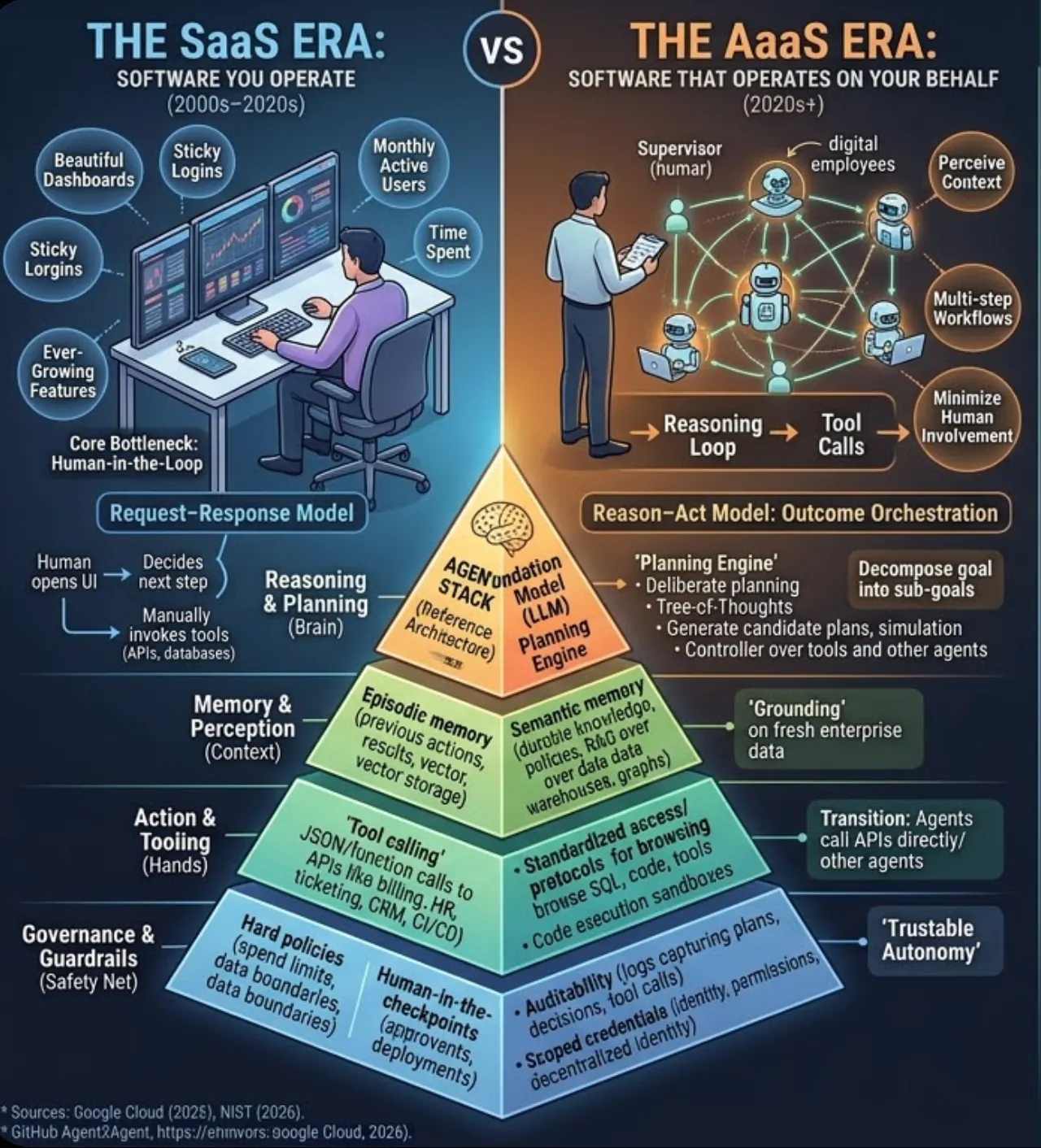
For two decades, we optimized SaaS around beautiful dashboards, sticky logins, and ever-growing catalogs of micro-features. We measured success by monthly active users and time spent in the product.
In 2026, those assumptions are starting to look dated. Autonomous agents are turning “software you operate” into “software that operates on your behalf,” shifting the center of gravity from UI design to outcome orchestration.
In this article, I’ll walk through how Agents-as-a-Service (AaaS) changes the underlying architecture, the operating model, and even the business model of modern software – and what that means for architects planning the next generation of systems.
1. The Death of the Dashboard
For most of the last two decades, we treated “good software” as a beautifully designed dashboard with a sticky login and a low churn rate. SaaS digitized workflows, exposed APIs, and centralized data, but it never removed the core bottleneck: a human in front of a screen clicking buttons.
At its core, SaaS is a request–response model:
- A human opens a UI.
- They interpret charts or tables.
- They decide what to do.
- They manually invoke the next system.
Even when we added “AI features,” they were often autocomplete for forms or smarter filters, not genuine autonomy.
Agents-as-a-Service upend this relationship. Instead of providing tools, we provide digital employees: entities that can perceive context, reason about objectives, and execute multi-step workflows across multiple systems with minimal human involvement.
If SaaS is software you operate, AaaS is software you supervise.
2. From Request–Response to Reason–Act
The architectural break from SaaS to AaaS is fundamentally about control flow.
SaaS: UI → API → Database, driven step-by-step by a person.AaaS: Goal → Reasoning Loop → Tool Calls → Outcome, driven by an agent.
Modern agents don’t just map prompts to responses. They run reasoning loops that look more like the OODA cycle: Observe, Orient, Decide, Act. Research such as Chain-of-Thought (CoT) prompting and ReAct (Reason + Act) showed that large language models can be guided to explicitly plan and then call tools, rather than emitting a single one-shot answer.
In practice, that means:
- Decomposing a user goal into sub-tasks.
- Querying relevant data sources at each step.
- Calling APIs or other agents to perform actions.
- Evaluating intermediate results and revising the plan.
This is not a new frontend trick; it’s a new cognitive architecture on top of cloud infrastructure.
3. The Agentic Stack: A Reference Architecture
To make this concrete, here’s a four-layer “Agentic Stack” I see emerging in real deployments.
3.1 Reasoning & Planning Layer (The Brain)
At the core is a foundation model (LLM) used not just for text generation, but as a planning engine. Techniques inspired by research like deliberate planning, multi-step CoT, and inference-time search enable the agent to:
- Generate candidate plans (e.g., Tree-of-Thoughts or graph-like plans).
- Simulate or hypothesize outcomes.
- Backtrack when a path fails.
A typical pattern:
- Receive a high-level goal (“Reduce cloud spend by 15% without affecting SLOs”).
- Expand that into sub-goals (inventory services, analyze usage, propose changes).
- Schedule calls to analysis tools, billing APIs, and ticketing systems.
The LLM becomes a controller over tools and other agents, not just a chatbot.
3.2 Memory & Perception Layer (The Context)
SaaS apps historically leaned on relational databases and caches. Agents need richer memory structures:
- Episodic memory: what happened in this current workflow—previous actions, intermediate results, and user feedback. Often backed by vector storage for long interaction histories.
- Semantic memory: durable, cross-task knowledge about the organization—policies, roles, thresholds, SLAs, definitions of “success” for each process. This is frequently implemented via retrieval-augmented generation (RAG) over data warehouses, document stores, and knowledge graphs.
Grounding is the keyword: every important decision should be tied back to fresh enterprise data, not just the model’s pretraining.
3.3 Action & Tooling Layer (The Hands)
This is where agents transition from “assistant” to “worker”. Key capabilities:
- Tool calling: The agent emits structured calls (JSON, function signatures) to invoke APIs—billing, HR, ticketing, CRM, CI/CD, etc.
- Standardized access: Emerging frameworks and protocols aim to make tools discoverable and uniform so that agents don’t require custom glue for every SaaS. Model-centric protocols help agents browse SQL databases, code repos, and collaboration tools through a single, typed interface.
- Code execution sandboxes: For non-trivial tasks (data transformations, report generation, simulations), agents often generate code and execute it in isolated containers.
The design shift here is from “humans call APIs through UIs” to “agents call APIs directly, and sometimes call other agents.”
3.4 Governance & Guardrail Layer (The Safety Net)
This is the make-or-break layer for enterprise AaaS adoption. The risks are real:
- Hallucinations: plausible but wrong decisions.
- Security: agents with write access to critical systems.
- Runaway loops: expensive or harmful repeated actions.
Modern AaaS systems add:
- Hard policies: declarative constraints about what agents may or may not do (e.g., spending limits, data boundaries).
- Human-in-the-Loop checkpoints: enforced approval for specific actions—payments, production deployments, legal commitments.
- Auditability: logs that capture agent plans, decisions, tool calls, and responses so that failures can be reconstructed and responsibility assigned.
- Scoped credentials: every agent has its own identity and permissions, often following ideas from decentralized identity and verifiable credentials.
In other words, we architect for trustable autonomy, not unfettered autonomy.
4. SaaS vs AaaS: How the Operating Model Changes
Let’s compare how a typical workflow looks under SaaS and under AaaS.
Example: B2B Lead Qualification
SaaS-era flow:
- Marketing exports leads from an automation tool.
- A human uploads them to a CRM.
- A sales rep filters by territory, manually scores them, and triggers outreach cadences using a sales engagement tool.
AaaS-era flow:
- A marketing agent monitors inbound events across multiple tools.
- It enriches leads via external APIs (firmographics, tech stack, intent data).
- It scores and routes them automatically to the appropriate team.
- A sales engagement agent drafts personalized outreach tailored to that prospect’s context, with a human optionally reviewing before send.
Humans define goals and constraints; agents orchestrate the work.
5. The A2A Economy: Agents as Primary Consumers of APIs
The next structural shift is already visible: Agent-to-Agent (A2A) communication.
Today, most APIs are designed for human-driven clients. In an A2A world, agents become the dominant consumers and producers of APIs. Emerging A2A protocol work describes agents discovering each other through metadata (“Agent Cards”), negotiating capabilities, and collaborating on tasks using JSON-based messages over secure channels.
Key capabilities described in such specifications include:
- Capability discovery: agents advertise functions and constraints as machine-readable descriptors.
- Task lifecycle management: clearly defined states like “requested,” “in progress,” “completed,” or “failed.”
- Secure transport: in-production A2A channels are expected to run over HTTPS with modern TLS, identity verification, and audit trails.
- Extensibility: agents can declare supported extensions (e.g., OAuth flows, streaming modalities) via typed metadata.
Imagine a procurement agent broadcasting a machine-readable RFP; multiple vendor agents respond with bids that account for current capacity, discounts, and SLOs, all negotiated programmatically in seconds. This is not science fiction; it’s an incremental extension of current API ecosystems, with agents acting as both clients and servers.
6. Business Models: From Per-Seat to Per-Outcome
AaaS also breaks the traditional SaaS pricing model. When an agent can perform the work of multiple humans, “per seat” pricing loses its relevance.
Industry commentary around AaaS emphasizes more outcome-centric economics:
- Per outcome: pay per resolved ticket, per qualified lead, per closed invoice.
- Usage-based: pay based on action credits or task invocations, tied to the cost of compute and API calls.
- Value sharing: for optimization agents (e.g., cost reduction, fraud detection), share a percentage of the savings or recovered value.
The cloud footprint also changes: more long-running agents, more event-driven compute patterns, and more emphasis on observability of intent and workflow, not just CPU and memory.
7. Governance: The Architect’s Real Job in the AaaS Era
Technically, we know how to compose LLMs, tools, and memory. The harder questions are about control and responsibility:
- Who is accountable when an agent makes a bad decision?
- How do we certify agents for regulated workflows?
- How do we prove compliance after the fact?
Security-focused analyses of AaaS point to several recurring themes:
- Automation-first, not automation-only: high-risk steps always have an explicit human fail-safe.
- Least privilege for agents: every agent runs with the minimum access it needs, for the shortest time, with revocable credentials.
- Multi-agent checks and balances: “critic” agents or policy-enforcement agents review plans or actions from worker agents before they reach critical systems.
As architects, we’re moving from designing deterministic state machines to designing probabilistic, policy-bounded cognitive systems. That’s a very different mindset.
8. How to Build and Sell AaaS Today
If you’re building an AaaS product or platform, you don’t have to boil the ocean on day one.
A practical sequence looks like this (and matches how many current AaaS offerings operate):
Pick a vertical, narrow outcome
- Example: “24/7 phone triage and job booking for local service businesses.”
- Example: “Tier-1 ticket resolution for SaaS support teams.”
Design the Agentic Stack for that outcome
- Reasoning: define how the agent plans and when it escalates.
- Memory: what it must remember about customers, history, and policies.
- Tools: which systems it must read and write (CRM, phone, calendar).
- Governance: where humans approve, how logs are retained.
Choose a pricing model aligned with value
- $ per booked job, $ per resolved ticket, % of recovered revenue.
Sell trust, not just automation
- Communicate guardrails, auditability, and opt-out controls.
- Provide clear SLAs around error rates, response times, and human fallback.
Real AaaS providers already market themselves not only on “AI” buzzwords, but on concrete operational metrics—conversion uplift, handle-time reduction, and 24/7 coverage.
9. From UX to AX: Rethinking Your Roadmap
If the last decade was about UX (user experience), the next one is about AX: agent experience.
Ask yourself:
- Can an autonomous agent discover, authenticate, and use your product via APIs without reverse engineering?
- Are your data contracts and error semantics clear enough that an agent can reason about failure and retry appropriately?
- Do you expose the right signals (policies, limits, SLAs) to let agents make safe, cost-aware decisions?
The passive software era, where systems patiently wait for humans to click is ending. The active agency era, where systems proactively coordinate to deliver outcomes is already taking shape across customer support, operations, finance, and beyond.
The question for architects is no longer “How do I build a better UI?” but “What do I want my agents to achieve, and what guardrails must they obey along the way?”
Conclusion
Agents-as-a-Service don’t just add another abstraction layer on top of SaaS; they invert who is in charge. Our systems are no longer waiting rooms for human clicks, but active participants in achieving business goals.
As architects, this forces us to think less about individual applications and more about the fabric that agents operate over: clean APIs, reliable data, explicit policies, and observable reasoning paths.
The organizations that will benefit most aren’t the ones that bolt an “AI assistant” on the side of an existing product, but the ones that methodically redesign their roadmaps around agent experience and guardrails. The key question for any roadmap now is simple: what outcomes should your agents own a year from today?
For Further Reading:
- Google Cloud (2026): 5 Ways AI Agents Will Transform the Way We Work
- NIST (2026): AI Agent Standards Initiative & Security Taxonomy
- GitHub: Agent2Agent (A2A) Open Protocol Specification