
Primary bottleneck for Enterprise AI is not the availability of tools or the identification of a tech stack, it is getting the data landscape in order.
Success in 2026 is predicated on having total clarity of the underlying data infrastructure and establishing a foundation that is petabyte-scale, secure, and high-performing.
Without a reliable data layer, AI initiatives remain experimental rather than transformational.
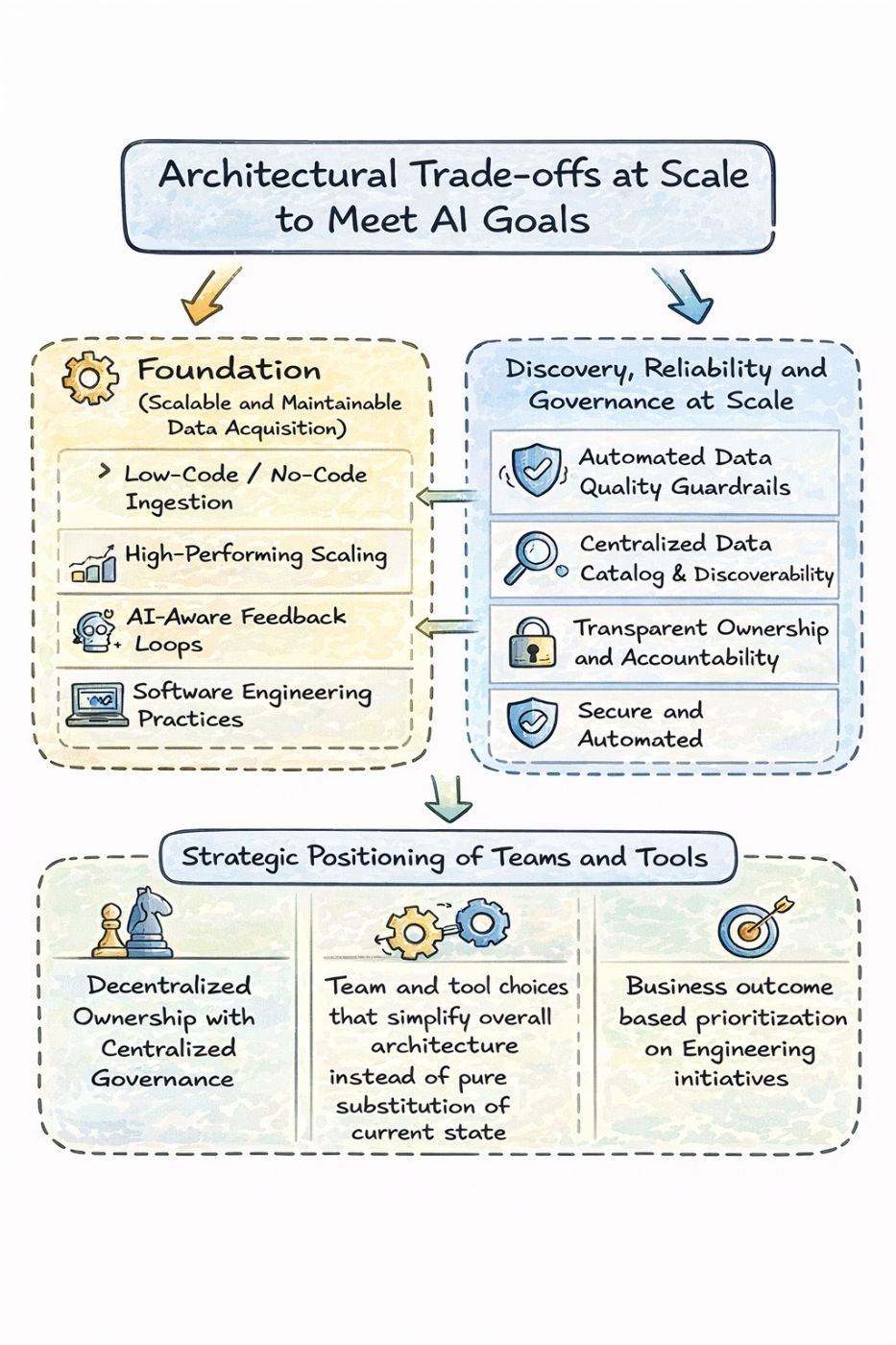
Foundation (Scalable and Maintainable Data Acquisition)
A useful litmus test for the engineering foundation is time to insigths: If we identify a new data source or a new requirement, how short can the lead time be before it is available for analytics and AI?
Continuously driving this number down is one of the most critical responsibilities of the data platform.
This requires implementing well-established frameworks that allow teams to onboard new data sources quickly without reinventing the architecture each time.
This typically involves a strategic mix of:
- Low-Code / No-Code Ingestion: Leveraging managed services (for example, Fivetran, Airbyte, or Snowflake Native Connectors) for standard SaaS and database sources helps reduce engineering overhead and accelerate delivery where differentiation is low. or custom Automated Frameworks for complex, proprietary, or high-stakes sources, metadata-driven ingestion engines built using Python and dbt allow pipelines to be created consistently and at scale.
- High-Performing Scaling: Underlying platform internals (Snowflake / AWS) must be explicitly architected to handle bursty AI workloads. This requires a stable and secure foundation that uses auto-scaling compute and workload isolation to maintain predictable performance baselines.
- AI-Aware Feedback Loop: AI-aware feedback loop captures structured signals from AI workloads and feeds them back into the data platform. These signals include data freshness violations, schema drift, low-confidence predictions, hallucination indicators, user overrides, and cost or latency metrics. Captured signals are stored as structured, queryable datasets and treated as first-class data assets to report and adjust operational behavior.
- No Compromise on Software Engineering Practices for Data Assets: Providing clear platform and infrastructure management direction ensures that coding standards and infrastructure-as-code practices support long-term system health rather than short-term delivery.
Establishing Discovery, Reliability and Governance at Scale
How much time does a user take to discover the right data for thier needs and gain the required access and start gaining insigths (time-to-insight).
Make this automated, rule driven yet with absolutly no compramize on security and regulatory requirements.
Governance is baked into the engineering foundation through robust identity management and clear data transparency.
- Automated Data Quality Guardrails to ensures only “trusted data” reaches the AI model, maintaining a high-performing and reliable baseline for downstream consumption.
- Centralized Data Catalog and Discoverability prioritizing a robust data catalog to ensure petabyte-scale assets are searchable and well-documented. This visibility reduces “time-to-insight” by allowing data consumers and AI agents to quickly identify and verify the correct data assets.
- Secure: Establishing a secure-by-design architecture through centralized Authentication (identity verification) and granular Authorization (role-based access control).
- Architecture as the Enforcement Mechanism: Using Infrastructure-as-Code (Terraform/CloudFormation) to standardize these guardrails to ensure is created with correct security and cataloging configurations, removing human error and building a maintainable ecosystem.
- Data Contracts and Cost as Architecture: At scale, trust and predictability require explicit data contracts between producers and consumers, covering schema expectations, freshness SLAs, quality thresholds, and access guarantees.
Along with this, cost becomes a first-class architectural signal:
- Usage-based cost attribution by domain
- Budget-aware scaling for AI workloads
- Guardrails to prevent runaway experimentation
Strategic Positioning of Teams and Tools
Eensure that the data infrastructure empowers teams rather than becoming a bottleneck, focusing on the strategic placement of both human and technical assets
- Decentralized Ownership with Centralized Governance: Positioning domain teams to own their data products while maintaining a central engineering foundation for Authentication, Authorization, and Infrastructure.
- Tooling for Efficiency, Not Complexity: Selecting tools based on the team’s ability to maintain them. This involves strategic use of Low-Code/No-Code ingestion for high-velocity requirements and reserving custom Python/Spark frameworks for complex, high-stakes architectural needs.
- Establish core platform engineering team as a service provider to the rest of the enterprise. The focus is on building a maintainable engineering foundation and a discoverable data catalog that other business units can consume autonomously.
- Bridging Technical Design and Business Objectives: Ensuring that the technical team’s roadmap is consistently aligned with management direction. This positioning prevents “engineering for engineering’s sake” and keeps the focus on delivering secure, petabyte-scale solutions that meet 2026 AI goals.
Closing Thoughts:
Meeting AI goals in 2026 is not about chasing tools, models, or architectural trends.
It is about building a data platform that is intentionally boring in its reliability and relentlessly opinionated in its standards.
Organizations that succeed will treat data infrastructure as a long-term product, not a one-time project — optimizing for fast onboarding, trust at scale, and continuous feedback between data, AI systems, and business outcomes.
When ingestion is predictable, governance is automated, discovery is effortless, and teams are empowered rather than constrained, AI stops being experimental.
It becomes operational.
At that point, the question is no longer:
“Can we build AI?”
But rather:
“How fast can we safely scale it?”
This article is co-authored by Google Gemini. (my opinions and perspectives made structured and blog worthy by AI)
[story continues]
tags