
"One More Feature" vs Monetization
Most founder aren’t ready to work on monetization “just yet”.
They just want to get done with the next phase of their roadmap. Or get one more thing done. Or ship that feature they've been promising for months.
This is a mistake.
The uncomfortable truth is, your product is never as good as you want it to be.
The product is never ready. There's always something else that needs to happen first.
"Just Build a Great Product"
You've heard this advice a thousand times. Just focus on the product. Make something people love. The money will follow.
This is partially true. But there's more to the story that you're not being told.
This advice (and most advice) comes from the outliers who were massively successful and had books written about them after the fact.
Facebook, Google, OpenAI, Oracle, etc
They ignored monetization for years and focused purely on building something incredible.
So why shouldn’t you do the same?
Dangers of The Unicorn Playbook
"Ignore monetization and focus on product" is just one part of a much larger playbook.
Here's what the rest of it looks like:
- Raise a ton of money to offset your losses
- Target a massive opportunity created by technology and/or distribution changes
- Hire the best team you possibly can, which means an expensive team
- Lose money for years investing in team, product, & acquisition
- Eventually make massive money for you and your investors
For the Unicorn Playbook to work, you have to run the whole thing.
Just blindly focusing on product, after you have product market fit, won’t get you unless you have the other parts.
The Business Olympics
The venture-backed startup game - is basically “the business version of the Olympics.
It's where the best founders go to compete with maximum resources, talent and focus.
Just like real olympians, the companies that win have incredible raw potential + funding + access resources + luck/timing.
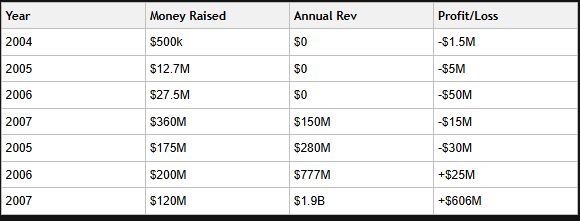
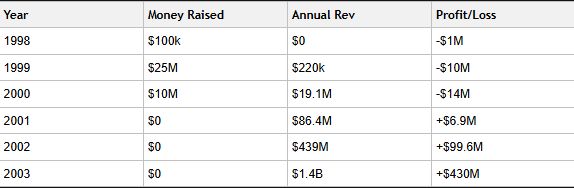
Lets look at the actual P&L from each of these companies and how long it took them to make not only profit, but “meaningful” profit based on their ambitions.
Facebook - raised $895.7M, starts making “real” profit by year 7
Google - Raised $35M, making “real” profit by year 5
I was going to build a table about OpenAI, but they still aren’t close to generating profit. They have raised $57.9B in about 10 years.
Who You Should Copy
If you want to become a better athlete, don't study the genetic freaks. Study the people who were good and figured out how to become great.
The vast majority of the people on this list aren’t raising billions to try to make 100 billion.
Study the people ones who built great businesses without the Unicorn Playbook:
- Mailchimp bootstrapped entirely and sold for $12 billion. The founders never took a dime of VC money. They each walked away with roughly $6 billion because they prioritized profitability from day one.
- Basecamp bootstrapped to tens of millions per year. The only outside money was Jeff Bezos, who invested after they were already profitable.
- ConvertKit went from zero to over $30 million ARR bootstrapped.
What do these companies have in common? They prioritized profitability early. They focused on a specific customer. They monetized aggressively rather than waiting.
Why This Matters For Your Exit
Most people reading this aren't building toward an IPO. You're building toward acquisition.
The goal is a $10-20 million ARR business that sells for $50-100 million or more. That's life-changing money.
Here's the problem: you don't know when those acquisition offers are coming.
They show up when they show up.
A strategic buyer gets interested. A PE firm is doing a roll-up in your space. A competitor decides to acquire rather than compete.
You don't control that timeline.
And when those offers come, the vast majority of you will get valued on your revenue, not your features. Nobody's paying a premium for your roadmap or your "potential." They're paying a multiple on your ARR and your trajectory.
The better your revenue trajectory when that offer lands, the higher the valuation.
Every quarter you delay investing in monetization is a quarter of weaker trajectory when the offer might come. That's the difference between a $30 million exit and an $80 million exit.
The One Exception
If you don't have product-market fit, work on that first.
But after product-market fit, you need to start monetizing so you can afford the acquisition and product development that makes a great product.
You can't run out of money. And you need to figure out who you actually have product-market fit with - not everyone, but a specific someone. (I wrote more about this here.)
So What Do You Do With This Information?
Invest in monetization every quarter.
This means measuring things correctly. If you're not tracking ARPU and usage-based retention, you're behind. You need to understand which of your investments are actually worth it.
Run a pricing test at least once or twice a year. This doesn't have to be a price increase - it could be packaging changes, new tiers, or repositioning.
Calculate your ARPU and conversion rate numbers. Look at them every week.
All subscription companies hit a growth ceiling. You want yours as high as possible to fund the product development and acquisition that makes a great business.
Stop waiting for the product to be ready. It never will be.
Good luck out there.
Dan
[story continues]
tags