


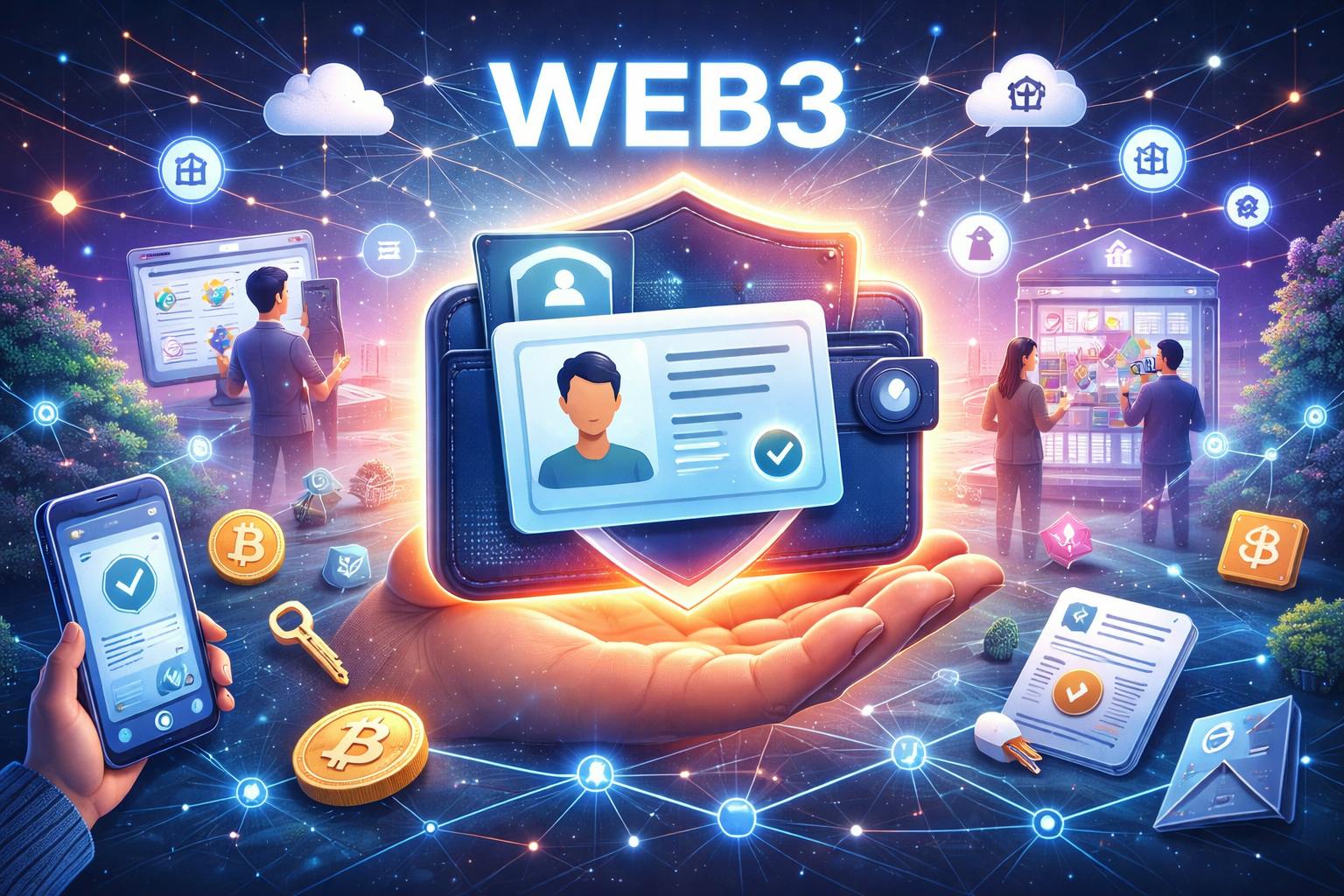
For most of the internet’s history, our online identity has never truly belonged to us. Instead, it lives inside the platforms we use every day. Social media accounts, gaming profiles, email addresses, and even work tools are all controlled by centralized companies. If one of those platforms decides to suspend an account or shut down a service, years of digital history can disappear overnight.
This is one of the problems that Web3 is trying to rethink.
Web3 is often described as the next evolution of the internet, but at its core, it’s really about something simpler: ownership. Instead of relying on large companies to manage our data and identities, Web3 technologies aim to give individuals more control over their digital lives.
The Problem With Today’s Online Identity
Right now, our online identity is scattered across dozens of platforms. You might have one account for social media, another for gaming, another for work tools, and many more for shopping or entertainment. Each platform stores its own version of who you are.
This creates two big problems.
First, control. The platform ultimately decides what happens to your account. If a service changes its policies or disappears, your data and digital presence may disappear with it.
Second, fragmentation. Your identity is spread across multiple services that rarely communicate with each other. The achievements you earn in one platform cannot move to another, and your reputation or history is locked inside individual apps.
In many ways, users have become renters of their own digital identities.
A Different Approach: Self-Owned Identity
Web3 introduces the idea of self-sovereign identity, which means people can control their identity directly rather than relying on centralized platforms.
Instead of signing in through a traditional account, users interact with applications through cryptographic wallets. These wallets act like digital passports that prove who you are without requiring a company to store your personal information.
In this model, your identity is not owned by a platform. It exists independently on decentralized networks.
That means your identity can move with you across different services. A reputation built in one application could follow you into another. Achievements, credentials, or memberships could be verified without needing a central authority to manage them.
A New Layer of the Internet
Imagine logging into multiple websites using the same wallet instead of creating new accounts everywhere. Your profile, digital assets, and history would travel with you.
This idea is already appearing in parts of the Web3 ecosystem. Decentralized applications allow users to connect a wallet and instantly interact with services without creating a traditional username and password.
In gaming, for example, players could truly own in-game items rather than leaving them locked inside a single platform. In online communities, reputation systems could be tied to a decentralized identity rather than controlled by a specific company.
The internet begins to look less like a collection of separate platforms and more like an interconnected network of services built around the user.
Privacy Becomes a Feature
Another interesting shift is how privacy works in Web3 systems.
Today, most services require users to share personal information when creating an account. Email addresses, phone numbers, and other details are often stored on company servers. This creates large databases of personal information that can become targets for hackers.
Web3 systems can reduce this reliance on centralized data storage. Instead of handing over personal information, users prove their identity using cryptographic verification.
In simple terms, you can prove something about yourself without revealing unnecessary details.
For example, you could prove you have access to a particular digital asset, belong to a specific community, or hold a certain credential without exposing your full identity.
This shift moves the internet slightly closer to a model where privacy is built into the system rather than treated as an afterthought.
Challenges Still Exist
Despite the promise of Web3 identity, the technology is still evolving.
User experience remains a major challenge. Managing wallets, private keys, and decentralized identities can feel complicated for people who are used to traditional login systems. Losing a private key can also mean losing access to an account permanently.
There are also questions about regulation, security, and long-term scalability. Decentralized systems must balance openness with safety, especially when identity and digital ownership are involved.
In many ways, Web3 is still experimenting with how these systems should work.
The Bigger Picture
Whether Web3 fully replaces current identity systems or simply influences them, the conversation it has started is important.
For years, internet users have traded control of their data in exchange for convenience. Web3 challenges that trade off by asking a simple question:
What if people owned their digital identities instead of platforms?
If the idea succeeds, the future internet might look less like a network controlled by a few large companies and more like an ecosystem where users carry their identity, reputation, and assets with them wherever they go.
And for the first time, our online identity might finally belong to us.