I spent last Tuesday watching our security team panic-test our entire infrastructure. Not because we'd been breached. Not because of a zero-day exploit. But because someone asked a simple question during standup: "Are we ready for Y2Q?"
Y2Q. The Year-2-Quantum moment. The cryptographic cliff edge that's barreling toward us faster than most companies realize.
Here's the uncomfortable truth: every encrypted file, message, and database record you create today has an expiration date. And for many organizations, that date is stamped "2030" in big, red letters.
⚠️ The Harvest Now, Decrypt Later Problem: Nation-states and sophisticated attackers are already storing encrypted data intercepted today, betting they'll be able to crack it with quantum computers in 5-10 years. Your "secure" communications from 2025 might be readable in 2030.
Why RSA Is Living on Borrowed Time
Let me paint you a picture. Right now, cracking a 2048-bit RSA key with classical computers would take approximately 300 trillion years. That's comforting, right? Your encrypted data is safe until long after the heat death of the universe.
Enter Shor's algorithm running on a sufficiently powerful quantum computer. Same RSA-2048 key? Cracked in hours, maybe days. Not millennia. Not centuries. Hours.
The math is brutal and elegant: quantum computers can factor large numbers exponentially faster than classical computers because they can evaluate multiple solutions simultaneously through superposition. It's not just faster—it's a fundamentally different computational paradigm that makes our current public-key cryptography look like a screen door on a submarine.
What Gets Broken (Spoiler: Almost Everything)
The quantum apocalypse isn't equally destructive across all cryptography. Some algorithms crumble instantly. Others merely weaken. A few might survive.
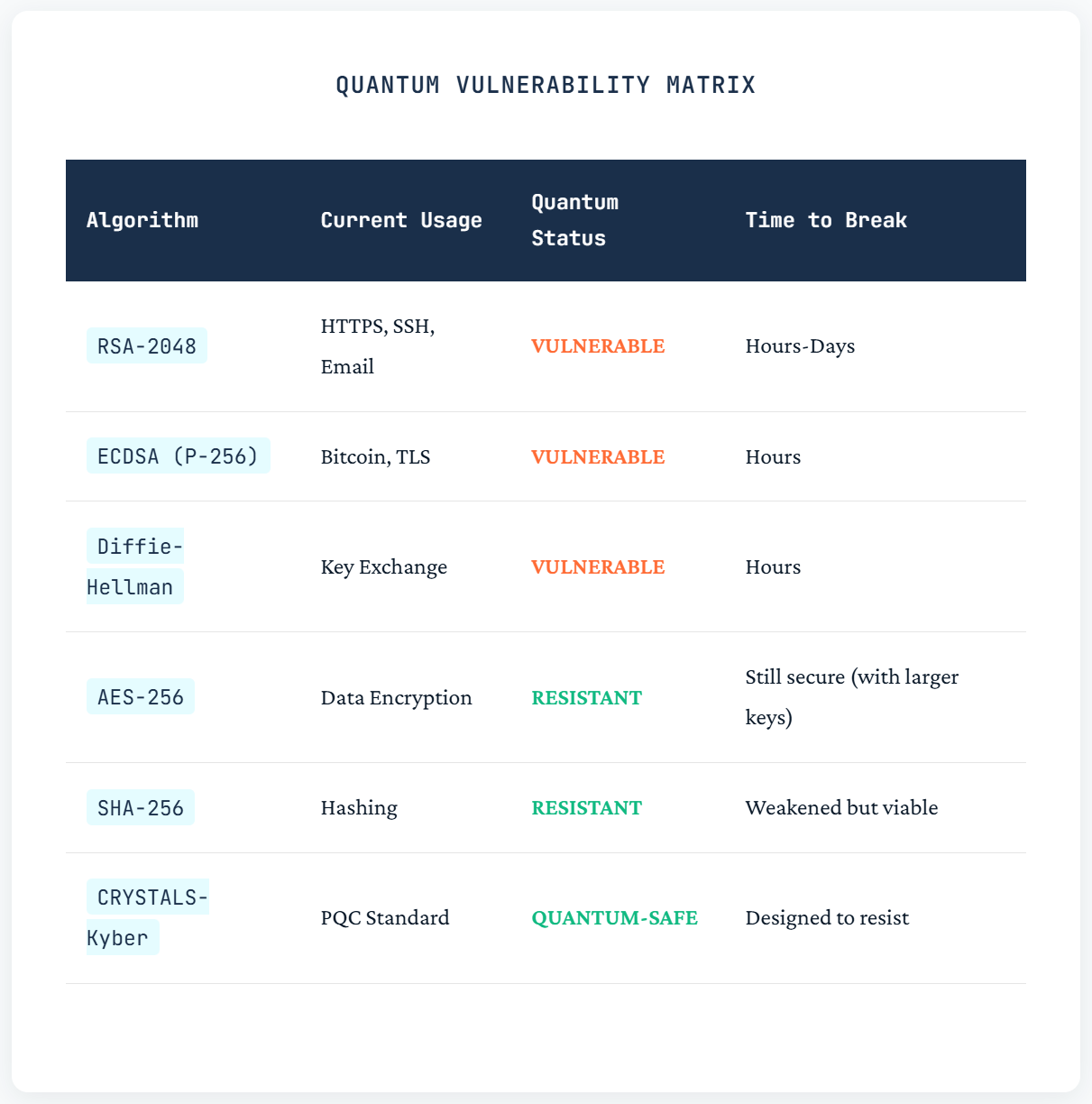
Notice a pattern? Asymmetric cryptography (RSA, ECC, Diffie-Hellman) gets obliterated. Symmetric encryption (AES) survives with minor adjustments. Hash functions need bigger output sizes but remain functional.
Translation: Your TLS handshakes, digital signatures, and key exchanges are doomed. Your encrypted file storage? Probably fine with some tweaks.
The Migration Timeline Nobody Wants to Hear
NIST finalized its first batch of post-quantum cryptographic standards in August 2024. Organizations are expected to complete migration by 2030-2035. Sounds reasonable, right? Here's why it's not:
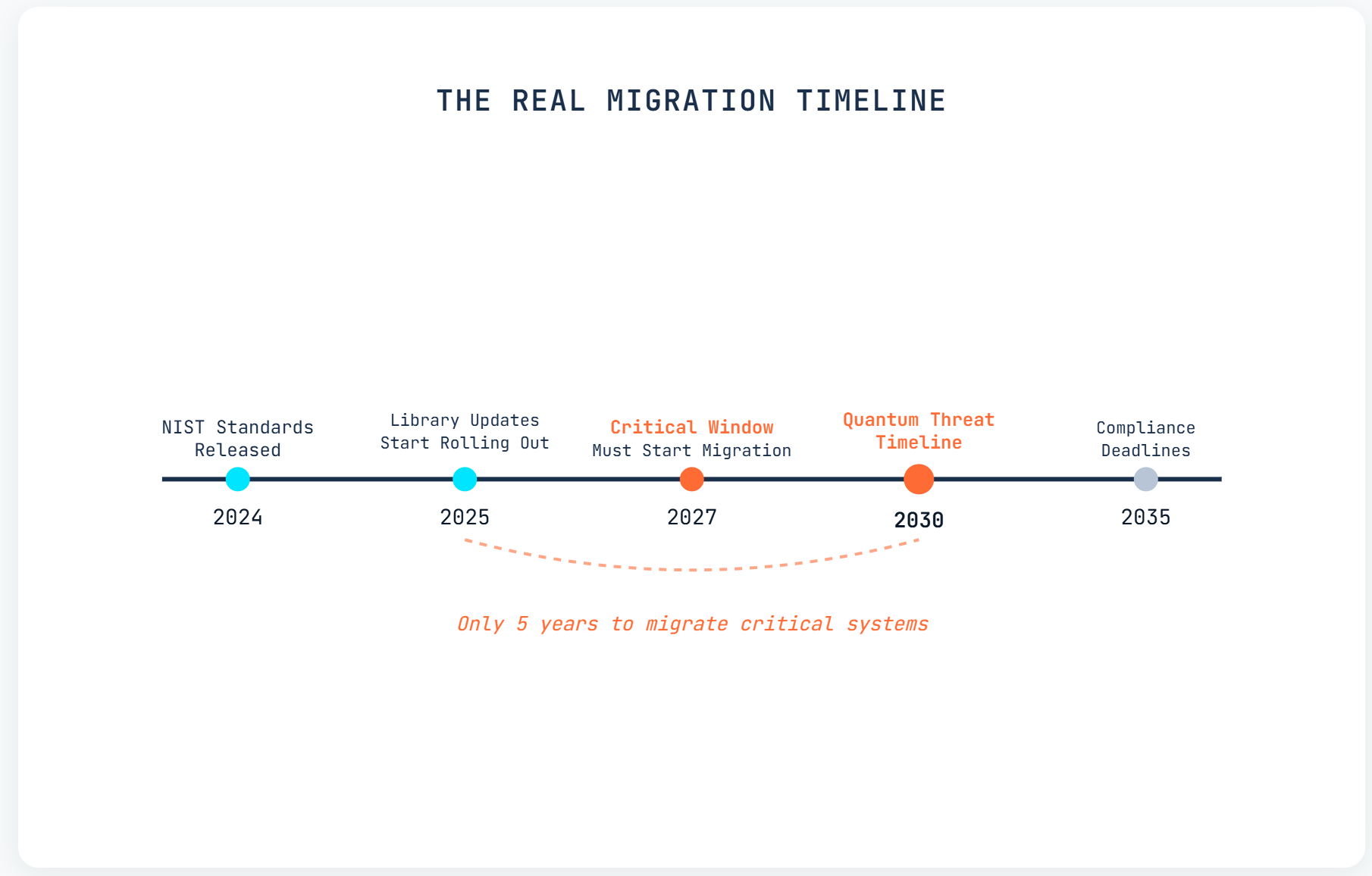
Reality Check: Enterprise organizations typically need 3-5 years for major cryptographic migrations. Legacy systems can take 7-10 years. We're already behind schedule.
Why This Migration Is Different
Unlike previous cryptographic transitions, this isn't just swapping out algorithm names in a config file. Here's what actually needs to happen:
- Inventory everything — Every certificate, every key, every cryptographic dependency across your entire stack. Most companies have no idea how many places they use RSA.
- Update libraries and frameworks — Your favorite crypto library might not support post-quantum algorithms yet. OpenSSL added experimental support in version 3.0, but production-ready implementation is still rolling out.
- Handle hybrid deployments — You can't flip a switch overnight. Systems need to support both classical and post-quantum crypto simultaneously during the transition.
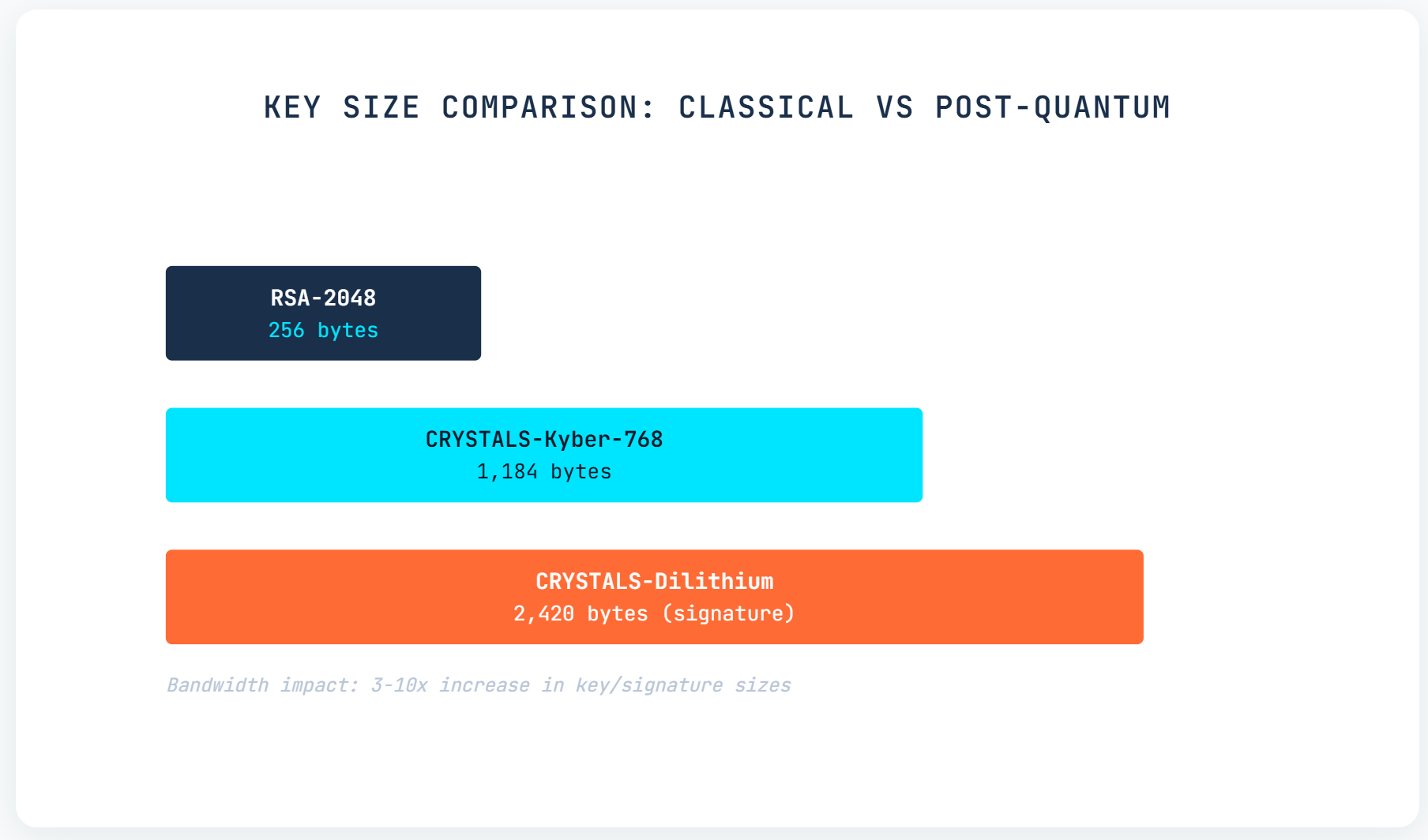
- Test everything — PQC algorithms have different performance characteristics. Kyber public keys are 800-1,568 bytes compared to RSA's 256-512 bytes. Your protocol buffers might need resizing.
- Replace hardware — Some HSMs (Hardware Security Modules) and embedded devices can't be firmware-updated to support new algorithms. They need physical replacement.
The Algorithms That Might Save Us
NIST's approved post-quantum algorithms aren't household names yet, but they will be:
CRYSTALS-Kyber (Key Encapsulation)
This is your RSA replacement for key exchange. It's based on lattice cryptography—imagine trying to find a specific point in a super-dense, high-dimensional mathematical lattice. Even quantum computers struggle with this problem. Google and Cloudflare are already testing it in production TLS implementations.
CRYSTALS-Dilithium (Digital Signatures)
Your new signing algorithm. Also lattice-based. Signature sizes are larger (2,420 bytes vs RSA's 256 bytes), which creates interesting challenges for blockchain applications where every byte costs gas fees.
SPHINCS+ (Hash-Based Signatures)
The conservative backup option. Slower than Dilithium but based on hash functions we've trusted for decades. If lattice cryptography somehow gets broken, SPHINCS+ is the fallback.
What You Need to Do Right Now
If you're responsible for security infrastructure, here's your action plan:
1. Crypto Inventory (Start Today)
Document every place you use public-key cryptography. TLS certificates, SSH keys, code signing, database encryption, VPN tunnels, API authentication. Use tools like crypto-inventory or build your own scanner.
2. Prioritize by Data Sensitivity (This Month)
Not everything needs immediate migration. Ask yourself: If this data is intercepted today and decrypted in 2030, what's the damage?
- Critical: State secrets, M&A documents, long-term medical records, biometric data
- High: Financial records, proprietary code, strategic plans
- Medium: General business communications, customer data
- Low: Public-facing content, short-lived session keys
3. Test Hybrid Deployments (Q1 2026)
Major vendors are rolling out hybrid crypto implementations. Chrome 116+ supports X25519Kyber768 for TLS. Test it in staging. Measure performance impact. Check for edge cases.
4. Budget for the Long Haul (This Quarter)
This isn't a one-time upgrade. Factor in:
- Cryptographic agility infrastructure (so you can swap algorithms without rewriting everything)
- Training for security and ops teams
- Third-party audits and compliance assessments
- Hardware refreshes for devices that can't be updated
The Uncomfortable Reality
Here's what keeps me up at night: we're not just racing against quantum computers. We're racing against the harvest now, decrypt later strategy.
Every day you delay migration, attackers collect more encrypted data that will become readable the moment a sufficiently powerful quantum computer comes online. Your encrypted backups from 2025? Fair game in 2030. That "secure" VPN session you're having right now? Someone might be recording it, waiting for Q-day.
The five-year shelf life isn't when your encryption stops working. It's when adversaries start reading everything you encrypted between now and then.
🎯 The Bottom Line: Post-quantum cryptography isn't a future problem—it's a present-day migration project with a hard deadline imposed by physics and mathematics. The organizations that start now will have breathing room. The ones that wait until 2028 will be in crisis mode.
Your encryption's shelf life is ticking down. The question isn't whether to migrate to PQC. It's whether you'll finish in time.
Where to Start Learning More
If you want to dive deeper, these resources are actually useful:
- NIST Post-Quantum Cryptography Standardization — The official source for approved algorithms and migration guidelines
- Open Quantum Safe Project — Open-source libraries and test implementations of PQC algorithms
- Cloudflare's PQC Blog Series — Real-world deployment insights from one of the largest networks implementing hybrid crypto
- NSA's Commercial National Security Algorithm Suite 2.0 — U.S. government requirements that often predict private sector compliance mandates
[story continues]
tags