
The digital currency ecosystem is evolving at a fast pace; however, it is still battling a vicious visibility trap. One of the primary hallmarks of the crypto market is liquidity or capital flow. Notably, investors have a misconceived idea of capital distribution, which most times is fueled by public relations.
This capital flow is most reflective in the crypto ETF market as these funds are designed to be appealing to Wall Street. Considering the need for these products to be adequately publicized, capital inflows and outflows into these products became the yardstick to gauge crypto demand.
This gauge systematically boycotts the impact of private markets, which are designed to be silent. In all, the crypto media is designed to track visibility, not capital allocation, a trend that contributed to the perception imbalance.
Crypto ETFs and the Impact of PR Difference
In today’s crypto ETF marketing, it is very easy to equate funds outflow with money leaving the broader digital currency ecosystem. This is because conversations ETF currently dominates perception in the industry.
Marketing for crypto ETFs has a set of defined logic. First, the publicity is driven and, by default, often emphasizes volume. Because of this growth-oriented mission, ETFs are heavily marketed by issuers with headline-oriented captions supplied by crypto media.
Historically, Bitcoin ETFs were approved by the US Securities and Exchange Commission (SEC) in January 2024. Since then to date, PR for the products has been optimized for inflows, visibility, retail, and treasury attention.
Firms with active ETF products have to do all they can to keep up with this hyper-bullish PR. The PR mission is such that they can justify fees and compete with other issuers in the broader financial market. Besides these individual efforts, they also help to keep the market agenda and narrative alive.
The System Underrating of Private Markets
Just like in every financial market, there is a thriving private market catering to the crypto market. While the goal of all asset managers in both arenas is to maximize profit, the PR ideology differs significantly from one to the other.
With the mission to minimize risk, PRs for the private market often have low hype or signal. It is also a known hallmark of private market investment to be more relationship-driven. This relationship is vital as regulatory provisions restricts private markets from using PR in its common way; only sophisticated, thought-leadership-based communication is typically available. In addition, these firms are often bounded by NDAs, forcing investor allocations to remain private. As such, it appears as though PRs are meant to be deliberately invisible.
Just like the rules of operation for many private firms, there is no obligation to make their activities known to the public. Despite the direct responsibilities to investors, they keep their media engagements low to protect their investment strategies. Since every firm takes pride in its unique market strategies, a low PR helps prevent copycats.
This is crucial as low PR moves also play a role in avoiding unnecessary regulatory noise. Overall, achieving a strong PR is the lifeblood of public markets; however, for private firms, silence is considered more strategic and obligatory.
Ideological Difference and Perception Imbalance
The crypto market is a very fragile one. One piece of information can result in a major shift in investor sentiment and capital allocation. From Bitcoin to Ethereum ETF and the newer entrants into the market tracking XRP, Solana, and Litecoin, there are dedicated data trackers for each market.
These data service providers help in amplifying both crypto inflows and outflows. With these data platforms, the market has been privy to the shift in institutional engagement with these ETF products.
On the contrary, private markets have no data services to track allocation. These difference generates one wrong conclusion: that when liquidity is flowing out of ETFs, it means capital is leaving crypto.
This sentiment impacts retail investors as they do not want to be caught holding an asset that corporate investors are actively dumping. Despite the currently distorted PR hype, the reality differs.
In terms of liquidity flows, the right conclusion is that when capital is changing vehicles, it does not mean the broader asset class is facing liquidity risks.
Proof of Impact of Private Crypto Markets
There are different proofs to show why private markets contribute as much to the broader crypto market evolution.
First, it is worth mentioning that ETFs are optimized for public access with room to scale as they mature. These products are not designed for yield and structured risks that private firms are known to pursue.
For assets of interest to private investors, it is not uncommon to unveil initial exposure to the public. However, the incremental allocation is private, and rebalancing often happens without announcements for the public to keep track.
One major characteristic of private investment is the prioritization of committee rooms, rather than trading screens. Capital allocation for these investors generally outlive headlines. Based on this, whenever an investment is newsworthy, it is worth noting that the capital has already moved.
By the numbers, VC deals comes with more billions of dollars according to a research from PWC. Although the precise figures are hard to estimate, the ratios which follows standard statistical conventions are represented below:
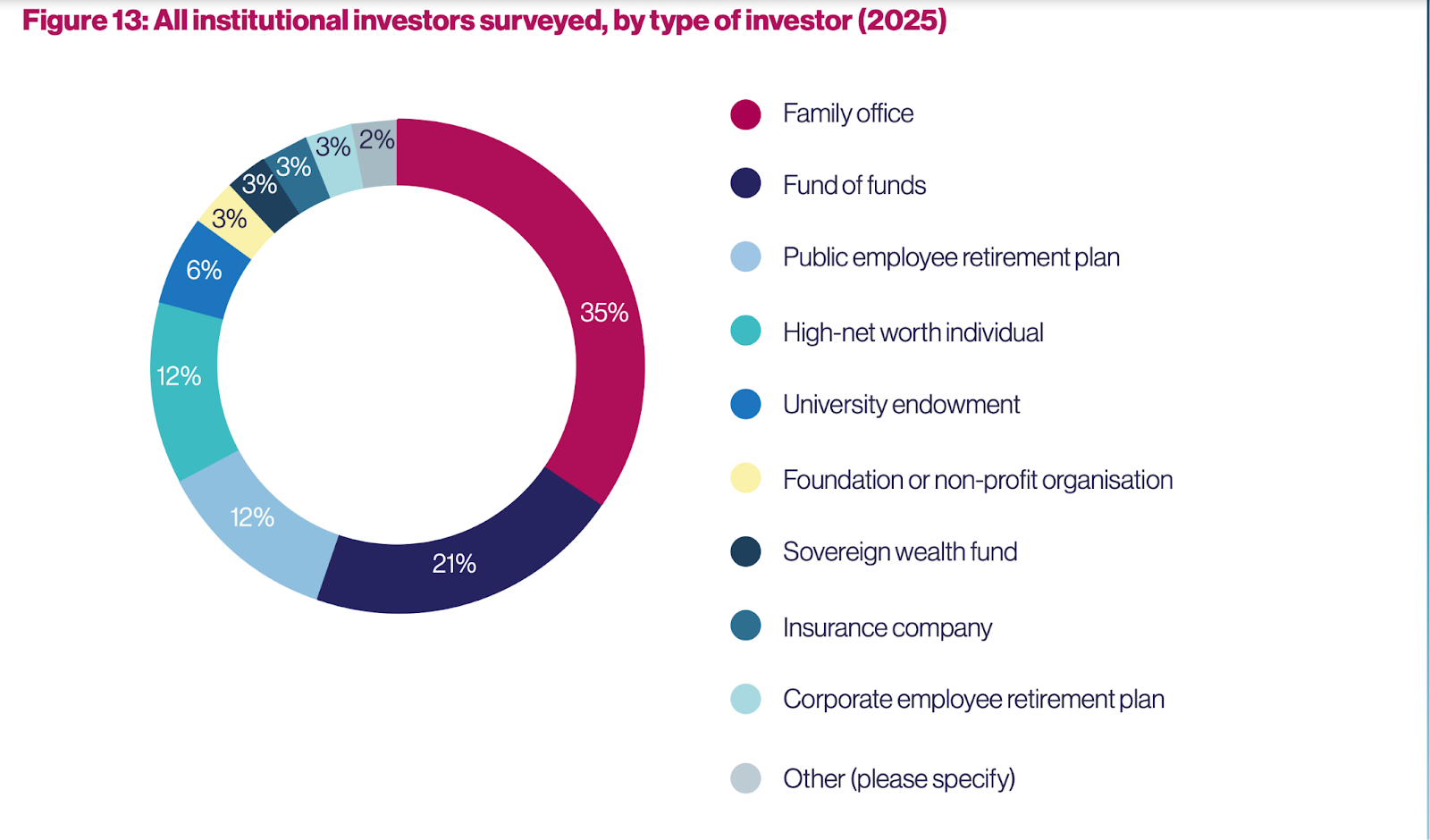
Image Source: Cayman Financials
As shown, private market investors already account for about 70% in any market, a proof of their impact beyond the ETF world.
Another notable benchmark: VC investors' interest kept rising in 2025. Thus, TheBlock reports The Block reports traditional venture investment reached about $18.9B in 2025, up from $13.8B in 2024 and PitchBook reports crypto VC funding more than doubled to $6B in Q1 2025. Although measured using different methodologies, both data points point to the same trend: investor interest in crypto companies is gradually increasing.
Yahoo Finance piece (Oct 17, 2025) reports crypto funding “surges past $19B in 2025” (i.e., year-to-date), citing active market participants. That implies 2025 YTD was already well above the full-year 2024 figure ($11.5B).
More explicitly, the bulk of investor allocations were not routed through crypto ETFs, but through OTC deals. Per Finery Markets’ Review, OTC volume saw a 106% jump YoY in 2024.
Implication for Investor Positioning: Conclusion
Having dived into the capital and PR realities of the crypto private and public markets, a re-orientation is important for retail investors. ETF outflows are clearly a wrong signal to watch for any asset.
ETF outflows do not categorically mean institutions are exiting the market, as these funds measure visibility and not actual conviction. Private markets, however, rarely reverse the headlines, letting the wrong narratives thrive most of the time.
Judging by current crypto market realities, capital is not disappearing; it is only becoming harder to see. With a proper reading and interpretation of crypto’s structures, mandates, and governance, everyone can come to a unifying conclusion. This conclusion is that big players, bothering institutional investors, private investors or High Networth Individuals’ embrace of crypto products is not weak, just in a quiet phase.
[story continues]
tags