


AI agents have become one of those phrases you can’t escape. They’re in product launches, keynote demos, enterprise slide decks, coding tools, workplace assistants, and just about every pitch deck trying to convince someone that software is about to stop being software and start being a coworker.
So last week, we asked a pretty simple question: Which will happen first: AI agents become a daily work tool, or people get tired of the buzzword?
After 206 votes, our readers landed on an answer that is optimistic — but not exactly starry-eyed.
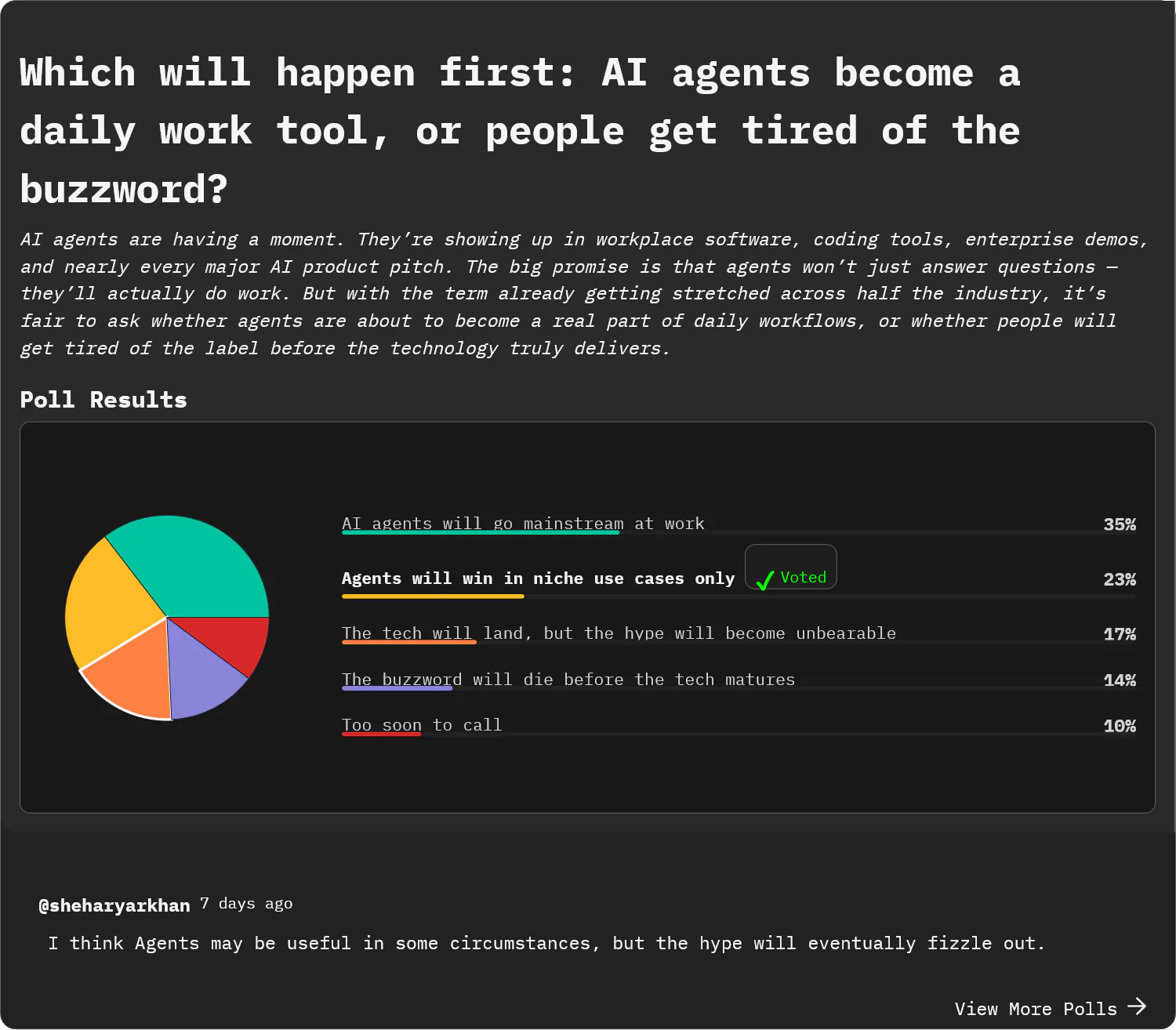
The biggest share of respondents, 35%, chose “AI agents will go mainstream at work.” That made it the single most popular answer in the poll. But the rest of the results tell a more complicated story. 23% said agents will win only in niche use cases, 17% said the tech will land but the hype will become unbearable, 14% said the buzzword will die before the tech matures, and 10% picked “Too soon to call.”
That means the plurality believes AI agents are headed for real workplace adoption. But it also means a clear majority did not vote for a clean, uncomplicated mainstream victory. Readers are interested. They’re curious. Some are even bullish. But they’re also deeply aware that the industry has a habit of taking one promising idea and marketing it until the walls shake.
Welcome to 3 Tech Polls, HackerNoon's brand-new Weekly Newsletter that curates Results from our Poll of the Week, and related polls around the web. Thanks for voting and helping us shape these important conversations!
The result says “yes, but”
A lot of people clearly think AI agents are more than a fad label. That view is not coming out of nowhere.
Major companies are actively reshaping workplace software around agent-style automation. Reuters reported today that Oracle is reworking parts of its finance and procurement software so AI agents can retrieve information and handle repetitive business tasks such as data entry and report generation. In other words, this is no longer just a chatbot pasted onto a sidebar; vendors are trying to wire agent behavior into the guts of enterprise systems.
OpenAI has also been explicit about where this market is going. Its business materials now frame agents as tools that can automate workflows across systems of record, with enterprise use cases in analysis, forecasting, support, and software engineering. OpenAI’s guidance to builders also makes clear that the real challenge is not just making an agent that can do something, but one that meets accuracy targets and works reliably enough to deploy.
Anthropic, meanwhile, has been pushing similar themes around agentic work, especially in coding and professional workflows. Its recent model announcements emphasize stronger performance in agentic tasks and tool use, while its research has continued to map where AI is already being used in the economy.
So yes, the category is real. Vendors are building for it. Buyers are testing it. The phrase “AI agents” may be slippery, but the underlying product push is not imaginary.
But readers are right to be suspicious
The more revealing number in this poll may be the one you get when you look beyond first place.
Only 35% picked full-on mainstream workplace adoption as the leading outcome. That means 65% of respondents landed somewhere else — niche success, hype fatigue, buzzword collapse, or outright uncertainty.
That skepticism also tracks with recent coverage.
TechCrunch reported in January on a benchmark called APEX-Agents, which tested AI systems on real white-collar tasks and found that even leading models struggled badly, often getting fewer than a quarter of questions right. That’s a sharp reminder that “good demo” and “daily work tool” are not the same thing.
Axios this week described an accelerating AI agent “arms race,” with companies racing to build tools that can send emails, move files, and act across live systems. But even in that bullish framing, the risks were hard to miss: deployment mistakes, security concerns, and the need to sharply limit what these systems are allowed to touch.
That’s the tension sitting right at the center of this whole category. The promise is obvious. So is the fragility.
It is very easy to imagine agents becoming normal in tightly scoped work: triaging inbound tickets, summarizing meetings, generating first drafts, monitoring dashboards, preparing research briefs, filling in repetitive forms, or handling rote coding tasks inside environments with guardrails. It is much harder to imagine the average enterprise happily handing broad autonomy to systems that still hallucinate, misread context, and occasionally sprint past common sense.
That’s why the 23% who picked “Agents will win in niche use cases only” may turn out to be the most prescient bloc in the whole poll.
The buzzword problem is not fake
The other thing our readers clearly understand is that “AI agents” is in danger of becoming one of those all-purpose industry terms that starts out useful and ends up meaning everything and nothing.
We’ve seen this movie before with “metaverse,” “Web3,” “big data,” and to some extent even “AI copilots.” Once every company can slap the same label on wildly different products, the phrase itself starts to decay faster than the underlying technology.
That concern shows up directly in the voting. Combine the people who chose “The tech will land, but the hype will become unbearable” (17%) with those who chose “The buzzword will die before the tech matures” (14%), and you get a significant chunk of readers effectively saying: sure, maybe something useful is here, but the branding may not survive the rollout.
And they may be onto something. Even the companies pushing agents most aggressively are quietly admitting that these systems still require orchestration, evaluation, tool design, permissioning, and a lot of human supervision to be production-ready. That’s not magic. That’s software engineering with extra uncertainty attached.
Readers are right to resist the grander mythology. For most people, the first truly useful agents will not feel like autonomous digital coworkers descending from the cloud to reinvent labor. They’ll feel like somewhat finicky workflow features that are very good at a few annoying tasks and still need supervision.
That may not sound glamorous, but it is how important technology usually arrives: not as a revolution all at once, but as a series of conveniences that quietly become hard to live without.
So the poll winner makes sense. AI agents probably do become a daily work tool first. But if the last year of tech coverage has taught us anything, it’s that the public may grow allergic to the term long before the software earns the myth.
In other words: the tech may stick. The branding may not.
And judging by this week’s vote, our readers are already preparing for both.
🌐 From Around the Web: Polymarket Pick
U.S. and Iran are trading bombs, threats, and.. memes? So Polymarket is doing what it does best; letting users decide whether both sides will reach a ceasefire and by when.
Most users think an official ceasefire could occur by the end of the year. Here’s to hoping ☮️
🌐 From Around the Web: Kalshi Pick
Over at Kalshi, users are betting whether OpenAI and/or Anthropic will go public this year (or next!). What do you think?
We want to hear from you!
Vote on this week’s poll: What’s the biggest limitation of AI tools today?
That’s it, folks! We’ll be back next week with more data, more debates, and more donut charts!